
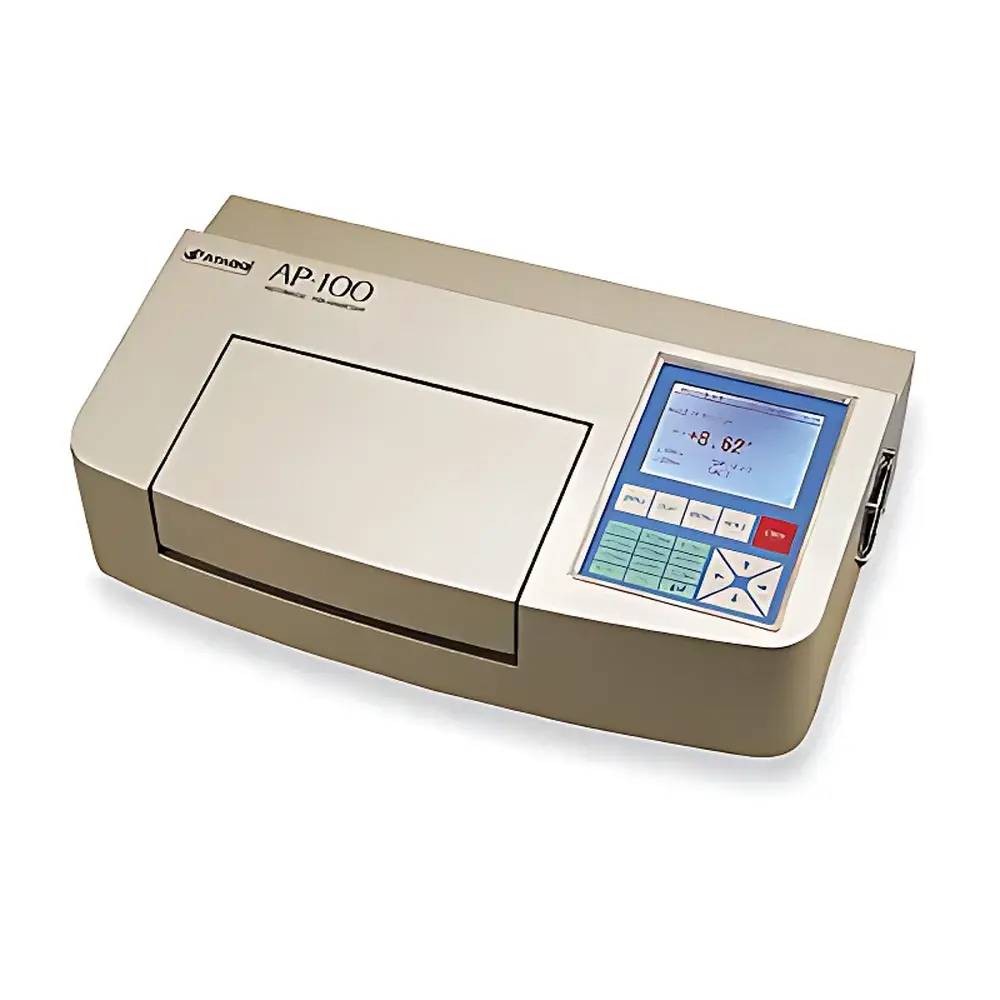
Cole-Parmer 81200-15 Automated Polarimeter
| Brand | Cole-Parmer |
|---|---|
| Origin | USA |
| Model | 81200-15 |
| Product Type | Automated Polarimeter |
| Temperature Control | None |
| Display | Backlit Color LCD |
| Light Source | LED with 589 nm filter |
| Sample Tube Options | 100 mm and 200 mm included |
| Data Storage | Last 30 measurements |
| Interface | RS-232 |
| Calibration Method | Quartz plate or reference standard |
| Compliance | Designed for GLP-compliant environments |
Overview
The Cole-Parmer 81200-15 Automated Polarimeter is a precision optical instrument engineered for the quantitative determination of optical rotation in chiral substances. Based on the fundamental principle of polarimetry—measuring the angular deviation of plane-polarized light as it passes through an optically active sample—the instrument delivers rapid, operator-independent analysis essential for quality control and regulatory documentation in regulated industries. Unlike manual or semi-automated systems, the 81200-15 performs full-parameter calculation in a single measurement cycle: observed rotation angle (α), specific rotation ([α]), concentration (c), purity assessment, and International Sugar Scale (ISS) values—all derived in real time from standardized optical path geometry and calibrated photodetector response. Its fixed-wavelength illumination at 589 nm (the sodium D-line equivalent, achieved via LED + interference filter) ensures spectral consistency aligned with pharmacopeial requirements including USP , EP 2.2.7, and JP 6.07. The system operates without active temperature regulation; however, it incorporates automatic temperature compensation using an internal thermistor to correct rotation values based on ambient thermal drift—a feature critical for reproducibility across laboratory environments where climate control is nominal but not precisely stabilized.
Key Features
- Single-button automated measurement sequence: load sample tube, initiate, and obtain fully processed results—including α, [α], concentration, purity index, and ISS—within seconds
- Backlit color LCD display showing simultaneous readouts of date/time stamp, measurement ID, tube length (100 mm or 200 mm), wavelength (589 nm), ambient temperature, and all calculated parameters
- Integrated memory storing the last 30 measurement records with timestamp and metadata, accessible for on-device review or export via RS-232
- RS-232 serial interface compliant with standard laboratory data acquisition protocols; supports direct transmission to LIMS, Excel, or legacy print systems without proprietary drivers
- Calibration traceable to NIST-traceable quartz control plates or certified sucrose solutions; calibration verification mode enables routine performance checks per ISO/IEC 17025 internal audit requirements
- Compact low-profile chassis (W × D × H: 240 × 320 × 140 mm) optimized for benchtop integration in QC labs, pilot plants, and R&D workstations
Sample Compatibility & Compliance
The 81200-15 accommodates standard 100 mm and 200 mm sample tubes (included), compatible with both aqueous and organic solvents commonly used in pharmaceutical intermediates, fine chemicals, essential oils, and food-grade syrups. It meets functional requirements outlined in ASTM E1254 (Standard Guide for Use of Polarimeters), USP General Chapter (Optical Rotation), and ICH Q5C (Quality of Biotechnological Products). While lacking active thermostatic control, its passive thermal compensation algorithm satisfies FDA expectations for “reasonable environmental mitigation” under 21 CFR Part 11 Annex A guidance for non-critical temperature-dependent measurements. All firmware operations maintain audit-ready timestamps and immutable parameter logging—supporting GLP/GMP documentation workflows during regulatory inspections.
Software & Data Management
No external software installation is required: the instrument functions as a standalone measurement node. RS-232 output follows ASCII-based SCPI-like syntax (e.g., “READ?”, “CAL?”, “MEM?”), enabling seamless integration with LabVIEW, Python (pySerial), or custom SQL-based data ingestion pipelines. Each transmitted record includes full contextual metadata: measurement ID, UTC timestamp, tube length, ambient temperature, raw detector signal, and all derived values—ensuring complete data lineage for ALCOA+ principles (Attributable, Legible, Contemporaneous, Original, Accurate). Exported datasets are CSV-compatible and structured for direct import into statistical process control (SPC) platforms such as Minitab or JMP.
Applications
- Pharmaceutical QC: verification of enantiomeric excess (ee) in chiral APIs, batch release testing of levofloxacin, ibuprofen, and other stereospecific drugs per USP monographs
- Sugar industry: determination of sucrose concentration and purity in cane/beet extracts using ISS scale—fully compliant with ICUMSA Methods GS4/3-12 and AOAC 951.02
- Flavor & fragrance: quantification of limonene, menthol, and camphor concentrations in essential oil blends where optical rotation correlates directly with compositional integrity
- Academic research: teaching tool for stereochemistry laboratories due to intuitive interface, immediate feedback, and transparent calculation methodology
- Cosmetic raw material certification: identity testing of L-ascorbic acid, L-cysteine, and other optically active actives against supplier specifications
FAQ
Does the 81200-15 support temperature-controlled measurements?
No. The instrument does not include Peltier or circulating bath integration. It relies on internal thermal sensing and algorithmic compensation for ambient temperature fluctuations.
Can calibration be performed without a quartz plate?
Yes. Certified sucrose solutions (e.g., 10% w/v in water) may be used as primary standards for routine calibration verification, provided they are prepared according to USP procedures.
Is the RS-232 interface compatible with modern Windows/macOS systems?
Yes—via USB-to-serial adapters (FTDI or CP2102 chipsets) and standard terminal emulators (Tera Term, CoolTerm) or custom scripts using Python’s pySerial library.
What is the maximum measurable rotation angle?
The system is designed for standard pharmaceutical and food applications; typical operational range spans ±89.9°, with auto-overrange detection triggering visual and audible alerts.
How is data integrity ensured during power interruption?
All measurement records are written to non-volatile memory immediately upon completion; no volatile RAM caching is employed, ensuring zero data loss during unexpected shutdowns.





