
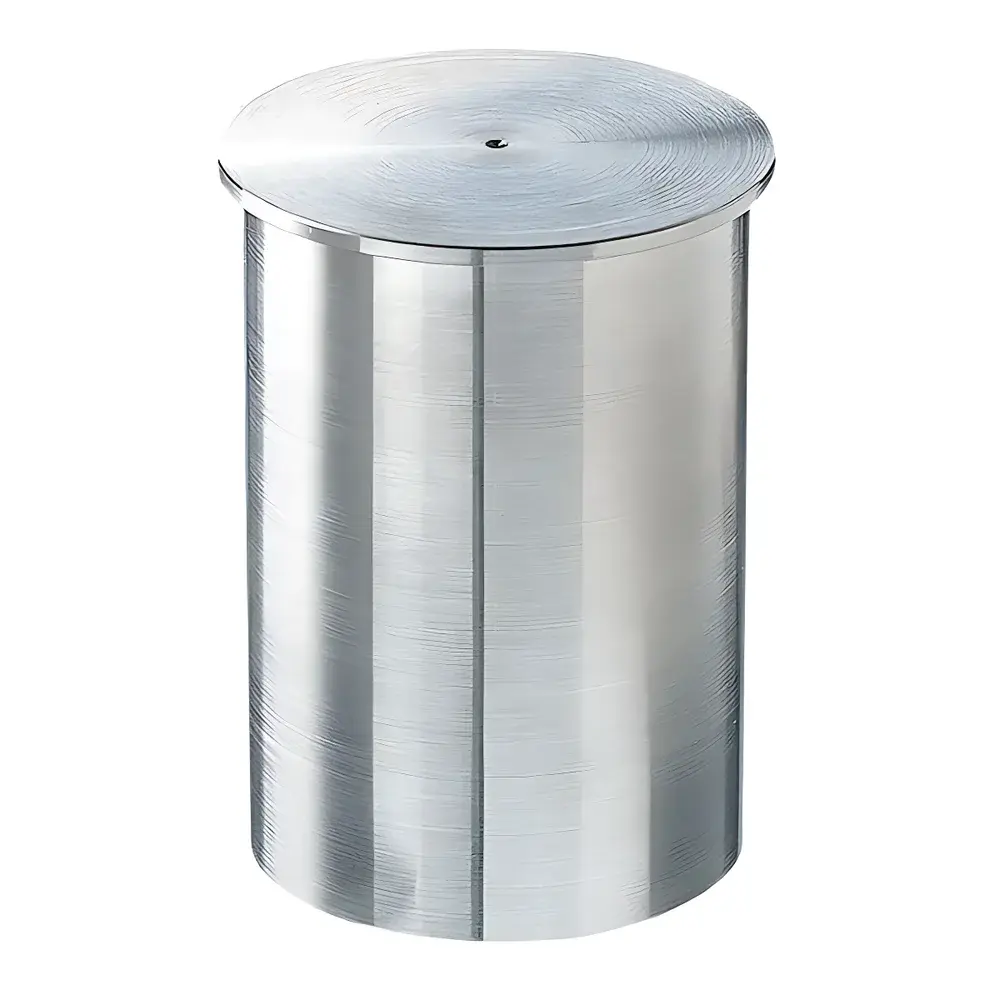
Cole-Parmer 38000-X Precision Stainless Steel Pycnometer Cup Set (US & UK Standards)
| Brand | Cole-Parmer |
|---|---|
| Origin | USA |
| Model | 38000-X |
| Capacity Options | 8.32 mL (US), 83.2 mL (US), 100 mL (UK) |
| Volume Tolerance | ±1.2% (38000-02), ±0.5% (all other variants) |
| Tare Accuracy | ±0.2 g (8.32 mL cup), ±0.1 g (38000-02 variant) |
| Compliance | MIL-STD-45662A |
| Calibration Certificate | Optional (38000-16, 38000-26) |
| Material | 316 stainless steel |
| Dimensions | 26.5 × 25.4 mm (38000-02), 63.5 × 44.5 mm (38000-12/16), 78.3 × 44.5 mm (38000-22/26) |
| Water Mass at Fill | 47 g (8.32 mL), 213 g (83.2 mL), 243 g (100 mL) |
Overview
The Cole-Parmer 38000-X Precision Stainless Steel Pycnometer Cup Set is a metrologically traceable volumetric standard designed for accurate density and specific gravity determination of petroleum liquids, solvents, fuels, and other homogeneous fluids in laboratory and quality control environments. Unlike electronic densitometers or oscillating U-tube instruments, this pycnometer system operates on the fundamental principle of hydrostatic weighing—measuring the mass difference between an empty (tared) cup and the same cup filled to calibration mark with a test liquid, using a calibrated analytical balance. Its design adheres strictly to classical ASTM D1298 (Standard Test Method for Density, Relative Density (Specific Gravity), and API Gravity of Crude Petroleum and Liquid Petroleum Products by Hydrometer Method) and ASTM D287 (Standard Test Method for API Gravity of Crude Petroleum and Petroleum Products (Hydrometer Method)) principles, where volumetric accuracy directly governs measurement uncertainty. Constructed from corrosion-resistant 316 stainless steel, each cup is precision-machined to deliver repeatable fill geometry and thermal stability across routine temperature ranges (15–25 °C), minimizing expansion-induced volume drift.
Key Features
- Three certified volumetric capacities: 8.32 mL (US standard, high-precision micro-volume application), 83.2 mL (US standard, general-purpose density work), and 100 mL (UK standard, aligned with BS EN ISO 3675 and BS EN ISO 12185)
- Tare-adjusted mass within ±0.2 g (±0.1 g for 38000-02 variant), enabling direct subtraction on analytical balances without manual zeroing—reducing operator-induced error
- Volume tolerances certified to ±1.2% (38000-02) or ±0.5% (all other models), verified against NIST-traceable standards per MIL-STD-45662A requirements for calibration laboratories
- Optional NIST-traceable calibration certificates available for models 38000-16 (83.2 mL, US) and 38000-26 (100 mL, UK), including as-found/as-left data, uncertainty budgets, and environmental conditions during verification
- Robust 316 stainless steel construction ensures long-term dimensional stability, resistance to hydrocarbon swelling, and compatibility with aggressive cleaning agents used in refinery QC labs
- Consistent meniscus alignment geometry across all sizes supports reproducible fill-level judgment under standardized lighting and viewing conditions per ASTM D1298 Annex A1
Sample Compatibility & Compliance
The 38000-X series is validated for use with non-viscous to moderately viscous petroleum products—including gasoline, diesel, kerosene, lubricating oils (ISO VG 32–100), crude assay fractions, and biodiesel blends (B5–B20)—provided samples are free of suspended solids and entrained air. It is not intended for volatile, highly flammable liquids requiring sealed handling (e.g., light naphthas below 40 °C flash point) unless used inside a ventilated containment hood with static-dissipative balance enclosures. All cups comply with MIL-STD-45662A for calibration laboratory equipment control, and models with optional certification meet ISO/IEC 17025:2017 clause 6.4.10 (reference material traceability). For regulatory submissions under EPA Method 1664 or ASTM D7042, documented cup calibration history and balance verification records must be retained as part of the laboratory’s GLP-compliant data package.
Software & Data Management
As a passive mechanical standard, the 38000-X requires no embedded firmware or proprietary software. However, it integrates seamlessly into LIMS and ELN workflows when paired with balances supporting RS232/USB output and compliant data capture modules. When used in FDA-regulated environments (e.g., fuel additive certification per 21 CFR Part 11), the tare-and-fill procedure must be documented with electronic signatures, audit trails, and metadata (balance ID, ambient temperature/humidity, operator ID, cup serial number, calibration certificate expiry). Cole-Parmer recommends pairing these cups with METTLER TOLEDO XSR or Sartorius Cubis® II balances configured for GxP mode, enabling automatic timestamped export of raw mass values into validated spreadsheets or validated chromatography data systems (CDS) via secure CSV/Excel templates.
Applications
- Determination of API gravity and specific gravity of crude oil and distillates per ASTM D1298 and IP 160
- Batch release testing of jet fuel (Jet A-1) density per ASTM D1655 Annex A2 and DEF STAN 91-91
- Verification of hydrometer calibration standards in metrology labs accredited to ISO/IEC 17025
- Quality assurance of solvent purity (e.g., toluene, xylene) in petrochemical synthesis lines
- Field-deployable density checks in mobile refinery labs where electronic instrumentation may be impractical
- Teaching core density measurement principles in university petroleum engineering laboratories
FAQ
What is the difference between US-standard and UK-standard pycnometers?
US-standard cups (38000-02, 38000-12, 38000-16) are calibrated to 60 °F (15.6 °C) and conform to ASTM D1298 reference temperature; UK-standard cups (38000-22, 38000-26) are calibrated to 15 °C and align with BS EN ISO 3675, which specifies identical temperature but different meniscus reading conventions.
Can I use the 38000-X cups for measuring viscosity or pour point?
No. These are volumetric density standards only. Viscosity requires rotational or capillary viscometry (e.g., ASTM D445); pour point requires controlled cooling per ASTM D97.
Is recalibration required after repeated thermal cycling?
Yes. While 316 stainless steel exhibits low thermal expansion (16 µm/m·°C), cumulative thermal stress from repeated boiling sterilization or cryogenic exposure may affect dimensional stability. Annual verification against traceable master standards is recommended for GMP applications.
Do I need a separate calibration certificate for each cup in a multi-cup set?
Yes. Each cup is individually measured and certified. Shared certificates are not issued, as volume tolerance is unit-specific and traceability must be maintained per ISO/IEC 17025 clause 6.4.10.
How does tare adjustment improve measurement reproducibility?
Pre-adjusted tare eliminates manual zeroing variability and reduces balance drift impact during sequential measurements—particularly critical when comparing multiple samples on the same balance within a single analytical run.





