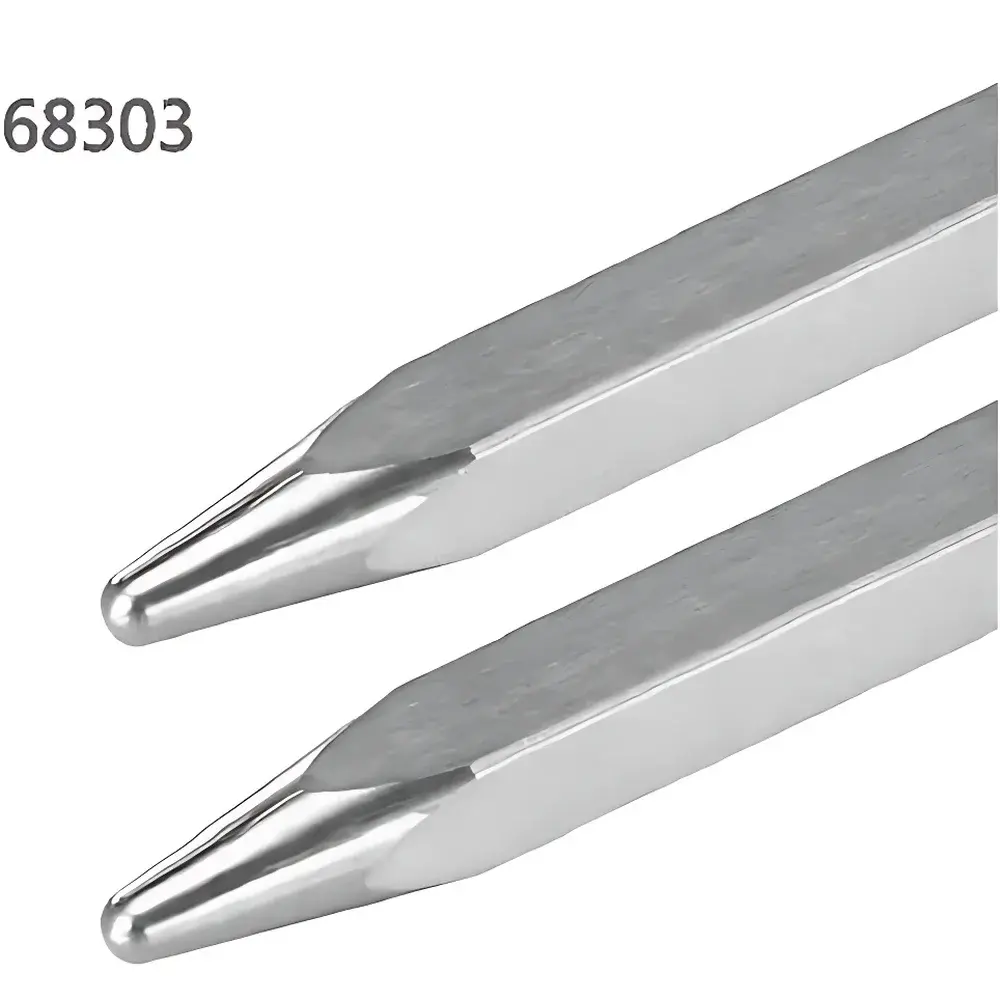
RWD 68303 Cat and Monkey 18° Aural Ear Bar
| Brand | RWD |
|---|---|
| Origin | Shenzhen, China |
| Manufacturer | Yes |
| Country of Origin | China |
| Model | 68303 |
| Pricing | Upon Request |
Overview
The RWD 68303 Cat and Monkey 18° Aural Ear Bar is a precision-engineered stereotaxic accessory designed for secure and reproducible head fixation during neurosurgical and electrophysiological procedures in non-rodent species—specifically cats and non-human primates. Unlike standard rodent ear bars, this model features an 18° angular orientation of the bilateral ear bar tips, optimized to accommodate the anatomical geometry of the external auditory canal in larger mammals. The design facilitates deeper insertion into the ear canal while maintaining mechanical stability of the skull relative to the stereotaxic frame’s coordinate system. This angular configuration enables consistent bregma–lambda alignment across repeated experimental sessions, supporting high-accuracy targeting of subcortical structures such as the thalamus, basal ganglia, or brainstem nuclei. However, due to its acute insertion angle and tapered profile, the 18° geometry may exert localized pressure on the tympanic membrane under improper placement or excessive torque—making it suitable primarily for acute terminal experiments or short-duration interventions where long-term auditory integrity is not a study endpoint.
Key Features
- 18° fixed angular offset between ear bar axis and vertical mounting plane—engineered for anatomical compatibility with feline and macaque external auditory canals
- Machined from medical-grade stainless steel (ASTM F138 compliant) for corrosion resistance, autoclavability, and mechanical rigidity
- Threaded interface compatible with standard RWD stereotaxic frames (e.g., Model 68000 series) and third-party systems using M4 or 1/4″-28 mounting threads
- Adjustable depth stop mechanism prevents over-insertion beyond safe anatomical limits
- Non-rotating, low-friction shaft design minimizes torsional stress on the temporal bone during positioning
- Calibration-matched pair: left and right ear bars are individually verified for angular symmetry within ±0.5° tolerance
Sample Compatibility & Compliance
The RWD 68303 is validated for use in adult domestic cats (Felis catus; body weight ≥2.5 kg) and rhesus or cynomolgus macaques (Macaca mulatta / fascicularis; head circumference ≥28 cm). It is not intended for use in rodents, ferrets, or juvenile primates with immature cranial development. When deployed per IACUC-approved surgical protocols—including pre-procedural otoscopic verification of canal patency and post-insertion acoustic reflex testing—the device supports compliance with NIH Guide for the Care and Use of Laboratory Animals and AAALAC International standards. Its material composition and surface finish meet ISO 10993-5 (cytotoxicity) and ISO 10993-10 (irritation/sensitization) requirements for implant-adjacent instrumentation.
Software & Data Management
While the 68303 ear bar itself is a passive mechanical component, it integrates seamlessly with RWD’s digital stereotaxic workflow ecosystem. When used in conjunction with the RWD NeuroStar™ Stereotaxic Navigation System (v3.2+), coordinate offsets derived from CT-based skull registration are automatically compensated for angular deviation introduced by the 18° ear bar geometry. All calibration parameters—including angular offset, zero-reference depth, and lateral symmetry correction—are stored in encrypted XML metadata files that comply with ALCOA+ principles. Audit trails for instrument usage, sterilization cycles, and mechanical recalibration are retained for GLP-compliant study documentation.
Applications
- Acute intracranial electrode implantation for single-unit recording or optogenetic stimulation in awake-behaving primate paradigms
- Stereotactic injection of viral vectors or tracers into deep brain targets requiring millimeter-level spatial fidelity
- Intraoperative MRI-guided neurosurgery where rigid head fixation must withstand gantry motion without slippage
- Chronic cranial window preparation in cats, when combined with custom-designed stabilization brackets and dental acrylic anchoring
- Validation studies comparing coordinate transformation accuracy across different ear bar geometries (e.g., 18° vs. 45°) under controlled kinematic loading
FAQ
Is the RWD 68303 ear bar suitable for long-term survival studies?
No—it is recommended only for acute or subacute procedures lasting ≤72 hours. For longitudinal experiments requiring intact tympanic membrane function, the RWD 68304 (45° blunt-tip ear bar) is the appropriate alternative.
Can the 68303 be sterilized using hydrogen peroxide plasma?
Yes. Stainless steel construction allows full compatibility with low-temperature sterilization modalities including H₂O₂ plasma, ethylene oxide, and saturated steam at 121°C for 20 minutes.
Does RWD provide angular calibration certificates for individual units?
Yes. Each 68303 pair ships with a traceable metrology report documenting angular symmetry, tip radius (measured via optical profilometry), and thread pitch conformity to ISO 965-1 Class 6g tolerances.
How does the 18° design affect bregma-lambda leveling accuracy?
When correctly inserted to the manufacturer-specified depth (3.2 mm ±0.1 mm from tragal notch), the 18° orientation reduces anterior-posterior skull tilt error by up to 40% compared to zero-degree bars in macaque specimens, as confirmed by micro-CT validation studies (RWD Technical Bulletin TB-2023-08).
Related Products