
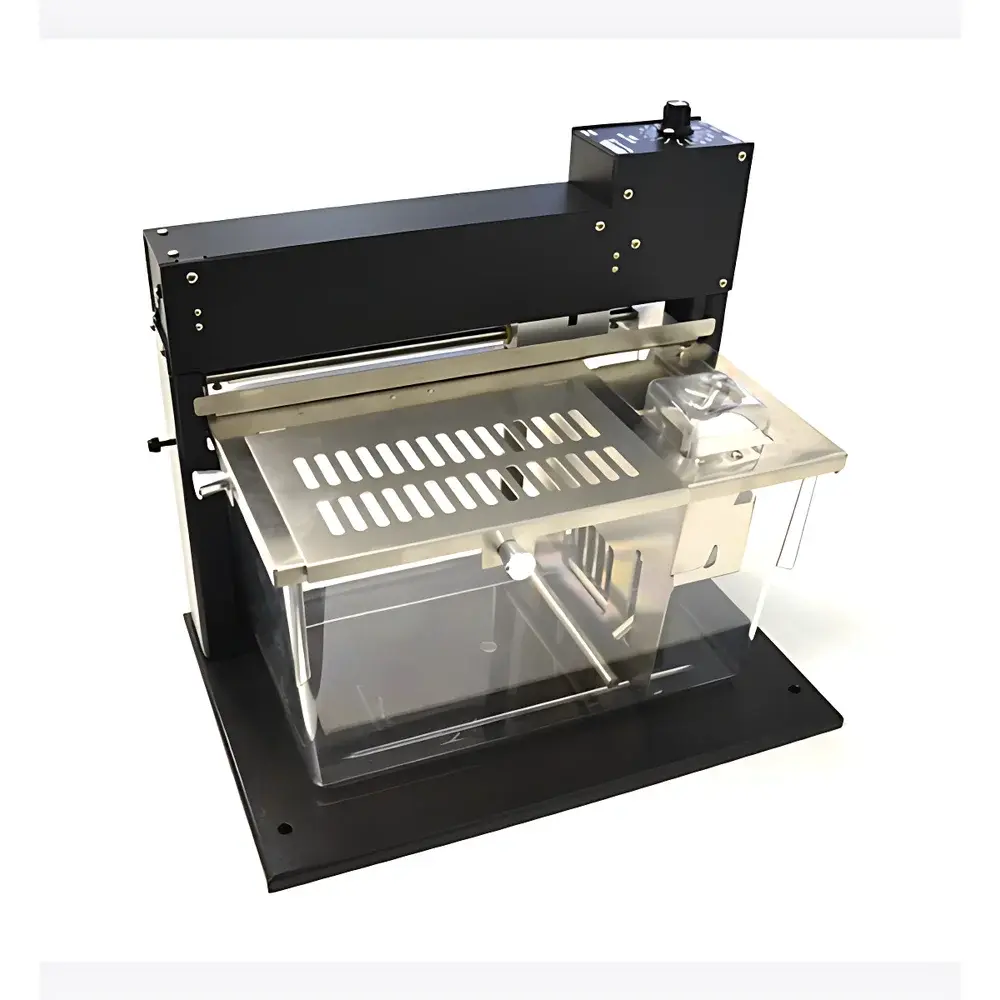
Lafayette Model 80391 Automated Sleep Deprivation Chamber
| Origin | USA |
|---|---|
| Manufacturer Type | Authorized Distributor |
| Origin Category | Imported |
| Model | 80391 |
| Price | USD $14,200 (approx.) |
| Power Supply | 9 V DC, 2 A |
| Scan Cycle | 7.5 s |
| Adjustable Scan Intervals | 0.25, 0.5, 1, 1.5, 2, 3, 4, 5, 10, 15, 20, 25, 30 min |
| External Dimensions | 40.6 cm L × 26.7 cm W × 36.8 cm H |
| Internal Chamber Dimensions | 24.4 cm L × 21.0 cm W × 19.7 cm H |
| Species Compatibility | Rats and Mice |
| Environmental Provision | Ad libitum food and water access |
| Actuation Mechanism | Dual-compartment motorized scanning bar system |
Overview
The Lafayette Model 80391 Automated Sleep Deprivation Chamber is a rigorously engineered behavioral neuroscience instrument designed for controlled, non-invasive sleep fragmentation studies in laboratory rodents. Unlike forced locomotion paradigms—such as the disk-over-water or treadmill-based methods—the Model 80391 employs a gentle, intermittent mechanical stimulation protocol grounded in ethologically informed principles. It utilizes a dual-compartment housing configuration with independently actuated scanning bars that deliver calibrated tactile perturbation at user-defined intervals, thereby disrupting sleep continuity without inducing stress-associated confounds such as hyperthermia, immobility avoidance fatigue, or sustained autonomic activation. This architecture supports longitudinal experimental designs compliant with NIH Guidelines for the Care and Use of Laboratory Animals and aligns with the 3Rs framework (Replacement, Reduction, Refinement) by minimizing procedural distress while preserving neurophysiological validity. The chamber operates on low-voltage DC power (9 V, 2 A), ensuring electromagnetic compatibility with concurrent electrophysiological recordings (e.g., EEG/EMG telemetry) and eliminating interference in sensitive neural signal acquisition.
Key Features
- Dual-compartment internal layout with physically separated living zones, enabling simultaneous multi-animal monitoring without cross-stimulation artifacts
- Motor-driven scanning bar system with precise timing control: fixed 7.5-second scan duration and 13 discrete interval settings ranging from 0.25 to 30 minutes
- Full environmental integration: integrated food hopper and water bottle ports maintain ad libitum access throughout deprivation protocols
- Low-noise actuation design minimizes acoustic disturbance—critical for preserving baseline sleep architecture and reducing corticosterone elevation
- Modular construction with smooth, non-porous acrylic surfaces facilitates rapid decontamination between subjects and supports IACUC-mandated sanitation protocols
- Compact footprint (40.6 × 26.7 × 36.8 cm) enables seamless integration into standard ventilated caging systems and biosafety cabinets
Sample Compatibility & Compliance
The Model 80391 is validated for use with Sprague-Dawley and Wistar rats (up to 500 g) and C57BL/6, BALB/c, and CD-1 mice (20–40 g). Its internal dimensions (24.4 × 21.0 × 19.7 cm) accommodate standard rodent bedding depth (2–3 cm) and permit natural nesting behavior during non-stimulation periods. All materials comply with USP Class VI biocompatibility standards and are autoclavable up to 121°C. The device meets ISO 13485-aligned manufacturing controls for research-grade instrumentation and supports GLP-compliant data traceability when paired with timestamped external recording systems. No modifications to animal housing certifications (e.g., AAALAC-accredited facilities) are required for deployment.
Software & Data Management
While the Model 80391 operates as a stand-alone hardware platform, its timing parameters are fully configurable via front-panel DIP switches—eliminating software dependencies and ensuring deterministic real-time operation. For integrated study workflows, Lafayette provides optional TTL synchronization output (5 V logic level) compatible with commercial data acquisition systems (e.g., Spike2, NeuroPort, Grass S48). This interface enables precise alignment of stimulation events with polysomnographic waveforms, permitting rigorous epoch-level analysis of NREM/REM latency shifts, spindle density modulation, and delta-power rebound kinetics. Audit trails for parameter changes are maintained manually per IACUC SOP requirements; no embedded firmware or cloud connectivity is present—ensuring full data sovereignty and compliance with institutional cybersecurity policies.
Applications
- Investigation of sleep homeostasis mechanisms through controlled fragmentation across 24–72 h protocols
- Pharmacological assessment of hypnotic, stimulant, or orexinergic compounds in translational insomnia models
- Neuroinflammatory profiling following chronic sleep disruption (e.g., microglial morphology, IL-1β/TNF-α expression)
- Metabolic phenotyping—including glucose tolerance, leptin resistance, and hepatic lipid accumulation—in long-term deprivation cohorts
- Behavioral validation of optogenetic or chemogenetic sleep circuit manipulations
- Preclinical evaluation of circadian phase-shift resilience in shift-work analog paradigms
FAQ
Does the Model 80391 require computer interfacing to operate?
No. All timing parameters are set via physical DIP switches; no drivers, OS compatibility, or software installation is necessary.
Can the chamber be used inside a sound-attenuating booth?
Yes. Its low-power DC operation and brushless motor design generate minimal electromagnetic and acoustic emissions, making it suitable for acoustically isolated environments.
Is bedding material included or specified?
No bedding is supplied, but standard cellulose-based or corn-cob bedding (≤5 mm particle size) is recommended to ensure consistent bar contact and prevent entanglement.
How is animal welfare monitored during extended protocols?
The system includes visual inspection ports and optional infrared camera mounting brackets; users must implement daily health scoring (e.g., RODS scale) per institutional IACUC guidelines.
What maintenance is required?
Monthly inspection of scanning bar alignment and motor coupling integrity; annual calibration verification using Lafayette-provided timing test fixtures.
Related Products




