
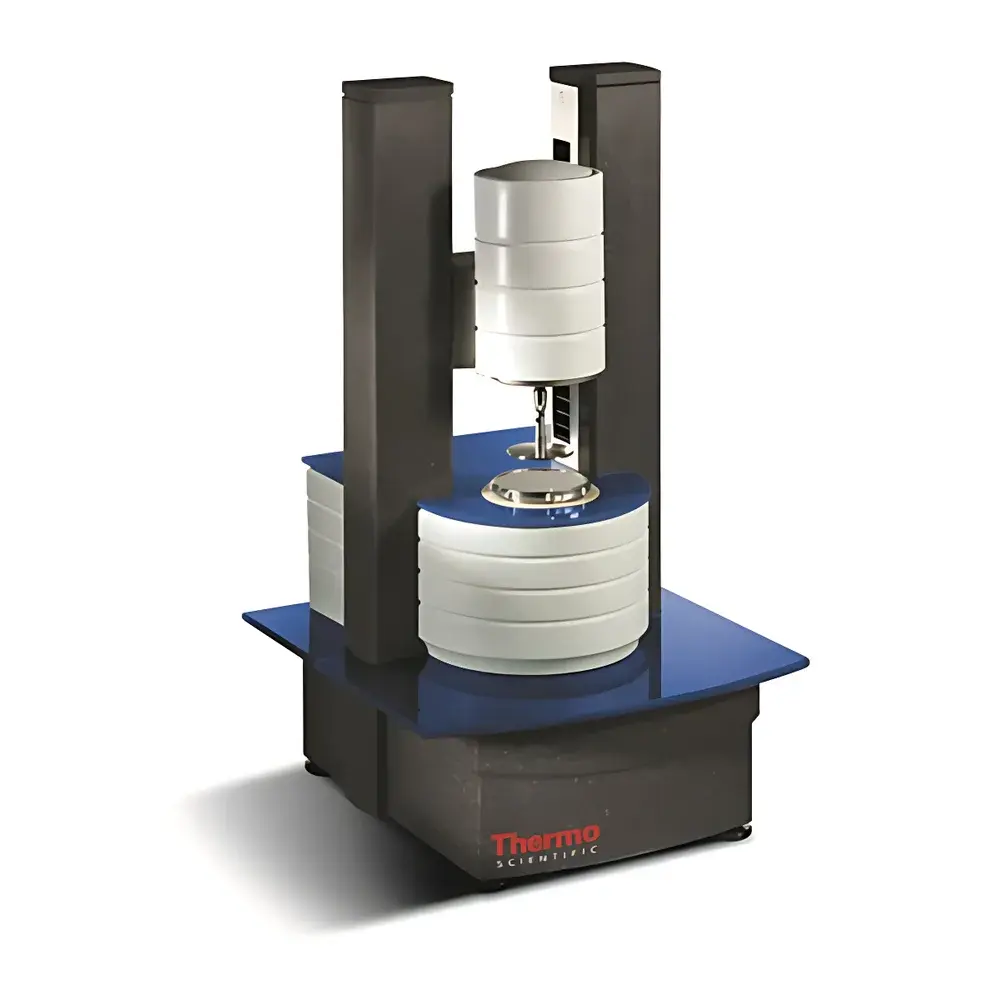
Thermo Fisher HAAKE RheoStress 1 Rotational Rheometer
| Brand | Thermo Fisher |
|---|---|
| Origin | USA |
| Manufacturer Type | Authorized Distributor |
| Origin Category | Imported |
| Model | HAAKE RheoStress 1 |
| Instrument Type | Rotational Rheometer |
| Motor Bearing | Air Bearing |
| Minimum Rotational Speed | 0.025 rpm |
| Frequency Range | 0.0001–100 rad/s |
| Maximum Rotational Speed | 1200 rpm |
| Maximum Torque | 100 mNm |
Overview
The Thermo Fisher HAAKE RheoStress 1 is a high-performance, research-grade rotational rheometer engineered for precision characterization of complex fluid and soft solid behavior under controlled shear and oscillatory conditions. Based on Couette flow principles and torque-controlled rotational mechanics, it delivers quantitative viscoelastic data—including viscosity, storage modulus (G′), loss modulus (G″), complex viscosity (η*), and phase angle (δ)—across a broad dynamic range. Its fourth-generation air-bearing motor system eliminates mechanical friction, enabling ultra-low torque detection and exceptional angular resolution. The integrated digital signal processor (DSP) drives a fast adaptive control loop, supporting true constant shear rate (CSR), constant shear stress (CSS), constant deformation (CD), and frequency-swept or amplitude-swept oscillatory modes—all within a single platform. Designed for reproducibility-critical environments such as QC labs, R&D centers, and contract testing facilities, the RheoStress 1 meets foundational requirements for GLP-compliant workflows and supports audit-ready operation in regulated industries.
Key Features
- Air-bearing motor with 0.025 rpm minimum rotational speed and 100 mNm maximum torque, ensuring high sensitivity for low-viscosity fluids and robust performance for yield-stress materials
- DSP-based real-time control architecture enabling seamless transitions between rotational (CS, CR, CD) and oscillatory (strain- or stress-controlled) measurement modes
- Automated lift system with micron-level positioning repeatability, guaranteeing precise, operator-independent gap setting for cone-plate, parallel-plate, and concentric cylinder geometries
- Modular temperature control options: Peltier-cooled plates (−10 to 120 °C), liquid-circulated coaxial cylinders, and high-temperature ceramic shafts (up to 300 °C) compatible with Haake’s full suite of geometry accessories
- Frame constructed from fiber-reinforced polymer composite—providing high mechanical damping, rapid thermal equilibration, and resistance to organic solvents and cleaning agents
- Coupled drag-cup motor technology optimized for low-inertia response and minimal thermal drift during extended time sweeps or creep recovery tests
Sample Compatibility & Compliance
The RheoStress 1 accommodates diverse sample classes—from Newtonian oils and polymer melts to structured gels, pastes, suspensions, and biological tissues—via interchangeable geometries including stainless steel, titanium, anodized aluminum (disposable), and high-purity alumina (for elevated-temperature applications). All standard Haake transducers and fixtures are natively supported. The instrument complies with ISO 6721 (plastics—determination of dynamic mechanical properties), ASTM D4440 (standard test method for rheological properties of asphalt binders), and USP (particulate matter in injections) when configured with appropriate accessories and protocols. Full traceability is maintained through built-in electronic logbooks, user-level access controls, and 21 CFR Part 11–compliant software architecture—including electronic signatures, audit trails, and immutable data archiving.
Software & Data Management
RheoWin software (v4.x or later) provides a fully integrated 32-bit Windows-native environment supporting multi-instrument control, script-driven automation, and regulatory compliance. Users define complete experimental workflows (“Jobs”) via intuitive drag-and-drop sequencing—enabling unattended execution of multi-step protocols (e.g., temperature ramp → preshear → oscillatory frequency sweep → steady shear curve). Analysis modules include time-temperature superposition (TTS), relaxation spectrum reconstruction, and molecular weight distribution estimation based on generalized Maxwell modeling. Data export supports customizable ASCII formats for integration with MATLAB, Python (Pandas/NumPy), or LIMS platforms. Twelve language interfaces—including English, German, French, Chinese, and Japanese—are available. Password-protected user roles (Operator, Supervisor, Administrator) enforce procedural integrity across shared laboratory environments.
Applications
- Quality control of coatings, adhesives, and inks: yield stress mapping, thixotropic recovery quantification, and sag resistance evaluation
- Pharmaceutical formulation development: gelation kinetics of thermoresponsive hydrogels, injectability profiling of depot suspensions, and stability assessment of emulsions
- Polymer processing simulation: melt elasticity (die swell prediction), extensional viscosity estimation via LAOS analysis, and crystallization-induced structural evolution
- Foods and personal care: mouthfeel correlation via small-amplitude oscillatory shear (SAOS), pumpability of high-fat spreads, and heat-induced protein network formation
- Academic rheology research: fractional derivative modeling, nonlinear viscoelastic parameter extraction, and interfacial rheology using biconical or double-wall ring fixtures
FAQ
What temperature control options are available for the RheoStress 1?
The instrument supports Peltier-based plate systems (−10 to 120 °C), liquid-circulated concentric cylinders (−40 to 200 °C), and custom high-temperature ceramic shaft assemblies (up to 300 °C), all factory-integrated and software-calibrated.
Does the RheoStress 1 support time-resolved rheology measurements?
Yes—its adaptive DSP control enables continuous data acquisition at up to 100 Hz sampling rate, suitable for real-time monitoring of curing, gelation, or enzymatic crosslinking processes.
Can the system be validated for GMP environments?
Absolutely. With 21 CFR Part 11–enabled software, IQ/OQ documentation packages, and optional third-party validation support, the RheoStress 1 is routinely deployed in FDA-audited pharmaceutical and biotech facilities.
Is geometry calibration automated?
While geometric alignment requires initial manual verification per ISO 16520, the auto-lift system ensures repeatable gap positioning within ±1 µm, and software-guided calibration routines verify torque and strain offsets prior to each test series.
How does the air-bearing design improve measurement fidelity?
By eliminating mechanical contact between rotating components, the air-bearing reduces static friction to sub-nN·m levels—critical for detecting weak elastic responses in dilute polymer solutions or fragile colloidal networks.



