
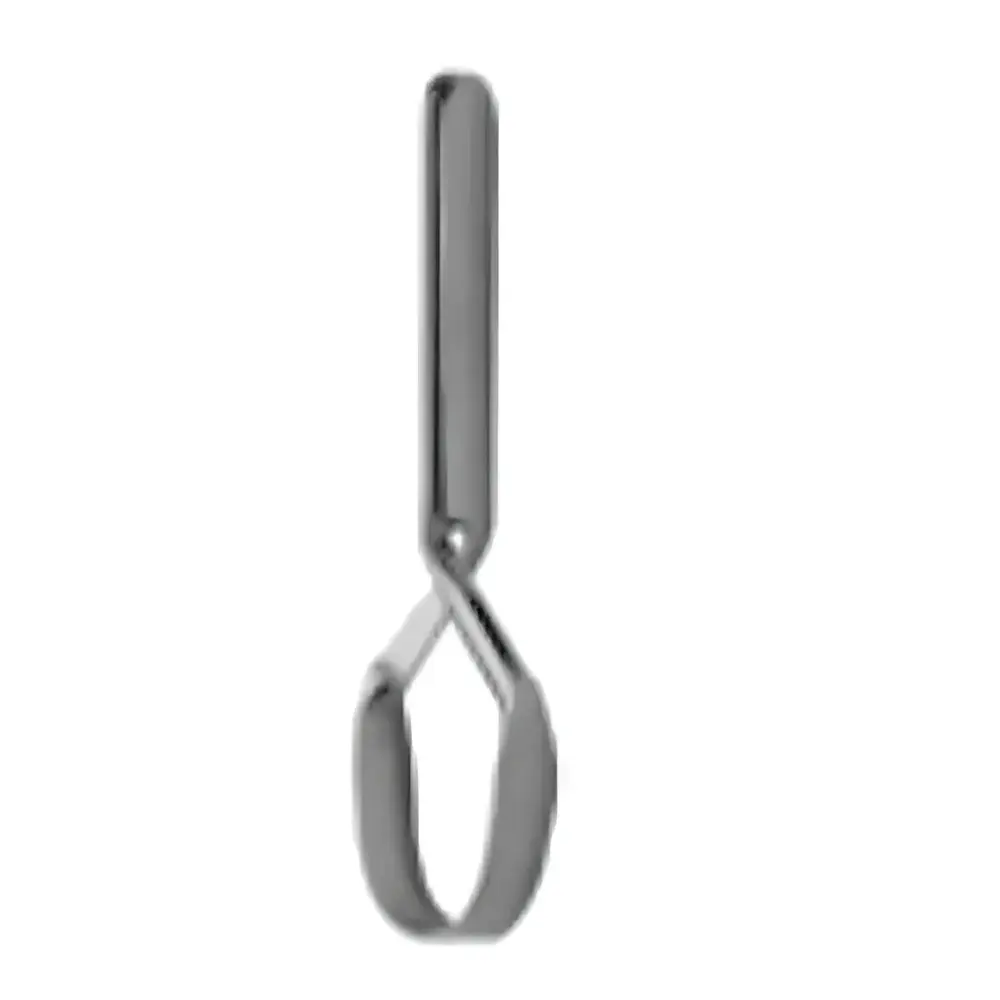
RWD R31004-01 Stainless Steel Microvascular Clip (2 mm Width, 19 mm Length)
| Brand | RWD |
|---|---|
| Origin | Shenzhen, China |
| Manufacturer Type | Original Equipment Manufacturer (OEM) |
| Country of Origin | China |
| Model | R31004-01 |
| Pricing | Upon Request |
Overview
The RWD R31004-01 is a precision-engineered microvascular clip designed for controlled, reversible occlusion of small-diameter vessels and neural structures during microsurgical and preclinical research procedures. Constructed from medical-grade austenitic stainless steel (AISI 304 or equivalent), the clip features a consistent 2 mm jaw width and 19 mm overall length—optimized for ergonomic handling under high-magnification stereomicroscopy and compatibility with standard microinstrument holders. Its mechanical design follows the principle of spring-loaded, self-retaining compression, delivering reproducible clamping force without requiring continuous manual actuation. This enables stable, transient vascular occlusion during microanastomosis, ischemia-reperfusion modeling, or targeted tissue perfusion control in rodent and small mammal surgical models.
Key Features
- Precision-machined stainless steel body ensuring corrosion resistance, autoclavability (up to 134°C, 21 psi, 18 min), and long-term dimensional stability.
- Consistent 2 mm jaw width and 19 mm total length—validated for use in intracranial, carotid, femoral, and mesenteric vessel manipulations in mice and rats (body weight range: 20–300 g).
- Controlled spring tension calibrated to deliver occlusive pressure within the physiological range for microvessels (typically 15–45 mmHg), minimizing intimal injury while maintaining reliable flow arrest.
- Smooth, burr-free jaw surfaces with rounded edges to reduce tissue trauma and prevent vessel wall slippage during placement or repositioning.
- Non-magnetic composition compatible with intraoperative MRI environments and electromagnetic tracking systems used in image-guided surgery platforms.
- Individually packaged in ISO 11607-compliant sterile barrier systems; available in non-sterile bulk packs for institutional sterilization protocols.
Sample Compatibility & Compliance
The R31004-01 is validated for use with biological tissues including arterial, venous, and dural vessels ≤0.8 mm in external diameter. It complies with ISO 7153-1:2016 (Surgical instruments — Metallic materials — Part 1: Stainless steels) and meets biocompatibility requirements per ISO 10993-1 (Biological evaluation of medical devices — Part 1: Evaluation and testing within a risk management process). All production batches undergo material certification (mill test reports), dimensional inspection (±0.05 mm tolerance on critical features), and functional testing per internal SOP-MICRO-CLIP-002. The device is registered with China NMPA as a Class I medical device (Registration No.: GD2022XXXXX) and conforms to GB/T 1220–2007 for stainless steel composition.
Software & Data Management
As a passive, manually operated surgical instrument, the R31004-01 does not incorporate embedded electronics, firmware, or digital interfaces. Consequently, it requires no software integration, driver installation, or data logging functionality. Its usage is documented through standard surgical logs, electronic health records (EHR), or preclinical study case report forms (CRFs). For GLP- or GCP-compliant studies, traceability is maintained via lot-number labeling on primary packaging and integration into institutional inventory management systems (e.g., LabVantage, Quartzy). Full audit trails—including sterilization cycle records, operator training logs, and procedural timestamps—are retained per ISO 13485:2016 and FDA 21 CFR Part 820 requirements.
Applications
- Transient middle cerebral artery occlusion (tMCAO) in murine stroke models.
- Carotid artery clamping during end-to-end anastomosis in rat microvascular transplantation.
- Controlled hepatic inflow interruption in partial hepatectomy protocols.
- Occlusion of retinal or choroidal vessels in ophthalmic microsurgery training.
- Temporary nerve root compression in peripheral nerve injury models.
- Flow regulation in ex vivo organ perfusion systems (e.g., isolated heart or kidney preparations).
FAQ
Is the R31004-01 reusable?
Yes—when processed according to validated cleaning, disinfection, and steam sterilization protocols (e.g., AAMI ST79 guidelines), the clip may be reused up to 25 cycles without measurable degradation in spring force or jaw alignment.
What sterilization methods are validated for this clip?
Autoclaving (gravity displacement or prevacuum cycles at 121°C or 134°C), ethylene oxide (EtO), and low-temperature hydrogen peroxide plasma (e.g., STERRAD®) are all validated. Dry heat and gamma irradiation are not recommended.
Can this clip be used in human clinical settings?
No—the R31004-01 is intended exclusively for laboratory research and preclinical animal use. It is not CE-marked or FDA-cleared for human application.
How is dimensional consistency verified during manufacturing?
Each production lot undergoes 100% automated optical measurement (AOM) using a Zeiss O-Inspect CMM system, with statistical process control (SPC) charts maintained for jaw width, length, and spring deflection angle.
Does RWD provide technical support for surgical protocol integration?
Yes—application engineers offer protocol-specific guidance, including force calibration recommendations, vessel size matching charts, and peer-reviewed literature references for model-specific deployment.



