
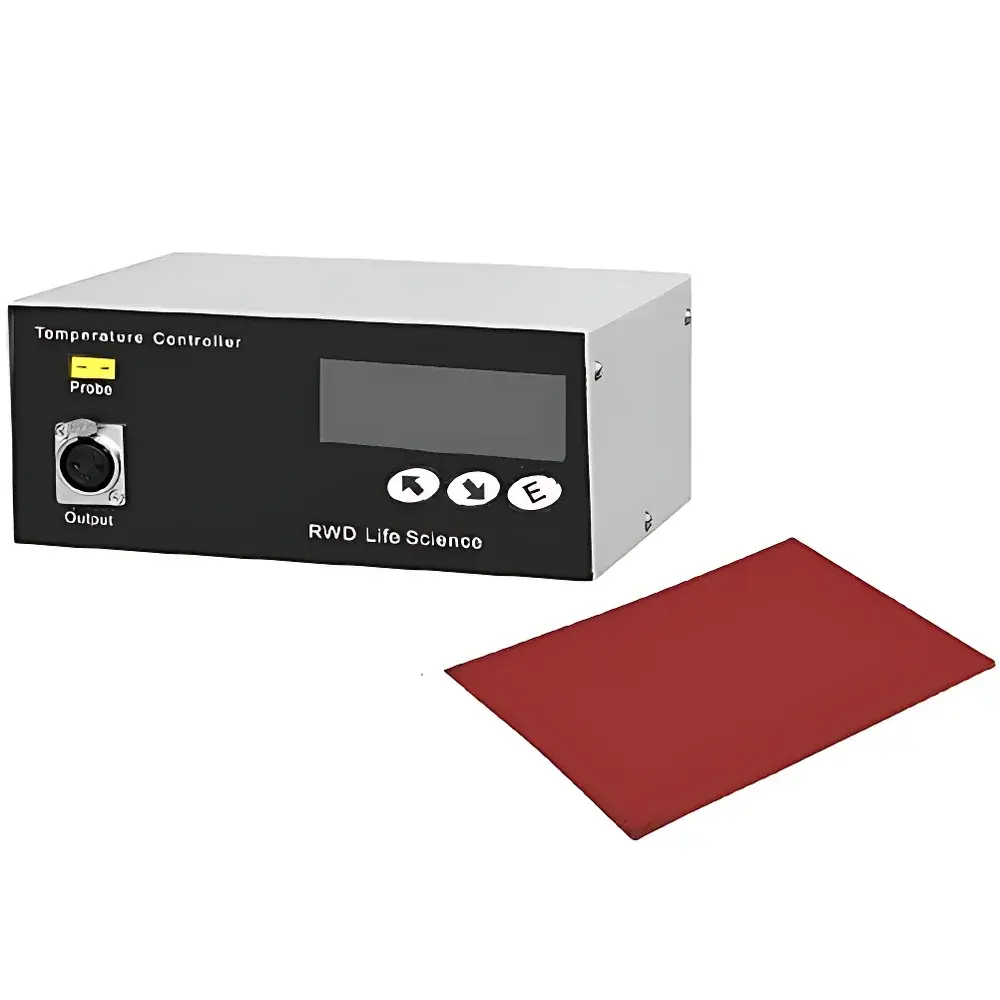
RWD 69001 Animal Temperature Maintenance System for Rodent Surgical Procedures
| Brand | RWD |
|---|---|
| Origin | Shenzhen, China |
| Manufacturer Type | Direct Manufacturer |
| Country of Origin | China |
| Model | 69001 |
| Heating Range | 25–45 °C |
| Temperature Display Resolution | 0.1 °C |
| Temperature Control Accuracy | ±0.5 °C |
| Heating Power Output | 0–30 W (rat), 0–10 W (mouse) |
| Input Voltage | AC 110 V or 240 V, 50/60 Hz |
| Output Voltage | DC 12 V |
| Probe Outer Diameter | 1.6 mm (mouse), 3.0 mm (rat) |
| Heating Pad Dimensions | 248 × 188 mm (rat), 95 × 65 mm (mouse) |
Overview
The RWD 69001 Animal Temperature Maintenance System is an engineered thermal regulation platform designed to sustain normothermia in laboratory rodents—primarily rats and mice—during surgical interventions, post-operative recovery, or prolonged physiological monitoring. Hypothermia remains a leading confounding variable in in vivo experimental models; uncontrolled core temperature loss impairs cardiovascular stability, immune response, metabolic rate, and anesthetic metabolism. This system mitigates such risks by delivering closed-loop, feedback-controlled conductive heating via precision-heated pads, coupled with real-time core temperature acquisition using calibrated K-type thermocouple probes inserted rectally. The device operates on a proportional-integral (PI) control algorithm to maintain setpoint temperature within ±0.5 °C across dynamic thermal loads, ensuring physiological fidelity during extended procedures lasting up to several hours. Its DC 12 V output architecture isolates the animal interface from mains voltage, meeting IEC 60601-1 safety requirements for biomedical equipment used in proximity to live subjects.
Key Features
- Adjustable heating range from 25 °C to 45 °C with 0.1 °C display resolution and ±0.5 °C steady-state control accuracy
- Dual-mode power delivery: 0–30 W for rat applications (model 69001), 0–10 W for mouse applications (model 69002), optimized for surface-area-to-mass ratios
- Interchangeable heating pads: 248 × 188 mm pad (69007) for rats; 95 × 65 mm pad (69008) for mice—both constructed with medical-grade silicone insulation and embedded NiCr resistance wire
- K-type thermocouple probes with biocompatible stainless-steel sheaths (OD 1.6 mm for mice, 3.0 mm for rats; models 69009 and 69010) featuring <1 s thermal response time (t90) in aqueous tissue simulants
- Universal AC input compatibility (110 V / 240 V, 50/60 Hz) with internal switching-mode power supply ensuring stable DC 12 V output under variable line conditions
- Mounting flexibility: compatible with non-ferromagnetic benchtop surfaces, RWD anesthesia workstations (model 68620), and motorized animal positioning platforms (models 68604, 68607)
Sample Compatibility & Compliance
The system supports acute and subacute rodent models weighing 15–500 g. It complies with ISO 14971:2019 for risk management of medical devices and incorporates design safeguards aligned with GLP-compliant vivarium practices. All electrical interfaces meet IEC 61000-6-3 (EMC emission) and IEC 61000-6-2 (immunity) standards. The thermocouple probes are sterilizable via ethylene oxide (EtO) or low-temperature hydrogen peroxide plasma methods—validated per ISO 11135 and ISO 14937. No ferromagnetic components are present, eliminating interference with MRI-compatible surgical workflows. Device labeling adheres to ISO 15223-1:2021 for symbols and traceability.
Software & Data Management
While the 69001 operates as a standalone analog-regulated instrument without embedded digital logging, its analog temperature output (0–5 V DC, linearly scaled to 0–50 °C) is compatible with third-party data acquisition systems—including National Instruments DAQmx, ADInstruments PowerLab, and Spike2—enabling synchronized recording alongside ECG, respiration, or neurophysiological signals. Optional integration with RWD’s LabSight™ acquisition suite (v3.2+) permits timestamped thermal trend export in CSV or HDF5 format, supporting audit trails required under FDA 21 CFR Part 11 for regulated preclinical studies.
Applications
- Intraoperative thermoregulation during stereotaxic brain surgery, thoracotomy, or abdominal laparotomy
- Post-anesthesia recovery monitoring in dedicated rodent recovery stations
- Chronic implantation studies requiring stable thermal baseline prior to telemetry transmitter calibration
- Pharmacokinetic/pharmacodynamic (PK/PD) assessments where drug-induced thermoregulatory shifts must be isolated from procedural hypothermia
- Training modules for veterinary and biomedical students in aseptic surgical technique and perioperative care
FAQ
Can the heating pad be autoclaved?
No. Autoclaving exceeds the thermal rating of the silicone encapsulation and may delaminate sensor wiring. Sterilization is limited to EtO or hydrogen peroxide plasma cycles only.
Is the system suitable for use inside a CO₂ incubator?
No. Ambient humidity >80% RH and elevated CO₂ concentrations may corrode internal electronics and compromise probe junction integrity.
What is the recommended calibration interval for the thermocouple probes?
Annual calibration against a NIST-traceable reference bath (±0.1 °C tolerance) is advised per ISO/IEC 17025 guidelines for accredited laboratories.
Does the unit support remote control via RS-232 or USB?
No. The 69001 is a manually operated analog controller. Digital interface capability is available in the RWD TMS-200 series (sold separately).
Can multiple animals be monitored simultaneously on one unit?
No. Each unit supports one thermocouple input and one heating zone. Multi-animal studies require individual units or a centralized thermal management system with multiplexed probe inputs.




