
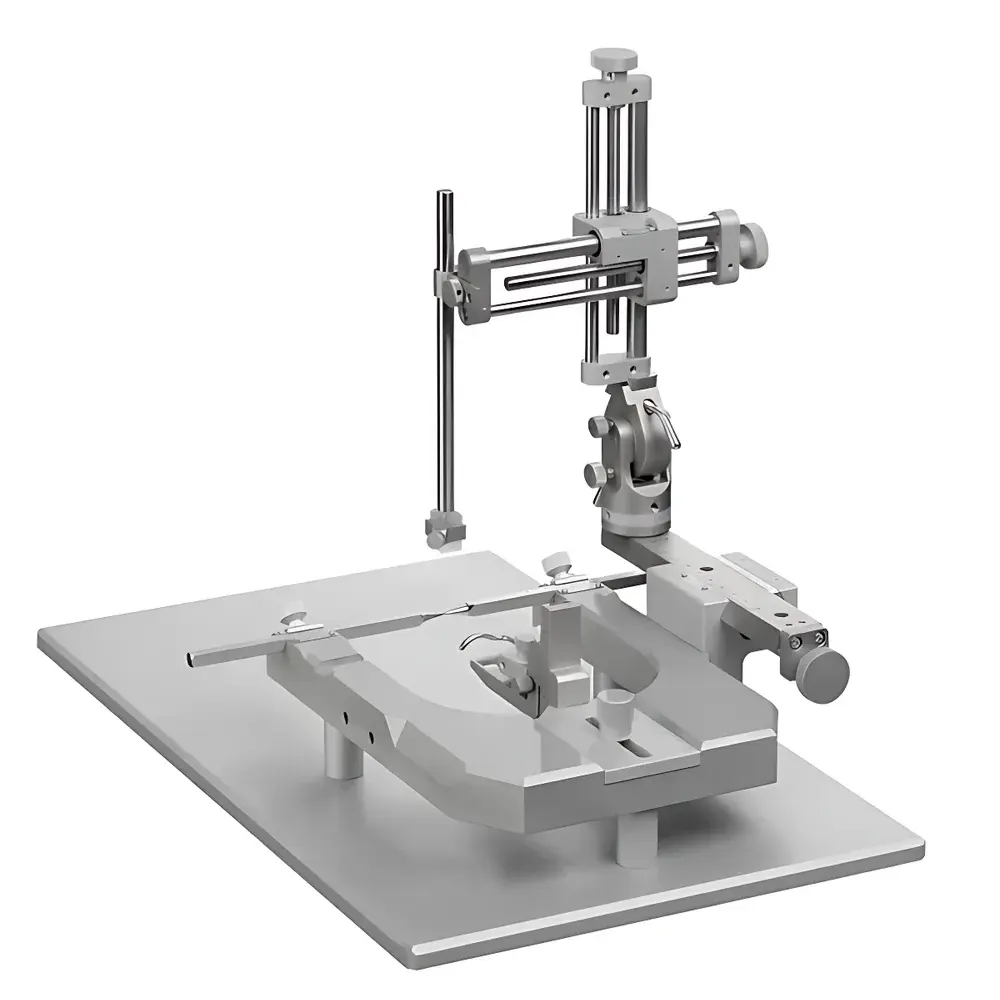
RWD Standard Stereotaxic Instrument for Small Animal Neurosurgery
| Brand | RWD |
|---|---|
| Origin | Shenzhen, China |
| Manufacturer | Yes |
| Country of Origin | China |
| Model | Standard |
| Price Range | USD 1,400 – 7,000 |
| Movement Range (X/Y/Z) | ±80 mm |
| Positioning Resolution | 0.1 mm |
| Vertical Rotation | 0–180° with independent lock |
| Horizontal Rotation | 0–360° with independent lock |
| Base Plate Dimensions | 400 mm × 255 mm |
| Scale Markings | Anti-fatigue etched stainless steel |
| Headholder Design | Anatomically contoured cradle |
| Ear Bar Fixation | Spring-loaded pressure plate |
| Compatibility | Microinjection pumps, stereomicroscopes, cranial drills, digital imaging systems |
Overview
The RWD Standard Stereotaxic Instrument is an engineered platform for precise intracranial targeting in small and medium-sized laboratory animals. Designed in accordance with established neuroanatomical coordinate systems—primarily the Paxinos & Watson and Franklin & Paxinos atlases—it enables reproducible placement of electrodes, cannulae, viral vectors, or microinjection needles into defined brain regions. Its mechanical architecture relies on orthogonal three-axis translation (anteroposterior, mediolateral, dorsoventral) combined with dual-axis rotational freedom (horizontal azimuthal and vertical elevation), allowing full spatial orientation of the manipulator relative to the stereotactic frame. This configuration supports both standard bregma-lambda referencing and alternative skull-flat or angled-coordinate paradigms used in developmental, behavioral, and optogenetic neuroscience workflows.
Key Features
- Dual-lead-screw actuation system ensures minimal backlash, high mechanical rigidity, and smooth, repeatable positioning across all three axes (X/Y/Z), each with ±80 mm travel range and 0.1 mm vernier scale resolution.
- Independent locking mechanisms for vertical (0–180°) and horizontal (0–360°) rotation enable stable angular alignment without compromising axial precision—critical for angled injections or multi-target trajectories.
- Extended base plate (400 mm × 255 mm) accommodates a wide range of animal holders, including custom-built restraint fixtures, thermal regulation platforms, and integrated electrophysiology rigs.
- Ergonomically optimized scale engravings on stainless steel components reduce visual fatigue during prolonged surgical sessions; markings are chemically etched for long-term legibility under disinfectant exposure.
- Contoured headholder design conforms to species-specific cranial geometry (rat, mouse, guinea pig, rabbit, cat, avian, and reptilian models), enhancing immobilization stability while minimizing tissue compression artifacts.
- Ear bar fixation employs a spring-loaded pressure plate mechanism—eliminating threaded knob torque variability and ensuring consistent, non-traumatic lateral skull stabilization.
- Dedicated directional indicators on the vertical column prevent inadvertent axis misalignment during multi-step procedures, supporting GLP-aligned documentation practices.
Sample Compatibility & Compliance
The instrument supports standardized adapters for rats (including Sprague-Dawley and Wistar strains), mice (C57BL/6, BALB/c), guinea pigs, rabbits, domestic cats, pigeons, and geckos. All adapter interfaces comply with ISO 9001-certified manufacturing tolerances (±0.05 mm positional repeatability per axis). The structural frame meets IEC 61000-6-2 electromagnetic immunity requirements for use in shared vivarium-electrophysiology suites. While not a medical device, its mechanical design aligns with AAALAC International recommendations for humane animal restraint and procedural accuracy in neurosurgical interventions.
Software & Data Management
As a hardware-only stereotactic platform, the RWD Standard Instrument does not include embedded firmware or proprietary software. However, it is fully compatible with third-party digital workflow tools—including open-source stereotactic planning suites (e.g., Brainstorm, STEREOTAXIC), commercial electrophysiology acquisition platforms (e.g., Spike2, OpenEphys), and DICOM-integrated surgical navigation systems. Coordinate data exported from MRI/CT atlases can be directly mapped to the instrument’s vernier scales using calibrated conversion tables provided in the user manual. For audit-trail compliance in regulated research environments (e.g., FDA 21 CFR Part 11–governed preclinical studies), users may log setup parameters (e.g., bregma coordinates, electrode angle, depth offsets) in validated electronic lab notebooks (ELNs) such as LabArchives or Benchling.
Applications
- Chronic intracerebral cannulation for repeated microdialysis or drug delivery in longitudinal behavioral pharmacology studies.
- Precise placement of silicon-based neural probes (e.g., Neuropixels, Michigan arrays) for high-density extracellular recording in awake, head-fixed preparations.
- Targeted viral vector injection (AAV, lentivirus) into subcortical nuclei (e.g., VTA, SNc, BLA) for circuit-specific optogenetic or chemogenetic manipulation.
- Stereotactic lesioning via electrolytic current or excitotoxic agents (e.g., ibotenic acid) in models of Parkinson’s disease or epilepsy.
- Combined use with intraoperative stereomicroscopy and motorized cranial drill systems for real-time visualization and minimally invasive craniotomy.
- Development of species-specific stereotactic templates for non-standard models (e.g., tree shrews, marmosets) via modular adapter customization.
FAQ
Is this instrument compatible with MRI-guided stereotaxy?
Yes—the base plate and manipulator assembly are constructed entirely from non-ferromagnetic 304 stainless steel and engineering-grade polymers, enabling safe use inside MRI scanner rooms (up to 7T) when paired with MR-compatible animal holders and RF-shielded cabling.
Can I retrofit my existing RWD instrument with motorized axes?
No—the Standard model is manually operated and lacks provisions for motor driver integration. Motorized upgrades require the RWD SmartStax series, which features embedded stepper motor controllers and USB-C communication protocols.
What calibration documentation is provided?
Each unit ships with a factory-verified dimensional certificate listing axis orthogonality deviation (<0.02°), lead-screw pitch error ( 0.9999 over full range).
Are replacement ear bars available for non-standard species?
Yes—custom-machined ear bars for ferrets, marmosets, and juvenile primates can be ordered separately under part numbers prefixed “EB-”. Tolerance specifications and biocompatibility test reports (ISO 10993-5 cytotoxicity) are supplied upon request.
Does RWD provide installation and training support?
On-site technician deployment is available for institutional purchasers in North America, EU, and APAC regions; remote video-assisted setup and SOP development are included at no additional cost with all orders.





