
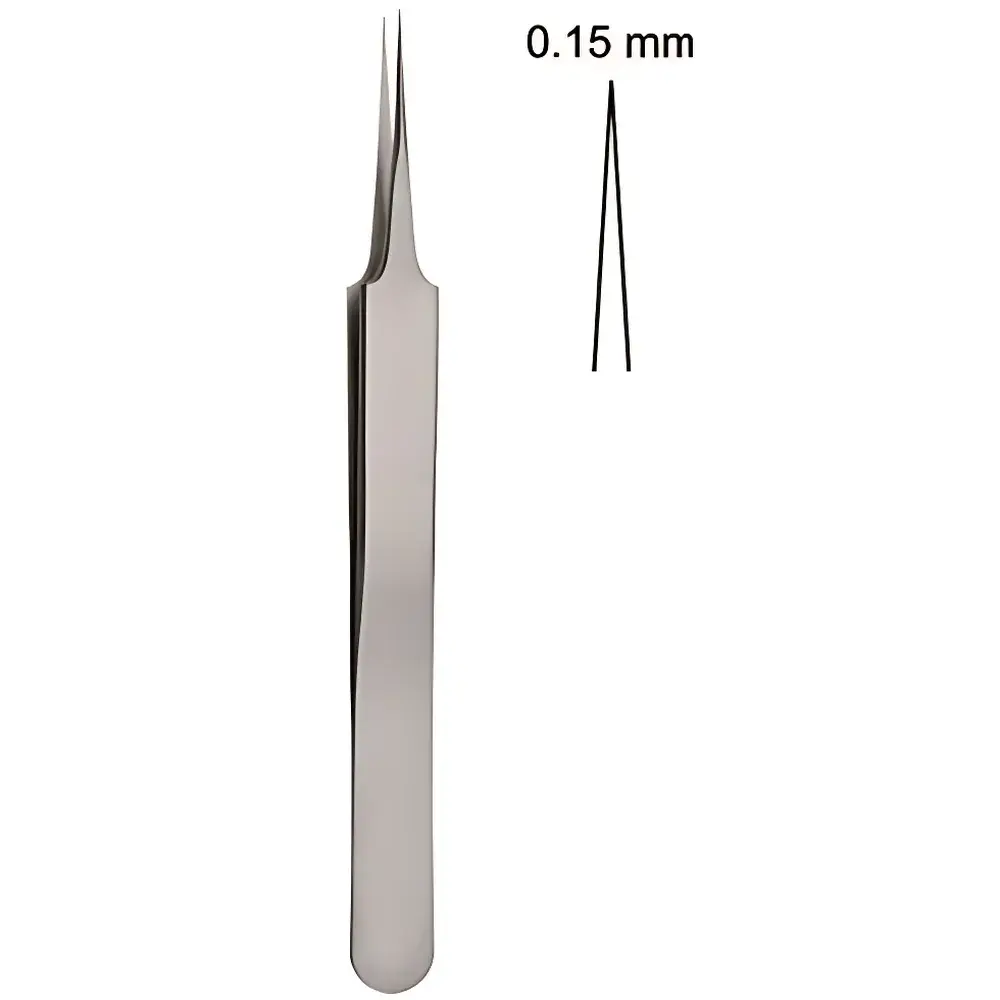
RWD F11002-11 Fine Straight Microforceps, 0.15 mm Tip Width, 11 cm Length
| Brand | RWD |
|---|---|
| Origin | Shenzhen, China |
| Manufacturer Type | Direct Manufacturer |
| Country of Origin | China |
| Model | F11002-11 |
| Price | Upon Request |
Overview
The RWD F11002-11 Fine Straight Microforceps is a precision-handling instrument engineered for high-magnification micro-manipulation tasks in life science research, electrophysiology, microsurgery, and semiconductor assembly. Constructed from premium-grade, corrosion-resistant stainless steel (AISI 420 or equivalent), the forceps features a hand-polished, non-magnetic, autoclavable tip with a precisely controlled width of 0.15 mm—optimized for delicate tissue separation, neural probe placement, embryo handling, and fine wire or fiber manipulation under stereo or inverted microscopy. Its 11 cm overall length provides ergonomic balance between reach and control, minimizing hand fatigue during prolonged procedures while maintaining tactile feedback critical for sub-millimeter positioning accuracy.
Key Features
- Ultra-fine straight-tip geometry with consistent 0.15 mm tip width across the entire batch—verified via optical comparator inspection per ISO 13485 manufacturing protocols.
- Electropolished surface finish (Ra ≤ 0.2 µm) to reduce sample adhesion, prevent biofilm nucleation, and ensure compatibility with sterile and cleanroom environments (ISO Class 5–7).
- Full-length heat treatment and cryogenic stress-relief annealing to eliminate residual deformation and guarantee long-term dimensional stability—even after repeated autoclaving (up to 134 °C, 30 min, 200+ cycles).
- Ergonomic tapered handle design with micro-textured grip zones, enabling secure control under gloved conditions (compatible with standard nitrile and latex surgical gloves).
- Non-pyrogenic, non-cytotoxic construction validated per ISO 10993-5 and ISO 10993-12; certified for in vitro diagnostic (IVD) ancillary use and GLP-compliant preclinical workflows.
Sample Compatibility & Compliance
The F11002-11 is routinely employed in applications requiring mechanical integrity without chemical interference—including live-cell micromanipulation (e.g., patch-clamp electrode positioning), zebrafish or mouse embryo transfer, retinal explant dissection, and microfluidic channel alignment. It exhibits full compatibility with common laboratory reagents (70% ethanol, isopropanol, hydrogen peroxide vapor, glutaraldehyde solutions) and is resistant to degradation in saline, PBS, and buffered enzymatic media. The instrument complies with ISO 7153-1:2016 (Surgical Instruments — Metallic Materials — Part 1: Stainless Steels) and meets CE marking requirements under Regulation (EU) 2017/745 (MDR) for Class I non-sterile, reusable surgical instruments. Documentation includes full material traceability (MTR), RoHS 3 and REACH SVHC declarations, and sterilization validation summaries.
Software & Data Management
As a manually operated mechanical tool, the F11002-11 does not incorporate embedded electronics or digital interfaces. However, it is fully compatible with digital workflow integration in regulated environments: its model number, lot code, and calibration history (if used in GMP/GLP labs with periodic metrological verification) can be logged into electronic lab notebooks (ELN) such as LabArchives or Benchling, or enterprise quality management systems (QMS) like Veeva Vault QMS. Traceability records support audit readiness for FDA 21 CFR Part 11 compliance when paired with appropriate access-controlled documentation practices and electronic signature protocols.
Applications
- Single-cell isolation and intracellular injection under micromanipulator guidance (e.g., with Narishige MM-89 or Sutter MP-285 systems)
- Microelectrode array (MEA) probe alignment and solder joint micro-adjustment in neuroengineering labs
- Preimplantation genetic diagnosis (PGD) biopsy procedures in IVF clinics using time-lapse imaging platforms
- MEMS device handling and wafer-level packaging in cleanroom fabrication lines
- High-resolution histology section mounting and ribbon flattening on cryostat or microtome stages
FAQ
Is the F11002-11 suitable for sterile surgical use in animal studies?
Yes—it is supplied non-sterile but validated for terminal steam sterilization (autoclaving) at 121–134 °C and compatible with ethylene oxide (EtO) and low-temperature hydrogen peroxide plasma methods.
Can this forceps be customized with alternative tip geometries or lengths?
RWD offers OEM/ODM services for specialized variants including angled, bent, serrated, or insulated tips; minimum order quantities and lead times apply.
What is the recommended maintenance protocol to preserve tip sharpness and alignment?
Clean immediately post-use with enzymatic detergent, rinse thoroughly with deionized water, dry with lint-free cloth, and store vertically in designated instrument trays; avoid ultrasonic cleaning unless followed by passivation.
Does RWD provide calibration certificates or metrological verification reports?
While not required for Class I passive instruments per ISO/IEC 17025, RWD issues optional factory inspection reports documenting tip width measurement (via calibrated vision system), surface roughness, and material composition upon request.




