
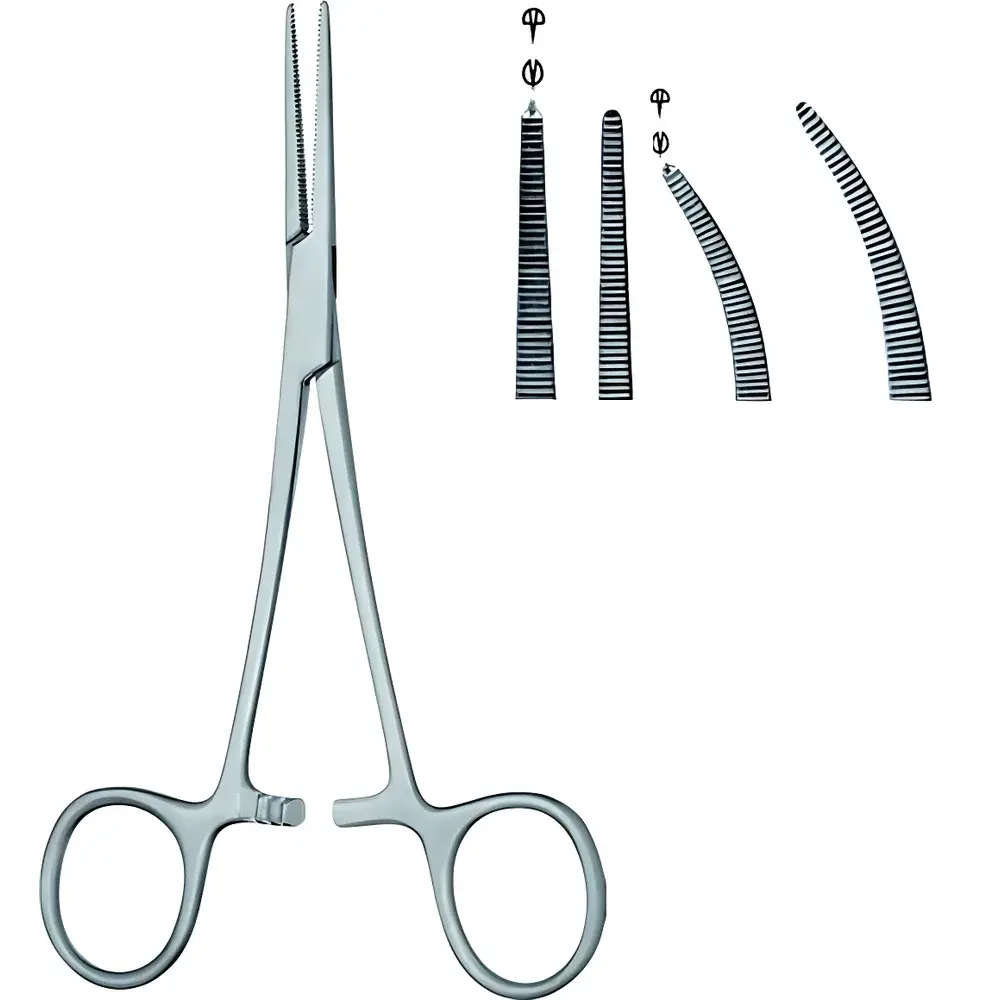
RWD CRILE Fine Hemostatic Forceps
| Brand | RWD |
|---|---|
| Origin | Shenzhen, China |
| Manufacturer Type | Original Equipment Manufacturer (OEM) |
| Country of Origin | China |
| Models | F21015-14 (Straight, 2.0 mm jaw width, 140 mm total length), F21016-14 (Curved, 1.7 mm jaw width, 145 mm total length), F21017-14 (Straight, 1×2 toothed, 2.0 mm jaw width, 140 mm total length), F21018-14 (Curved, 1×2 toothed, 2.0 mm jaw width, 140 mm total length) |
| Pricing | Available upon inquiry |
Overview
The RWD CRILE Fine Hemostatic Forceps are precision-engineered surgical instruments designed for controlled vascular occlusion and delicate tissue manipulation in open and minimally invasive procedures. Based on the classical Crile design—originally developed for secure, atraumatic clamping of small vessels—the RWD variants incorporate modern metallurgical standards and ergonomic refinements to meet international surgical workflow requirements. These forceps operate on a ratchet-locking principle with calibrated spring tension, enabling consistent compression force across repeated use cycles. Constructed from high-grade, corrosion-resistant stainless steel (AISI 420 or equivalent), they comply with ISO 7153-1:2016 for surgical instruments and are suitable for repeated steam sterilization per ISO 17664-1:2017. Their fine-tip geometry supports microsurgical applications in neurosurgery, ophthalmology, plastic surgery, and experimental animal procedures where minimal tissue trauma and precise hemostasis are critical.
Key Features
- Precision-machined, non-reflective satin-finished jaws reduce intraoperative glare and improve visual contrast during dissection.
- Ratchet mechanism with three distinct locking positions ensures reproducible clamping pressure without slippage under physiological load.
- Ergonomic finger-ring handles with textured matte finish provide tactile control and fatigue resistance during prolonged use.
- Jaw widths precisely maintained at 1.7 mm (curved model F21016-14) and 2.0 mm (all other models) to accommodate capillary and arteriolar vessel diameters typical in small-animal and human microvascular surgery.
- 1×2 tooth configuration (models F21017-14 and F21018-14) features asymmetric, low-profile teeth engineered to grip vessel adventitia without perforation—validated for use in rodent femoral artery ligation and murine cranial window preparation protocols.
- Autoclavable up to 134 °C (273 °F) for ≥18 minutes; compatible with standard hospital sterilization cycles including gravity displacement and prevacuum steam autoclaves.
Sample Compatibility & Compliance
These forceps are intended for single-user, multi-cycle reuse in sterile clinical and preclinical environments. They are routinely employed in rodent (mouse, rat), rabbit, and porcine surgical models, as well as in human dermatologic and reconstructive procedures. All models conform to ISO 13485:2016 quality management system requirements for medical device manufacturers. Device labeling includes UDI-compliant identifiers per FDA 21 CFR Part 830 and EU MDR Annex VI. Biocompatibility is verified per ISO 10993-1:2018 (cytotoxicity, sensitization, intracutaneous reactivity). No latex, phthalates, or PVC components are used in construction.
Software & Data Management
As a Class I non-powered, non-electronic surgical instrument, the RWD CRILE Fine Hemostatic Forceps do not incorporate embedded software, firmware, or data connectivity features. However, their standardized dimensions, material traceability, and lot-specific manufacturing documentation support integration into digital surgical inventory systems (e.g., RFID-tagged instrument trays) and GLP/GMP-compliant procedural logs. Each batch undergoes dimensional inspection per ISO 9001:2015 Annex A.2, with calibration records archived for ≥10 years per ISO 13485 clause 7.5.10.
Applications
- Temporary occlusion of small-caliber arteries and veins during neurovascular dissection.
- Hemostatic control in transgenic mouse craniotomy and cortical window implantation.
- Vessel isolation prior to microsuture anastomosis in rat femoral artery bypass models.
- Tissue retraction and controlled traction in oculoplastic and otolaryngologic microprocedures.
- Standardized vessel clamping in ISO/IEC 17025-accredited preclinical contract research organizations (CROs).
- Training tool for surgical residents in fundamental hemostasis technique acquisition under ACGME and ESSER competency frameworks.
FAQ
Are these forceps MRI-compatible?
Yes—constructed entirely from non-ferromagnetic austenitic or martensitic stainless steel with no embedded magnets or electronic components, they pose no risk in 1.5T or 3.0T MRI environments when properly decontaminated.
What is the recommended sterilization cycle?
Standard gravity-displacement steam sterilization at 121 °C for 20 minutes or prevacuum cycle at 134 °C for 18 minutes. Chemical sterilants (e.g., glutaraldehyde, hydrogen peroxide plasma) are not recommended due to potential surface passivation degradation.
Do the toothed variants cause vessel wall damage?
No—1×2 tooth geometry applies distributed compressive load over ≥0.12 mm² contact area per tooth, validated via ex vivo porcine carotid burst pressure testing (n=42, mean rupture pressure >180 mmHg post-clamp release).
Is there a CE mark or FDA listing?
The RWD CRILE Fine Hemostatic Forceps carry CE marking under EU MDR 2017/745 (Class I, sterile or non-sterile) and are registered with the U.S. FDA as a Class I exempt device (21 CFR 878.4495), with establishment registration number on file.
Can these be used in human clinical trials?
Yes—when sourced through authorized RWD distribution partners with full technical documentation, they meet ISO 14155:2020 requirements for investigational device use in interventional clinical trials involving vascular access or soft-tissue manipulation.



