
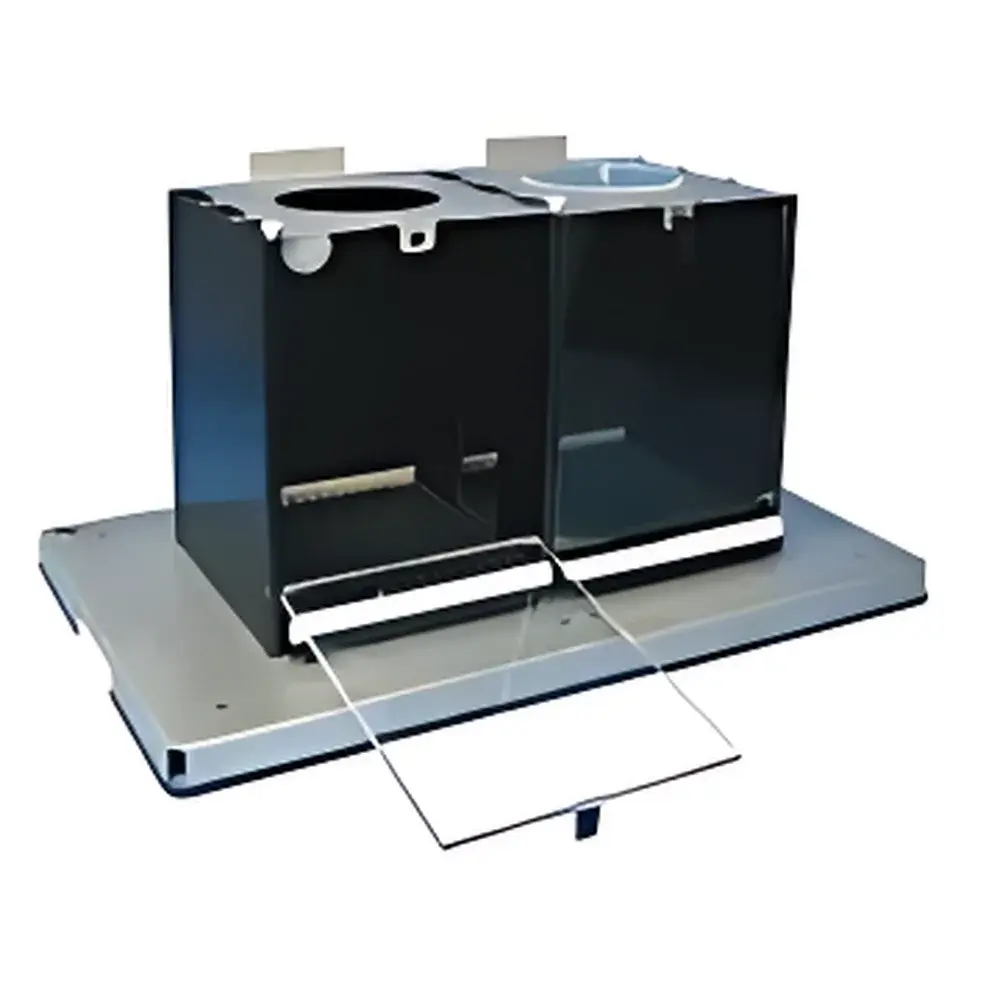
Panlab LE916/918 Shuttle Box System for Active & Passive Avoidance Behavioral Testing
| Origin | Spain |
|---|---|
| Manufacturer Type | Authorized Distributor |
| Origin Category | Imported |
| Model | LE916 (Mouse), LE918 (Rat) |
| Price Range | USD 13,500 – 68,000 |
| Max Channel Capacity | 8 units |
| Stimulus Modalities | Auditory (programmable tone), Visual (LED light), Aversive (constant-current foot shock) |
| Detection Method | Dual-load-cell weight sensing (no optical or tilt-based artifacts) |
| Interface | USB 2.0, no internal PCI/PCIe card required |
| Compliance | Designed for GLP-compliant behavioral labs |
Overview
The Panlab LE916 (mouse) and LE918 (rat) Shuttle Box Systems are purpose-engineered platforms for standardized assessment of associative learning, fear conditioning, and affective states in rodent models. Based on the classical two-compartment shuttle paradigm, these systems implement precise, temporally controlled aversive stimulation—delivered via constant-current foot shock through independently addressable grid floors—to quantify active avoidance (voluntary crossing to escape an impending cue), passive avoidance (suppression of movement following prior punishment), and learned helplessness (failure to initiate escape despite opportunity). The core measurement principle relies on validated ethological endpoints: latency to cross, number of crossings, freezing duration, and shock-elicited response patterns—all captured with millisecond-level temporal resolution. Unlike optical beam or tilt-sensor designs prone to false positives from tail drag or rapid locomotion, the dual-load-cell detection system ensures unambiguous subject localization and eliminates motion artifact in high-velocity behavioral assays.
Key Features
- Modular two-chamber architecture with identical dimensions (LE916: 20 × 20 × 20 cm per compartment; LE918: 30 × 25 × 25 cm), each equipped with electrically isolated stainless-steel grid floors for independent shock delivery and real-time current monitoring.
- Simultaneous multimodal stimulus presentation: programmable 1–10 kHz tone generator (±1 dB accuracy), high-intensity white LED (500–550 nm, 100 lux at floor level), and calibrated constant-current shock (0.05–1.5 mA, ±2% tolerance, adjustable in 0.05 mA increments).
- Weight-based subject detection using dual precision load cells (±0.5 g resolution), eliminating occlusion errors common in infrared arrays and mechanical instability inherent in pivot-based tilt sensors—critical for reliable detection during high-acceleration escapes in C57BL/6 mice or Sprague-Dawley rats.
- Front-access hinged door and top-mounted transparent acrylic lid enable rapid, low-stress animal handling without chamber disassembly; all hardware components are autoclavable or ethanol-compatible for rigorous sanitation between trials.
- Scalable multi-unit configuration supporting up to eight independent shuttle boxes synchronized via USB hub; each unit operates autonomously with onboard timing logic, ensuring deterministic stimulus-response latency regardless of host PC performance fluctuations.
Sample Compatibility & Compliance
The LE916 is optimized for Mus musculus (18–30 g), while the LE918 accommodates Rattus norvegicus (200–500 g), with adjustable grid spacing (3 mm for mice, 12 mm for rats) to prevent limb entrapment. All electrical stimuli comply with IEC 60601-1 safety standards for laboratory animal equipment. The system meets ISO/IEC 17025 requirements for test method validation when used with Panlab’s SMART v3.0 software, which includes built-in calibration routines traceable to NIST-certified force and current standards. Experimental protocols align with NIH Guide for the Care and Use of Laboratory Animals and support full documentation for AAALAC-accredited facilities, including timestamped operator logs, protocol versioning, and electronic signatures compliant with 21 CFR Part 11 Annex 11.
Software & Data Management
SMART v3.0 (Standardized Modular Acquisition & Reporting Tool) provides a validated, scriptable environment for protocol definition, real-time monitoring, and statistical post-processing. It supports automated generation of ITI (inter-trial interval) randomization, adaptive shock escalation, and conditional branching based on subject performance (e.g., criterion-based session termination). Raw data—including load-cell voltage traces, stimulus onset markers, and shock delivery timestamps—are stored in HDF5 format with embedded metadata (animal ID, protocol name, operator, calibration date). Export modules generate CSV, MATLAB .mat, and SPSS .sav files; integrated Python API enables custom analysis pipelines. Audit trails record every parameter change, file export, and user login, satisfying GLP/GCP documentation requirements.
Applications
- Learning & Memory: Quantification of acquisition curves in active avoidance (e.g., shuttle latency over 100-trial sessions), retention deficits in passive avoidance (step-through latency >300 s threshold), and reversal learning paradigms.
- Fear & Anxiety: Discriminative fear conditioning using compound cues (tone + light), contextual generalization testing, and PTSD-relevant delayed extinction protocols.
- Depression Modeling: Standardized learned helplessness induction (60-min inescapable shock, 24-hr recovery, subsequent shuttle test), with objective metrics including immobility ratio and escape failure rate.
- Pharmacological Screening: Dose-response evaluation of anxiolytics (diazepam), antidepressants (fluoxetine), NMDA antagonists (ketamine), and cognitive enhancers (donepezil) under blinded, randomized conditions.
- Genetic Phenotyping: High-throughput behavioral phenotyping of transgenic lines (e.g., BDNF-KO, CRH-overexpressing mice) across longitudinal cohorts.
FAQ
What is the difference between LE916 and LE918?
The LE916 is dimensionally and electrically configured for mice (smaller chamber, finer grid spacing, lower max current); the LE918 is scaled for rats with reinforced structural framing and higher current capacity.
Can the same software control both models simultaneously?
Yes—SMART v3.0 auto-detects connected hardware and applies model-specific calibration profiles and safety limits without manual reconfiguration.
Is shock intensity calibrated per chamber or per unit?
Each grid floor is individually calibrated during factory certification; real-time current feedback ensures consistent delivery across all eight channels in multi-box setups.
How is data integrity maintained during power interruption?
Onboard non-volatile memory buffers the last 30 seconds of trial data; upon restart, SMART resumes synchronization and appends buffered records to the primary dataset without timestamp gaps.
Does the system support integration with third-party video tracking?
Yes—TTL sync pulses and UDP packet streaming enable frame-accurate alignment with EthoVision XT, ANY-maze, or custom OpenCV-based tracking pipelines.
Related Products




