
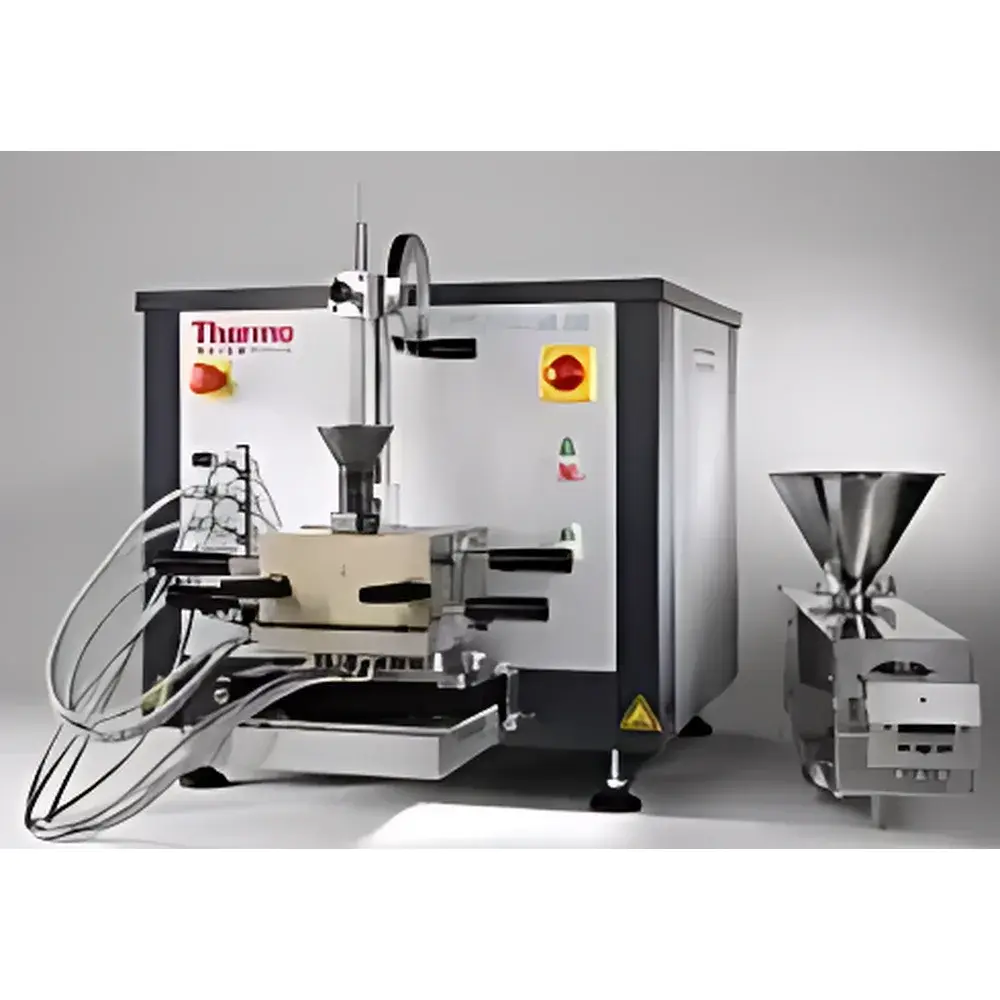
Thermo Fisher HAAKE PolyLab QC Modular Torque Rheometer
| Brand | Thermo Fisher |
|---|---|
| Origin | USA |
| Manufacturer Type | Authorized Distributor |
| Origin Category | Imported |
| Model | HAAKE PolyLab QC |
| Instrument Type | Torque Rheometer |
| Drive Configuration | Single-Screw Motor Drive |
| Minimum Speed | 1 rpm |
| Frequency Range | 1–21 rad/s |
| Maximum Speed | 200 rpm |
| Maximum Torque | 300 N·m |
| Torque Resolution | 0.1 N·m |
Overview
The Thermo Fisher HAAKE PolyLab QC is a modular torque rheometer engineered for precise, reproducible characterization of polymer melt processing behavior under realistic shear and thermal conditions. Unlike capillary or rotational rheometers, the PolyLab QC operates on the principle of torque-based viscoelastic measurement—quantifying resistance to rotation as polymer melts undergo controlled deformation within interchangeable processing modules (internal mixer, single-screw extruder, conical counter-rotating twin-screw extruder). This design bridges laboratory-scale material development with industrial-scale process validation, enabling direct correlation between rheological response and extrusion/mixing performance. The system’s downward-compatible architecture allows integration with legacy HAAKE mixing and extrusion units, minimizing capital investment while extending equipment lifecycle. Its robust mechanical construction—including nitrogen-hardened stainless-steel screws (DIN 1.8550), AISI 304 stainless-steel mixing chambers (DIN 1.4301), and air-cooled electric heating zones—ensures long-term stability across temperature ranges up to 450 °C and pressure loads up to 700 bar.
Key Features
- Modular configuration supporting three core processing units: internal mixer (120 cm³ or 625 cm³ chamber volume), single-screw extruder (L/D = 25, Ø = 19.05 mm, L = 300 mm), and conical counter-rotating twin-screw extruder (Ø = 31.8/20 mm)
- High-torque drive system delivering up to 300 N·m with 0.1 N·m resolution and ±0.15% torque accuracy
- Precise speed control from 1 rpm to 200 rpm (0.1 rpm resolution) over angular frequency range of 1–21 rad/s
- Electrically heated, air-cooled temperature control with independent zone management; maximum operating temperature of 450 °C
- Compact footprint options: benchtop or floor-standing configurations adaptable to laboratory spatial constraints
- Integrated safety interlocks, overload protection, and real-time thermal monitoring compliant with IEC 61000-6-2/6-4 electromagnetic compatibility standards
Sample Compatibility & Compliance
The PolyLab QC accommodates thermoplastics (e.g., PE, PP, PET, PC), thermoplastic elastomers, filled compounds, reactive polymers, and high-viscosity engineering resins. Its modular architecture supports ASTM D2538 (torque rheometry of thermoplastics), ISO 11443 (determination of melt rheological properties), and ISO 25577 (characterization of polymer melts in internal mixers). Temperature and torque data logging meets GLP/GMP traceability requirements when used with audit-trail-enabled software configurations. All electrical components conform to UL 61010-1 and CE marking directives for laboratory instrumentation.
Software & Data Management
Control and analysis are performed via HAAKE PolySoft software—a Windows-native application built on Microsoft .NET Framework. The interface provides real-time visualization of torque, temperature, pressure, and screw speed across all modules. Automated method scripting enables unattended execution of multi-step protocols (e.g., temperature ramps, shear rate sweeps, dwell cycles), reducing operator dependency and enhancing inter-laboratory reproducibility. Raw data export is supported in CSV, ASCII, and HDF5 formats. Optional LAN connectivity enables centralized instrument fleet management and integration into enterprise LIMS environments. Software validation documentation (IQ/OQ/PQ templates) is available for regulated pharmaceutical and medical device development workflows.
Applications
- Formulation screening of polymer blends, masterbatches, and nanocomposites
- Processing window determination for extrusion and compounding operations
- Thermal stability assessment via time-temperature superposition and degradation onset detection
- Viscoelastic parameter extraction (e.g., apparent viscosity, storage/loss moduli) under non-linear flow conditions
- Downstream line integration testing with optional accessories: melt pump, pelletizer, haul-off unit, water bath, and inline melt pressure sensor
- Teaching and training in polymer engineering curricula where hands-on processing simulation is required
FAQ
Can the PolyLab QC be integrated with existing HAAKE equipment?
Yes—the system is designed with full backward compatibility for legacy HAAKE internal mixers and extruders manufactured since the early 2000s.
What temperature control accuracy is achievable during extended runs?
The system maintains ±1 °C stability across the full 20–450 °C range under steady-state conditions, verified per ISO 17025-accredited calibration procedures.
Is FDA 21 CFR Part 11 compliance supported?
PolySoft supports electronic signatures, audit trails, and user access controls when deployed in validated environments with appropriate IT infrastructure and procedural governance.
What maintenance intervals are recommended for the gearmotor and bearing assembly?
Thermo Fisher recommends inspection and lubrication every 1,000 operational hours or annually—whichever occurs first—using specified ISO VG 220 synthetic gear oil.
Are custom firmware updates available for specialized rheological protocols?
Firmware modifications require formal change control documentation and are provided only through Thermo Fisher Field Service Engineers following risk assessment and verification testing.
Related Products



