
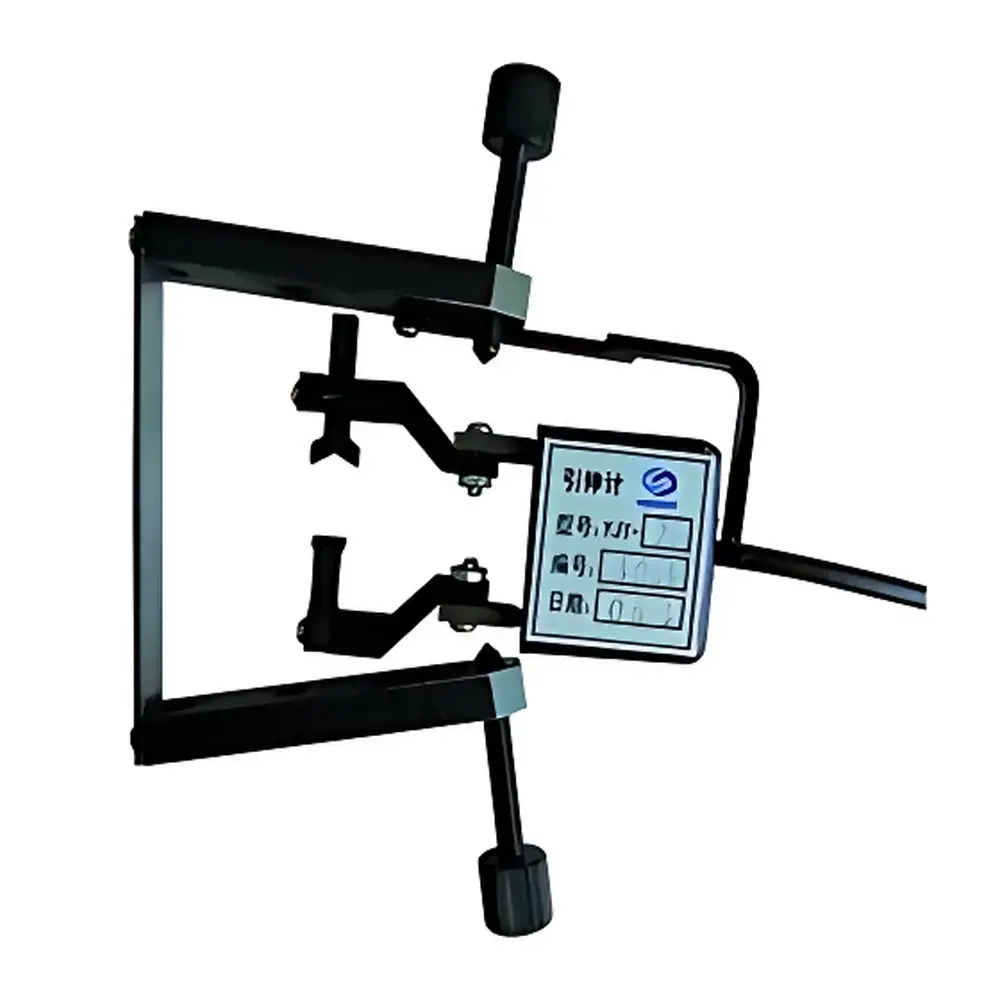
Radial Extensometer CBY1-J Series by CIMACH
| Brand | CIMACH |
|---|---|
| Origin | Jilin, China |
| Model | CBY1-J |
| Gauge Length | 6–22 mm |
| Travel Range | ±2 mm |
| Accuracy Class | 0.5% FS |
| Compliance | ISO 9513:2012, ASTM E83 Type B-2 |
Overview
The Radial Extensometer CBY1-J Series by CIMACH is a precision mechanical displacement transducer engineered for high-fidelity axial strain measurement during uniaxial tensile, compression, and cyclic testing of metallic, polymeric, and composite specimens. Unlike clip-on axial extensometers, the CBY1-J employs a symmetrical radial lever mechanism that clamps concentrically around the specimen’s gage section—eliminating parasitic bending moments and minimizing contact-induced stress concentrations. Its operating principle relies on mechanical amplification of radial deformation via dual opposing arms coupled to a high-linearity linear variable differential transformer (LVDT) or strain-gauge-based sensing element (configuration-dependent), delivering analog or digital output compatible with standard universal testing machine (UTM) controllers. Designed for integration with servo-hydraulic and electromechanical test frames—including those compliant with ISO 6892-1, ASTM E8, and GB/T 228.1—the CBY1-J meets the metrological requirements of Class 0.5 per ISO 9513:2012 for extensometer verification, ensuring traceable, repeatable strain data across laboratory and production QA environments.
Key Features
- Radial clamping geometry ensures uniform load distribution and eliminates slippage during high-strain-rate tests up to 10 s⁻¹
- Gauge length adjustable from 6 mm to 22 mm via precision-machined interchangeable anvils—enabling standardized testing per ISO 6892-1 Annex A (short gauge lengths for sheet metal) and ASTM E21
- Full-scale travel range of ±2 mm accommodates yield point detection, plastic deformation tracking, and post-necking strain analysis in ductile materials
- Stainless steel lever arms and hardened tungsten-carbide contact tips provide long-term dimensional stability and wear resistance under repeated loading
- Low-inertia design minimizes dynamic error at frequencies up to 50 Hz, supporting quasi-static and controlled-rate fatigue protocols
- Interchangeable output interface: 0–10 V analog, ±5 V differential, or RS-422 digital signal—fully configurable for synchronization with MTS, Instron, or Shimadzu controller firmware
Sample Compatibility & Compliance
The CBY1-J supports cylindrical, rectangular, and dog-bone specimens with diameters ranging from 3 mm to 25 mm and thicknesses up to 12 mm. Its radial symmetry allows reliable use on specimens exhibiting minor out-of-roundness (<0.02 mm TIR) without recalibration. The device conforms to ISO 9513:2012 for extensometer classification (Class 0.5), and its calibration certificate includes traceability to CNAS-accredited national standards. When used within validated UTM systems, the CBY1-J satisfies GLP documentation requirements for strain measurement in materials certification reports. It is routinely deployed in third-party testing labs accredited to ISO/IEC 17025 and supports audit-ready data integrity when paired with compliant software platforms.
Software & Data Management
The CBY1-J interfaces natively with CIMACH’s TestMaster Pro v4.2 and is fully supported by industry-standard platforms including Bluehill 3, MTS TestSuite TW, and INSTRON Mercury. All firmware updates and calibration coefficients are stored internally in non-volatile memory, enabling plug-and-play operation without host-side configuration. Raw strain signals include built-in low-pass filtering (100 Hz cutoff) and real-time zero-drift compensation. Audit trails—including sensor ID, calibration date, operator ID, and environmental timestamp—are embedded in exported .csv and .tdms files. For regulated environments, optional FDA 21 CFR Part 11 compliance packages are available, providing electronic signature enforcement, role-based access control, and immutable change logs.
Applications
- Tensile property characterization of aerospace aluminum alloys (e.g., 2024-T3, 7075-T6) per AMS 4027 and MIL-STD-461
- Yield strength and uniform elongation determination in cold-rolled steel sheets (ASTM A370, EN 10002-1)
- Strain hardening exponent (n-value) and plastic strain ratio (r-value) measurement in deep-drawing applications
- Creep and stress relaxation testing of thermoplastics (ISO 899-1, ASTM D2990) using slow-scan protocols
- Quality conformance verification in automotive component stamping lines, integrated into SPC dashboards via OPC UA gateway
FAQ
What is the maximum specimen temperature compatible with the CBY1-J?
The standard version operates continuously at ambient temperatures from –10 °C to +50 °C. High-temperature variants with ceramic-coated levers and heat-resistant LVDTs support intermittent use up to 200 °C.
Can the CBY1-J be used on coated or painted specimens?
Yes—its low-contact-pressure design (≤0.3 MPa at full clamping force) prevents coating damage on electrogalvanized, phosphated, or powder-coated surfaces commonly tested in automotive validation.
Is recalibration required after changing gauge length anvils?
No. Anvil sets are factory-matched and serialized; each anvil pair carries a unique correction factor embedded in the sensor’s EEPROM, automatically applied upon detection.
Does the CBY1-J support real-time strain rate control?
Yes—when connected to closed-loop UTM controllers with strain-rate feedback capability (e.g., Instron 5980 series with Bluehill 3 Advanced), it enables ASTM E2092-compliant constant strain rate testing from 0.00025 s⁻¹ to 0.1 s⁻¹.
How is traceability maintained during inter-laboratory comparisons?
Each unit ships with a CNAS-accredited calibration report referencing NIM (National Institute of Metrology, China) standards; cross-lab verification follows ISO/IEC 17043 guidelines using certified reference specimens with known modulus and Poisson’s ratio.



