
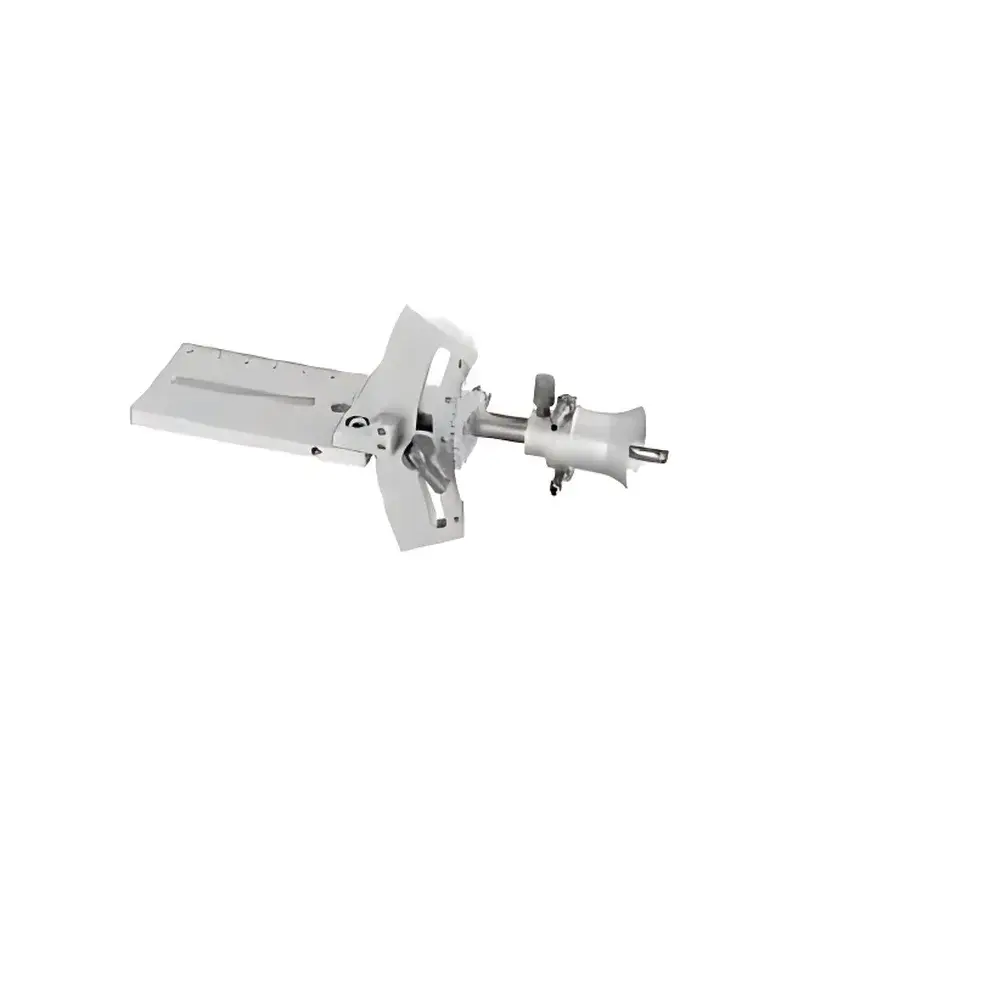
RWD 68058 Rat Anesthesia Adapter
| Brand | RWD |
|---|---|
| Origin | Guangdong, China |
| Manufacturer Type | Original Equipment Manufacturer (OEM) |
| Country of Origin | China |
| Model | 68058 |
| Pricing | Available Upon Request |
| Angular Adjustment Range | ±20° (Total 40°), Resolution: 1° |
| Longitudinal Adjustment Range | 43.5 mm |
| Anesthetic Gas Inlet/Outlet Diameter | 2 mm |
Overview
The RWD 68058 Rat Anesthesia Adapter is an engineered mechanical interface designed for precise head positioning and reliable inhalational anesthetic delivery during rodent neurophysiological, stereotactic, or imaging procedures. It operates on a dual-function principle: combining rigid cranial stabilization with dynamic angular freedom—enabling controlled reorientation of the rat’s head without compromising gas flow integrity. Unlike static restraint systems, this adapter utilizes a Couette-style rotational pivot mechanism integrated with linear translation rails, allowing investigators to maintain consistent airway patency while adjusting head orientation relative to stereotaxic coordinates or optical axes. The device is intended for use with standard small-animal anesthesia machines delivering isoflurane, sevoflurane, or halothane in oxygen or medical air carrier gas.
Key Features
- Bi-directional angular adjustment from –20° to +20° (total 40° range) with 1° incremental locking capability, facilitating reproducible alignment for repeated experimental sessions.
- 43.5 mm longitudinal travel along calibrated linear rails, enabling fine-tuned anterior–posterior positioning of the skull relative to bregma or lambda landmarks.
- Integrated arc-shaped incisor bar with zero-reference ear bars—designed to accommodate natural craniofacial geometry while minimizing pressure-induced tissue deformation or mandibular displacement.
- Gas pathway optimized for laminar flow: 2 mm internal-diameter inlet and outlet ports positioned to align coaxially with the nasal airway, reducing dead space and ensuring rapid anesthetic induction and washout kinetics.
- Machined aluminum alloy construction with anodized surface finish—providing corrosion resistance, thermal stability, and compatibility with common disinfectants used in vivarium environments.
- Tool-free assembly and modular mounting options compatible with standard stereotaxic frames (e.g., David Kopf, Stoelting, and RWD-branded systems).
Sample Compatibility & Compliance
The adapter is validated for use with Sprague-Dawley, Wistar, and Long-Evans rats weighing 200–500 g. It conforms to ISO 10993-5 (biological evaluation of medical devices — cytotoxicity testing) for materials in contact with mucosal surfaces. While not a medical device per FDA 21 CFR Part 820, its design supports compliance with AAALAC International accreditation standards for surgical and procedural refinement. All components meet RoHS Directive 2011/65/EU requirements for hazardous substance restrictions. Documentation includes material traceability certificates and mechanical tolerance reports per ISO 2768-mK.
Software & Data Management
This is a purely mechanical adapter with no embedded electronics, firmware, or software dependencies. Consequently, it requires no driver installation, calibration files, or data logging integration. However, its repeatable positioning characteristics support GLP-compliant experimental documentation: users may record angular and translational settings alongside procedural timestamps in electronic lab notebooks (ELNs) such as LabArchives or Benchling. When used in conjunction with digital stereotaxic systems (e.g., Neurostar or Angle2), the adapter’s deterministic mechanical offsets can be incorporated into coordinate transformation matrices for improved targeting accuracy.
Applications
- Stereotaxic surgery—including intracranial injection, electrode implantation, and fiber photometry cannula placement—where head angle affects trajectory depth and target localization.
- In vivo two-photon microscopy and intrinsic signal optical imaging, where slight head tilt adjustments optimize cortical surface exposure and reduce motion artifact.
- fMRI and PET studies in awake or lightly sedated rats requiring stable head fixation with minimal respiratory interference.
- Electrophysiological recordings (e.g., LFP, single-unit, or EEG) where consistent head orientation improves inter-session signal registration and spatial referencing.
- Behavioral assays involving head-fixed paradigms (e.g., whisker-dependent texture discrimination or visual stimulus presentation) requiring precise ocular or nasal alignment.
FAQ
Is the RWD 68058 compatible with non-RWD anesthesia vaporizers?
Yes—the 2 mm gas ports are dimensionally compatible with standard tubing connectors used by Datex-Ohmeda, Kent Scientific, and VetEquip anesthesia delivery systems.
Can this adapter be sterilized using autoclaving?
No—autoclaving is not recommended due to thermal expansion mismatch between aluminum components and polymer seals; ethylene oxide (EtO) or 70% ethanol wipe disinfection is validated.
Does the device include ear bars or incisor plates?
The 68058 includes a fixed arc-shaped incisor bar and adjustable ear bar mounts; replacement ear bars (RWD P/N 68058-EB) and silicone-coated incisor plates (RWD P/N 68058-IP) are available as accessories.
What is the maximum rat weight supported?
Mechanical load testing confirms structural integrity up to 500 g under static loading; dynamic loads during anesthesia induction should remain below 400 g for optimal clamping force retention.
Is technical support available for integration with third-party stereotaxic platforms?
Yes—RWD provides dimensional drawings (STEP and PDF), mounting hole specifications, and application notes for integration with Kopf, Stoelting, and custom-built frames.




