
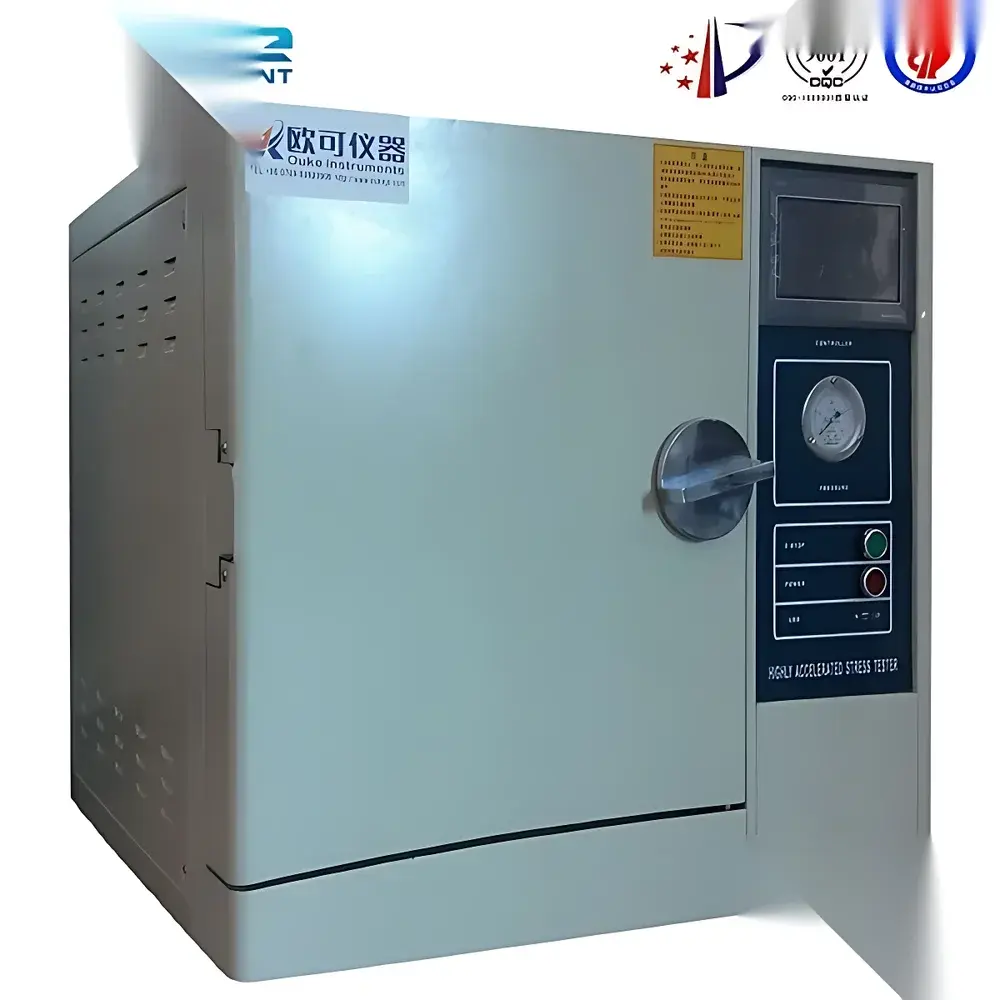
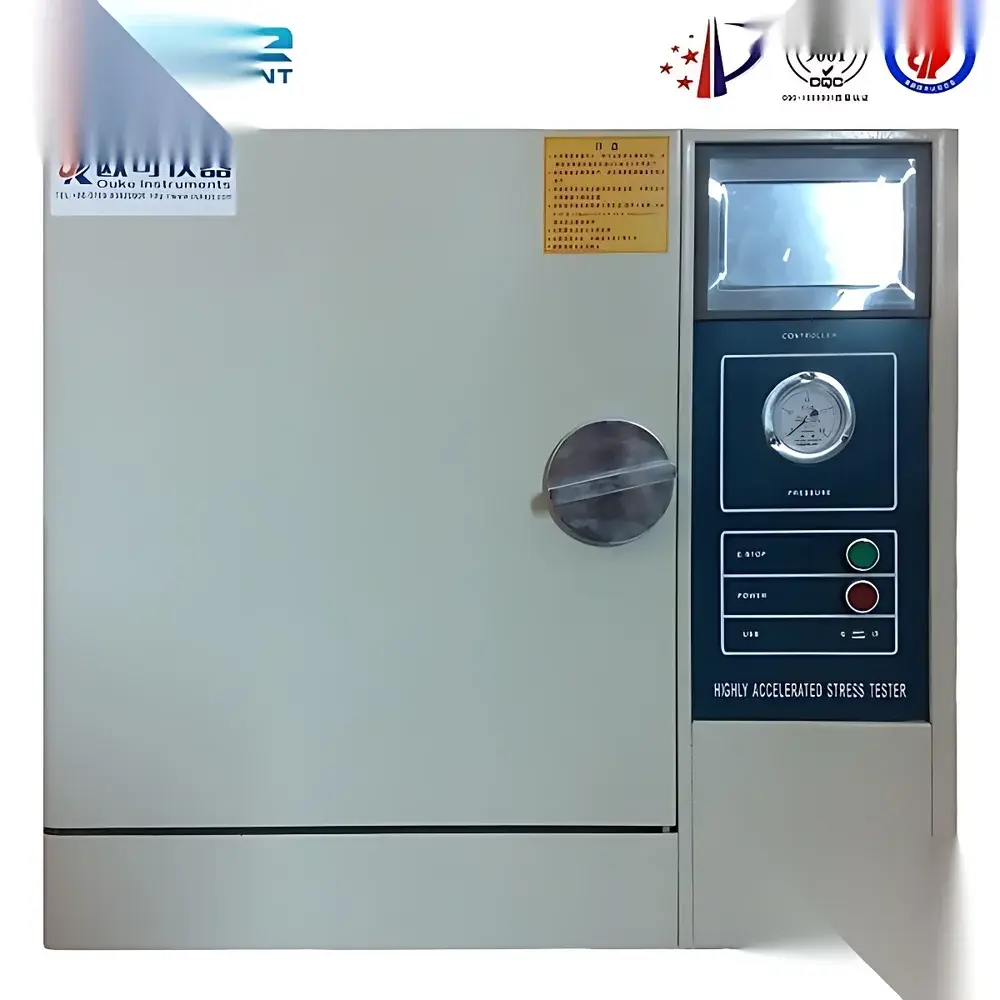
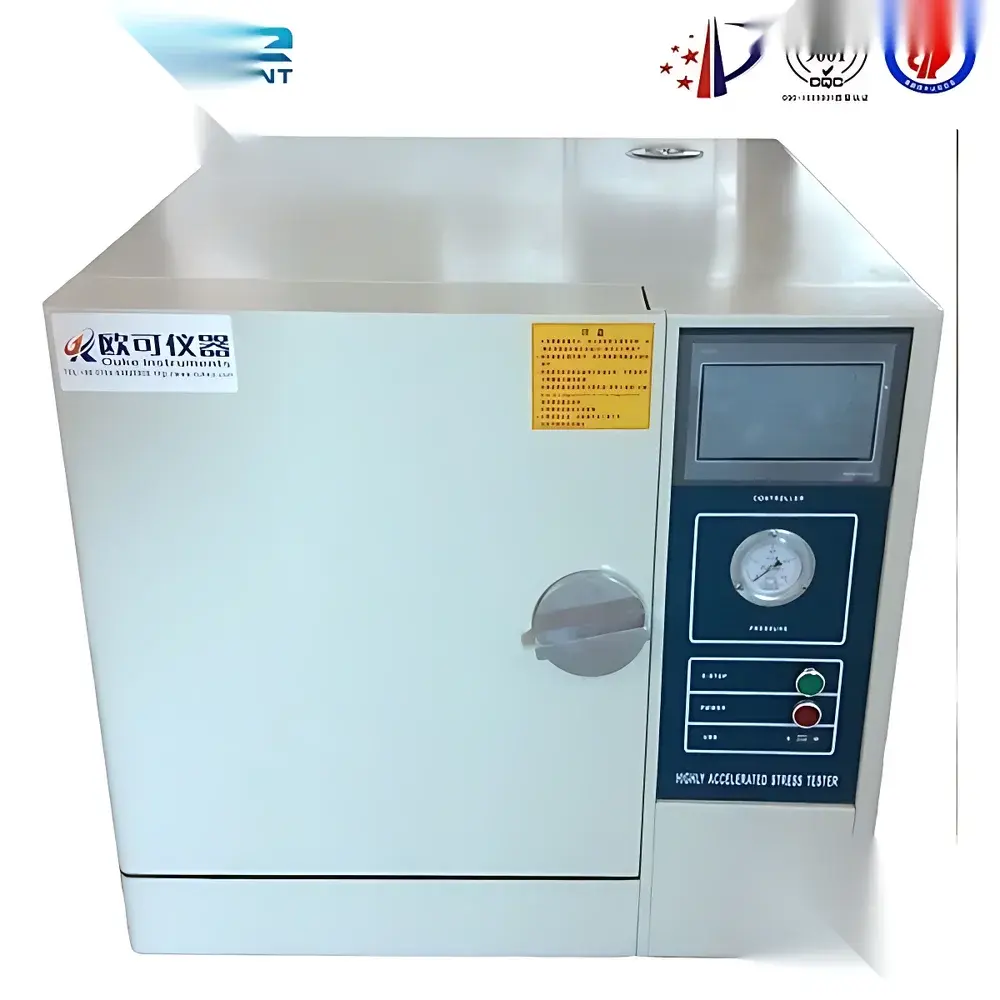
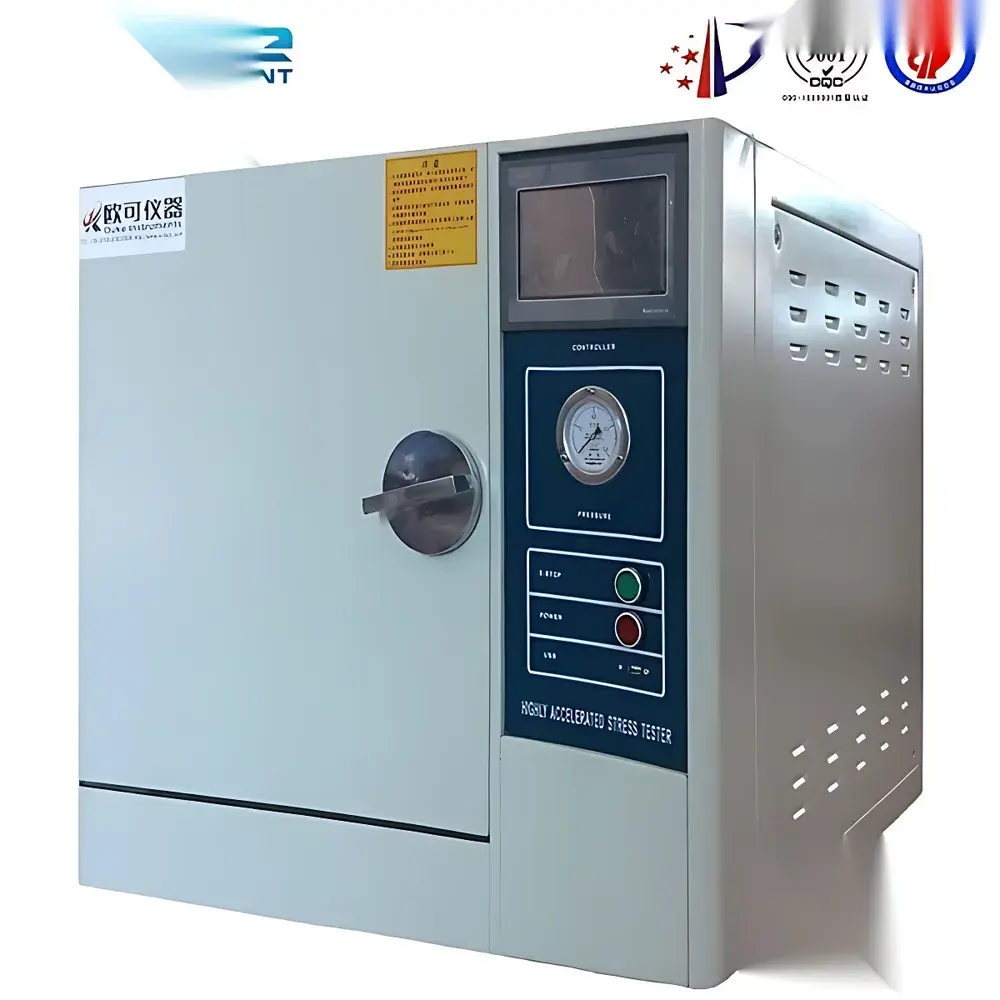
PCT Accelerated Aging Test Chamber (Generic Industrial Grade)
| Brand | Other Brands |
|---|---|
| Origin | Imported |
| Manufacturer Type | General Distributor |
| Price | USD 4,200 (FOB) |
| Temperature Range | 110 °C / 132 °C (saturated steam) |
| Humidity Range | 100 % RH (saturated) |
| Pressure Range | 0.5–2.0 kgf/cm² (max safety capacity: 3.5 kgf/cm²) |
| Time Setting Range | 0–999 h |
| Temperature Uniformity | ±2.0 °C |
| Temperature Ramp Rate | RT to 132 °C in ≤35 min |
| Pressure Ramp Rate | 0 to 2.0 kgf/cm² in ≤40 min |
| Temperature Control Accuracy | ±0.5 °C |
| Temperature Resolution | 0.1 °C |
| Operating Ambient | ≤30 °C, well-ventilated |
Overview
The PCT Accelerated Aging Test Chamber is an industrial-grade pressure cooker-type environmental stress test system engineered for Highly Accelerated Stress Testing (HAST) and Pressure Cooker Test (PCT) protocols. It subjects electronic components, PCB assemblies, semiconductor packages, metallic alloys, and polymeric materials to controlled combinations of elevated temperature, saturated steam humidity, and applied overpressure—conditions that significantly accelerate moisture diffusion and electrochemical degradation mechanisms such as corrosion, delamination, and wire bond failure. Unlike conventional thermal-humidity chambers, this chamber operates exclusively in the saturated steam regime, where temperature and pressure are intrinsically coupled via water’s vapor pressure curve. This thermodynamic constraint ensures reproducible, physics-based aging kinetics aligned with industry-standard reliability models (e.g., Eyring and Peck equations), enabling quantitative lifetime extrapolation under real-world field conditions.
Key Features
- Independent microprocessor-based controller with integrated PID algorithm for simultaneous regulation of saturated steam temperature, chamber pressure, and dwell time
- Dual-sensor feedback loop: high-stability PT100 temperature sensor + calibrated pressure transducer with real-time compensation for steam saturation point deviation
- Robust stainless-steel pressure vessel conforming to ASME BPVC Section VIII Div. 1 design standards, rated for continuous operation up to 2.0 kgf/cm² with 3.5 kgf/cm² burst margin
- Precise thermal uniformity control: ±2.0 °C across working volume per IEC 60068-3-5, verified by 9-point mapping at 132 °C
- Fast thermal and pressure ramp profiles: reaches 132 °C in ≤35 minutes and 2.0 kgf/cm² in ≤40 minutes from ambient, minimizing non-stress preconditioning periods
- Intuitive HMI interface with password-protected parameter locking, event logging, and configurable alarm thresholds for overtemperature, overpressure, and door interlock faults
Sample Compatibility & Compliance
This chamber accommodates standard JEDEC trays (JEDEC J-STD-020, J-STD-033), component carriers, and bare PCBs up to 400 mm × 400 mm × 300 mm (W×D×H). It supports both unsaturated (uHAST) and saturated (sHAST/PCT) test modes per IPC-9708, JEDEC JESD22-A102F, and A110C. The system is fully compliant with international reliability testing standards including ASTM F1876 (Moisture Resistance of Plastic-Encapsulated Microcircuits), ISO 16750-4 (Road Vehicles – Environmental Conditions), IEC 60749-26 (Moisture Sensitivity Level Testing), and MIL-STD-202 Method 108. All operational parameters—including temperature setpoint, pressure setpoint, soak duration, and cycle count—are traceable and auditable to support GLP/GMP documentation requirements.
Software & Data Management
Data acquisition is performed at 1-second intervals and stored internally with timestamped records of actual temperature, absolute pressure, and elapsed test time. Export options include CSV and PDF report generation via USB port. While no proprietary PC software is bundled, raw log files are compatible with third-party statistical analysis platforms (e.g., JMP, Minitab) for Weibull analysis, activation energy calculation, and failure rate modeling. The controller firmware supports audit trail functionality per FDA 21 CFR Part 11 when paired with external validation-compliant data management systems. All calibration constants and sensor offsets are digitally signed and write-protected to prevent unauthorized modification.
Applications
- Qualification testing of plastic-encapsulated ICs prior to tape-and-reel packaging (MSL level verification)
- Process validation for conformal coating adhesion and solder mask integrity under moisture-laden stress
- Comparative reliability screening of lead-free vs. SnPb solder joint architectures
- Corrosion susceptibility assessment of copper-metallized interconnects and aluminum bond wires
- Accelerated life testing of automotive ECUs exposed to under-hood thermal-humidity cycling
- Material compatibility studies for encapsulants, underfills, and molding compounds used in power electronics
FAQ
What distinguishes PCT from standard THB (Temperature-Humidity-Bias) testing?
PCT eliminates air gaps and uses saturated steam at elevated pressure to drive moisture deeper into package interfaces at rates orders of magnitude faster than 85 °C/85 % RH testing—enabling detection of latent defects within hours rather than weeks.
Is calibration certification included with shipment?
A factory-as-tested calibration report (traceable to NIST standards) is provided; on-site ISO/IEC 17025 calibration services are available upon request.
Can the chamber be operated without applied pressure?
No—it is designed exclusively for saturated steam environments; pressure is thermodynamically required to achieve temperatures above 100 °C at atmospheric boiling point.
What maintenance intervals are recommended?
Daily visual inspection of safety valves and door gasket integrity; quarterly verification of pressure transducer linearity and annual replacement of steam trap filter elements.
Does the system meet CE or UKCA marking requirements?
Yes—the electrical architecture complies with EN 61000-6-2/6-4 (EMC) and EN 61010-1 (safety); CE Declaration of Conformity is supplied with delivery documentation.



