
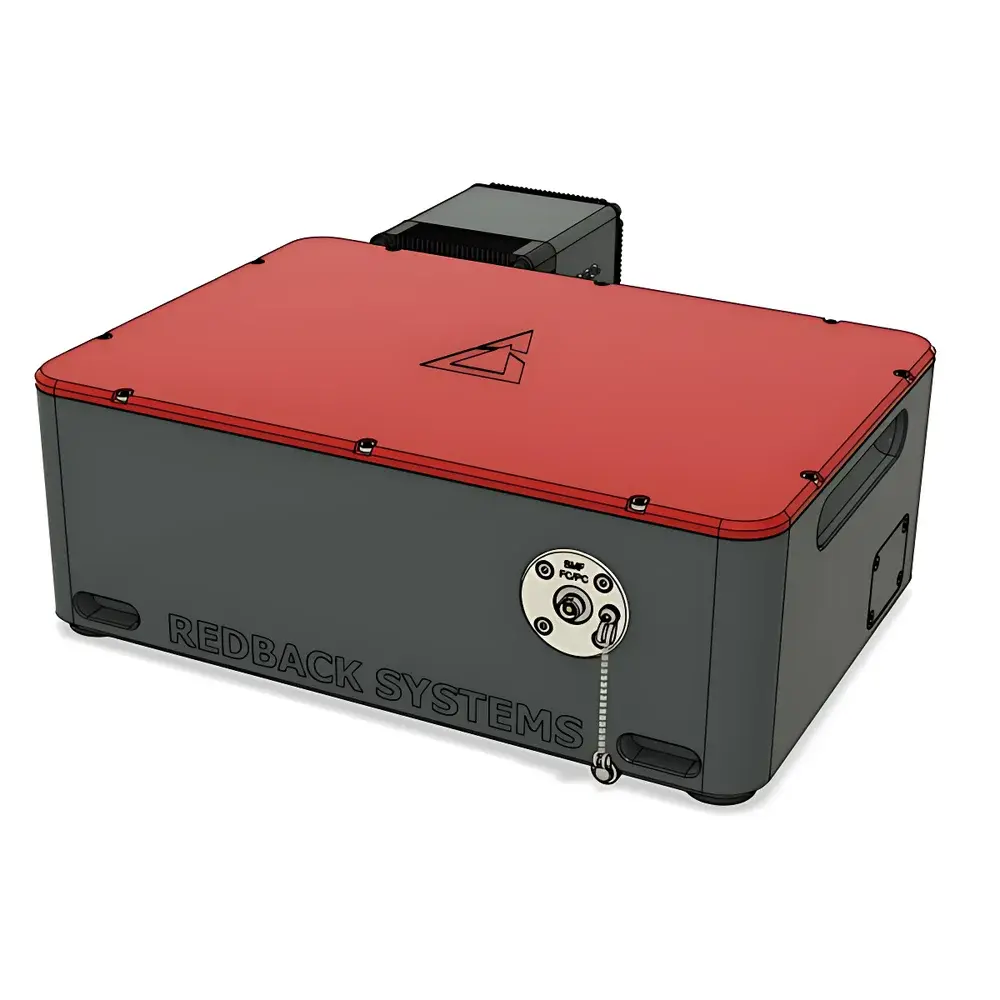
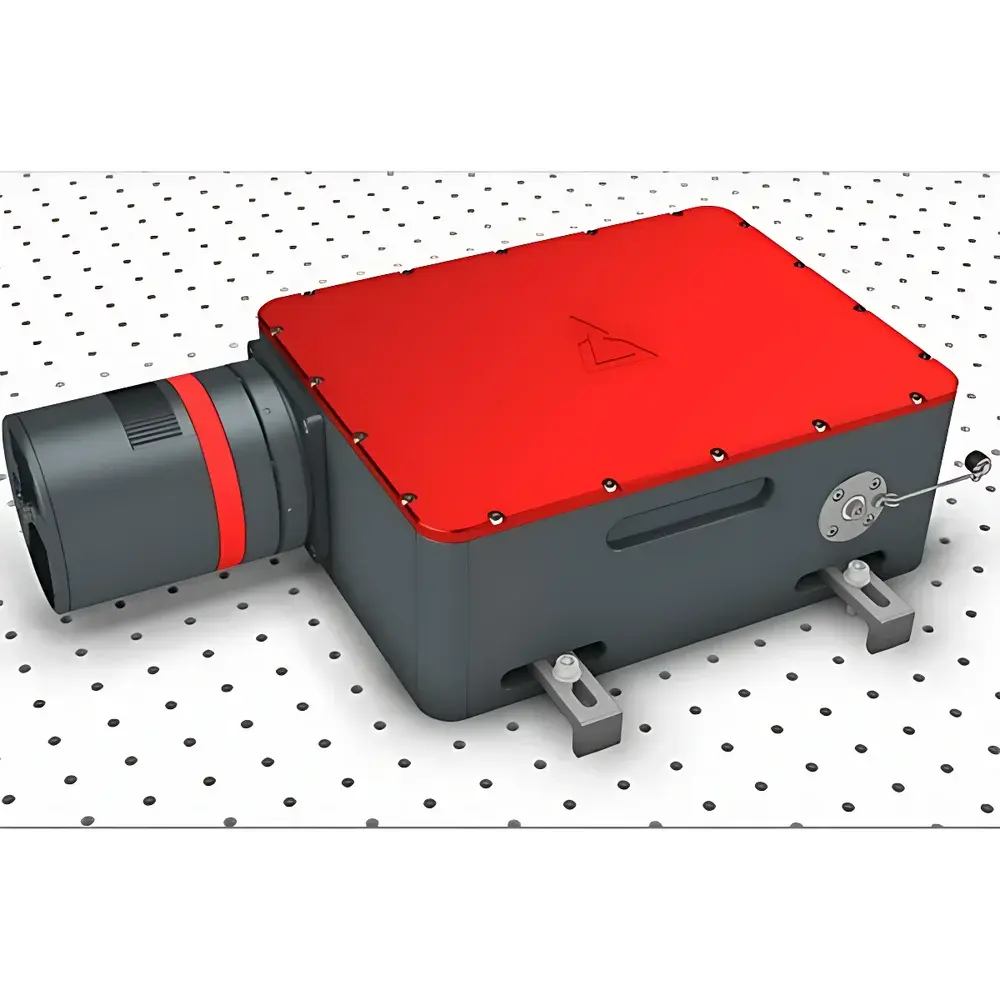
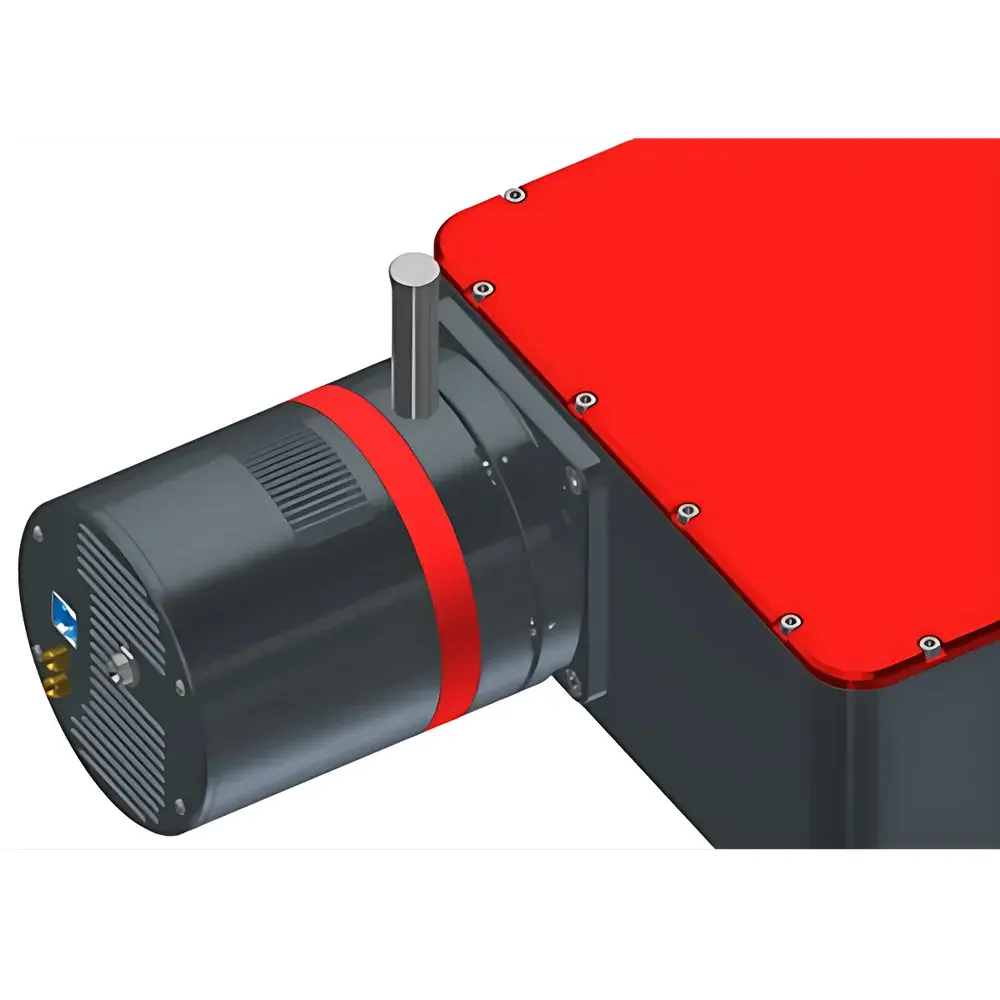
Redback Systems RS40k High-Resolution Echelle Spectrometer
| Brand | Redback Systems |
|---|---|
| Origin | Australia |
| Model | RS40k |
| Spectral Range | 430–950 nm |
| Resolution (R = λ/Δλ) | 44,000–32,000 |
| Wavelength Stability | <5 pm/°C |
| Wavelength Accuracy | <20 pm |
| Input Interface | Single-mode fiber, FC/PC |
| Detector | Cooled sCMOS (Sony STARVIS) |
| Exposure Time | 1–20,000 ms |
| Dark Current | 0.2 e⁻/pixel/s |
| Read Noise | 1.9 e⁻/pixel (rms) |
| Data Acquisition Rate | up to 5 Hz |
| Dimensions (H×W×L) | 105 × 320 × 292 mm |
Overview
The Redback Systems RS40k is a high-resolution echelle spectrometer engineered for precision spectroscopic analysis across the visible and near-infrared (VIS-NIR) spectrum (430–950 nm). Unlike conventional grating monochromators or Czerny-Turner spectrometers, the RS40k employs an echelle diffraction grating architecture coupled with cross-dispersion optics to achieve high spectral resolution without mechanical scanning. This design enables simultaneous detection of the full spectral range in a single exposure — a critical advantage for time-resolved, low-light, or transient signal applications. The instrument leverages a thermoelectrically cooled Sony STARVIS sCMOS sensor, optimized for quantum efficiency in the NIR region and exceptionally low read noise (1.9 e⁻/pixel rms) and dark current (0.2 e⁻/pixel/s), ensuring high signal-to-noise ratio even at sub-second integration times. With resolving power ranging from R = 32,000 to 44,000 — corresponding to ~10–14 pm resolution at 600 nm — the RS40k delivers pm-level wavelength discrimination suitable for atomic line profiling, laser mode structure analysis, and high-fidelity plasma diagnostics.
Key Features
- Full-frame, single-shot spectral acquisition from 430 nm to 950 nm without scanning or moving parts
- Echelle optical layout with fixed alignment and intrinsic thermal stability (wavelength drift <5 pm/°C)
- Cooled sCMOS detector with high QE (>70% at 800 nm), low noise, and linear response over 16-bit dynamic range
- Single-mode fiber input (FC/PC) enabling compatibility with standard fiber-coupled light sources and immunity to polarization-dependent loss
- Compact footprint (105 × 320 × 292 mm) and robust aluminum chassis designed for OEM integration and laboratory benchtop deployment
- No internal motors or adjustable optics — eliminates mechanical hysteresis and long-term calibration drift
Sample Compatibility & Compliance
The RS40k is compatible with a broad class of emission and transmission light sources, including pulsed and CW lasers, hollow-cathode lamps (e.g., Th–Ar), gas discharge tubes (Ne, Na), fluorescence samples, and fiber-based interferometric sensors. Its wide spectral bandwidth and high resolution support compliance with established spectroscopic validation protocols, including ISO/IEC 17025 requirements for spectral calibration traceability. When used with certified Th–Ar lamp standards, the system achieves wavelength accuracy better than ±20 pm — sufficient for verification against NIST-traceable line databases (e.g., NIST Atomic Spectra Database v10.0). While not inherently FDA 21 CFR Part 11–compliant, audit-ready data logging (via timestamped CSV export and metadata tagging in RedSolve) supports GLP/GMP-aligned workflows when deployed in regulated environments such as photonics R&D labs or analytical method development suites.
Software & Data Management
RedSolve — the native control and analysis software — provides a deterministic, low-overhead interface for instrument operation and spectral post-processing. All acquired spectra are saved in plain-text CSV format with no proprietary binary wrappers, ensuring long-term data accessibility and third-party interoperability (e.g., MATLAB, Python, Origin). Key capabilities include real-time preview with live gain/exposure adjustment, user-defined ROI mapping for multi-line tracking, overlay-enabled comparative analysis, and automatic baseline correction using polynomial or asymmetric least squares algorithms. A built-in plotting engine supports dual-axis visualization, spectral normalization, and peak centroiding with sub-pixel interpolation. For automation and integration, RedMote — a documented Python API — exposes full hardware control (exposure, triggering, ROI selection) and raw frame access, enabling synchronization with external devices (e.g., pulse generators, translation stages) and incorporation into custom measurement pipelines. Software licensing is perpetual and royalty-free; no dongles, subscriptions, or activation servers are required.
Applications
- Laser longitudinal mode analysis: Resolving individual cavity modes (<10 pm spacing) in diode, DPSS, and fiber lasers
- Atomic & ionic emission spectroscopy: Identification and quantification of narrow-line emitters (Na D-lines, Th/Ar calibration lines, He I transitions)
- Plasma diagnostics: Doppler-broadened line shape fitting for electron temperature and ion velocity estimation
- Fiber-optic sensing: Interrogation of FBG, LPG, and interferometric sensors via spectral shift detection
- Raman spectroscopy: High-fidelity Stokes/anti-Stokes band separation under low-power excitation
- Fluorescence lifetime correlation: Time-gated spectral acquisition synchronized with TCSPC modules
FAQ
Does the RS40k require wavelength recalibration after thermal cycling?
No. The monolithic echelle optical path and passive thermal management ensure wavelength stability below 5 pm per degree Celsius. Routine recalibration is only recommended after physical shock or fiber connector replacement.
Can the RS40k resolve the sodium D1 and D2 doublet?
Yes. At R ≈ 40,000, the theoretical resolving power separates the 589.5924 nm (D1) and 588.9950 nm (D2) lines by >3.5 pixels on the sCMOS sensor — fully resolvable with Gaussian deconvolution.
Is polarization sensitivity compensated in the optical train?
The RS40k accepts unpolarized or arbitrarily polarized input via single-mode fiber without throughput penalty or spectral distortion — no waveplate or polarization-maintaining fiber is required.
What is the shortest usable exposure time?
The minimum programmable exposure is 1 ms, limited by electronic shutter latency. Sub-millisecond effective integration is achievable using external TTL triggering in gated mode.
How is spectral calibration performed?
Factory calibration uses a stabilized Th–Ar lamp with ≥100 reference lines across 430–950 nm. Users may perform field recalibration using any known multi-line source; RedSolve supports polynomial (up to 5th order) and spline-based wavelength mapping.







