
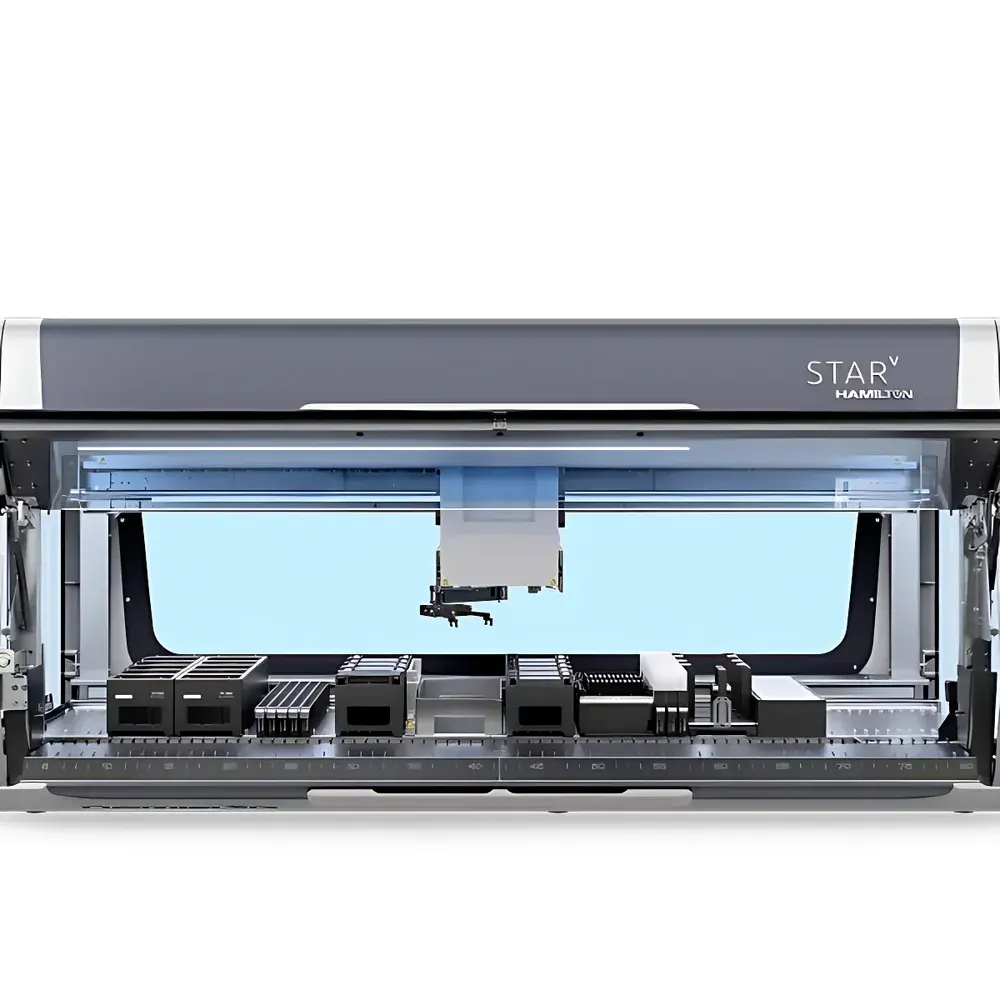
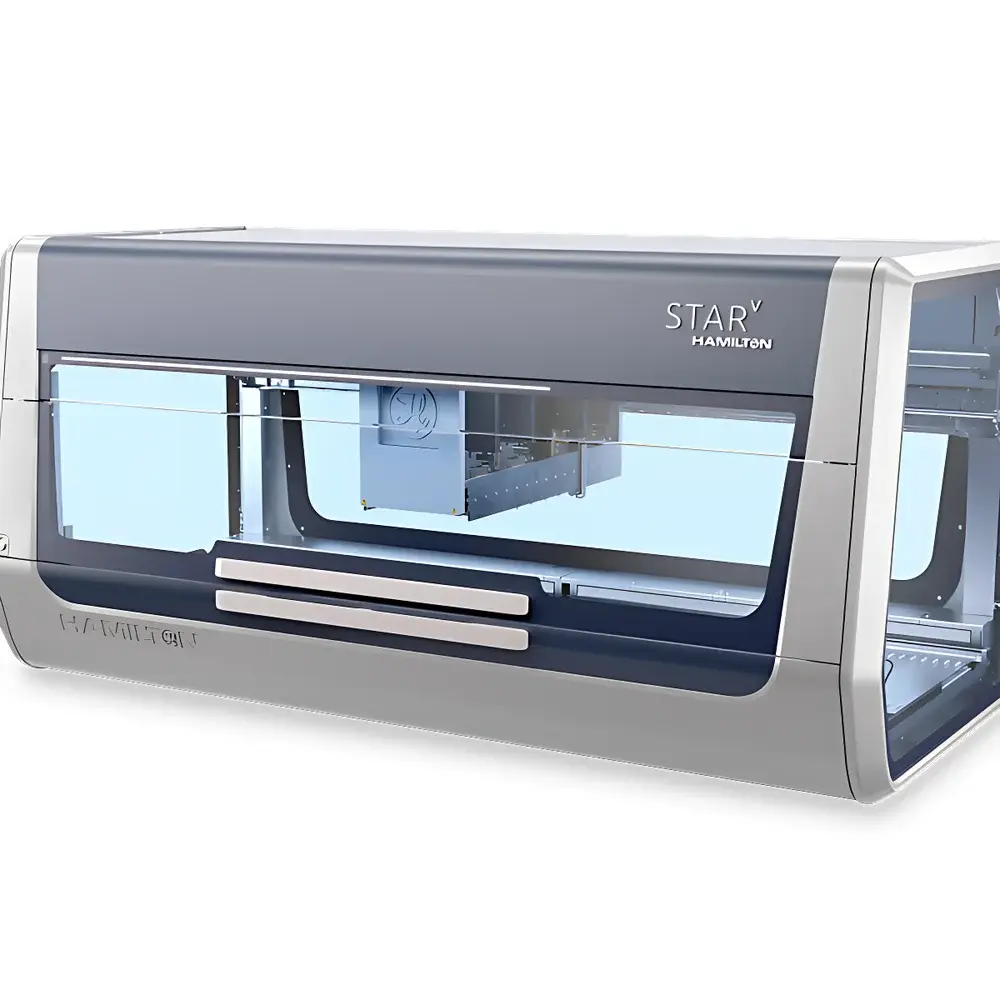
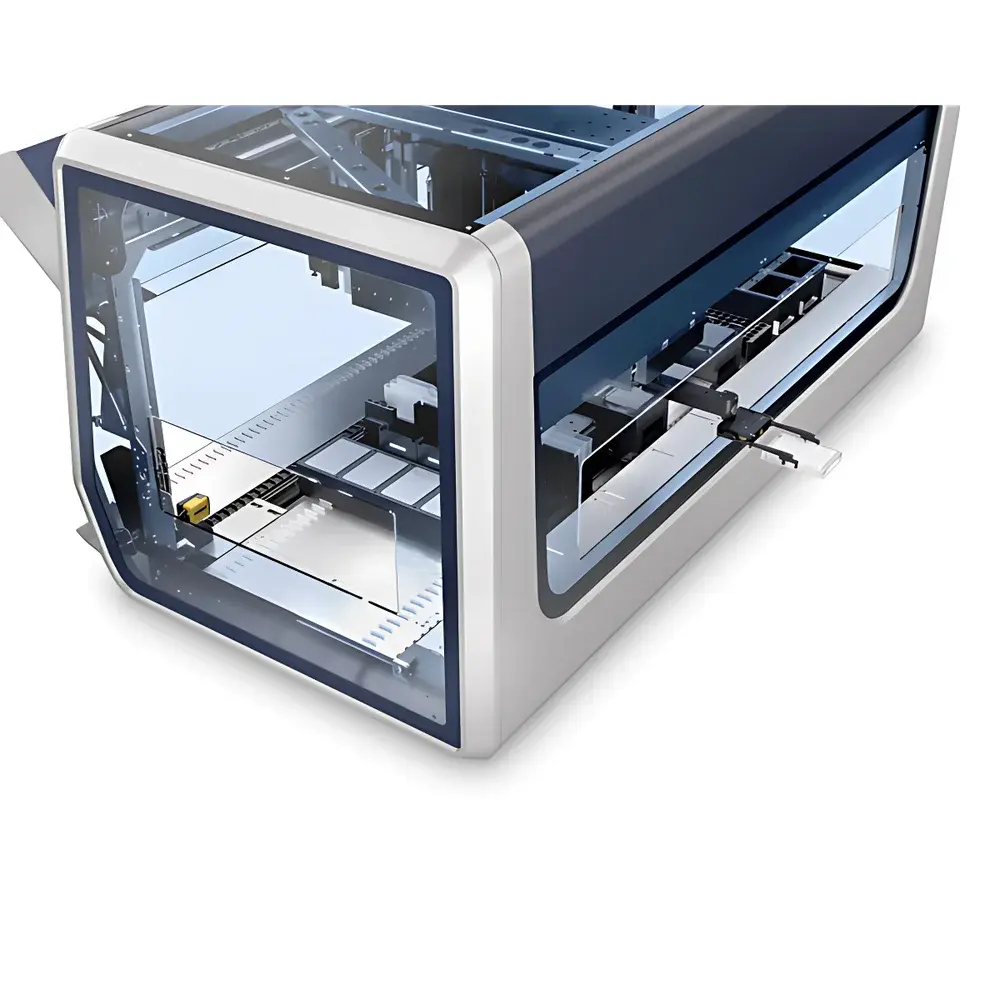
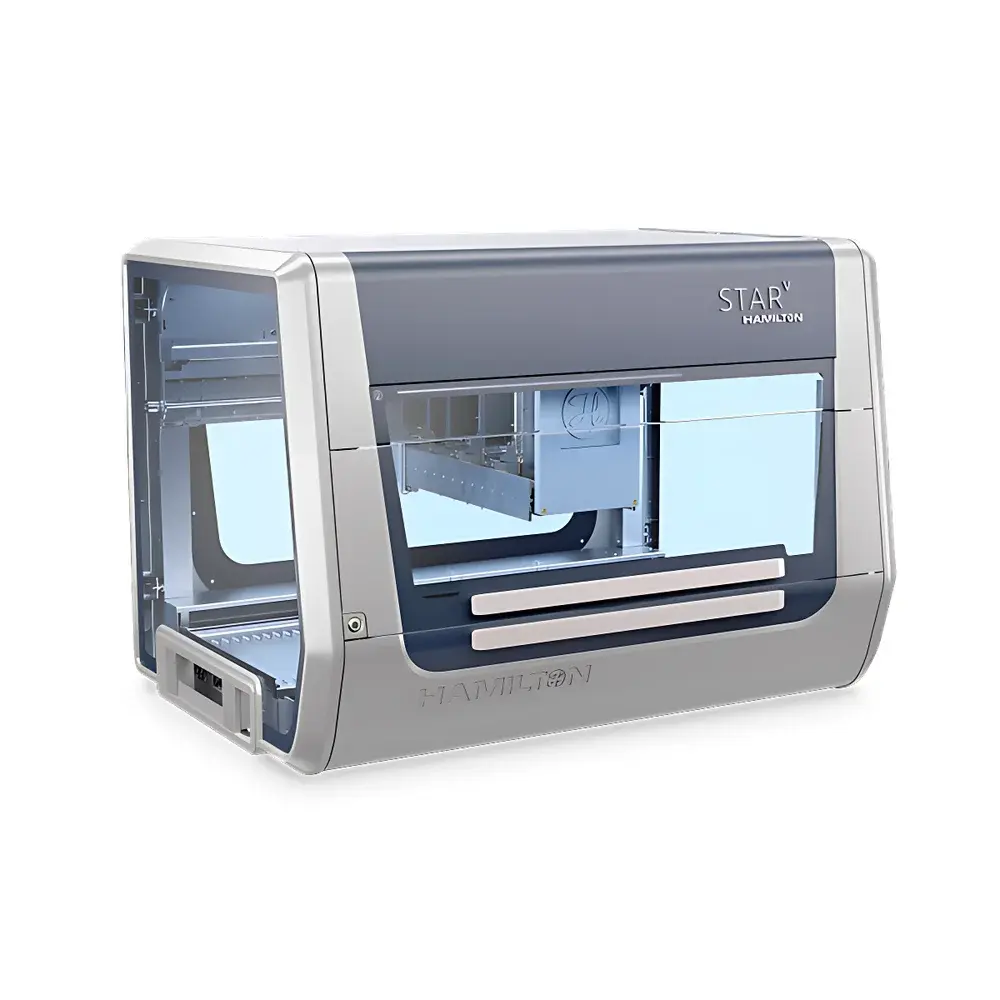
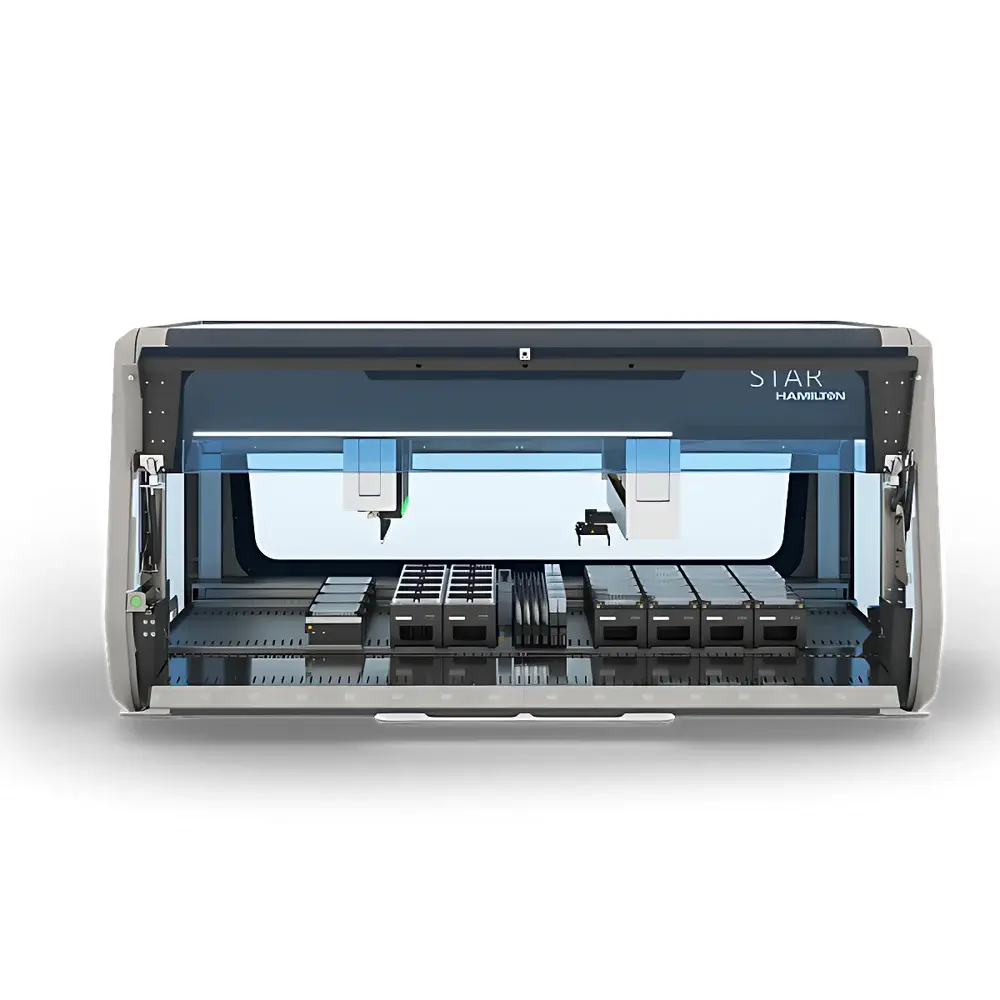
Hamilton Microlab STAR V Automated Liquid Handling Workstation
| Brand | Hamilton |
|---|---|
| Origin | Switzerland |
| Manufacturer Type | Original Equipment Manufacturer (OEM) |
| Import Status | Imported |
| Model | Hamilton ML STAR V |
| Deck Capacity | 35 or 60 positions |
| Pipetting Accuracy | ±1–8% CV |
| Pipetting Range | 0.35–5000 µL |
| Sample Throughput | Up to 384 samples per run |
| Dimensions (W×D×H) | 1010 × 2000 × 1000 mm |
Overview
The Hamilton Microlab STAR V Automated Liquid Handling Workstation is an integrated, modular benchtop platform engineered for precision liquid transfer, assay setup, sample normalization, and high-throughput workflow automation in life science, pharmaceutical, and clinical research laboratories. Built upon Hamilton’s proven CO-RE (Compressed O-Ring Expansion) positive-displacement pipetting technology and synergistic robotic architecture, the STAR V combines the robust dispensing performance of the VANTAGE series with the adaptive deck layout and expandability of the STAR platform. Its core operation relies on air displacement and positive-displacement pipetting modalities—switchable per tip type—to ensure low-volume accuracy (<1 µL) and high-viscosity fluid compatibility without carryover or evaporation artifacts. Designed for reproducible, walk-away automation under GLP/GMP-aligned environments, the system supports fully traceable, audit-ready execution of SOP-driven protocols across diverse assay formats including qPCR, NGS library prep, ELISA, cell-based assays, and compound screening.
Key Features
- Modular 35- or 60-position deck configuration—optimized for flexible integration of standard SBS-format plates, tubes, reservoirs, and auxiliary modules (e.g., thermal cyclers, shakers, readers)
- Single multi-functional robotic arm with independent Z-axis control and interchangeable tool mounts—including CO-RE pipetting channels (1–8 or 96-channel), grippers, barcode scanners, and vacuum manifolds
- True positive-displacement pipetting (0.35–100 µL range) and air-displacement pipetting (100–5000 µL range) within one system—enabling seamless handling of DMSO, glycerol, blood, serum, and viscous reagents
- On-deck calibration and real-time liquid level sensing via capacitive detection—minimizing aspiration errors and supporting dynamic volume adjustment during runs
- Front-, side-, and rear-access design compliant with ISO 15195 and CLSI EP25-A guidelines for laboratory automation integration—facilitating seamless coupling with third-party analyzers, incubators, and storage systems
- Robust mechanical architecture with vibration-damped baseplate and linear motor-driven axes—ensuring positional repeatability < ±0.1 mm over full deck travel
Sample Compatibility & Compliance
The STAR V accommodates a broad spectrum of consumables: 96-well and 384-well microplates (flat, round, V-bottom), PCR strips, tube racks (including 1.5/2.0 mL, 15/50 mL conical), deep-well plates, and custom labware via user-defined coordinate mapping. All liquid handling operations comply with ISO 8655-6 (volumetric accuracy of piston-operated instruments) and support FDA 21 CFR Part 11-compliant electronic signatures and audit trails when deployed with Venus software in validated environments. System validation documentation—including IQ/OQ/PQ templates, risk assessments (per ISO 14971), and traceability matrices—is provided to facilitate GxP compliance for QC labs and regulated biopharma workflows.
Software & Data Management
Controlled exclusively by Hamilton’s Venus software (v4.0+), the STAR V delivers a script-free, drag-and-drop protocol builder with built-in method validation tools, real-time run monitoring, and integrated error recovery logic. Venus supports structured data export in CSV, XML, and SDMX formats, and integrates natively with LIMS (e.g., LabVantage, Thermo Fisher SampleManager) and ELN platforms (e.g., Benchling, LabArchives) via RESTful API and HL7 messaging. Audit trail logs record all user actions, parameter changes, and hardware events with immutable timestamps—meeting ALCOA+ principles (Attributable, Legible, Contemporaneous, Original, Accurate, Complete, Consistent, Enduring, Available). Software updates are delivered through secure, digitally signed packages validated against SHA-256 checksums.
Applications
- High-fidelity nucleic acid library preparation for next-generation sequencing (NGS), including fragmentation, end-repair, A-tailing, adapter ligation, and size selection
- Automated qPCR and digital PCR assay setup with precise serial dilution, master mix dispensing, and plate sealing
- Cell culture workflow automation: media exchange, passaging, viability staining, and compound dosing in 96-/384-well formats
- Pharmaceutical QC testing: dissolution sampling, content uniformity analysis, and stability-indicating assay preparation
- Biobanking operations: sample aliquoting, plate replication, and inventory tracking with 2D barcode verification at every transfer step
- Diagnostic assay development: multiplex immunoassay plate coating, wash cycles, and substrate addition under ambient or temperature-controlled conditions
FAQ
What pipetting technologies does the STAR V support?
It supports both positive-displacement (for volumes ≤100 µL and high-viscosity fluids) and air-displacement (for volumes ≥100 µL) pipetting, selectable per channel and tip type.
Can the STAR V be validated for GMP use?
Yes—Hamilton provides comprehensive validation support packages, including IQ/OQ/PQ protocols, traceability documentation, and 21 CFR Part 11 readiness assessment reports.
Is remote monitoring or troubleshooting possible?
Venus software enables secure remote desktop access (via TLS-encrypted connection) and diagnostic log export for rapid technical escalation—subject to local network security policies.
How is cross-contamination prevented during high-throughput runs?
Through disposable CO-RE tips, automated tip wiping, aspirate/dispense speed optimization, and programmable air-gap dispensing—all configurable per step in Venus.
Does the system support dynamic deck reconfiguration during runtime?
No—deck layout is fixed per protocol; however, Venus allows conditional branching and real-time liquid level feedback to adjust subsequent steps without manual intervention.



