
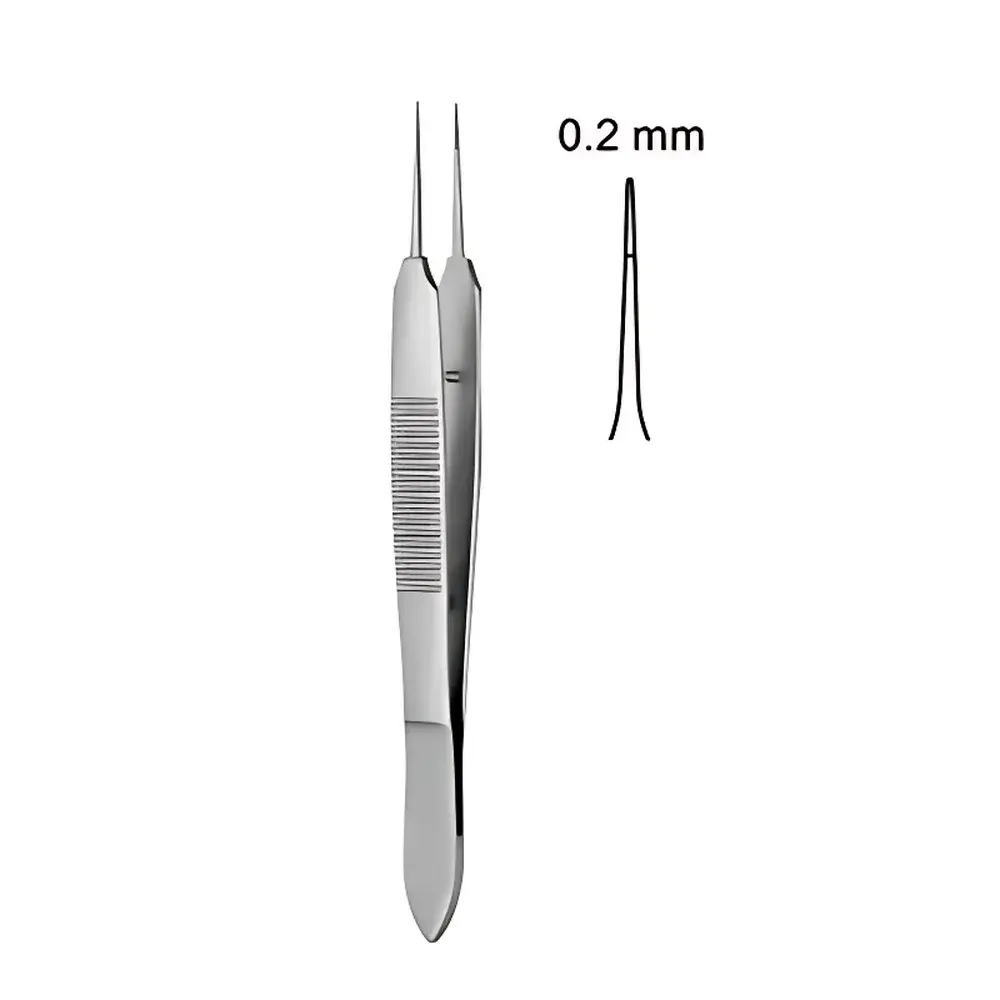
RWD F11008-09 1×2-Tooth Fine-Tip Microforceps, Straight, 0.2 mm Tip Width, 9.5 cm Length
| Brand | RWD |
|---|---|
| Origin | Shenzhen, China |
| Manufacturer Type | Direct Manufacturer |
| Country of Origin | China |
| Model | F11008-09 |
| Price | USD 49.50 (FOB) |
Overview
The RWD F11008-09 is a precision-engineered straight microforceps designed for high-fidelity manipulation of delicate biological specimens, microelectronic components, and thin-film materials in controlled laboratory environments. Constructed from premium-grade stainless steel (AISI 420 or equivalent), this instrument operates on the fundamental mechanical principle of lever-based force amplification with minimal tip deflection—ensuring consistent tactile feedback and sub-millimeter positional control. Its 1×2-tooth configuration features two finely spaced, parallel micro-teeth (pitch ≈ 50 µm) aligned along a 0.2 mm wide flat tip platform, enabling secure yet non-marring engagement of fragile structures such as neural tissue strands, embryonic zebrafish yolk sacs, silicon nanowires, or polymer-coated sensor membranes. With an overall length of 9.5 cm, the forceps balances ergonomic reach with fine motor control—optimized for use under stereo microscopes (7–50× magnification) and within laminar flow hoods or cleanroom ISO Class 5/6 workspaces.
Key Features
- Precision-ground 0.2 mm flat-tip platform with dual 1×2 micro-teeth geometry—engineered to minimize lateral slippage and localized pressure concentration
- Full-length 9.5 cm design with balanced weight distribution (≈12.3 g), supporting extended procedural use without hand fatigue
- Electropolished stainless steel surface finish (Ra < 0.2 µm) compliant with ISO 13485 biocompatibility requirements for non-implantable surgical instrumentation
- Autoclavable up to 134 °C / 2 bar saturated steam (20 min cycle); validated per EN 285 and AAMI ST79 standards
- Tip hardness ≥ 52 HRC, ensuring long-term resistance to edge rounding during repeated contact with glass coverslips, quartz substrates, or ceramic microfluidic chips
Sample Compatibility & Compliance
The F11008-09 is routinely deployed in applications requiring mechanical interaction with samples ranging from live primary neurons (diameter 5–15 µm) to MEMS cantilevers (thickness 1–5 µm) and hydrogel microparticles (20–100 µm diameter). Its non-magnetic construction eliminates interference with SEM/TEM sample stages and MRI-compatible experimental setups. The device meets essential regulatory benchmarks for research-grade instrumentation: it is CE-marked under Directive 2017/746 (IVDR) for in vitro diagnostic ancillary tools, conforms to ISO 7730 ergonomics guidelines for hand tools, and supports GLP-compliant documentation through traceable batch-lot serialization (engraved on proximal shank). While not classified as a medical device for human implantation, its manufacturing quality system is certified to ISO 13485:2016 by TÜV SÜD.
Software & Data Management
As a manual mechanical tool, the F11008-09 does not incorporate embedded electronics or digital interfaces. However, its physical specifications—including tip geometry, material lot number, and calibration history—are fully integrated into RWD’s LabTrack™ digital asset management platform (v3.2+). This cloud-based system enables institutions to maintain audit-ready records for ISO/IEC 17025-accredited testing laboratories, including sterilization logs, usage frequency tracking, and scheduled reconditioning alerts. For facilities operating under FDA 21 CFR Part 11, LabTrack supports electronic signatures, role-based access control, and immutable audit trails—ensuring full traceability from procurement to end-of-life decommissioning.
Applications
- Micromanipulation of dissociated cortical neurons during patch-clamp electrode positioning
- Handling of CRISPR-Cas9 ribonucleoprotein complexes immobilized on gold nanoparticle carriers
- Transfer and alignment of perovskite microplatelets onto photodetector arrays
- Removal of debris from optical fiber end-faces prior to fusion splicing
- Assembly of multi-layer soft lithography masters for microchannel replication
- Ex vivo dissection of Drosophila larval neuromuscular junctions under differential interference contrast (DIC) microscopy
FAQ
Is the F11008-09 compatible with electron microscopy sample preparation workflows?
Yes—the non-magnetic stainless steel composition and absence of polymer coatings prevent charging artifacts; tip cleaning protocols using argon plasma (50 W, 60 sec) are validated for EM-grade residue removal.
What is the recommended sterilization method for repeated use in sterile cell culture procedures?
Autoclaving at 121 °C for 15 minutes is standard; however, for heat-sensitive applications, vaporized hydrogen peroxide (VHP) sterilization (≤30% concentration, 1 hr cycle) maintains tip integrity without compromising tooth sharpness.
Can this forceps be used for gripping silicone elastomer films thinner than 10 µm?
Yes—when operated under 40× microscope magnification with calibrated micromanipulator mounts, the 0.2 mm platform distributes load across ~200 µm² contact area, reducing stress below the yield threshold of PDMS (≈100 kPa).
Does RWD provide metrology certification for individual units?
Upon request, NIST-traceable tip width verification (calibrated via scanning electron microscopy with certified reference standard SRM 2050a) is available as an add-on service with Certificate of Conformance (CoC).




