
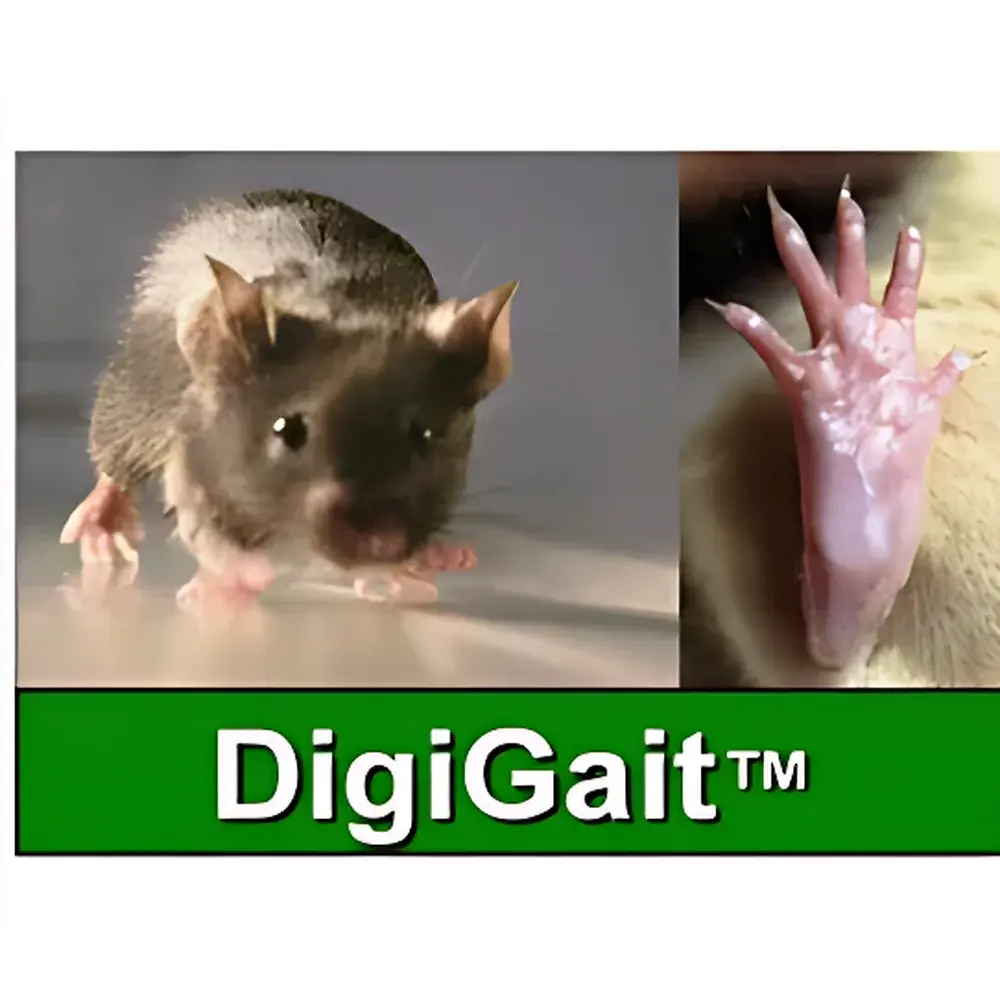
DigiGait™ Rodent Gait Analysis System by Mouse Specifics Inc.
| Origin | USA |
|---|---|
| Manufacturer Type | Authorized Distributor |
| Origin Category | Imported |
| Model | DigiGait™ |
| Pricing | Upon Request |
Overview
The DigiGait™ Rodent Gait Analysis System, engineered by Mouse Specifics Inc. (MSI), is a patented, high-fidelity platform for quantitative, non-invasive gait assessment in small laboratory rodents. Unlike conventional top-down video tracking systems, DigiGait employs an inverted imaging architecture: a high-speed digital camera (150 fps) captures ventral-view footage of animals walking or running on a transparent treadmill belt from beneath the running surface. This optical configuration—combined with proprietary real-time image segmentation algorithms—enables precise, frame-by-frame identification of paw contact geometry, timing, and spatial trajectory relative to the moving belt. The system operates on the principle of dynamic contact photometry: differential reflectance between paw pads and the translucent polymer belt is used to generate binary “digital paw prints” at temporal resolution better than 10 ms. This foundational measurement paradigm ensures objective, operator-independent quantification of locomotor dynamics—critical for preclinical studies of neuromuscular disease, spinal cord injury, peripheral neuropathy, pharmacological intervention, and genetic phenotyping.
Key Features
- Ventral-view high-speed imaging at 150 frames per second with sub-10 ms temporal resolution
- Patented transparent treadmill belt made of durable, cleanable polymer—optimized for traction and optical clarity across walking and sprinting speeds
- Digitally controlled DC motor drive (0–2500 px/s range; 2.5 px/s resolution) eliminates AC-induced speed fluctuation and ensures reproducible locomotor demand
- Adjustable treadmill length (190–1525 px) and incline (real-time angle display) support species- and age-specific protocols—including neonatal mice, rats, guinea pigs, hamsters, and small rabbits
- Integrated dual-source illumination: 25 kHz flicker-free, 5000 K color temperature lighting—ensures consistent contrast under variable ambient light conditions
- No external markers, dyes, or manual annotation required; automated limb segmentation identifies head, tail, and all four paws based on anatomical contrast
- Modular hardware design: aluminum alloy chassis with corrosion-resistant finish and industrial casters for lab-to-lab mobility
- Configurable enclosures (rat- or mouse-specific) constructed from optically clear polycarbonate to minimize motion artifacts and biological interference (e.g., fur, tail drag, fecal contamination)
Sample Compatibility & Compliance
The DigiGait™ system accommodates a broad spectrum of rodent models without modification: C57BL/6, BALB/c, FVB, Sprague-Dawley, Wistar, and transgenic lines—including models with hypopigmentation (e.g., albino, piebald) or hyperkeratosis. Its markerless, contrast-agnostic algorithm adapts dynamically to paw pad pigmentation and surface texture, ensuring data integrity across diverse genetic backgrounds. The system supports GLP-compliant workflows: audit trails, user access controls, and electronic signature capability are embedded in MSI-SOF-DIG software. All hardware components meet IEC 61000-4 electromagnetic compatibility standards, and the illumination system complies with IEC 62471 photobiological safety requirements. While not FDA-cleared as a medical device, DigiGait™ data are routinely cited in peer-reviewed publications adhering to ARRIVE 2.0 guidelines and accepted by regulatory agencies (e.g., EMA, PMDA) for nonclinical locomotor endpoint validation.
Software & Data Management
MSI-SOF-DIG is a Windows-based application built on a deterministic, deterministic image-processing pipeline. It provides a graphical interface for real-time contrast adjustment—enabling optimization of paw-background differentiation without altering acquisition parameters. Each gait cycle is parsed into spatial-temporal events (contact onset/offset, swing phase, stance duration), and over 50 validated gait indices are computed automatically—including stride length, base of support, inter-limb coordination, braking/propulsion ratio, regularity index, and sciatic functional index (SFI). Output formats include CSV, Excel-compatible .xlsx, and HDF5 for integration with MATLAB or Python-based analysis pipelines. Raw video (.avi) and processed metadata are time-stamped and stored with full provenance: operator ID, session date/time, animal ID, treadmill speed, and calibration settings. Software versioning, backup scheduling, and encrypted local storage align with 21 CFR Part 11 requirements for electronic records and signatures when deployed in regulated environments.
Applications
DigiGait™ serves as a primary endpoint tool in translational neuroscience and musculoskeletal research. It is widely applied in longitudinal assessment of disease progression in models of amyotrophic lateral sclerosis (ALS), Parkinson’s disease, multiple sclerosis (MS), Charcot–Marie–Tooth disorder, and Duchenne muscular dystrophy. Its sensitivity to subtle asymmetries enables early detection of unilateral deficits post-stroke or spinal hemisection. In toxicology and pharmacology, it supports dose-response characterization of neuroactive compounds and rehabilitation interventions. The incline-capable platform facilitates metabolic load modulation—making it suitable for studies of fatigue resistance, endurance adaptation, and energy expenditure. Additionally, its passive treadmill mode allows standardized locomotor challenge independent of motivation, while the optional active walkway (MSI-DIG-AMW) extends applicability to voluntary locomotion paradigms.
FAQ
Is DigiGait™ compatible with both mice and rats?
Yes—hardware platforms (MSI-DIG-AM for mice and MSI-DIG-AR for rats) are optimized for species-specific dimensions, but the same software and analytical framework apply across models.
Does the system require animal training or acclimation?
Minimal habituation is recommended (typically 1–2 short sessions), but no forced training is necessary; the passive treadmill design reduces stress-related locomotor artifacts.
Can data be exported for third-party statistical analysis?
Yes—time-series gait metrics and event logs export directly to CSV and Excel formats; raw video and metadata are archived in open, non-proprietary containers.
How is calibration performed?
A single-point pixel-to-millimeter calibration is conducted using a precision grid placed on the treadmill surface; calibration persists across sessions unless hardware configuration changes.
What maintenance does the system require?
Routine cleaning of the transparent belt with ethanol or isopropanol; annual verification of motor speed accuracy and illumination intensity is recommended for ISO/IEC 17025-aligned labs.






