
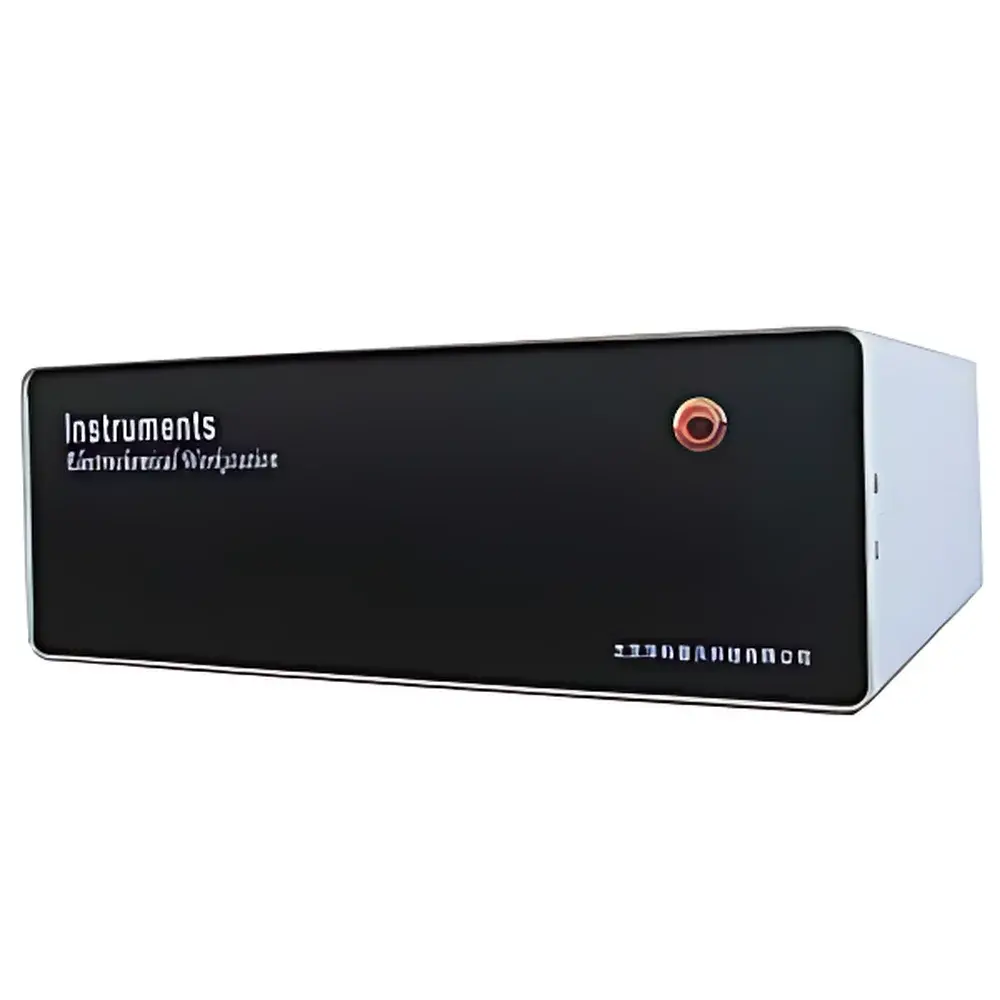
QCM-400 Electrochemical Quartz Crystal Microbalance System
| Origin | Beijing, China |
|---|---|
| Manufacturer Type | Authorized Distributor |
| Origin Category | Domestic (China-made) |
| Model | QCM-400 |
| Price Range | USD 2,800 – 7,000 |
| Potentiostat/Galvanostat | Model 440C |
| Potential Range | ±10 V |
| Potential Resolution | ±12.12 µV |
| Electrode Configuration | 3-electrode, 4-electrode, or dual 4-electrode mode |
| Current Range | 10 nA to 100 mA (full-scale, auto-ranging) |
Overview
The QCM-400 Electrochemical Quartz Crystal Microbalance System is an integrated instrumentation platform engineered for real-time, in situ monitoring of mass changes at electrode interfaces during electrochemical processes. It combines a high-stability 5 MHz AT-cut quartz crystal sensor with a precision potentiostat/galvanostat (Model 440C) to simultaneously acquire electrochemical signals (cyclic voltammetry, chronoamperometry, impedance spectroscopy) and nanogram-level mass shifts via the Sauerbrey relationship (Δf ∝ Δm). This dual-modality architecture enables quantitative correlation between charge transfer and interfacial mass accumulation—critical for studying redox-driven polymer deposition, ion insertion in battery materials, adsorption/desorption kinetics of biomolecules, and corrosion inhibitor film formation. The system operates on the principle of piezoelectric resonance frequency shift detection, where a change of 1 Hz corresponds to approximately 1.67 ng/cm² mass change on a standard 5 MHz crystal (assuming rigid, uniformly distributed film and Sauerbrey conditions).
Key Features
- Integrated electrochemical workstation with built-in potentiostat/galvanostat (Model 440C), supporting CV, LSV, CA, CP, EIS, and pulse techniques
- High-resolution frequency measurement: ±0.1 Hz stability over 60 s (typical), enabling sub-nanogram mass sensitivity
- Flexible electrode configuration: configurable 3-electrode, 4-electrode, or dual 4-electrode setups for uncompensated resistance correction and current distribution control
- Dual-channel data acquisition: synchronized time-stamped recording of frequency shift (Δf), dissipation (ΔD, optional with QCM-D upgrade), potential (E), current (I), and charge (Q)
- Temperature-stabilized crystal holder with Peltier-based thermal control (±0.1 °C accuracy) to minimize thermal drift during long-term experiments
- Rugged, shielded design compliant with laboratory electromagnetic compatibility (EMC) standards (IEC 61326-1)
Sample Compatibility & Compliance
The QCM-400 accommodates standard 14 mm diameter quartz crystals with gold, platinum, or carbon working electrodes; custom-coated crystals (e.g., ITO, PEDOT:PSS, SAM-functionalized Au) are fully supported. Liquid-phase measurements are performed in standard electrochemical cells (e.g., three-neck Pyrex cells, microfluidic flow cells, or custom-designed thin-layer cells). Solid-state thin-film studies—including Li-ion cathode/anode materials under inert atmosphere—are feasible using glovebox-integrated cell adapters. The system meets essential regulatory expectations for research-grade instrumentation: raw data files include full metadata (timestamp, instrument ID, operator, method parameters), supporting GLP-compliant documentation. While not certified for GMP production environments, its audit trail functionality (user login, parameter change logs, data export history) aligns with FDA 21 CFR Part 11 principles for electronic records in academic and industrial R&D settings.
Software & Data Management
Control and analysis are executed via QCM-Studio v3.x—a Windows-based application featuring modular experiment wizards, real-time dual-axis plotting (f vs. t and E vs. I), and batch processing for multi-run comparative analysis. All acquired datasets are saved in open-format HDF5 containers, ensuring long-term readability and third-party interoperability (e.g., Python pandas, MATLAB, OriginLab). Software includes built-in Sauerbrey and Voigt-model fitting tools for viscoelastic correction, as well as automated baseline drift compensation algorithms. Export options include CSV, ASCII, and image (PNG/SVG); no proprietary lock-in or subscription licensing applies. Firmware updates are delivered via secure HTTPS download with SHA-256 checksum verification.
Applications
- Electropolymerization kinetics and film growth modeling of polyaniline, polypyrrole, and PEDOT derivatives
- In situ quantification of Li⁺/Na⁺ intercalation mass changes in layered oxide and alloy anodes
- Real-time binding affinity and dissociation rate analysis of antibody–antigen or DNA hybridization on functionalized surfaces
- Corrosion science: evaluation of passivation layer formation, inhibitor efficiency, and localized pitting onset
- Electrocatalyst stability assessment under CO₂ reduction or oxygen evolution reaction (OER) conditions
- Hydrogel swelling/deswelling dynamics under potentiostatic stimulation
FAQ
What crystal frequencies are supported?
The QCM-400 is optimized for 5 MHz fundamental-mode AT-cut quartz crystals; optional configurations support 10 MHz crystals for enhanced mass resolution (subject to hardware revision and firmware update).
Can the system perform simultaneous QCM and EIS measurements?
Yes—frequency and impedance spectra are acquired in alternating sequence within a single experiment protocol, with phase-synchronized triggering to ensure temporal alignment.
Is third-party software integration possible?
The instrument provides documented TCP/IP and DLL-based APIs for LabVIEW, Python (PySerial/pyQCM), and MATLAB, enabling custom automation and hybrid experimental workflows.
Does the system comply with ISO/IEC 17025 requirements for calibration traceability?
While the QCM-400 itself is not a calibrated reference standard, its frequency counter module is factory-traceable to NIST-calibrated oscillators; users may perform periodic verification using certified quartz standards (e.g., NIST SRM 1910).
What maintenance is required for long-term stability?
Annual verification of crystal holder contact resistance (< 0.5 Ω) and potentiostat offset calibration is recommended; no consumable parts require replacement under normal operation.





