
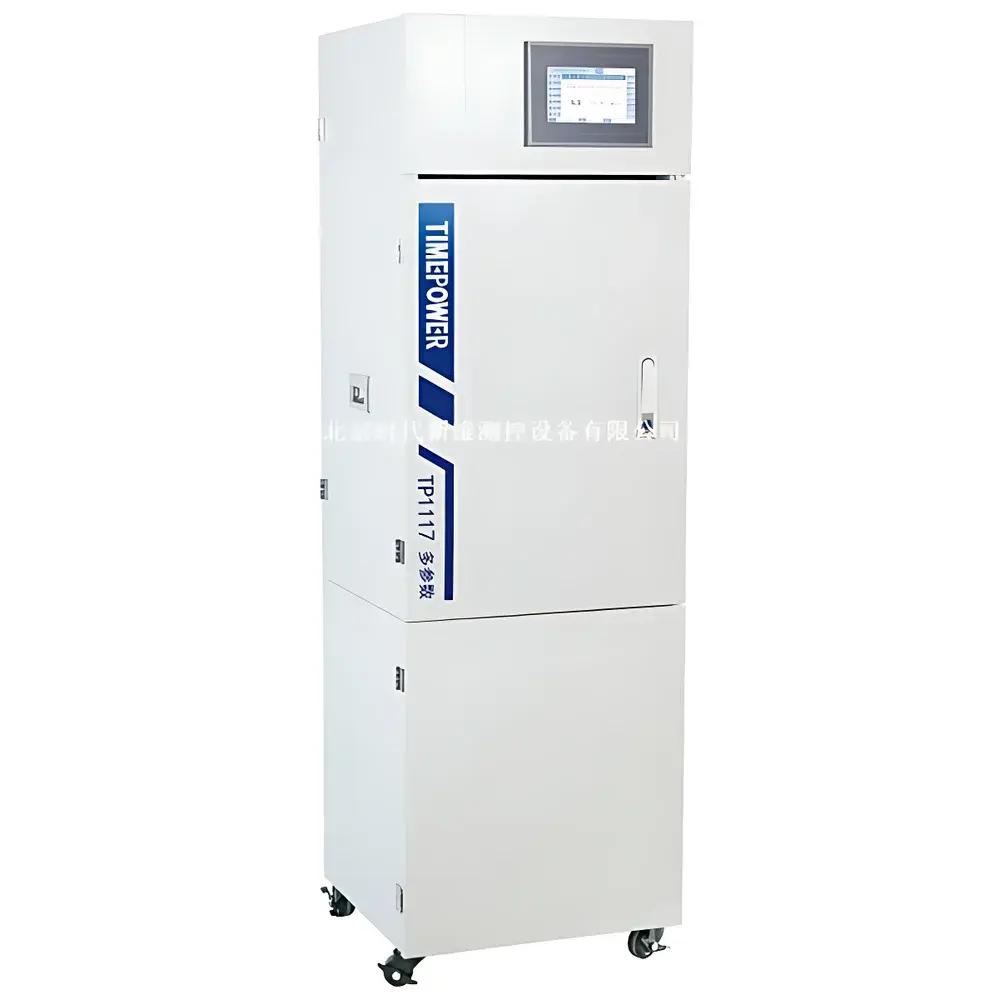
TimePower TP1117 Multi-Parameter Online Water Quality Analyzer
| Brand | TimePower |
|---|---|
| Origin | Beijing, China |
| Manufacturer Type | Manufacturer |
| Country of Origin | Domestic (China) |
| Model | TP1117 |
| Instrument Type | Laboratory & Online Water Quality Analyzer |
| Measurable Parameters | Dissolved Oxygen (DO), Electrical Conductivity (EC), Turbidity, pH, Oxidation-Reduction Potential (ORP), Chlorophyll-a, Oil-in-Water, Ammonia-Nitrogen (NH₃-N) |
| Sensor Interface | RS485 with MODBUS RTU protocol |
| Probe Configuration | Up to 6 digital sensor inputs (simultaneous 7-parameter measurement) |
| Calibration Data Storage | Embedded in each smart sensor |
| Environmental Rating | IP68 submersible housing |
| Cleaning System | Integrated automatic mechanical wiper and air-pulse anti-fouling module |
| Compliance | Designed for ASTM D3370, ISO 5814 (DO), ISO 7888 (EC), ISO 7027 (Turbidity), USP <643>, EPA Method 180.1 (pH), GLP-compliant data logging architecture |
Overview
The TimePower TP1117 Multi-Parameter Online Water Quality Analyzer is an engineered platform for continuous, high-reliability monitoring of critical physicochemical and biological water quality indicators in surface water, wastewater, industrial effluent, groundwater, and marine environments. Built upon a modular digital sensor architecture, the analyzer employs standardized RS485 communication with MODBUS RTU protocol to interface with calibrated, intelligent probes—each storing its own calibration coefficients, serial identity, and sensor-specific metadata. Its core measurement principles include luminescence-based dissolved oxygen detection (ASTM D3370 compliant), four-electrode conductivity measurement (eliminating polarization error across wide salinity ranges), near-infrared fiber-optic turbidity sensing (ISO 7027 alignment), solid-state digital pH and ORP electrodes with temperature compensation, and fluorometric detection for chlorophyll-a and hydrocarbon-based oil-in-water quantification. The system operates without reagents and requires no consumables beyond routine probe maintenance, making it suitable for unattended deployment in remote or harsh field conditions.
Key Features
- Modular digital probe architecture supporting up to six concurrently connected sensors—enabling simultaneous measurement of seven parameters (e.g., DO, EC, turbidity, pH, ORP, temperature, plus one optional parameter such as chlorophyll-a or ammonia-nitrogen)
- Smart sensor design: Each probe contains non-volatile memory storing factory calibration data, user calibration history, serial number, and manufacturing traceability—ensuring metrological continuity during field replacement
- Integrated anti-fouling system combining programmable mechanical wiper motion and pulsed air injection to suppress biofilm formation, remove sediment adhesion, and eliminate microbubble interference on optical and electrochemical surfaces
- IP68-rated stainless-steel and POM housing rated for continuous submersion up to 10 m depth; operating temperature range: 0–50 °C
- Onboard data logger with configurable sampling intervals (1 min to 24 h), local SD card storage (up to 32 GB), and timestamped audit trails compliant with GLP requirements
- RS485/Modbus RTU output enables seamless integration into SCADA systems, PLC networks, or cloud-based telemetry platforms without proprietary gateways
Sample Compatibility & Compliance
The TP1117 is validated for use across diverse aqueous matrices including freshwater rivers and lakes, municipal and industrial wastewater streams, estuarine and coastal seawater, and shallow aquifer groundwater. Its sensor suite meets international method equivalency standards: dissolved oxygen via luminescent quenching (ISO 5814, ASTM D3370), conductivity via four-electrode cell (ISO 7888), turbidity via 90° NIR scattering (ISO 7027), and pH/ORP per USP and EPA Method 180.1. All firmware and data handling routines support ALCOA+ principles (Attributable, Legible, Contemporaneous, Original, Accurate, Complete, Consistent, Enduring, Available) for regulated environmental monitoring applications. Optional configurations support 21 CFR Part 11-compliant electronic signatures when paired with validated third-party software platforms.
Software & Data Management
The analyzer supports dual-mode data acquisition: local real-time display via optional 4.3″ touchscreen HMI (with graphical trend visualization), and remote access via Modbus TCP bridge or cellular telemetry module. Raw sensor values are transmitted as scaled engineering units (e.g., mg/L, µS/cm, NTU, pH) with embedded uncertainty metadata. Internal logging includes sensor diagnostics (impedance checks, signal noise ratio, cleaning cycle logs), environmental timestamps with NTP synchronization capability, and event-triggered alerts (e.g., calibration due, fouling threshold exceeded, out-of-range deviation). Export formats include CSV and XML, both structured to align with WQX (Water Quality Exchange) schema for direct ingestion into EPA STORET or national water information systems.
Applications
- Real-time compliance monitoring at wastewater treatment plant influent, effluent, and sludge dewatering lines
- Ecological assessment of eutrophication dynamics through concurrent DO, chlorophyll-a, turbidity, and nutrient surrogate (ammonia-N) tracking
- Industrial process water surveillance in power generation, pharmaceutical manufacturing, and food & beverage facilities
- Long-term ambient monitoring in river basins and reservoirs under national water quality assessment programs
- Early warning detection of accidental discharges or algal bloom onset using multi-parameter anomaly correlation algorithms
- Calibration reference station support for distributed low-cost sensor networks via high-accuracy anchor node functionality
FAQ
Does the TP1117 require annual recalibration of its internal electronics?
No—the analyzer’s signal conditioning circuitry is factory-calibrated and drift-stabilized; only individual smart sensors require periodic verification or recalibration per their respective ISO/ASTM protocols.
Can the system operate autonomously for extended periods without manual intervention?
Yes—when powered by solar-charged battery banks and equipped with the optional cellular telemetry module, the TP1117 supports fully autonomous operation for >6 months between maintenance cycles.
Is sensor cross-sensitivity compensated in firmware?
Yes—temperature-compensated algorithms are embedded per sensor type (e.g., EC compensation for pH drift, DO temperature/pressure correction), and multi-sensor correlation matrices are available for advanced data fusion in post-processing.
What cybersecurity measures are implemented for remote data transmission?
Modbus TCP traffic supports TLS 1.2 encryption when routed through enterprise-grade firewalls; local RS485 communication is electrically isolated and inherently non-networked.
Are replacement sensors certified to the same metrological standards as original units?
All TimePower-branded digital sensors undergo individual NIST-traceable calibration prior to shipment and include a certificate of conformance with uncertainty budgets aligned to ISO/IEC 17025 laboratory practices.







