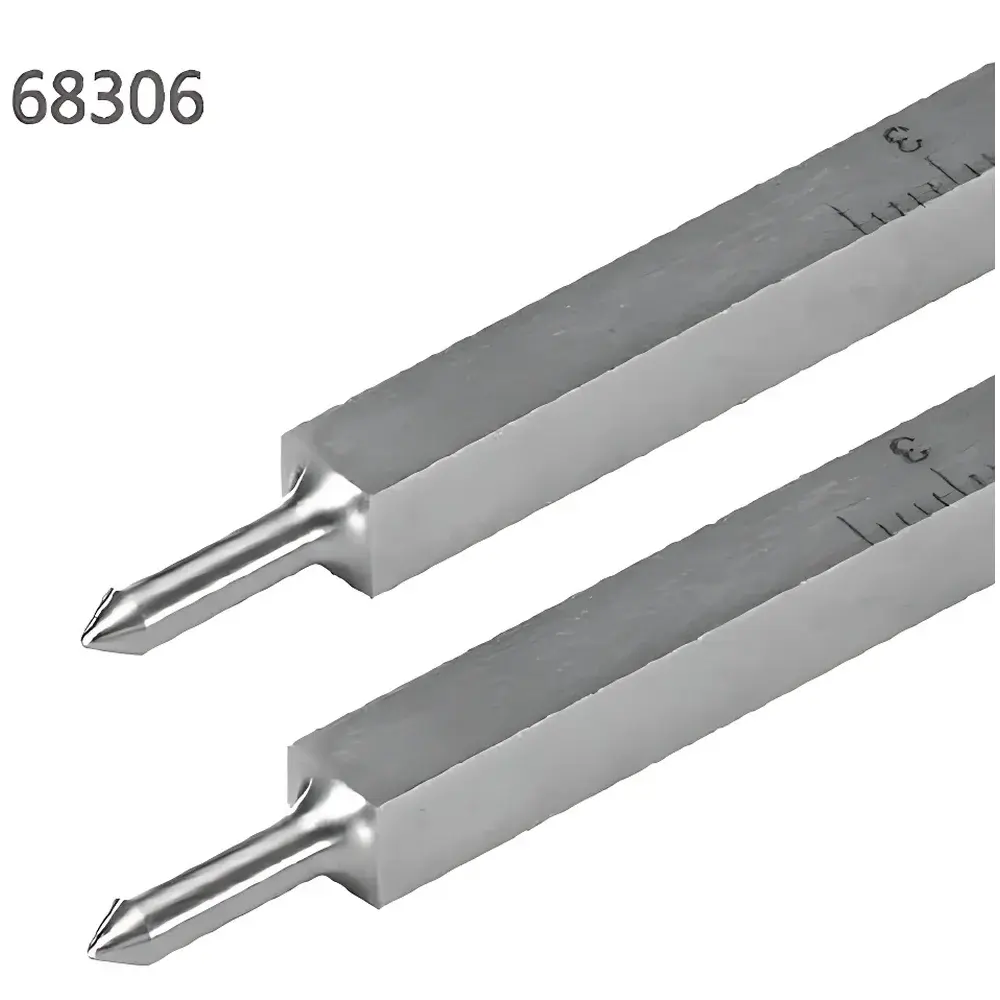
RWD 68301 Rat Ear Bar for Stereotaxic Instrument
| Brand | RWD |
|---|---|
| Origin | Shenzhen, China |
| Manufacturer Type | Direct Manufacturer |
| Product Category | Domestic (China-Made) |
| Model | 68301 |
| Pricing | Available Upon Request |
| Angular Orientation | 18° |
| Tip Radius | 0.8 mm |
| Graduation Scale | 1 mm Resolution |
| Compatibility | Designed for rat skull fixation with stereotaxic frames |
| Optional Variants | 68302 (45° solid), 68305 (45° hollow, 1.0 mm front / 3.0 mm rear bore, acoustic stimulus delivery), 68060 (external stabilization base) |
Overview
The RWD 68301 Rat Ear Bar is a precision-engineered component of the RWD stereotaxic instrument system, specifically designed for secure, reproducible, and low-trauma immobilization of rat heads during neurosurgical, electrophysiological, or behavioral neuroscience procedures. It operates on the biomechanical principle of bilateral auditory canal engagement—leveraging the anatomical geometry of the rat temporal bone to achieve rigid three-point fixation (two ear bars + incisor bar) within the stereotaxic frame. The 18° angular orientation and 0.8 mm tip radius are empirically optimized to align with the natural curvature of the rat external auditory meatus, minimizing insertion force and reducing risk of tympanic membrane perforation or cartilage deformation. Unlike generic or non-graduated ear bars, the 68301 features laser-etched millimeter-scale graduations along its shaft, enabling real-time depth monitoring during bilateral placement—a critical factor for symmetry verification and inter-hemispheric coordinate consistency in stereotactic targeting.
Key Features
- Calibrated 1 mm graduation scale for precise, repeatable depth control during bilateral ear bar insertion
- 18° angled tip geometry matched to rat auditory canal anatomy for low-resistance entry and stable anchoring
- 0.8 mm spherical tip radius—engineered to distribute contact pressure across the medial surface of the auditory bulla, preventing focal stress concentration
- Stainless steel construction (AISI 316L grade) with electropolished finish ensuring biocompatibility, corrosion resistance, and autoclavability (up to 134°C, 21 psi, 18 min)
- Interchangeable compatibility with RWD 68000-series stereotaxic frames and universal ear bar adapters (e.g., 68060 auxiliary support base)
- Modular design supporting parallel use with complementary variants: 68302 (45° solid, for high-stability craniotomy), 68305 (45° hollow, ISO/IEC 17025-aligned acoustic calibration port for auditory evoked potential studies)
Sample Compatibility & Compliance
The 68301 is validated for use with Sprague-Dawley, Wistar, and Long-Evans rats weighing 200–500 g. Its mechanical interface conforms to the DIN 32975 standard for stereotaxic accessory mounting interfaces, ensuring interoperability with third-party manipulators and microdrive systems. All materials comply with ISO 10993-5 (cytotoxicity) and ISO 10993-10 (irritation/sensitization) requirements. Device traceability includes batch-specific sterilization validation records and material certification per EN 10204 3.1. No animal testing was conducted during product development; design validation followed OECD TG 407 (repeated dose 28-day oral toxicity) reference thresholds for stainless steel leachables.
Software & Data Management
As a mechanical positioning component, the 68301 does not incorporate embedded electronics or firmware. However, it integrates seamlessly into digital stereotaxic workflows via RWD’s NeuroLab Suite v4.2+ software platform. When used with RWD 68500-series digital manipulators, insertion depth data from the graduated scale can be manually logged into the procedure metadata module, supporting GLP-compliant audit trails. The system supports export of structured XML logs compliant with NIH BIDS (Brain Imaging Data Structure) extension for electrophysiology metadata, facilitating alignment with FAIR (Findable, Accessible, Interoperable, Reusable) data principles.
Applications
- Intracranial cannula implantation for chronic microdialysis or optogenetic fiber optic delivery
- Stereotactic injection of viral vectors, tracers, or pharmacological agents into subcortical nuclei (e.g., VTA, SNc, BLA)
- Chronic electrode array implantation for in vivo single-unit or local field potential recording
- Craniotomy stabilization during two-photon imaging or intrinsic signal optical mapping
- Acoustic stimulation paradigms using the 68305 hollow variant under controlled sound-pressure-level (SPL) conditions per ANSI S3.6-2018
- High-throughput behavioral assays requiring consistent head alignment across cohorts (e.g., conditioned place preference, fear extinction)
FAQ
Is the 68301 compatible with non-RWD stereotaxic frames?
Yes—its standardized 8 mm outer diameter and M6 threaded mounting interface comply with ISO 80601-2-62 mechanical interchangeability guidelines for neurosurgical accessories.
What is the recommended torque for tightening the ear bar adapter?
Maximum torque: 0.45 N·m. Exceeding this may deform the aluminum alloy adapter housing and compromise angular repeatability.
Can the 68301 be resterilized after use?
Yes—validated for ≥50 cycles of saturated steam sterilization at 134°C (21 psi, 18 min) without degradation of graduation legibility or dimensional stability.
How does the 1 mm graduation improve surgical accuracy?
It enables real-time bilateral depth matching—critical for eliminating yaw-axis rotation error that propagates as >150 µm coordinate deviation at 4 mm ventral target depth in bregma-referenced atlases.
Does RWD provide installation training or SOP documentation?
Yes—comprehensive bilingual (English/Chinese) SOPs, video-guided setup protocols, and IACUC-compliant animal positioning checklists are provided with all instrument shipments and accessible via RWD’s secure customer portal.