
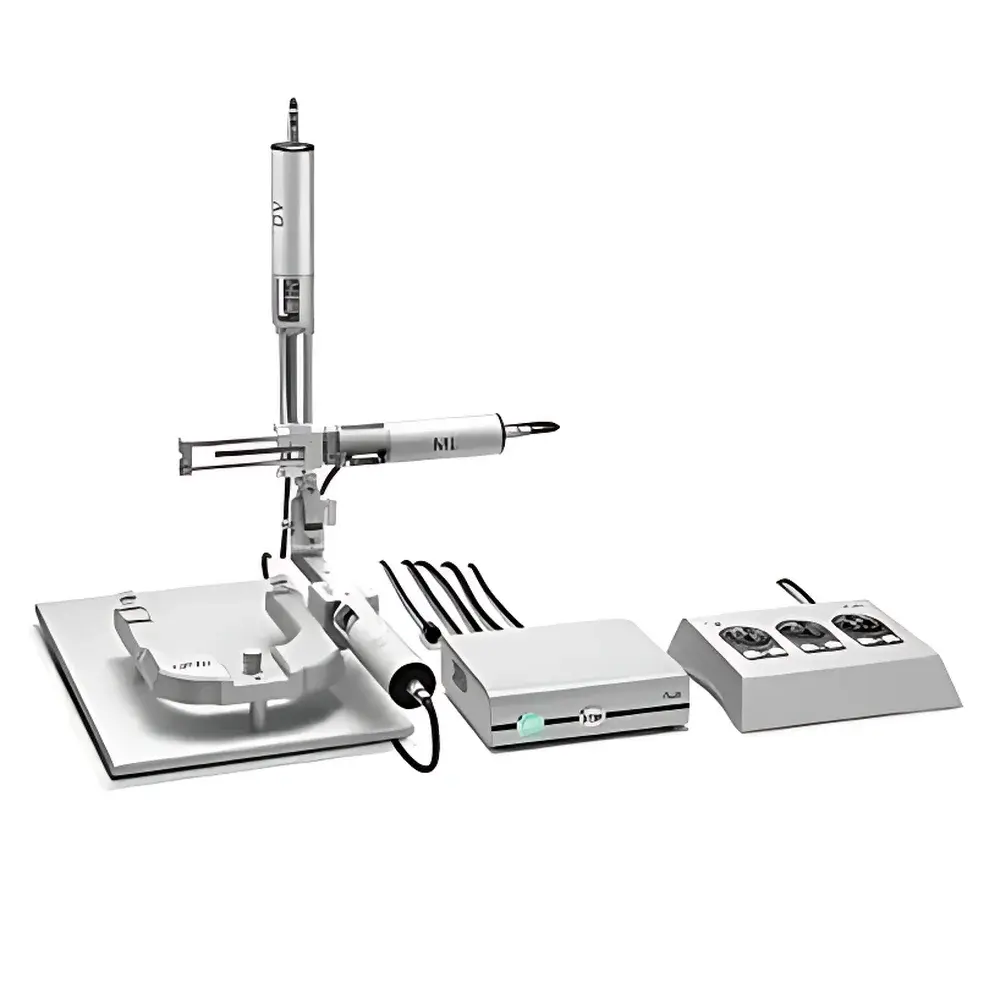
RWD 71000 Automated Stereotaxic Instrument for Rodents (Rat & Mouse)
| Brand | RWD |
|---|---|
| Origin | Guangdong, China |
| Manufacturer Type | Direct Manufacturer |
| Region of Origin | Domestic (China) |
| Model | 71000 |
| Pricing | Upon Request |
Overview
The RWD 71000 Automated Stereotaxic Instrument is an electromechanically integrated neurosurgical platform engineered for high-precision intracranial interventions in laboratory rodents. It operates on the principle of stereotactic coordinate navigation—leveraging the standardized anatomical reference frame defined by the bregma–lambda line and interaural axis—to enable reproducible targeting of submillimeter brain structures. Unlike manually operated stereotaxic frames, the 71000 employs closed-loop stepper motor control with 1 µm positional resolution across all three axes (anteroposterior, mediolateral, dorsoventral), ensuring minimal mechanical drift and operator-induced variability. Designed specifically for rat and mouse neuroanatomy, the system integrates digital atlas-based planning with real-time motorized actuation to support complex, multi-step procedures including craniotomy, tissue ablation, microinjection, and chronic implantation—all under software-defined protocol execution.
Key Features
- 1 µm axial resolution achieved via high-torque, low-backlash stepper motors with optical encoder feedback, enabling stable positioning at subcellular scales.
- Built-in digital brain atlas software supporting both Paxinos & Watson’s *The Rat Brain in Stereotaxic Coordinates* (8th ed.) and *The Mouse Brain in Stereotaxic Coordinates* (4th ed.), rendered in interactive 3D for intuitive coordinate mapping and trajectory visualization.
- Three validated automated workflows: (1) Auto-Craniotomy—programmable drill path generation with adjustable depth, speed, and dwell time; (2) Multi-Site Injection—up to 10 user-defined coordinates with independent dwell durations and injection volumes per site; (3) Tissue Ablation & Lens Implantation—controlled aspiration and surface leveling for optical window preparation or GRIN lens embedding.
- Modular hardware architecture: interchangeable adapters for rat (71000-R) and mouse (71000-M) skull fixation; optional TRA-220 tissue removal module compatible with standard 220 V AC supply.
- Non-contact electrode/electrode array mounting interface compliant with standard 3.2 mm ceramic shank dimensions and 250 µm pitch microdrives.
Sample Compatibility & Compliance
The RWD 71000 supports adult Sprague-Dawley and Wistar rats (250–500 g) and C57BL/6, BALB/c, and CD-1 mice (20–35 g). Skull fixation utilizes non-traumatic ear bar clamping with adjustable torque-limiting mechanisms to prevent temporal bone deformation. All motion control firmware adheres to IEC 61000-6-2 (EMC immunity) and IEC 61000-6-4 (EMC emission) standards. While not certified for clinical use, the instrument meets GLP-aligned documentation requirements—including audit-trail-enabled software logging of all motor commands, timestamped coordinate entries, and user authentication—for preclinical neuroscience studies conducted under AAALAC-accredited facilities.
Software & Data Management
The LATITUDE 3420 laptop (included) runs proprietary RWD NeuroControl Suite v3.x, a Windows-based application supporting DICOM-compatible atlas import, coordinate transformation (e.g., bregma-referenced to lambda-referenced), and export of procedure logs in CSV/JSON format. Software enforces role-based access control (administrator, technician, trainee) and maintains immutable records of all executed protocols—including motor step counts, dwell times, and manual overrides—for retrospective analysis and regulatory traceability. Data exports are compatible with MATLAB, Python (via pandas), and commercial electrophysiology platforms (e.g., Spike2, OpenEphys) for downstream behavioral–neural correlation modeling.
Applications
- Subnuclear-scale viral vector delivery (e.g., AAV9-Cre into nucleus accumbens shell, ~100 µm diameter targets).
- Chronic calcium imaging: automated preparation of thinned-skull or cranial windows with uniform surface flatness (<0.5 µm RMS roughness) prior to GRIN lens implantation.
- Multi-electrode array (MEA) and tetrode implantation with simultaneous depth calibration across ≥4 shanks.
- Optogenetic fiber photometry: co-registration of optical fiber tip placement with fMRI-defined functional boundaries using atlas overlay.
- Longitudinal intervention studies requiring repeatable targeting across sessions (e.g., weekly dopamine neuron ablation in substantia nigra pars compacta).
FAQ
Is the RWD 71000 compatible with third-party microinjection pumps or electrophysiology amplifiers?
Yes—the instrument provides TTL and analog voltage output interfaces (0–5 V) for synchronization with external devices such as World Precision Instruments’ Micro4 pump controllers or Intan Technologies’ RHD2000 amplifiers.
Does the system support stereotaxic surgery in awake, head-fixed animals?
No—the 71000 is designed exclusively for terminal or anesthetized preparations. Awake-behavioral integration requires supplemental restraint systems not included in the base configuration.
Can users import custom atlases or modify existing coordinate templates?
Yes—NeuroControl Suite accepts NIfTI-formatted volumetric atlases and supports user-defined landmark registration (e.g., custom bregma detection algorithms) via Python API extension hooks.
What maintenance is required for long-term accuracy retention?
Biannual recalibration using the included precision gauge block set (traceable to NIST standards) is recommended; stepper motor belts require replacement every 18 months under continuous lab use.
Is FDA 21 CFR Part 11 compliance supported?
The software includes electronic signature capability, audit trail export, and password-protected configuration lockdown—meeting core technical requirements for Part 11 adherence, though formal validation documentation must be generated per institutional SOP.




