RWD Orbital-Type Stereotaxic Instrument
| Brand | RWD |
|---|---|
| Origin | Shenzhen, China |
| Manufacturer Type | Direct Manufacturer |
| Regional Classification | Domestic (China) |
| Model Type | Orbital-Type |
| Pricing | Upon Request |
Overview
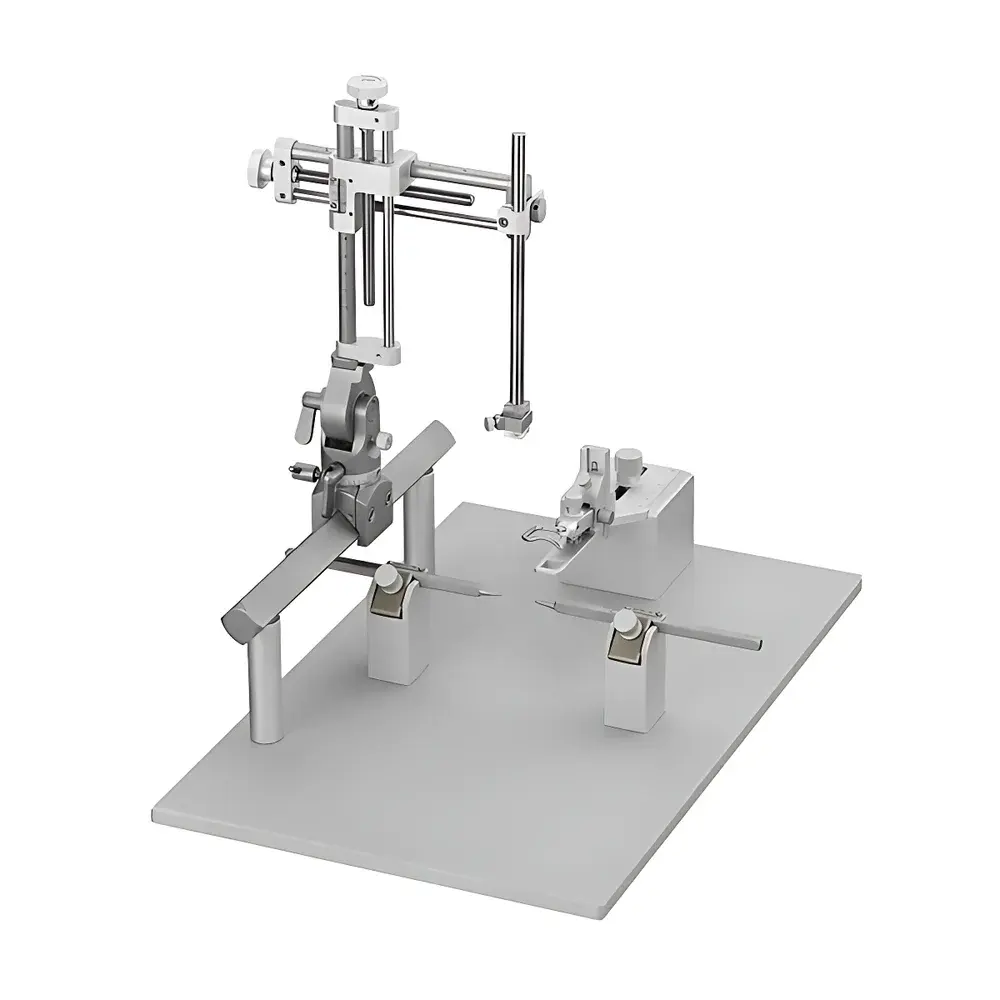
The RWD Orbital-Type Stereotaxic Instrument is a precision-engineered neurosurgical platform designed for high-accuracy intracranial and spinal targeting in rodent models. Unlike conventional stereotaxic systems relying on articulated arm mechanisms for Y-axis translation, this instrument employs a linear orbital rail system—providing ±100 mm of calibrated anterior–posterior (Y-axis) travel with mechanical stability across the full range. The rail-based architecture eliminates the structural constraints of traditional U-frame designs, significantly expanding unobstructed head-access volume above the animal’s skull and enabling multi-angle approach trajectories for deep-brain or cervical/spinal interventions. Its core measurement principle is based on orthogonal Cartesian coordinate referencing (AP–ML–DV), aligned to standardized bregma–lambda landmarks via digital or vernier-scale readouts depending on configuration. The system supports both acute and chronic implantation workflows under stereotactic guidance, including microinjection, electrophysiological electrode placement, optogenetic fiber optic cannula insertion, and targeted spinal cord delivery.
Key Features
- Orbital rail-driven Y-axis translation with ±100 mm travel range—enabling simultaneous cranial and spinal targeting without repositioning the animal.
- Modular arm configuration: available as single-arm (68506), dual-arm (68509), digital-readout single-arm (68512), or digital-readout dual-arm (68515) variants—supporting concurrent multi-site manipulations.
- Selectable positioning resolution: 100 µm coarse adjustment and 10 µm fine adjustment options accommodate diverse experimental requirements—from gross anatomical targeting to sub-millimeter neural circuit mapping.
- Expanded working envelope: removal of the conventional U-shaped frame increases vertical clearance and lateral access, facilitating integration of upright microscopes, patch-clamp rigs, or multi-electrode arrays.
- Universal mechanical compatibility: accepts industry-standard small-animal holders, ear bars (rat and mouse), stereotaxic injectors, microdrills (e.g., RWD handheld cranial drill), and gas anesthesia manifolds (e.g., RWD vaporizer-integrated systems).
Sample Compatibility & Compliance
The instrument is validated for use with Sprague-Dawley and Wistar rats (standard adapter included) and C57BL/6, BALB/c, and CD-1 mice (mouse-specific ear bars and adapters available as optional accessories). Spinal targeting is supported using the RWD 68091 Rodent Spinal Adapter Kit, enabling reproducible thoracic, lumbar, and cervical injections, ablations, or stimulation protocols. All structural components comply with ISO 13485-aligned manufacturing controls for laboratory instrumentation. Mechanical tolerances adhere to internal RWD QC standards traceable to NIST-calibrated gauges. While not a medical device, the system supports GLP-compliant study documentation when used in conjunction with audit-trail-enabled software platforms and calibrated ancillary tools.
Software & Data Management
The digital-readout models (68512 and 68515) integrate optical encoder-based position sensing with USB output, compatible with third-party data acquisition environments such as MATLAB, LabVIEW, or Python-based control suites. Position logs can be timestamped and exported in CSV format for longitudinal experiment tracking. When paired with RWD’s anesthesia monitoring modules, synchronized physiological metadata (e.g., respiration rate, O2 saturation) may be co-registered with stereotaxic coordinates. No proprietary closed-software ecosystem is required; all firmware updates are delivered via signed binary packages with version-controlled release notes.
Applications
- Intracerebral microinjection of viral vectors, tracers, or pharmacological agents into discrete nuclei (e.g., hippocampus, striatum, VTA) with sub-100 µm spatial fidelity.
- Chronic implantation of tetrodes, silicon probes, GRIN lenses, or ceramic guide cannulas for in vivo electrophysiology or fiber photometry.
- Spinal cord interventions—including intraparenchymal injection, dorsal root entry zone lesioning, and epidural electrode placement—using the 68091 spinal adapter.
- Combined anesthesia–surgery workflows: seamless integration with RWD isoflurane vaporizers and nose-cone delivery systems ensures stable physiological conditions during extended stereotaxic procedures.
- Multi-modal surgery platforms: dual-arm configurations allow simultaneous coordination of injection and electrophysiological recording, or concurrent bilateral targeting in symmetrical brain structures.
FAQ
Is the orbital rail mechanism compatible with existing stereotaxic accessories from other manufacturers?
Yes—the base plate, ear bar mounts, and standard L-shaped clamping interfaces conform to ANSI/ISO 80000-4 dimensional conventions, ensuring mechanical interoperability with most third-party holders, manipulators, and injection systems.
What is the maximum weight capacity of the rail-mounted arm assembly?
The load rating is 1.2 kg per arm at full Y-axis extension, sufficient for standard syringe pumps, microelectrode drives, and lightweight imaging optics.
Can the system be sterilized for repeated surgical use?
All stainless-steel and anodized aluminum components are autoclavable at 121°C for 20 minutes; polymer elements (e.g., scale dials, cable sheaths) are wipe-clean only with 70% ethanol or isopropyl alcohol.
Does RWD provide calibration certificates for the digital-readout models?
Yes—each 68512 and 68515 unit ships with a factory-issued calibration report traceable to national metrology institutes, including linearity error (< ±5 µm over full range) and repeatability (< ±2 µm, 3σ).