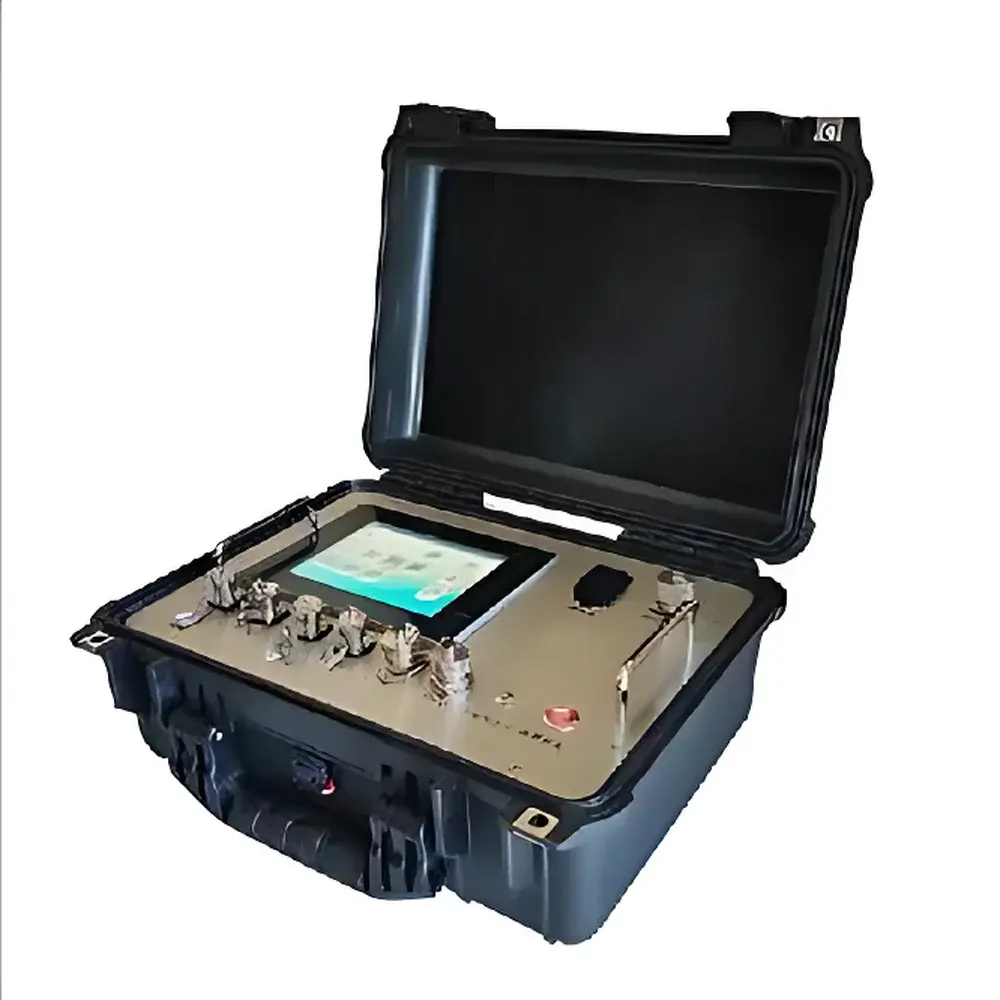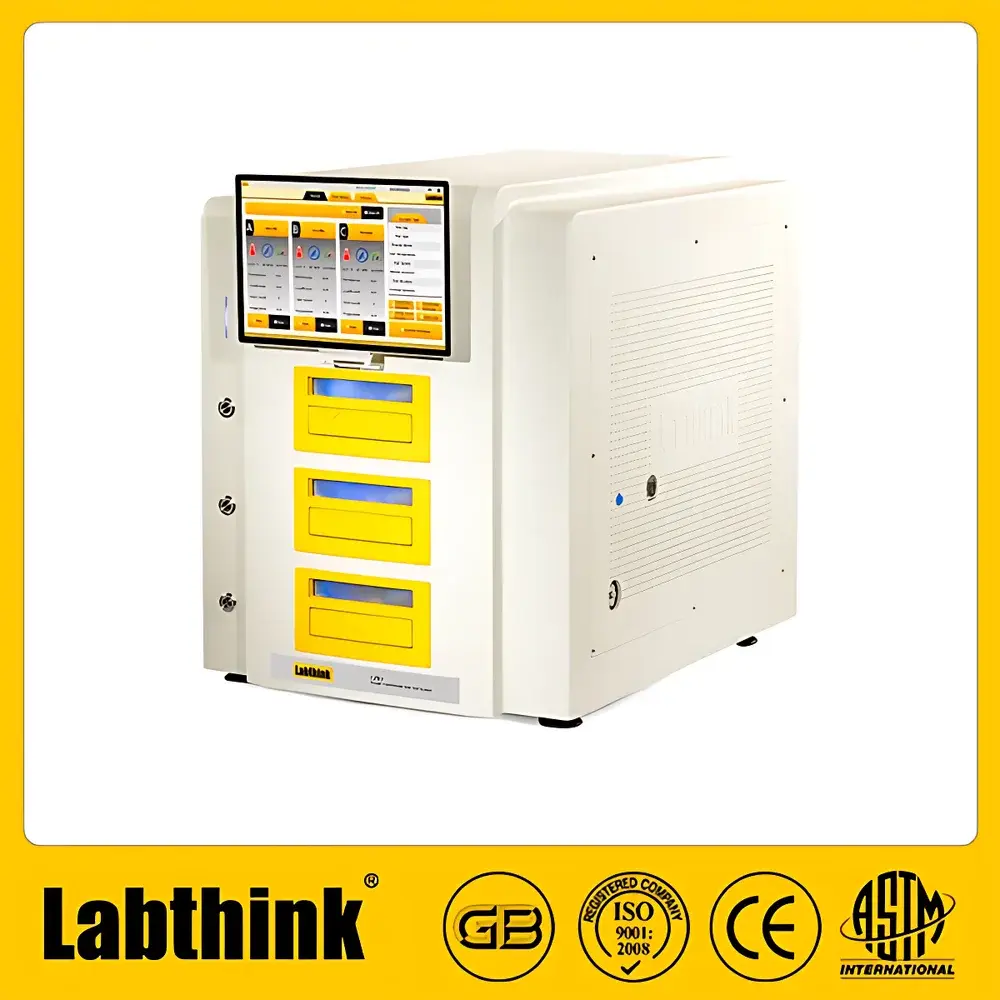
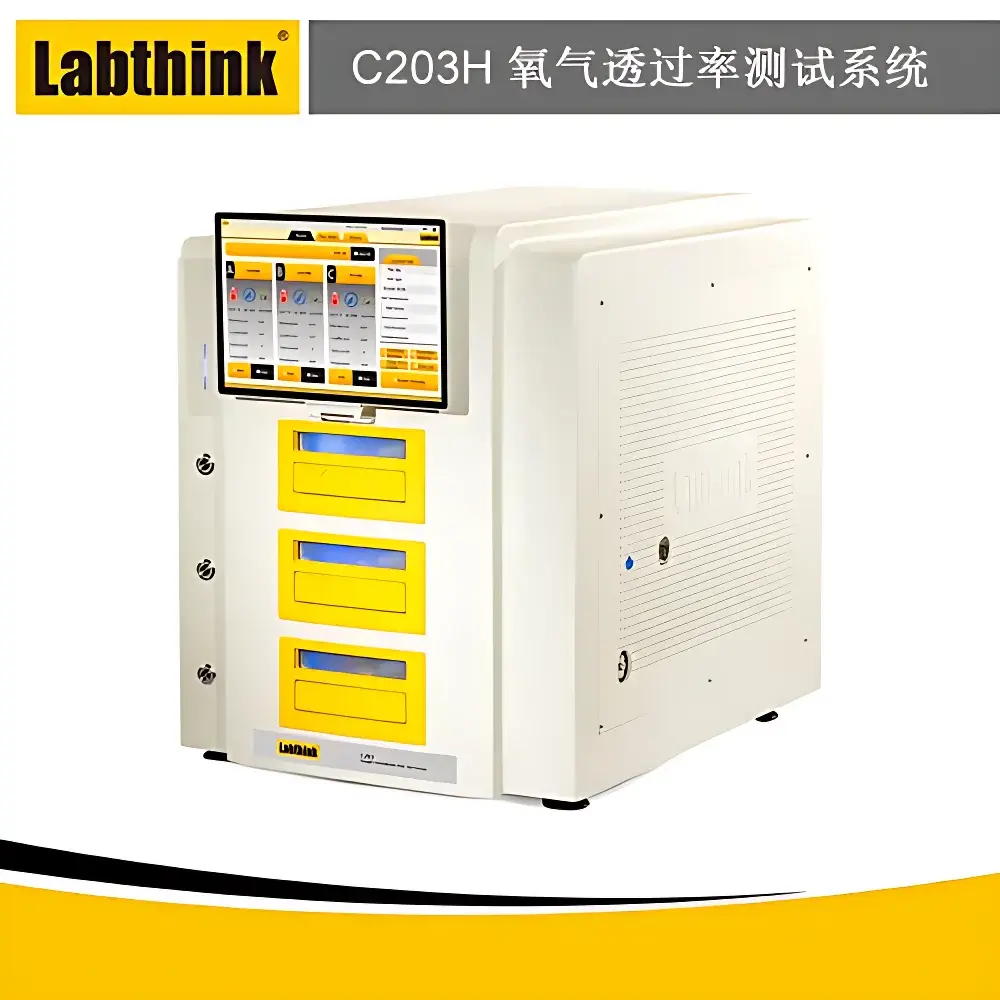
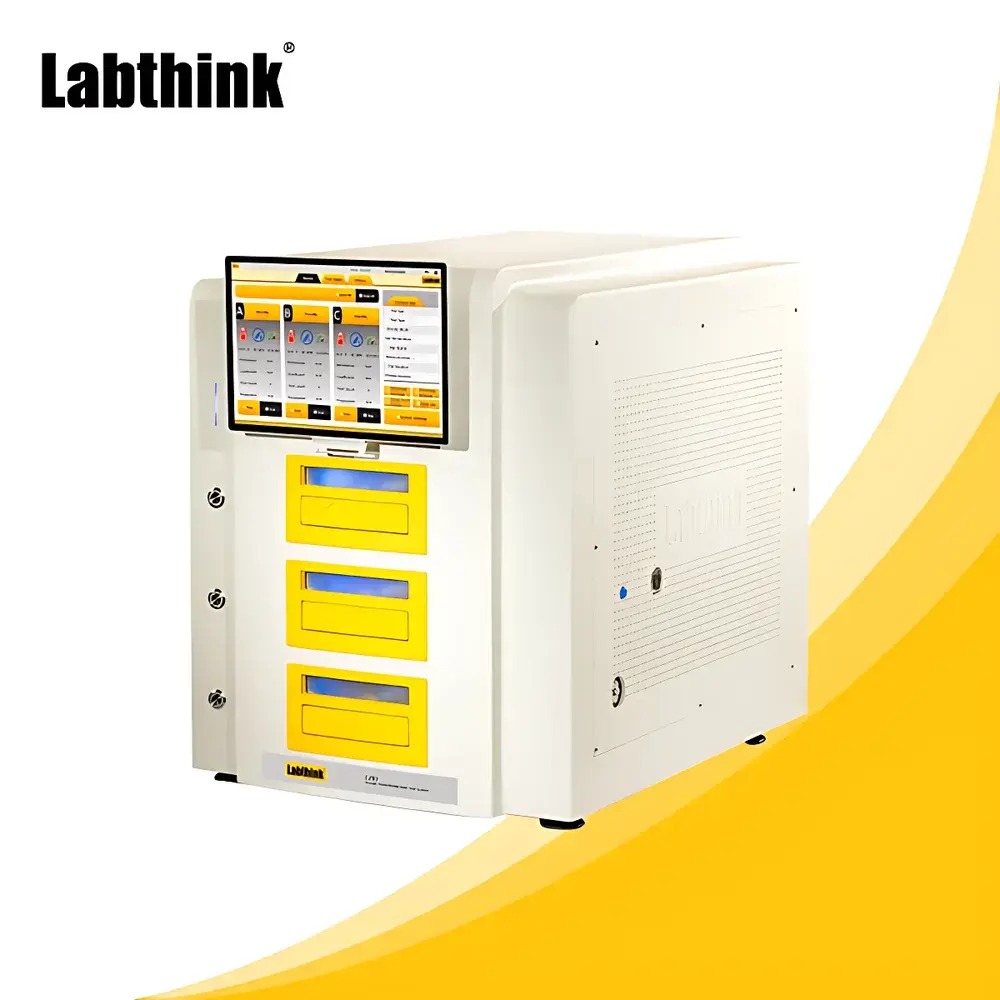
Labthink C203H Coulometric Oxygen Permeation Analyzer
| Brand | Labthink |
|---|---|
| Model | C203H |
| Principle | Coulometric oxygen sensor + isobaric method |
| Standards | ASTM D3985, ASTM F1307, GB/T 19789, GB/T 31354, DIN 53380-3, JIS K7126-2-B, YBB 00082003-2015 |
| Test Range | 0.02–200 cc/(m²·day) (50 cm²), extendable to 400,000 cc/(m²·day) |
| Resolution | 0.0001 cc/(m²·day) |
| Repeatability | ±0.02 cc/(m²·day) or ±1%, whichever is greater |
| Temperature Range | 15–50 °C (standard), 5–60 °C (optional) |
| Temp. Stability | ±0.05 °C |
| Humidity Range | 0–90 %RH ±2 %RH |
| Test Area | 50 cm² (standard), 5 cm² / 1 cm² (optional masks) |
| Sample Size | 11.2 cm × 11.2 cm |
| Max. Thickness | 3 mm |
| Gas Supply | 99.999% N₂, 99.5% O₂ |
| Inlet Pressure | ≥280 kPa |
| Power | 120 VAC ±10% 60 Hz / 220 VAC ±10% 50 Hz |
| Dimensions | 600 mm × 500 mm × 700 mm |
| Weight | 100 kg |
Overview
The Labthink C203H Coulometric Oxygen Permeation Analyzer is an ISO/IEC 17025-aligned instrumentation platform engineered for precise, trace-level oxygen transmission rate (OTR) measurement in flexible barrier materials. It operates on the coulometric detection principle—where oxygen molecules permeating through a test specimen are swept by high-purity nitrogen carrier gas into a ppb-grade electrochemical oxygen sensor, generating a current proportional to O₂ concentration. This absolute measurement methodology eliminates reliance on calibration standards, ensuring metrological traceability per ASTM D3985 and ASTM F1307. Designed for laboratories requiring regulatory-compliant gas barrier characterization, the C203H delivers stable, reproducible results across demanding applications in pharmaceutical primary packaging, sterile medical device pouches, food-grade laminates, photovoltaic encapsulants, and high-reliability electronics substrates.
Key Features
- ppb-level coulometric oxygen sensor with threefold extended service life versus conventional sensors, minimizing maintenance intervals and long-term cost of ownership.
- Triple independent test chambers (50 cm² each), enabling concurrent analysis of three specimens under identical environmental conditions—increasing throughput by 50% versus dual-chamber systems.
- 360° circumferential air-circulation thermal control system maintaining temperature stability within ±0.05 °C across all chambers—critical for low-OTR materials where thermal gradients induce measurement drift.
- Integrated high-accuracy RH and temperature sensors with real-time logging; humidity control (0–90 %RH ±2 %RH) and thermal regulation fully automated during test execution.
- Motorized drawer-style test chamber with acoustic and visual confirmation of sample loading/unloading—reducing operator error and improving inter-laboratory reproducibility.
- Dedicated industrial-grade embedded computer (Windows OS) with 12-inch capacitive touchscreen interface—immune to external malware, ensuring data integrity and uninterrupted operation under GLP/GMP environments.
- Auto-clamping mechanism applying uniform pressure across sample periphery, eliminating seal-induced leakage and ensuring consistent gasket compression for leak-tight integrity.
Sample Compatibility & Compliance
The C203H accommodates films and sheets up to 3 mm thick and 11.2 cm × 11.2 cm in dimension—including multilayer coextrusions, metallized PET/AL/PE laminates, SiOₓ- and AlOₓ-coated substrates, PVDC-coated paperboard, fluoropolymer films, silicone elastomers, and rigid thermoplastic sheets (e.g., PP, PVC, PVDC). All test configurations comply with global regulatory requirements: ASTM D3985 (oxygen permeation of plastic film via coulometric detection), ASTM F1307 (OTR of dry packages), GB/T 19789 and GB/T 31354 (Chinese national standards for packaging barrier testing), JIS K7126-2-B (Japanese standard for film OTR), and YBB 00082003-2015 (Chinese pharmaceutical packaging standard). Optional CFR 21 Part 11-compliant software modules support audit trails, electronic signatures, and role-based access control for FDA-regulated facilities.
Software & Data Management
Labthink’s proprietary OTR Control Suite provides full lifecycle test management—from method definition and environmental setpoint configuration to real-time curve visualization, statistical reporting (mean, SD, CV%), and export-ready PDF/CSV outputs. The system logs timestamped environmental parameters (T, RH, flow rates), sensor output signals, and chamber pressure differentials at user-defined intervals. DataShield™ encryption ensures file-level protection; optional GMP-compliant computer validation packages include IQ/OQ documentation, performance qualification protocols, and backup/recovery validation reports. All raw data and metadata are stored locally on the embedded SSD with automatic daily backups to network drives—fully compliant with ALCOA+ (Attributable, Legible, Contemporaneous, Original, Accurate, Complete, Consistent, Enduring, Available) principles.
Applications
The C203H serves as a core analytical tool in QC/QA labs validating barrier performance of:
- Pharmaceutical blister lidding foils and cold-form foil laminates used in moisture- and oxygen-sensitive solid dosage forms;
- Sterile medical device packaging—Tyvek®/PET/AL pouches, peelable lids, and thermoformed trays subject to ISO 11607-1 validation;
- Retortable and aseptic food packaging—aluminum-coated CPP, SiOₓ PET, and EVOH-containing multilayers for shelf-stable dairy, meat, and infant formula;
- Photovoltaic backsheet films requiring <0.1 cc/(m²·day) OTR to prevent encapsulant oxidation and PID degradation;
- Flexible OLED encapsulation barriers and thin-film transistor (TFT) substrate films where sub-ppm O₂ ingress compromises display lifetime.
FAQ
What gas purity specifications are required for optimal sensor performance?
High-purity nitrogen (≥99.999%) and oxygen (≥99.5%) are mandatory. Impurities such as CO₂, H₂O, or hydrocarbons may poison the coulometric sensor or generate false-positive signals.
Can the C203H measure ultra-low OTR materials below 0.05 cc/(m²·day)?
Yes—its ppb-range coulometric sensor and thermal stabilization architecture enable reliable quantification down to 0.02 cc/(m²·day) at 50 cm², validated per ASTM D3985 Annex A1 for low-permeability materials.
Is humidity control mandatory for all tests?
No—zero-RH (dry nitrogen) mode is supported for inert-condition testing; however, controlled RH exposure (5–90 %RH) is required when evaluating hygroscopic polymers or simulating end-use storage environments.
How does the triple-chamber design impact data comparability?
Each chamber operates independently with dedicated sensor, flow control, and environmental monitoring—ensuring statistical independence of results while maintaining identical boundary conditions across replicates.
What validation documentation is provided for regulated industries?
Factory-issued IQ/OQ protocols, sensor linearity verification reports, temperature/humidity mapping data, and optional 21 CFR Part 11 compliance packages—including electronic signature workflows and audit trail configuration—are available upon request.