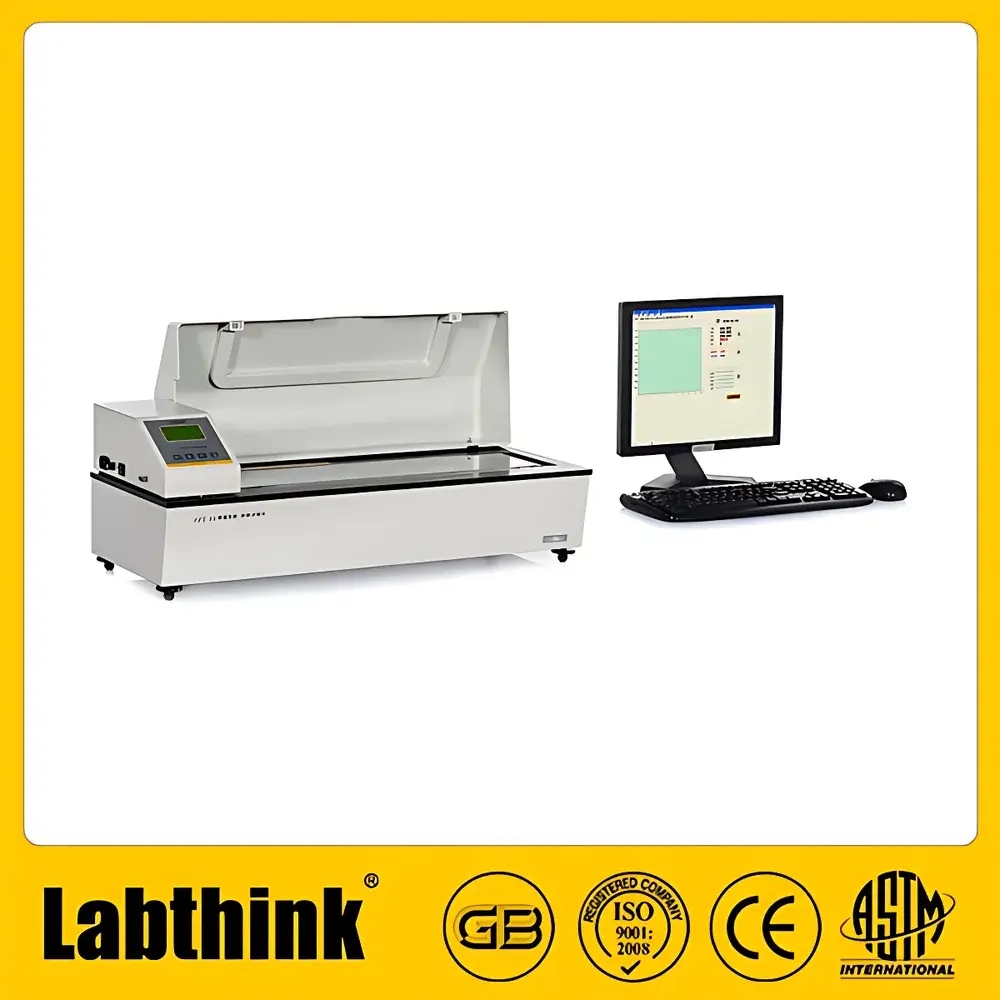
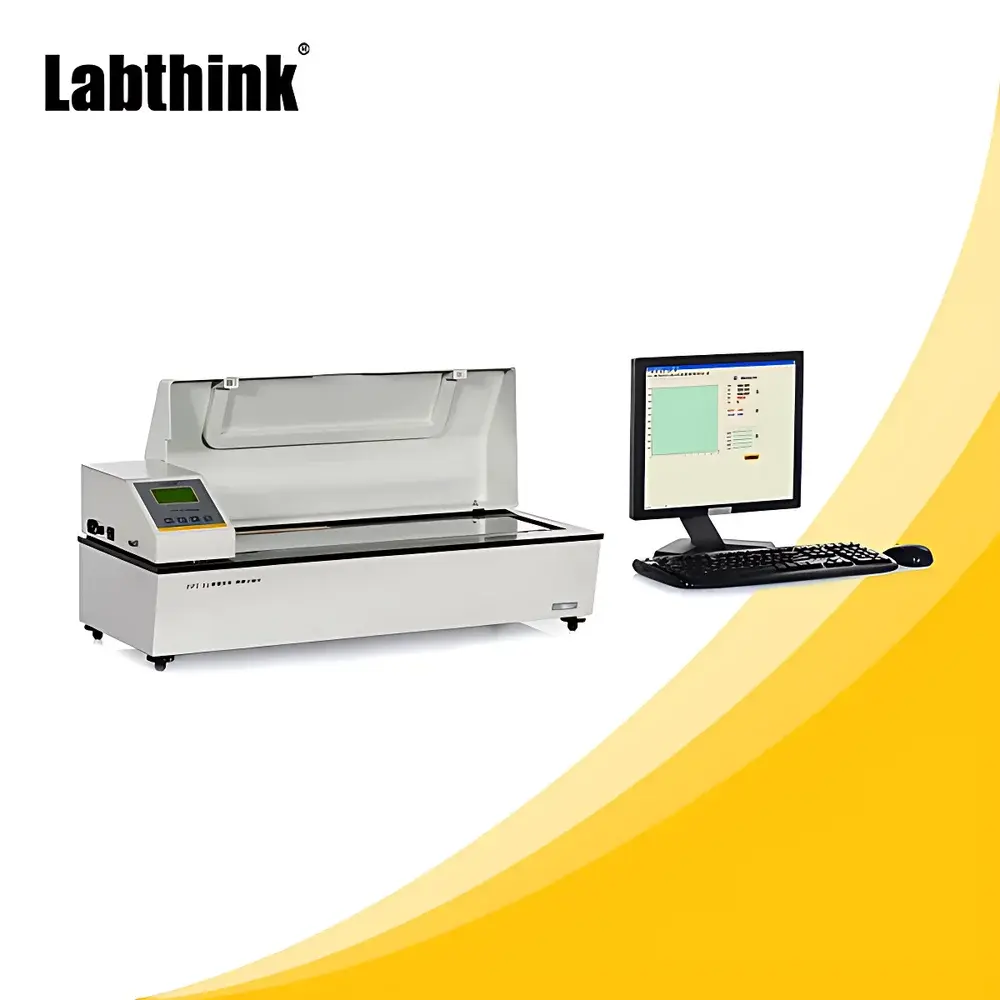
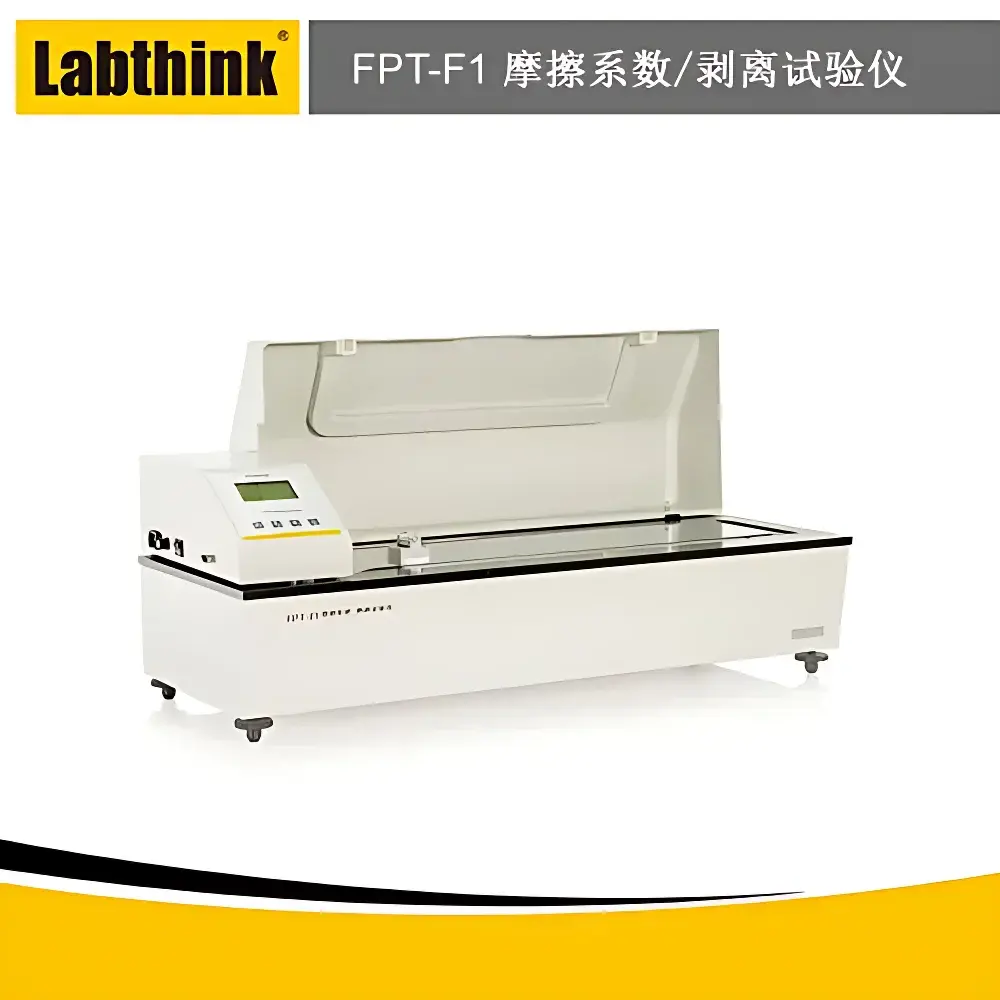
Labthink FPT-F1 Multi-temperature Coefficient of Friction and 180° Peel Tester
| Brand | Labthink |
|---|---|
| Model | FPT-F1 |
| Origin | Shandong, China |
| Manufacturer | Labthink Instruments Co., Ltd. |
| Test Range | 0–5 N / 0–10 N / 0–30 N |
| Accuracy Class | 0.5 |
| Slider Mass Options | 200 g, 500 g (custom: 100 g, 1000 g, 1814 g, 2000 g) |
| Test Speeds | 50, 100, 150, 200, 250, 300, 500 mm/min |
| Temperature Control Range | Ambient to 99.9 °C |
| Power Supply | AC 220 V 50 Hz / AC 120 V 60 Hz |
| Dimensions (L×W×H) | 850 × 350 × 290 mm |
| Net Weight | 30 kg |
| Compliance Standards | ISO 8295, ISO 8510-2, GB 10006, GB/T 2790–2792, ASTM D1894, ASTM D4917, ASTM D3330, TAPPI T816, TAPPI T549 |
Overview
The Labthink FPT-F1 Multi-temperature Coefficient of Friction and 180° Peel Tester is an engineered solution for precision measurement of static and kinetic coefficients of friction (COF), as well as 180° peel strength, across a thermally controlled environment. Designed in accordance with fundamental tribological principles—specifically based on the ASTM D1894 and ISO 8295 sliding plate method—the instrument applies controlled normal force via calibrated sliders and measures lateral resistance during linear motion. Its integrated Peltier-based temperature regulation system enables stable thermal conditioning of both test surfaces—from ambient up to 99.9 °C—ensuring material-specific surface energy, polymer chain mobility, and interfacial adhesion behavior are accurately captured under realistic processing or end-use conditions. This dual-function architecture eliminates the need for separate COF and peel testing platforms, reducing lab footprint and cross-instrument calibration drift.
Key Features
- Dual-mode operation: Simultaneous support for coefficient of friction (static/kinetic) and 180° peel strength testing per ISO 8510-2 and ASTM D3330
- Multi-range load cell configuration: Interchangeable sensor modules covering 0–5 N, 0–10 N, and 0–30 N ranges, each certified to 0.5 accuracy class per JJG 475
- Thermally stabilized test bed: PID-controlled heating system with ±0.3 °C uniformity across the 100 mm × 100 mm contact zone; real-time temperature logging synchronized with force data
- Seven programmable test speeds (50–500 mm/min) and three preloaded slider mass options (200 g, 500 g standard; extended range available)
- Magnetically neutralized test platform: All metallic components—including the base plate, slider body, and guide rails—undergo degaussing and residual magnetism verification (<0.2 mT) to prevent electromagnetic interference with strain gauge output
- Embedded microprocessor + PC hybrid control: Real-time closed-loop speed regulation, automatic zero-point compensation, and overload protection at hardware level
Sample Compatibility & Compliance
The FPT-F1 accommodates rigid and flexible substrates used extensively in packaging, medical device, and industrial material supply chains. Validated sample types include biaxially oriented polypropylene (BOPP), polyester (PET), aluminum foil laminates, kraft paperboard, silicone-coated release liners, pressure-sensitive adhesive (PSA) tapes, transdermal patches, and extruded polymer conveyor belts. All mechanical and thermal subsystems comply with GLP-aligned design requirements: audit-trail-enabled software, user-access-level permissions, electronic signature support (aligned with FDA 21 CFR Part 11 Annex 11 expectations), and full traceability of calibration records, environmental logs, and raw force/time datasets. The instrument meets mandatory mechanical safety standards (IEC 61000-6-2/6-4) and electromagnetic compatibility directives applicable to laboratory instrumentation sold in EU, North America, and APAC markets.
Software & Data Management
Labthink’s proprietary CoF-Peel Analysis Suite v3.2 operates on Windows OS and provides ISO/IEC 17025-compliant data handling. It supports synchronized acquisition of force, displacement, temperature, and time stamps at ≥100 Hz sampling rate. Key capabilities include: overlay comparison of up to eight COF curves under identical thermal profiles; statistical reporting of μs, μk, and peel average/standard deviation per ASTM E29; automated pass/fail evaluation against user-defined specification limits; export of raw ASCII (.txt), Excel (.xlsx), and PDF report formats with embedded metadata (operator ID, instrument serial number, calibration due date). All data files carry SHA-256 checksums and are stored in a write-once-read-many (WORM) archive structure to satisfy long-term archival requirements under GMP Annex 11.
Applications
This tester serves critical quality control and R&D functions across regulated and high-volume manufacturing sectors. In packaging development, it quantifies slip performance of food-grade films under refrigerated or hot-fill conditions—directly informing bagging line speed optimization and anti-blocking additive selection. For medical device manufacturers, it verifies consistency of peel forces for sterile barrier systems (e.g., Tyvek® pouches) across sterilization cycles (EtO, gamma, steam), supporting ISO 11607 validation protocols. In cable and wire production, it assesses metal-polymer interfacial adhesion in shielded composite tapes under elevated temperatures mimicking extrusion die zones. Additionally, it supports academic tribology studies involving polymer–polymer, polymer–metal, and bio-adhesive interfaces where thermal history significantly influences interfacial shear response.
FAQ
What standards does the FPT-F1 natively support for COF and peel testing?
The instrument implements test logic and reporting templates for ISO 8295 (COF), ISO 8510-2 (180° peel), GB 10006, ASTM D1894, ASTM D3330, and TAPPI T816. Custom protocol scripting is available upon request.
Can the system operate without a connected computer?
Yes—the embedded controller enables standalone execution of pre-programmed methods, with results viewable on the 5.7-inch TFT display and exportable via USB flash drive.
Is third-party calibration certification available?
Labthink provides NIST-traceable calibration certificates issued by CNAS-accredited laboratories (Certificate No. CNAS LXXXXX), including uncertainty budgets per ISO/IEC 17025:2017.
How is thermal uniformity verified across the test surface?
Each unit undergoes thermal mapping using nine calibrated PT100 sensors positioned in a 3×3 grid; validation reports document maximum deviation ≤±0.3 °C at 40 °C, 60 °C, and 90 °C setpoints.
Are non-standard slider geometries supported?
Yes—custom sliders (e.g., cylindrical, curved, or multi-point contact) can be integrated with mechanical interface adapters and validated through Labthink’s Application Engineering team.