
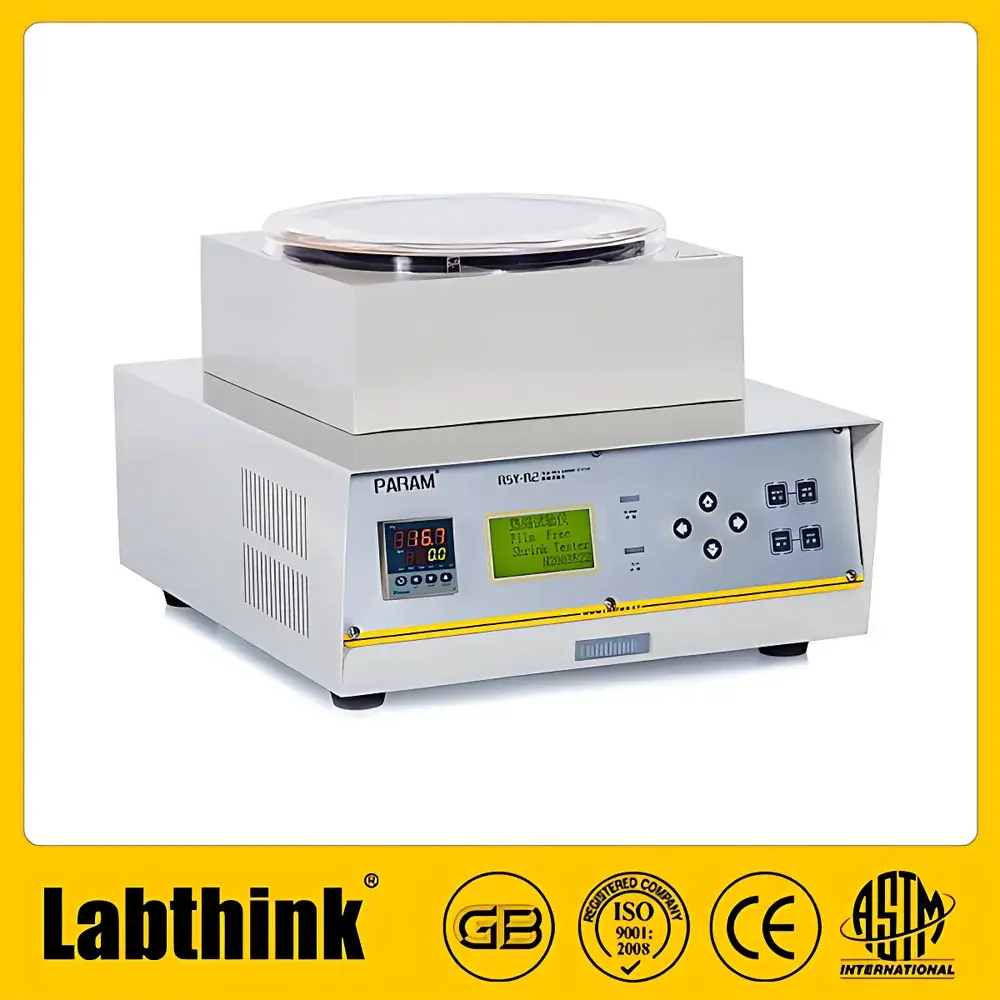
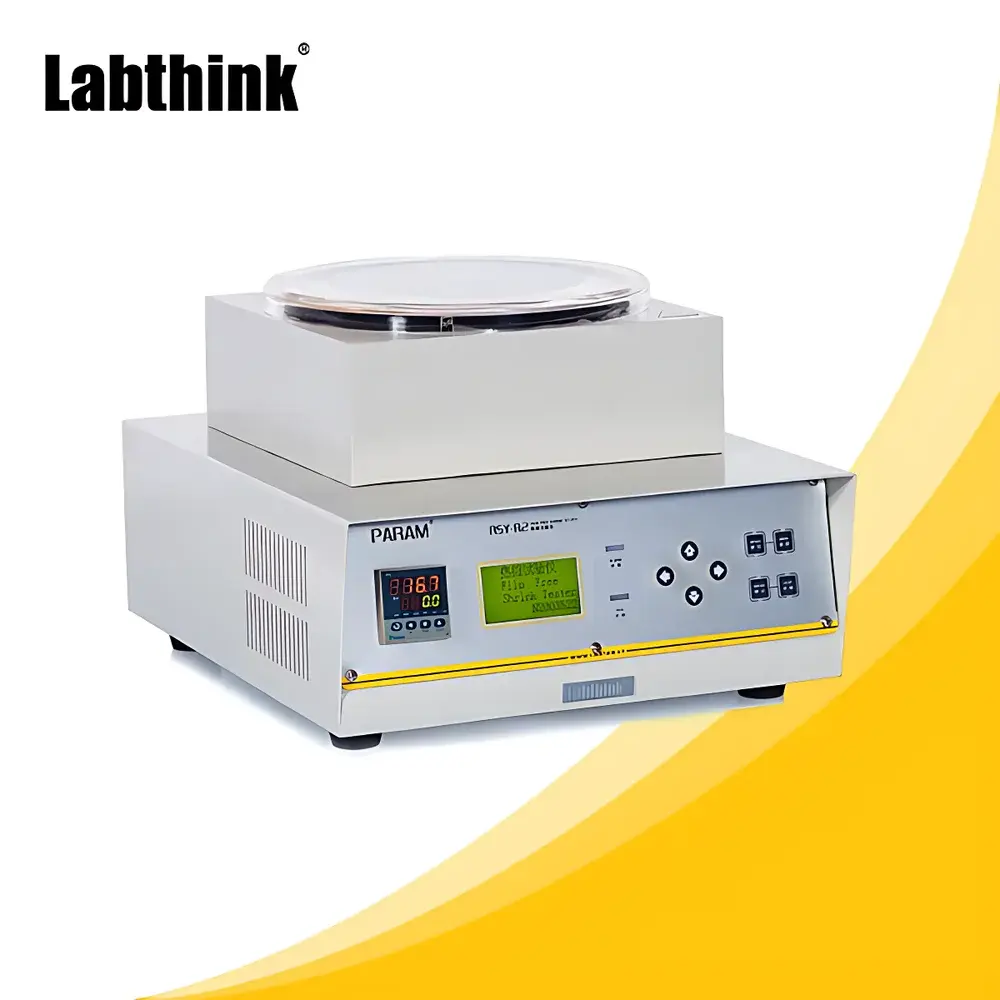
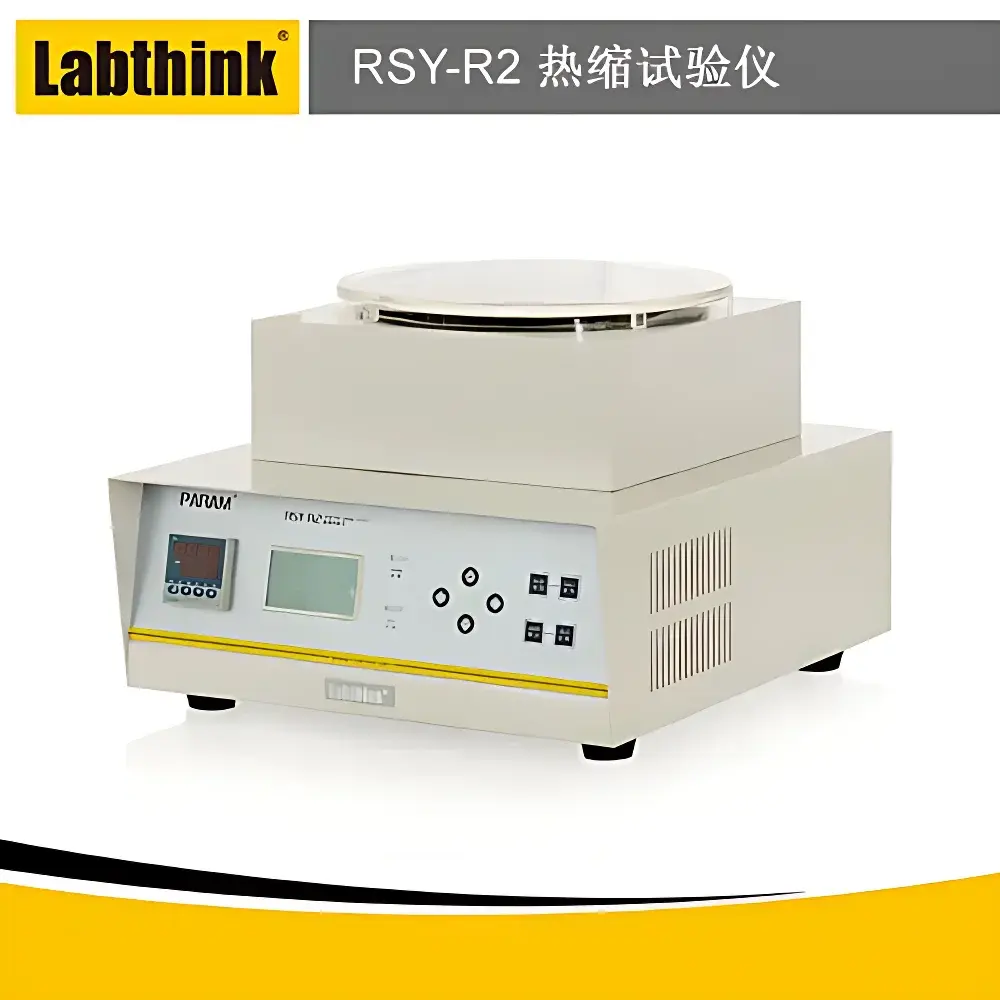
Labthink RSY-R2 Thermal Shrinkage Tester for POF and Polymeric Films
| Brand | Labthink |
|---|---|
| Model | RSY-R2 |
| Origin | Shandong, China |
| Manufacturer | Labthink Instruments Co., Ltd. |
| Temperature Range | Ambient to 200 °C |
| Temperature Control Accuracy | ±0.3 °C |
| Sample Size Limit | ≤140 mm × 140 mm |
| Power Supply | AC 220 V, 50 Hz |
| Dimensions (L×W×H) | 440 mm × 370 mm × 310 mm |
| Net Weight | 24 kg |
| Standards Compliance | GB/T 13519, ASTM D2732 |
| Control System | Microprocessor-based with LCD interface, PID temperature regulation, automatic timing |
| Sample Fixture | Standard stainless-steel mesh frame set (5 frames + 3 supports) |
| Heating Medium | Liquid bath (oil or water, user-selectable) |
Overview
The Labthink RSY-R2 Thermal Shrinkage Tester is an engineered solution for quantitative evaluation of dimensional stability and thermal shrinkage behavior in polymeric films, shrink sleeves, heat-shrink tubing, pharmaceutical PVC rigid sheets, photovoltaic backsheet materials, and other thermoplastic packaging substrates. It operates on the principle of controlled immersion heating—where specimens are suspended in a precisely regulated liquid medium (e.g., silicone oil or deionized water) and subjected to defined thermal profiles. This method ensures uniform heat transfer across the sample surface, minimizing thermal gradients and enabling reproducible measurement of percentage shrinkage in both machine direction (MD) and transverse direction (TD), as specified in ISO 11508 and ASTM D2732. The instrument is not a generic oven-based system; its liquid-bath architecture provides superior thermal homogeneity and response fidelity compared to air-circulation alternatives—critical for compliance-driven quality control in regulated packaging manufacturing.
Key Features
- Microprocessor-controlled PID temperature regulation with real-time feedback loop, maintaining ±0.3 °C stability across the full operating range (ambient to 200 °C)
- Liquid-phase heating system using interchangeable bath media—optimized for low-viscosity thermal transfer and minimal evaporation drift during extended test cycles
- Automated timing sequence initiated upon sample immersion, eliminating operator-dependent start delays and ensuring consistent exposure duration per ASTM D2732 Section 7.2
- Intuitive LCD interface with menu-driven navigation, English-language firmware, and non-volatile memory for parameter recall and test history logging
- Dedicated specimen handling hardware: five precision-machined stainless-steel mesh frames with calibrated tensioning geometry and three height-adjustable support rods—designed to prevent sagging, wrinkling, or edge contact during shrinkage
- Robust aluminum-alloy chassis with insulated bath chamber, integrated overtemperature cutoff, and CE-compliant electrical safety architecture
Sample Compatibility & Compliance
The RSY-R2 accommodates flat, flexible polymeric specimens up to 140 mm × 140 mm, including biaxially oriented polypropylene (BOPP), polyolefin (POF), polyethylene terephthalate (PET), polyvinyl chloride (PVC), and multilayer coextruded structures. Its design conforms explicitly to the mechanical and procedural requirements of GB/T 13519–2016 (“Plastic Heat-Shrinkable Packaging Film”) and ASTM D2732–21 (“Standard Test Method for Unrestrained Linear Thermal Shrinkage of Plastic Film and Sheeting”). These standards mandate controlled immersion depth, fixed dwell time, and post-cooling dimensional measurement protocols—all supported natively by the RSY-R2’s hardware configuration and operational workflow. The instrument is routinely deployed in GLP-compliant laboratories for release testing of medical device packaging, pharmaceutical blister lidding, and solar module encapsulant films where shrinkage-induced delamination or seal integrity loss must be quantified pre-shipment.
Software & Data Management
While the RSY-R2 operates as a standalone benchtop unit with embedded firmware, it supports optional RS-232 serial output for integration into centralized LIMS or MES platforms. All test parameters—including setpoint temperature, dwell time, ambient reference values, and operator ID—are logged with timestamps in internal memory (capacity: ≥1,000 test records). When connected to Labthink’s optional DataMaster v3.1 software (sold separately), users gain audit-trail functionality compliant with FDA 21 CFR Part 11 Annex 11 requirements: electronic signatures, role-based access control, change history tracking, and PDF report generation with embedded calibration certificates. Raw dimensional data (pre- and post-shrink length/width measurements) are exportable in CSV format for statistical process control (SPC) analysis using JMP or Minitab.
Applications
- Quantification of unrestrained linear shrinkage (%) in POF shrink films used for beverage multipack bundling
- Evaluation of thermal stability in PV backsheet laminates exposed to lamination press temperatures
- Validation of shrink force consistency across production lots of pharmaceutical blister foil
- Comparative assessment of MD/TD anisotropy in biaxially stretched PET shrink labels
- Pre-qualification testing of heat-shrink tubing for wire harness insulation in automotive electronics
- Root-cause analysis of curling or warping defects in thermoformed tray lids during sterilization cycles
FAQ
What liquid media are compatible with the RSY-R2 bath system?
Silicone oil (up to 200 °C), glycerol (up to 150 °C), and deionized water (up to 95 °C) are validated options. Viscosity and flash point must align with ASTM D2732 Annex A1 recommendations.
Is calibration traceable to national standards?
Yes—Labthink provides NIST-traceable temperature calibration certificates (ISO/IEC 17025 accredited) upon request. Annual recalibration is recommended per ISO 17025 Clause 6.5.
Can the RSY-R2 measure shrink force, or only dimensional change?
It measures unrestrained linear shrinkage only. For shrink force quantification, Labthink’s FST-01 Force Shrink Tester is the designated complementary instrument.
Does the system meet requirements for pharmaceutical packaging validation under USP <661.2>?
While the RSY-R2 itself is not a USP monograph instrument, its output data (shrinkage %, repeatability CV ≤1.2%) directly supports USP <661.2> material characterization dossiers when combined with documented IQ/OQ/PQ protocols.
How many samples can be tested simultaneously?
One specimen per test cycle. However, the included five mesh frames allow rapid sequential testing without recalibration—typical throughput: 8–12 samples per 8-hour shift.



