

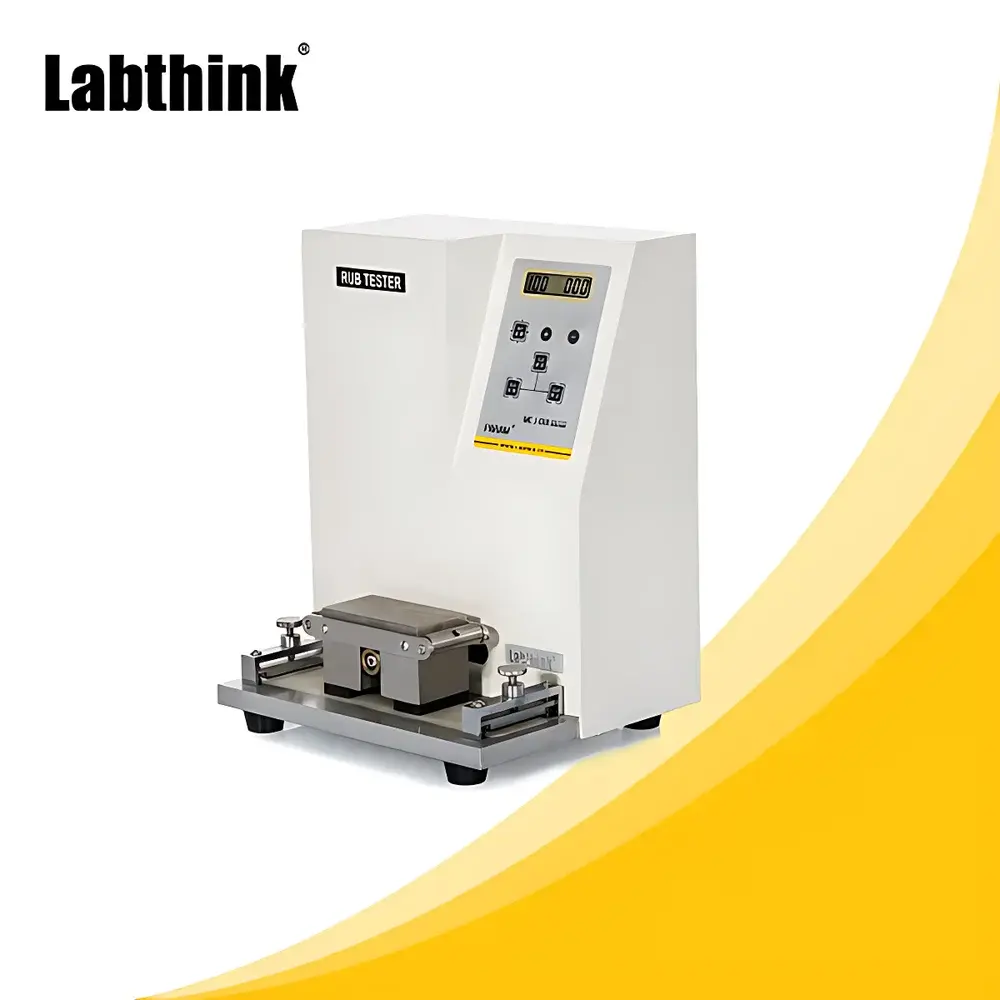

Labthink MCJ-01A Reciprocating Abrasion Tester for Printing Ink and Coating Adhesion Compliance with GB 7706
| Key | Brand: Labthink |
|---|---|
| Model | MCJ-01A |
| Type | Reciprocating Tribological Tester |
| Max Friction Force | 20 ± 0.2 N |
| Force Resolution | 0.1 N |
| Stroke Frequency | 43 cycles per minute (cpm) |
| Test Area | 155 mm × 50 mm |
| Specimen Size | 230 mm × 50 mm |
| Power Supply | AC 220 V, 50 Hz |
| Dimensions (L×W×H) | 260 × 230 × 360 mm |
| Net Weight | 22 kg |
| Compliance | GB/T 7706–2008 |
Overview
The Labthink MCJ-01A Reciprocating Abrasion Tester is an engineered precision instrument designed to quantify the mechanical resistance of surface layers—particularly printing inks, photopolymer coatings on PS plates, and functional thin-film coatings—against linear reciprocating abrasion under controlled normal load and motion parameters. It operates on the principle of standardized reciprocating sliding contact, where a calibrated abrasive element (typically a rubber or felt stylus) traverses a defined path across the specimen surface at a fixed frequency and applied normal force. This method replicates real-world handling, stacking, and transport-induced wear encountered by printed packaging, labels, and prepress materials. Unlike rotary or pin-on-disk configurations, the MCJ-01A implements a cam-driven linear actuation mechanism, ensuring consistent stroke amplitude, uniform velocity profile, and minimal dynamic deviation—critical for inter-laboratory reproducibility in quality control environments governed by national standards.
Key Features
- Microprocessor-controlled operation with LCD interface for intuitive parameter setting and real-time cycle counting
- Embedded standard friction platform with rigid aluminum alloy base and precision-machined guide rails to minimize lateral drift and ensure orthogonal motion alignment
- High-stability electromagnetic speed regulation system delivering constant 43 cpm (cycles per minute) without torque fluctuation across operational lifetime
- PVC-sealed membrane keypad and industrial-grade control panel offering IP54-rated dust and splash resistance for routine lab use
- Power-loss memory function retaining last configuration and accumulated cycle count after unexpected shutdown
- Low-noise motor assembly (<55 dB(A)) and vibration-damped housing enabling placement in shared analytical workspaces without acoustic interference
- Modular load application system supporting interchangeable weights and calibrated spring mechanisms to maintain 20 ± 0.2 N nominal normal force within ISO 9001 traceable tolerances
Sample Compatibility & Compliance
The MCJ-01A accommodates flat, rigid specimens up to 230 mm in length and 50 mm in width—including offset-printed cartons, flexographic labels, gravure-decorated films, lithographic PS plates, and laboratory-coated substrates (e.g., PET, BOPP, paperboard, aluminum foil). Its test geometry conforms strictly to the geometric and kinematic requirements specified in GB/T 7706–2008 “Flexographic and Letterpress Printing Inks – Determination of Rub Resistance”, which defines stroke length (155 mm), dwell time per cycle, and permissible deviation in applied load. While primarily aligned with Chinese national standards, the instrument’s mechanical fidelity supports comparative evaluation against ASTM D5264 (Standard Practice for Determining the Rub Resistance of Printed Materials) and ISO 11664-3 (Colorimetry – Part 3: CIE 1931 XYZ color space), particularly when integrated with post-test spectrophotometric assessment of color shift or gloss loss. It is suitable for GLP-compliant documentation workflows when paired with external audit-trail-enabled data loggers.
Software & Data Management
The MCJ-01A operates as a standalone hardware platform with no proprietary software dependency; all operational parameters are configured directly via front-panel controls. Cycle count, elapsed time, and error status are displayed in real time on the monochrome LCD. For traceable recordkeeping, users may integrate the device into LIMS or QA systems using optional RS-232 serial output (available upon request), enabling automated capture of test start/stop timestamps, total cycles, and operator ID fields. Raw data export supports CSV formatting compatible with Microsoft Excel, Minitab, and JMP for statistical process control (SPC) charting—including X̄-R charts for batch-to-batch consistency analysis. All firmware revisions undergo internal verification per IEC 62304 Class B software lifecycle requirements, with version logs archived for regulatory review.
Applications
- Evaluation of ink adhesion strength on flexible packaging films prior to lamination or sterilization processes
- Quality assurance of UV-curable and water-based ink formulations during R&D screening
- Validation of coating hardness and crosslink density in photopolymer PS plate manufacturing
- Comparative testing of anti-scratch topcoats applied to medical device labels subject to repeated handling
- Root-cause analysis of print marring in high-speed packaging lines through correlation of abrasion cycles with field failure reports
- Pre-certification testing for compliance with China’s GB 9685–2016 food-contact material migration regulations, where surface integrity affects extractable compound release
FAQ
Does the MCJ-01A support variable normal loads beyond 20 N?
No—the mechanical design and calibration certificate are validated exclusively for 20 ± 0.2 N. Alternate load configurations require factory recalibration and updated metrological documentation.
Can it be used for wet abrasion testing?
Not natively. The base unit lacks fluid containment or environmental control. Optional accessories include a custom-fit drip tray and hydrophobic specimen clamps for limited semi-wet protocols, but such modifications void standard compliance with GB/T 7706.
Is the 43 cpm frequency adjustable?
No—frequency is fixed by cam geometry and motor gearing to ensure repeatability across laboratories. Deviation would invalidate conformance to GB/T 7706–2008 Clause 6.2.
What maintenance intervals are recommended?
Lubrication of linear guides every 6 months; inspection of cam follower wear and belt tension annually; full metrological verification every 12 months or after 10,000 cycles, whichever occurs first.
Does Labthink provide installation qualification (IQ) or operational qualification (OQ) documentation?
Yes—upon request, IQ/OQ protocols compliant with ISO/IEC 17025 and FDA 21 CFR Part 11 Annex 11 can be supplied, including sensor linearity checks, timing accuracy validation, and load cell hysteresis testing.



