
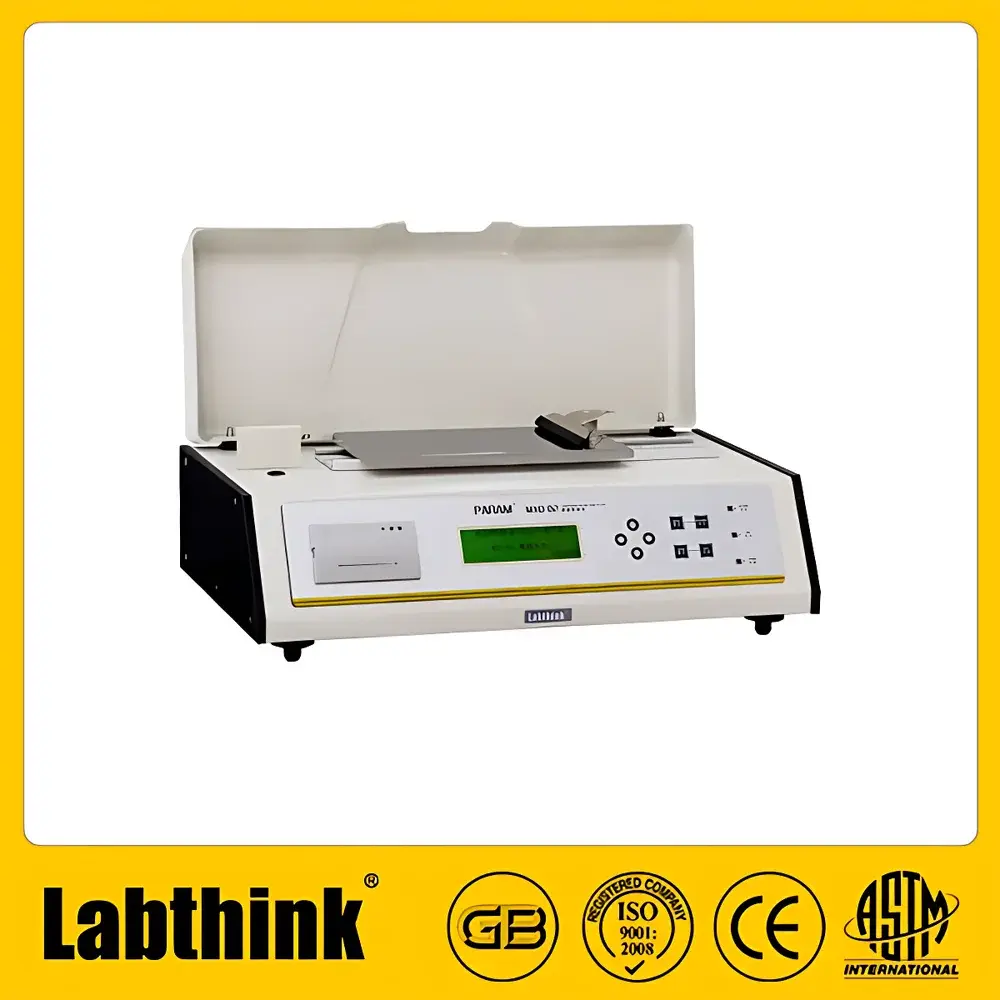
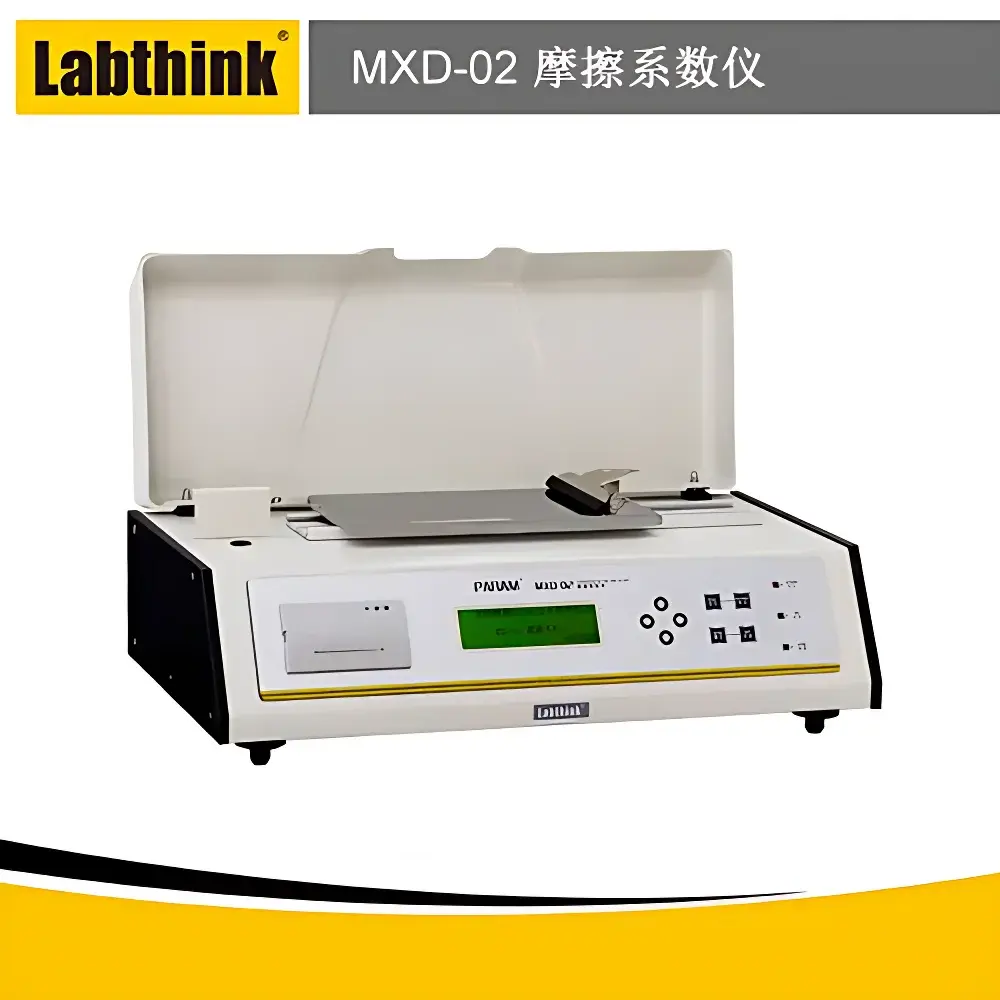
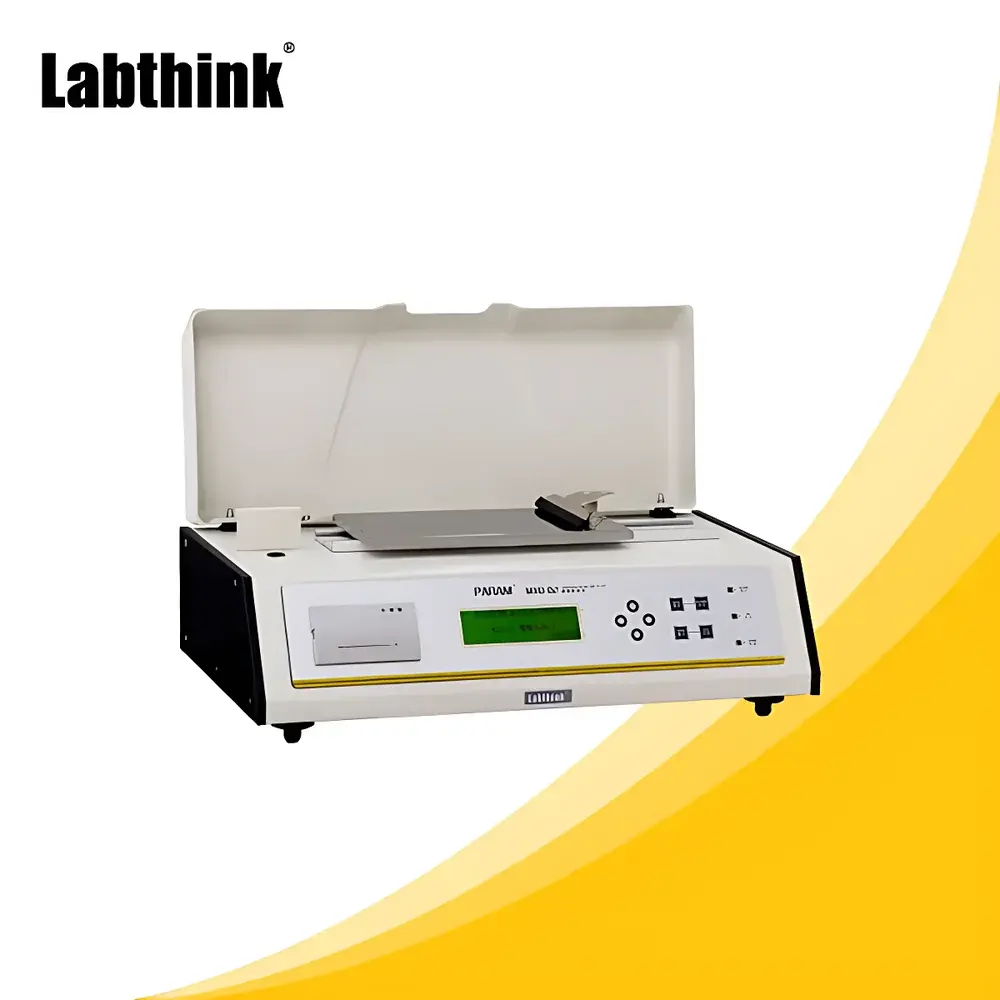
Labthink MXD-02 Coefficient of Friction (COF) Tester for Wipes, Nonwovens, and Packaging Films
| Brand | Labthink |
|---|---|
| Model | MXD-02 |
| Origin | Shandong, China |
| Manufacturer Type | OEM Manufacturer |
| Country of Origin | China |
| Load Range | 0–5 N |
| Accuracy Class | 0.5 |
| Travel Distance | 70 mm / 150 mm |
| Standard Sled Mass | 200 g |
| Test Speeds | 100 mm/min, 150 mm/min |
| Environmental Conditions | 23 ± 2 °C, 20–70 %RH |
| Compliance Standards | ISO 8295, GB 10006, ASTM D1894, TAPPI T816 |
Overview
The Labthink MXD-02 Coefficient of Friction (COF) Tester is an engineered precision instrument designed for quantitative measurement of static and kinetic coefficients of friction in flexible sheet materials under controlled tribological conditions. Based on the horizontal plane sled-drag principle—where a standardized mass slides across a fixed specimen surface—the device quantifies the tangential force required to initiate motion (static COF) and sustain uniform sliding (kinetic COF). This methodology conforms to internationally recognized mechanical test paradigms for surface interaction analysis and is widely adopted in quality assurance workflows across packaging, hygiene product manufacturing, and nonwoven processing industries. The MXD-02 delivers repeatable, traceable friction data essential for evaluating slip resistance, seal integrity, stacking stability, and handling performance of wipes, spunbond/meltblown nonwovens, laminated films, coated papers, and medical-grade barrier materials.
Key Features
- Triple-mode operation: independent selection of static COF, kinetic COF, or combined static-to-kinetic transition testing
- Programmable test speed with factory-calibrated options at 100 mm/min and 150 mm/min; additional speeds configurable via firmware update
- Modular sled system supporting standardized 200 g mass and customizable sled weights (e.g., 100 g, 500 g) to simulate application-specific normal loads
- Dual-range load cell (0–5 N) with 0.5-class accuracy per JJG 391–2019, validated against NIST-traceable reference standards
- Demagnetized test bed and sled components, verified via gaussmeter measurement (<0.2 mT residual field), minimizing electromagnetic interference with force transduction
- Microprocessor-based control architecture with backlit LCD interface and tactile PVC membrane keypad for stand-alone operation
- Integrated RS232 serial port compliant with EIA/TIA-232-F specifications for bidirectional communication with host systems
- Optional thermal/hygrometric environmental enclosure (sold separately) enables testing within ISO 291-standard conditioning environments (23 ± 2 °C / 50 ± 5 %RH)
Sample Compatibility & Compliance
The MXD-02 accommodates specimens up to 150 mm wide × 300 mm long, including single-layer and multilayer substrates such as wet wipe bases (viscose, polyester, bamboo pulp), spunlace nonwovens, PE/PP laminates, metallized PET films, corrugated board facing layers, and elastomeric medical packaging composites. All mechanical and electrical subsystems comply with IEC 61000-6-3 (EMI emission) and IEC 61000-6-2 (immunity) requirements. Test methodology adheres strictly to the procedural definitions and calibration protocols specified in ISO 8295 (Plastics — Film and sheeting — Determination of coefficient of friction), ASTM D1894 (Standard Test Method for Static and Kinetic Coefficients of Friction of Plastic Film and Sheeting), GB 10006 (Chinese national standard for plastic film COF), and TAPPI T816 (Coefficient of Friction of Paper and Paperboard). Data acquisition meets ALCOA+ principles for raw data integrity when used with Lystem™ Laboratory Data Management System (LDMS).
Software & Data Management
Bundled Lystem™ COF Analysis Software (v3.2+) provides GLP-compliant data handling: automatic calculation of mean COF values with standard deviation, confidence intervals (95%), and outlier detection per Grubbs’ test. The software supports multi-sample batch processing, cross-trial statistical comparison (ANOVA, t-test), overlay of time-force curves for kinetic behavior assessment, and generation of audit-ready reports compliant with FDA 21 CFR Part 11 requirements—including electronic signatures, change history logs, and immutable raw data archives. Export formats include CSV, PDF/A-1b, and XML for integration into enterprise QMS platforms (e.g., TrackWise, MasterControl). Optional cloud synchronization enables centralized data governance across global R&D and QC laboratories.
Applications
- Optimization of surfactant and silicone coating formulations on pre-moistened wipes to achieve target slip thresholds
- Verification of calendering pressure and temperature parameters in nonwoven production lines
- Validation of heat-seal compatibility between inner pouch layers and outer carton surfaces
- Assessment of glove-on friction for medical packaging opening ergonomics (ISO 11607-1 Annex C)
- Stability testing of pharmaceutical blister lidding foils under accelerated aging conditions
- Regulatory submission support for cosmetic applicator films (e.g., mascara wands, facial pads) per CTFA guidelines
FAQ
What standards does the MXD-02 natively support for COF reporting?
The instrument’s firmware and software are pre-configured for ISO 8295, ASTM D1894, GB 10006, and TAPPI T816 test sequences—including automatic unit conversion, pass/fail flagging against specification limits, and report footers citing clause numbers.
Can the MXD-02 measure friction on curved or textured surfaces?
No. It is designed exclusively for flat, planar specimens mounted on a rigid horizontal platen. Curved, embossed, or highly heterogeneous topographies require alternative methods such as pin-on-disk or incline-plane testers.
Is third-party calibration certification available?
Yes. Labthink offers ISO/IEC 17025-accredited calibration services through its CNAS-certified metrology lab (Certificate No. CNAS L5962), covering load cell verification, speed validation, and thermal drift compensation.
Does the system support 21 CFR Part 11 compliance out-of-the-box?
Full Part 11 functionality—including role-based access control, audit trail activation, and electronic signature capture—is enabled upon installation of Lystem™ LDMS with validated configuration files and documented IQ/OQ protocols.
What maintenance intervals are recommended for sustained accuracy?
Load cell zero-point verification every 30 operational days; annual full recalibration; biannual cleaning of linear guide rails and optical encoder path using lint-free isopropyl alcohol swabs; replacement of polyurethane sled base every 10,000 test cycles.





