
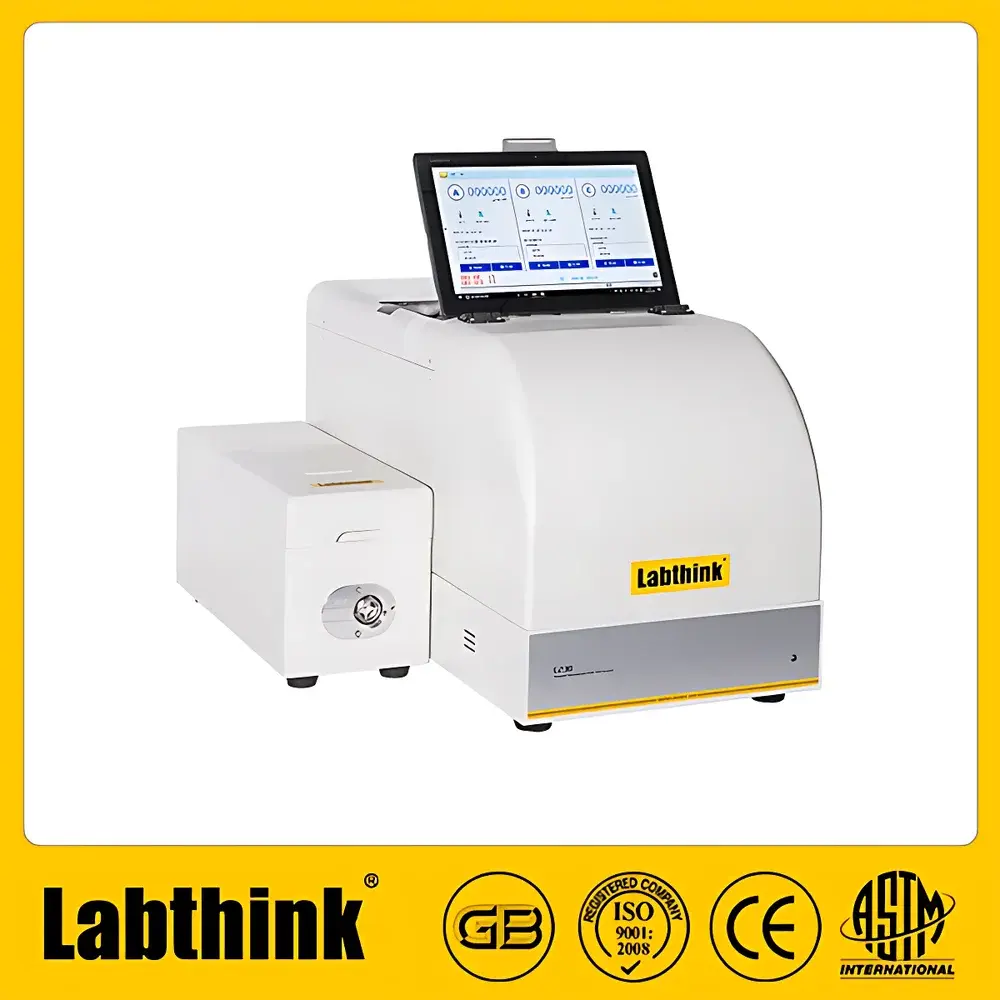
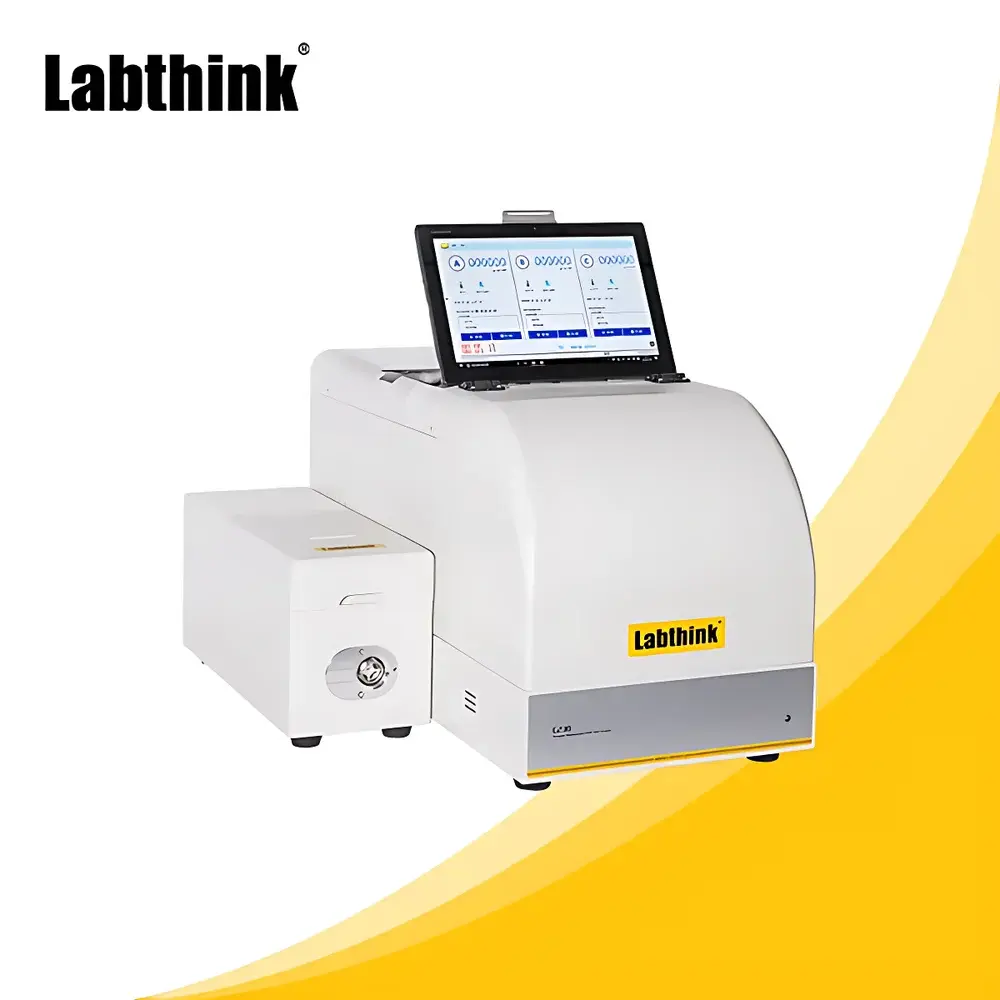
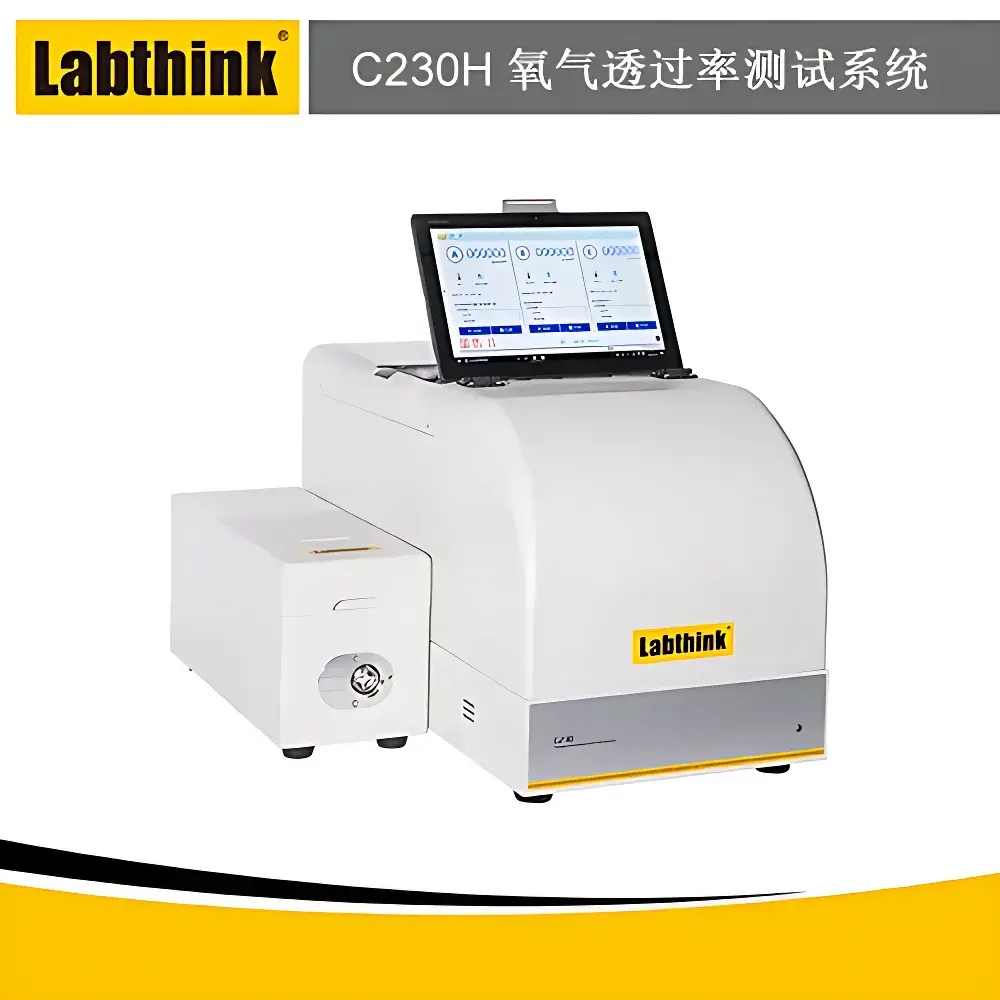
Labthink C230H Oxygen Transmission Rate (OTR) Tester for PP Eight-Treasure Congee Cups – Tri-Cavity Isobaric Coulometric Sensor System
| Brand | Labthink |
|---|---|
| Origin | Shandong, China |
| Manufacturer Type | OEM/ODM Producer |
| Country of Origin | China |
| Model | C230H |
| Price Range | USD 14,000 – 70,000 |
| Test Principle | Isobaric Coulometric Oxygen Sensor Method (ASTM D3985 compliant) |
| Test Range | 0.01–200 cm³/(m²·day) |
| Resolution | 0.001 cm³/(m²·day) |
| Temp Control | 10–55 °C ±0.2 °C |
| RH Control | 0%RH, 5–90%RH ±1%RH, 100%RH |
| Sample Capacity | 3 cavities |
| Max Package Volume | 3 L |
| Standard Test Area | 50 cm² |
| Specimen Size | 108 mm × 108 mm |
| Max Thickness | ≤3 mm |
| Carrier Gas | ≥99.999% N₂, ≥0.28 MPa |
| Interface | 1/8″ stainless steel tubing |
| Data Compliance | Optional 21 CFR Part 11, GMP audit trail, DataShield™ secure export |
Overview
The Labthink C230H Oxygen Transmission Rate (OTR) Tester is an isobaric, coulometric-sensor-based instrumentation system engineered for precise, repeatable quantification of oxygen permeation through flexible and rigid packaging materials—including polypropylene (PP) eight-treasure congee cups, blister packs, pouches, laminates, and pharmaceutical containers. It operates on the fundamental principle defined in ASTM D3985: oxygen diffuses across a conditioned test specimen under a controlled partial pressure gradient, where air or O₂ flows on one side and high-purity nitrogen (≥99.999%) sweeps the opposite side, carrying permeated O₂ molecules to a coulometric sensor for electrochemical detection. The resulting current is linearly proportional to O₂ flux, enabling calculation of OTR in standardized units (cm³/m²·day). Designed for regulatory-grade testing environments, the C230H integrates thermal and humidity uniformity control, tri-cavity parallel measurement architecture, and traceable metrology—making it suitable for QC labs operating under ISO/IEC 17025, USP , YBB 00082003-2015, and FDA-aligned packaging validation protocols.
Key Features
- Tri-cavity integrated test block: Patented monolithic aluminum manifold engineered using computational fluid dynamics (CFD) and thermodynamic modeling to minimize inter-chamber variance in temperature, humidity, and gas flow distribution—ensuring <±0.2 °C thermal homogeneity and <±1% RH stability across all three test stations.
- Independent environmental monitoring: Each test cavity houses dedicated platinum resistance thermometer (Pt100) and capacitive RH sensors, feeding real-time feedback to dual-loop PID controllers for dynamic compensation during extended-duration tests (e.g., 7-day shelf-life simulations).
- Automated environmental conditioning: Fully motorized humidification and thermoelectric heating/cooling subsystems enable unattended ramp-and-hold profiles per ASTM F1927 or GB/T 31354 without manual intervention.
- 12-inch industrial touch panel running Windows 10 IoT Enterprise: Preloaded with Labthink’s proprietary OTRControl™ software; supports both guided auto-test mode (ISO-compliant single-click execution) and advanced manual mode with granular parameter override (flow rate, dwell time, sensor zeroing interval, baseline drift correction).
- DataShield™ secure data management: AES-256 encrypted local storage, configurable audit trail (user login, method change, result modification), role-based access control, and export to CSV, PDF, XML, or LIMS-compatible formats—including direct integration with LabWare LIMS and Thermo Fisher SampleManager via OPC UA.
Sample Compatibility & Compliance
The C230H accommodates flat films (max 108 mm × 108 mm, ≤3 mm thick) and package forms—including seal-intact PP congee cups up to 3 L volume—via optional dome-shaped test fixtures that maintain isobaric equilibrium during headspace analysis. It meets the geometric and procedural requirements of ASTM F1307 (for packages), ASTM F1927 (for pouches with peelable seals), GB/T 19789 (Chinese national standard for plastic films), and JIS K7126-2-B (Japanese method B for cup-shaped containers). All hardware components—including gas manifolds, sensor housings, and chamber gaskets—are constructed from electropolished 316L stainless steel and PTFE-lined fittings to prevent catalytic O₂ decomposition or surface adsorption artifacts. Calibration traceability is maintained to NIST-traceable O₂ permeation standards (SRM 2811), with annual verification supported by Labthink’s ISO/IEC 17025-accredited calibration service.
Software & Data Management
OTRControl™ v5.2 provides full 21 CFR Part 11 compliance when configured with electronic signatures, biometric authentication, and immutable audit logs—enabling use in FDA-regulated pharmaceutical packaging validation. The software implements ALCOA+ principles (Attributable, Legible, Contemporaneous, Original, Accurate, Complete, Consistent, Enduring, Available) across all data lifecycles. Automated report generation includes uncertainty budgets per GUM (Guide to the Expression of Uncertainty in Measurement), repeatability statistics (n=3 per condition), and trending charts for long-term stability monitoring. Remote diagnostics and firmware updates are supported over wired Ethernet or optional IEEE 802.11ac Wi-Fi, with TLS 1.2–encrypted communication to enterprise networks.
Applications
- Food packaging R&D: Quantifying OTR of PP-based congee cups under accelerated aging conditions (e.g., 40 °C / 75% RH) to predict oxidative rancidity onset in lipid-rich formulations.
- Pharmaceutical primary packaging: Validating barrier integrity of Alu-Alu blisters and HDPE bottles per USP and EP 3.2.1.
- Medical device sterile barrier systems: Measuring OTR of Tyvek®-based pouches and thermoformed trays per ISO 11607-1.
- Photovoltaic encapsulant qualification: Screening EVA and POE films for edge-delamination risk under damp heat (85 °C / 85% RH).
- Regulatory submission support: Generating GLP-compliant test reports for PMDA, Health Canada, and ANVISA dossier submissions.
FAQ
Does the C230H support testing of non-flat, rigid containers such as PP congee cups?
Yes—the system includes optional package test fixtures with conformal sealing rings and internal N₂ purge manifolds to maintain isobaric equilibrium within 3 L volume limits.
Is sensor recalibration required between tests?
No. The coulometric sensor features auto-zeroing and baseline drift compensation algorithms; full recalibration is recommended only every 12 months or after sensor replacement.
Can the instrument be integrated into an existing LIMS or MES environment?
Yes—via RESTful API, OPC UA server, or direct database write (SQL Server/PostgreSQL); validated interfaces available for Siemens Opcenter, Thermo Fisher SampleManager, and LabWare LIMS.
What gas purity is mandatory for carrier nitrogen?
≥99.999% (5.0 grade) N₂ with total hydrocarbon content <0.1 ppmv and moisture <1 ppmv—verified via in-line dew point analyzer (optional accessory).
How is measurement uncertainty quantified in C230H reports?
Per ISO/IEC 17025:2017 Annex A, uncertainty is calculated using Type A (repeatability SD) and Type B (sensor sensitivity, temp/RH error, area tolerance) components, reported at k=2 (95% confidence).
Related Products





