
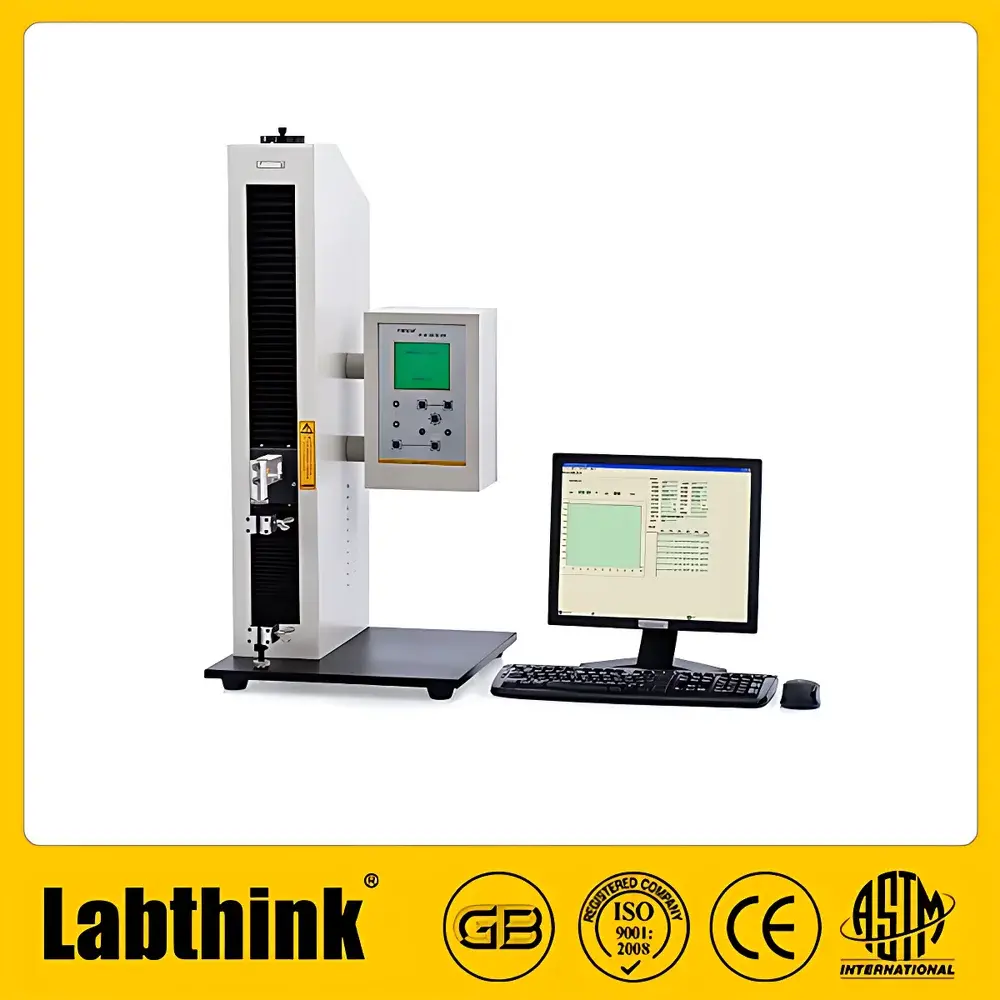
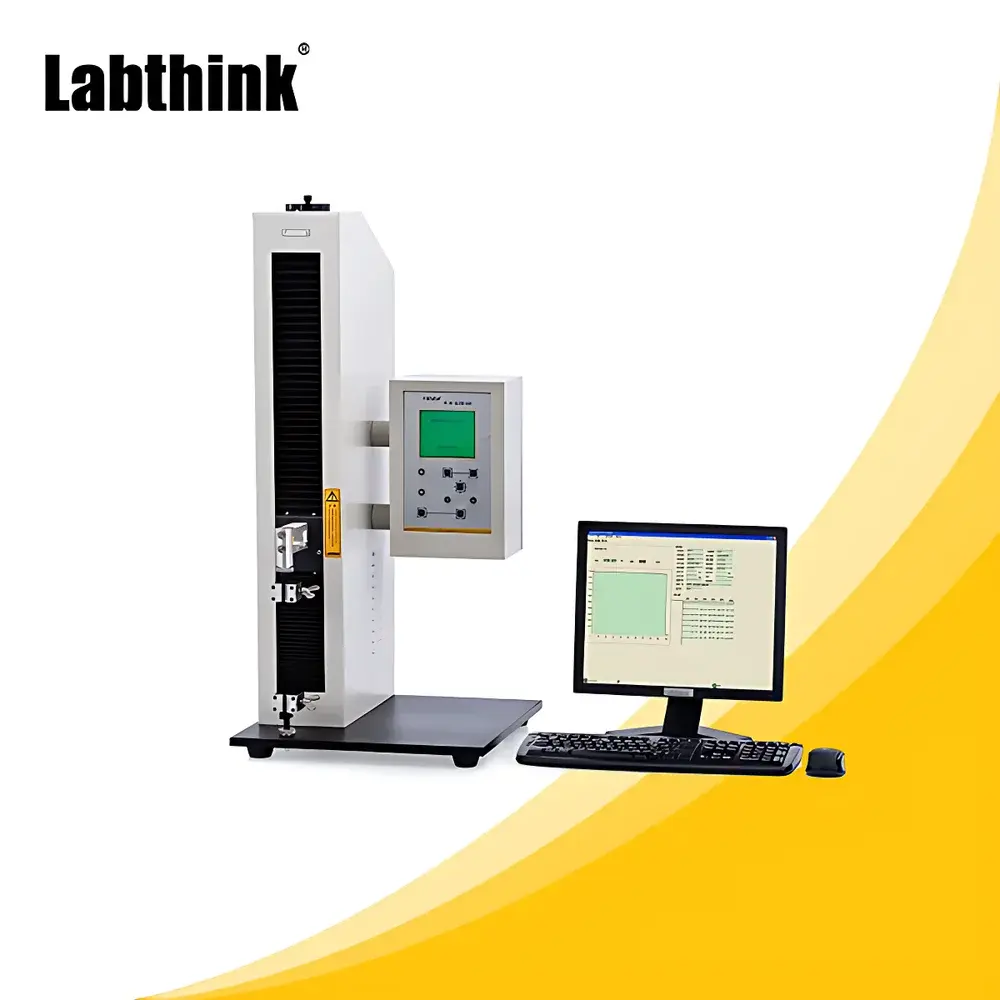
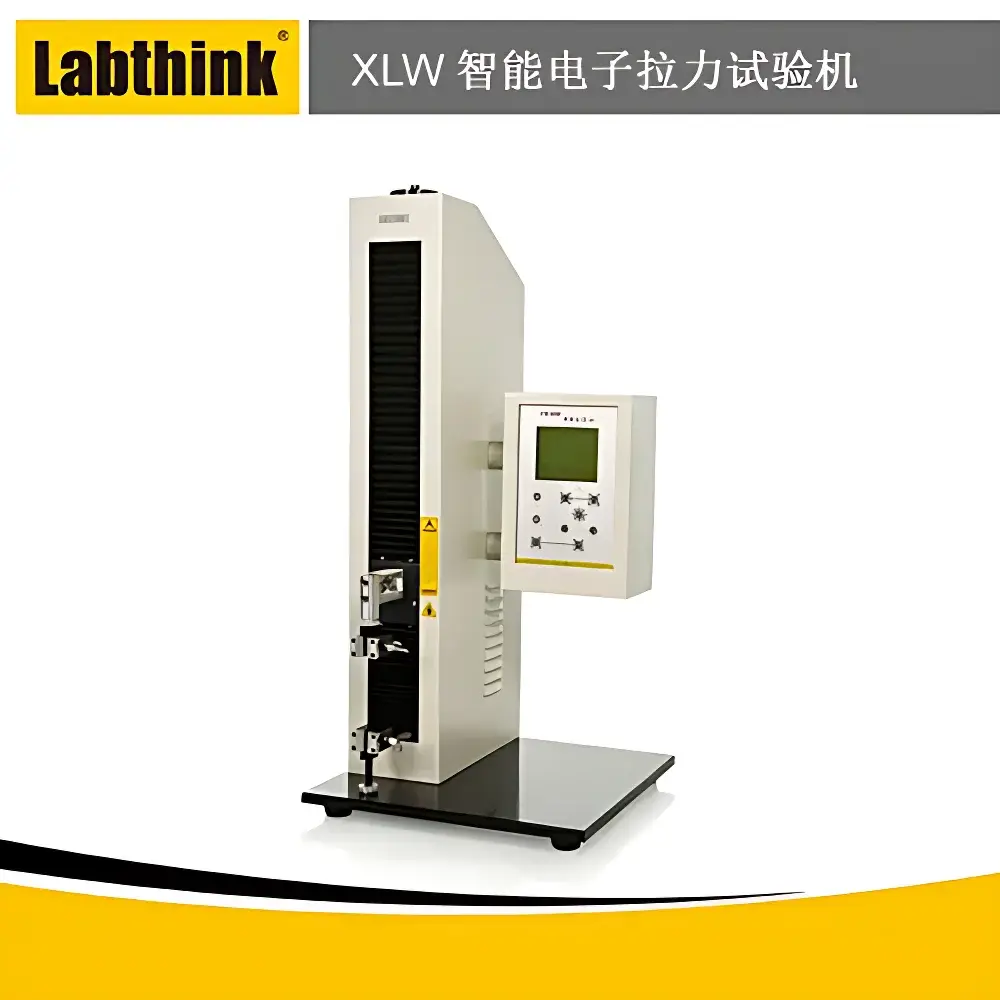
Labthink XLW Intelligent Electronic Tensile Testing Machine for Battery Separator Strength and Puncture Resistance Evaluation
| Brand | Labthink |
|---|---|
| Model | XLW |
| Origin | Shandong, China |
| Manufacturer Type | Direct Manufacturer |
| Instrument Category | Electronic Tensile Testing Machine |
| Maximum Load Capacity | 1 kN |
| Force Accuracy Class | Class 1 (per ISO 7500-1 / ASTM E4) |
| Test Stroke | 600 mm |
| Standard Load Cell | 500 N |
| Optional Load Cells | 30 N, 50 N, 100 N, 200 N, 750 N, 1000 N |
| Test Speeds | 50, 100, 150, 200, 250, 300, 500 mm/min (7 fixed rates) |
| Sample Width | 30 mm (standard fixture), 50 mm (optional) |
| Power Supply | 220 VAC 50 Hz / 120 VAC 60 Hz |
| Dimensions (L×W×H) | 450 × 450 × 980 mm |
| Net Weight | 65 kg |
Overview
The Labthink XLW Intelligent Electronic Tensile Testing Machine is a precision-engineered universal testing system designed specifically for mechanical property evaluation of thin-film materials used in advanced energy storage and packaging applications. It operates on the fundamental principle of uniaxial tensile loading under controlled displacement rate, where specimens are gripped between two parallel jaws and subjected to axial force until failure or predefined deformation. Force is measured via high-stability load cells mounted on the moving crosshead, while displacement is captured by an integrated linear encoder with sub-millimeter resolution. The system complies with core international standards governing mechanical testing of polymeric films and laminates—including ISO 37 (rubber vulcanized), ISO 7500-1 (static calibration of force-proving instruments), ASTM D882 (tensile properties of thin plastic sheeting), and ASTM D1938 (tear resistance of plastic film). Its primary application focus includes quantitative assessment of lithium-ion battery separator tensile strength (MD/TD), puncture resistance, elongation at break, Young’s modulus, and yield behavior—critical parameters directly correlated with cell safety, cycle life, and thermal runaway mitigation.
Key Features
- Class 1 force accuracy per ISO 7500-1 and ASTM E4, ensuring traceable measurement uncertainty suitable for QC laboratories operating under GLP/GMP frameworks
- Seven pre-programmed test modes: tensile, peel, tear, seal strength (ASTM F88), puncture, heat seal, and shear—each configured with dedicated algorithm logic and pass/fail thresholds
- Modular load cell architecture supporting 30 N to 1000 N ranges; standard 500 N cell optimized for separator and thin-film testing
- Seven fixed-speed drive options (50–500 mm/min), enabling compliance with method-specific strain-rate requirements across ISO, ASTM, and GB standards
- Microprocessor-based control with PVC membrane keypad, large LCD display, and intuitive menu navigation—designed for minimal operator training and rapid method recall
- Comprehensive hardware safety suite: mechanical limit switches, overload cut-off, automatic return-to-start post-test, and power-loss memory retention
- RS232 serial interface and optional thermal printer port for direct data export and hard-copy reporting without PC dependency
Sample Compatibility & Compliance
The XLW accommodates a broad spectrum of planar soft materials critical to battery, medical, and flexible packaging industries. Validated specimen types include microporous polyolefin separators (PP/PE/PP trilayer, ceramic-coated), polymer electrolyte membranes, aluminum/plastic laminates, metallized PET films, pressure-sensitive adhesives, medical transdermal patches, surgical drapes, and nonwovens. All test configurations adhere strictly to referenced methods: tensile tests follow ISO 37 and GB/T 1040 series; puncture resistance aligns with ISO 25539-2 (for biomedical devices) and internal battery industry protocols derived from UL 2580 Annex C; peel strength conforms to ASTM D3330 and GB/T 2792; seal integrity testing satisfies ASTM F88 and GB/T 10004. The instrument’s mechanical design and software logic support full audit trails required for FDA 21 CFR Part 11-compliant environments when paired with Lystem™ Laboratory Data Management System.
Software & Data Management
Bundled Lystem™ v3.x software provides ISO/IEC 17025-aligned data handling capabilities. Functions include group-wise statistical analysis (mean, SD, CV%, min/max), overlay of up to eight stress–strain curves for comparative material screening, elastic modulus calculation via initial linear slope fitting (per ASTM D882 Annex A2), and customizable report templates compliant with internal SOPs or external regulatory submissions. All test parameters—speed, gauge length, preload, break criteria—are digitally logged with timestamp and user ID. Audit trail features record every parameter modification, result deletion, or calibration event, satisfying GLP documentation requirements. Data export supports CSV, PDF, and XML formats; integration with Lystem™ cloud platform enables centralized result archiving, cross-site comparison, and automated certificate generation.
Applications
- Lithium-ion battery separator: MD/TD tensile strength, puncture force (needle diameter 1.0 mm, speed 50 mm/min), elongation at break, and modulus profiling
- Electrode coating integrity: binder adhesion strength (tape peel per ASTM D3330), current collector foil delamination resistance
- Flexible packaging: seal strength of pouches (ASTM F88), peel resistance of laminated structures (GB/T 2792), tear propagation (ASTM D1938)
- Medical devices: tensile performance of wound dressings, burst strength of IV bags, puncture resistance of sterile barrier systems (ISO 11607-2)
- Automotive interiors: tensile and tear behavior of acoustic foams, nonwoven headliner substrates, and adhesive-backed trim materials
FAQ
What standards does the XLW comply with for battery separator testing?
The system implements test protocols aligned with GB/T 1040.3–2006 (plastics—tensile testing—film and sheet), ISO 37 (vulcanized rubber), and internally validated puncture methods referenced in UL 2580 and IEC 62660-1.
Can the XLW perform simultaneous multi-specimen testing?
No—it is a single-station tester designed for sequential evaluation of individual specimens to ensure consistent jaw alignment and environmental control.
Is calibration certification included with shipment?
Yes—each unit ships with a factory-issued ISO/IEC 17025-accredited calibration certificate covering force and displacement axes, valid for 12 months under normal use conditions.
How is puncture testing configured for separators?
A standardized stainless-steel puncture probe (1.0 mm diameter, hemispherical tip) is mounted on the upper crosshead; specimen is clamped flat beneath a rigid support ring; force vs. displacement is recorded until breakthrough or 2 mm penetration depth.
Does the software support electronic signatures for regulated environments?
When deployed with Lystem™ Enterprise Edition and configured per customer validation protocol, it supports role-based electronic signatures compliant with 21 CFR Part 11 Annex 11 requirements.



