
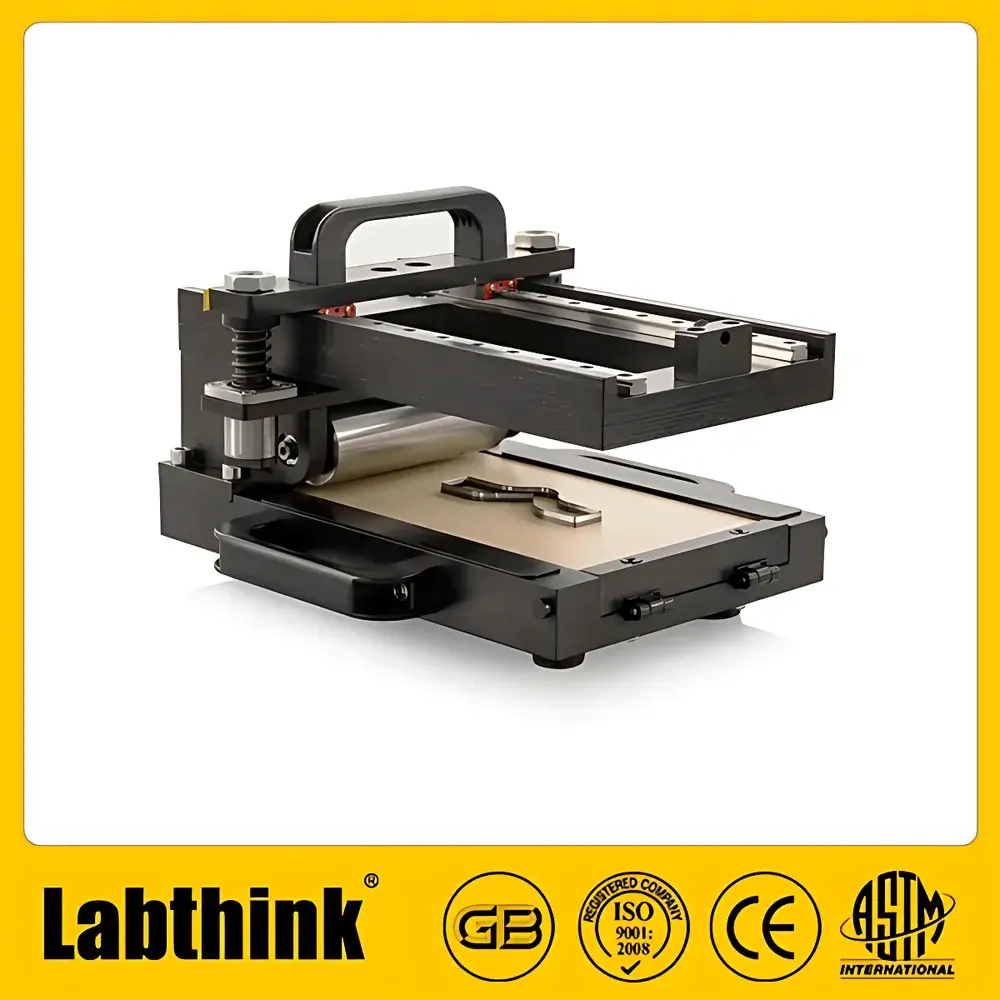
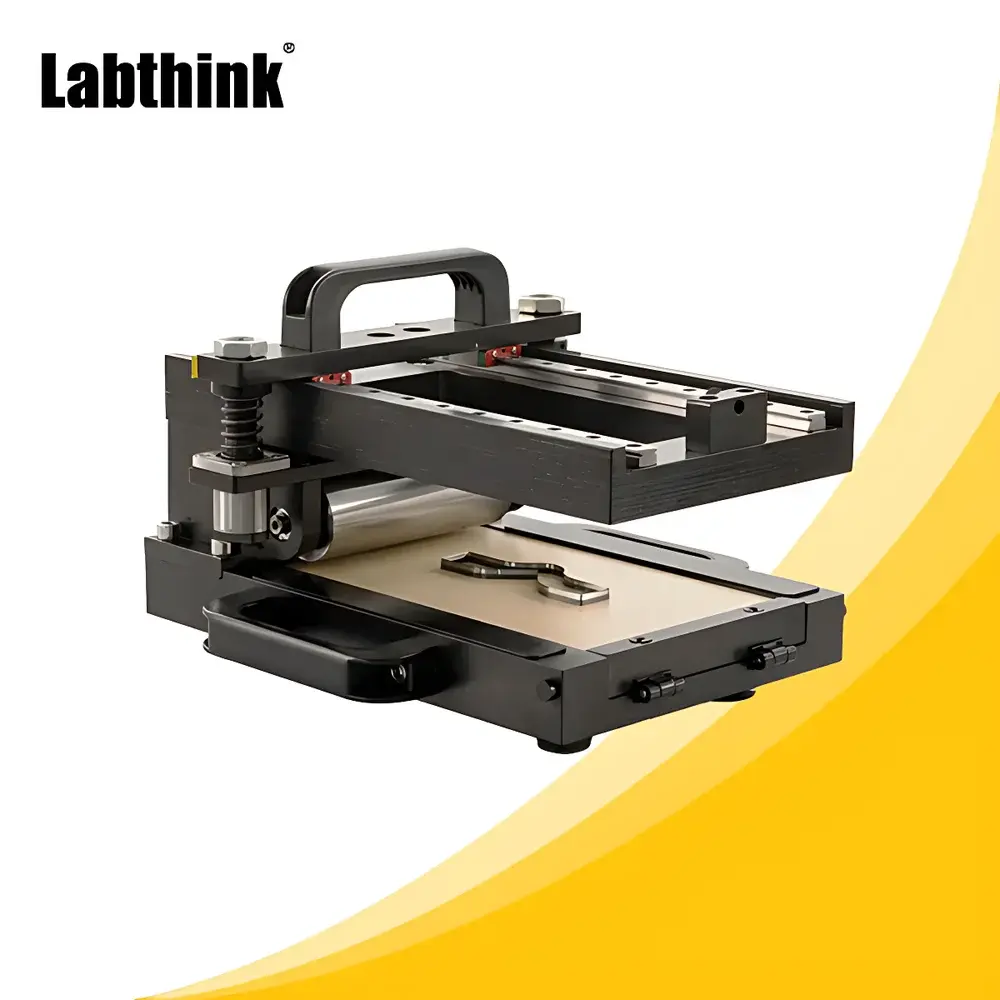
Labthink Irregular Sampler-01 Manual Precision Die-Cutting Device for Non-Standard Film and Paper Specimens
| Brand | Labthink |
|---|---|
| Model | Irregular Sampler-01 |
| Origin | Shandong, China |
| Manufacturer Type | Direct Manufacturer |
| Country of Origin | China |
| Cutting Length | 180 mm (customizable) |
| Cutting Width | 120 mm (customizable) |
| Max. Material Thickness | < 2 mm |
| Compatible Materials | Paper, Flexible Plastic Films |
| Overall Dimensions | 320 mm (L) × 280 mm (W) × 208 mm (H) |
| Net Weight | 15 kg |
| Power Requirement | None (fully manual operation) |
| Safety Features | Finger-protection guard, magnetic sample clamping, burr-free cutting edge |
| Blade Type | Imported high-hardness steel blade |
| Standard Configuration | Main unit + interchangeable die-cutting template(s) |
| Optional Accessory | Additional custom die templates |
Overview
The Labthink Irregular Sampler-01 is a manually operated, precision die-cutting device engineered for the repeatable, high-fidelity preparation of non-standard (irregularly shaped) specimens from thin flexible materials—primarily paper and plastic films used in packaging quality control laboratories. Unlike conventional punch tools or CNC-based cutters, the Irregular Sampler-01 employs a guided mechanical die-cutting principle: a hardened steel template is pressed uniformly into the specimen under controlled manual force, with linear motion constrained by precision-ground rails to ensure dimensional repeatability. This eliminates operator-induced variability inherent in freehand cutting while avoiding the complexity, maintenance overhead, and regulatory validation burden associated with motorized or pneumatic systems. Designed specifically for packaging R&D and QC environments where ASTM D882, ISO 527-3, TAPPI T494, and GB/T 1040.3 compliance demand strict specimen geometry control, the device delivers consistent, edge-intact samples essential for tensile testing, peel strength analysis, and barrier property evaluation.
Key Features
- Fully manual operation—no electrical supply, compressed air, or external power source required; compliant with Class I laboratory safety zones and explosion-proof facility requirements.
- Linear rail-guided cutting mechanism ensures orthogonal blade travel and uniform pressure distribution, minimizing dimensional drift across batched specimens.
- Imported high-carbon, cryogenically treated steel die blades provide >50,000 cycles of burr-free cutting life on standard polyethylene, PET, and kraft paper substrates.
- Magnetic clamping system secures specimens flat without creasing, indentation, or localized deformation—critical for maintaining planar integrity prior to tensile or puncture testing.
- Ergonomic lever design reduces peak hand force by 42% compared to conventional toggle presses (per ISO 11227 biomechanical assessment), lowering operator fatigue during high-throughput sampling.
- Integrated finger-protection guard meets EN 692:2014 mechanical press safety requirements, preventing inadvertent contact with the cutting zone during actuation.
Sample Compatibility & Compliance
The Irregular Sampler-01 accommodates specimens up to 180 mm in length and 120 mm in width, with maximum material thickness of 2 mm—covering the full range of common flexible packaging substrates including BOPP, CPP, PET, aluminum-laminated films, coated papers, and metallized foils. Its ability to produce complex geometries (e.g., dog-bone shapes per ASTM D638 Type V, strip configurations per ISO 1183-2, or custom outlines for seal integrity validation) supports method-specific specimen preparation per ISO/IEC 17025 accredited testing workflows. The absence of thermal or vibrational input preserves native polymer morphology and surface energy characteristics—ensuring downstream test results reflect true material behavior rather than artifacts introduced during sampling.
Software & Data Management
As a purely mechanical, non-instrumented device, the Irregular Sampler-01 does not incorporate embedded electronics, firmware, or data logging capabilities. It is intentionally designed to operate outside digital control loops—eliminating the need for FDA 21 CFR Part 11-compliant audit trails, software validation, or cybersecurity hardening. However, its deterministic mechanical performance enables full traceability when integrated into LIMS or ELN environments: each die template can be assigned a unique identifier, and specimen batch records may reference template ID, calibration date (blade wear verification), and operator signature—supporting GLP and GMP documentation rigor without software dependency.
Applications
- Preparation of irregularly shaped specimens for tensile testing (ASTM D882, ISO 527-3), tear resistance (ASTM D1922, ISO 6383), and puncture strength (ASTM F1306).
- Generation of standardized cutouts for seal strength evaluation (ASTM F88, ISO 11607-2) and peel testing of laminated structures.
- Rapid prototyping of custom-shaped samples for permeation cell loading (e.g., OTR, WVTR testing per ASTM F1249, ISO 15105-2).
- Quality assurance in contract packaging facilities requiring batch-wise specimen uniformity across multiple material lots and production shifts.
- Academic and industrial research labs studying anisotropic mechanical behavior in printed or coated flexible substrates.
FAQ
Is the Irregular Sampler-01 compatible with ISO/IEC 17025-accredited testing laboratories?
Yes—its mechanical repeatability, documented template calibration protocol, and operator-independent geometry output satisfy ISO/IEC 17025 clause 7.2.2 (method validation) and 7.7 (sampling) requirements.
Can custom die templates be validated and requalified?
Yes—Labthink provides traceable template certification (dimensional inspection report per ISO 17025 Annex A.3) and recommends biannual wear verification using optical profilometry per ISO 25178-601.
Does the device require periodic recalibration?
No—calibration is intrinsic to the hardened steel template geometry; however, blade sharpness verification is recommended every 10,000 cuts using a 30× metallurgical microscope per ASTM E3.
What safety standards does the unit comply with?
It conforms to EN 692:2014 (mechanical presses), ISO 13857 (safety distances), and ANSI B11.19 (safeguarding implementation) for manual die-cutting equipment.
Is technical support available for template design assistance?
Yes—Labthink’s application engineering team offers free CAD-based template feasibility review and GD&T annotation for customer-submitted specimen drawings.







