
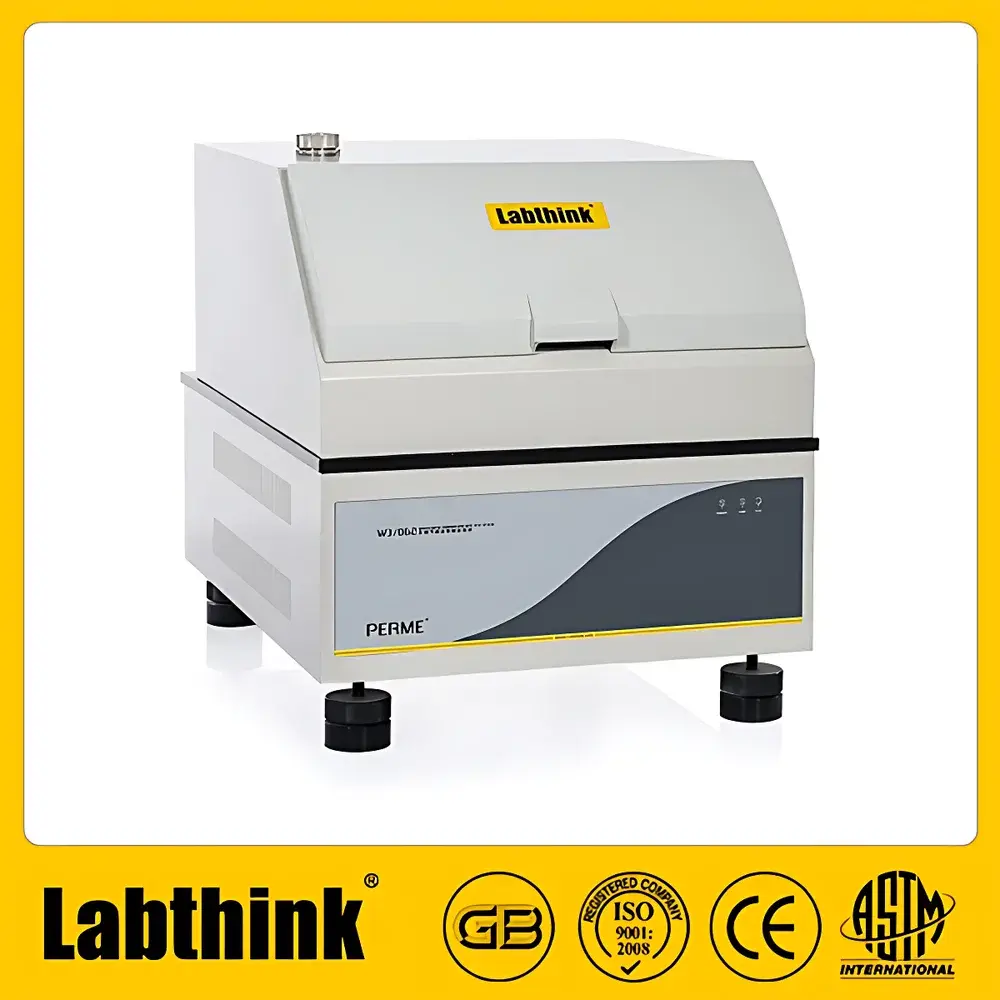
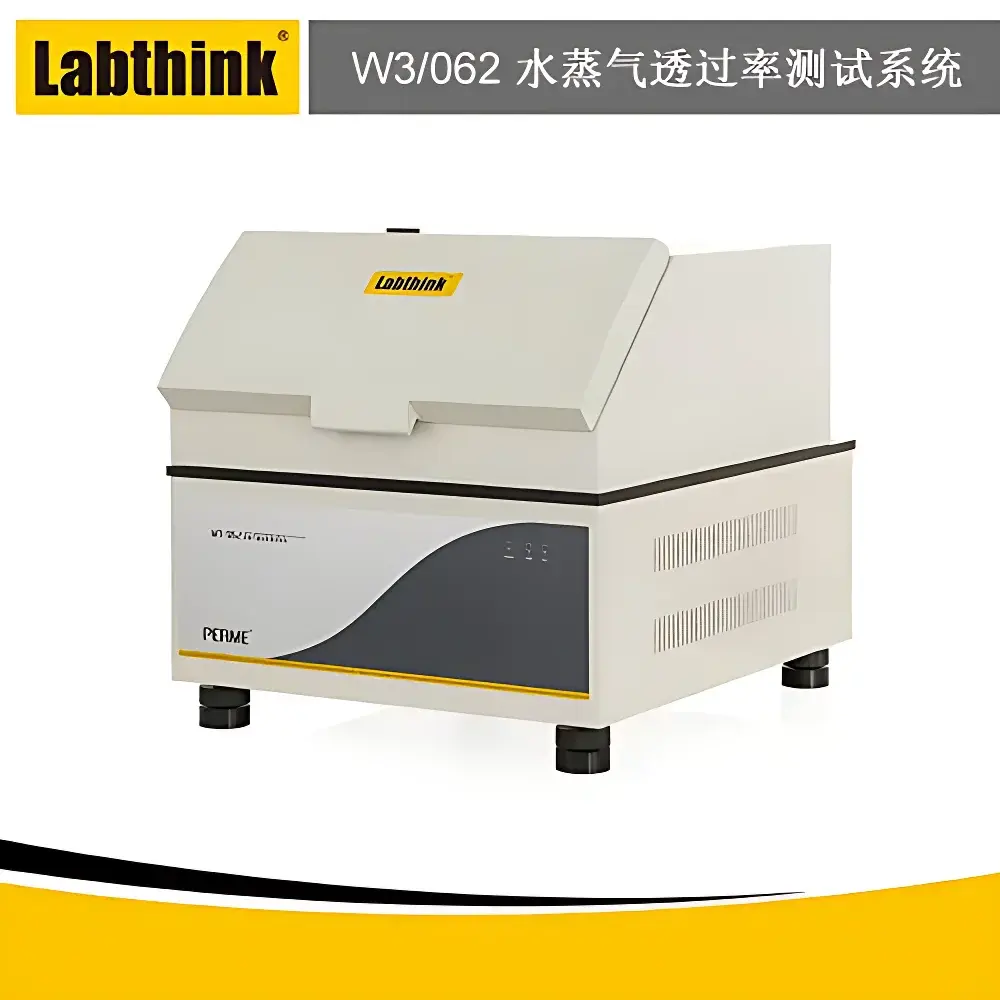
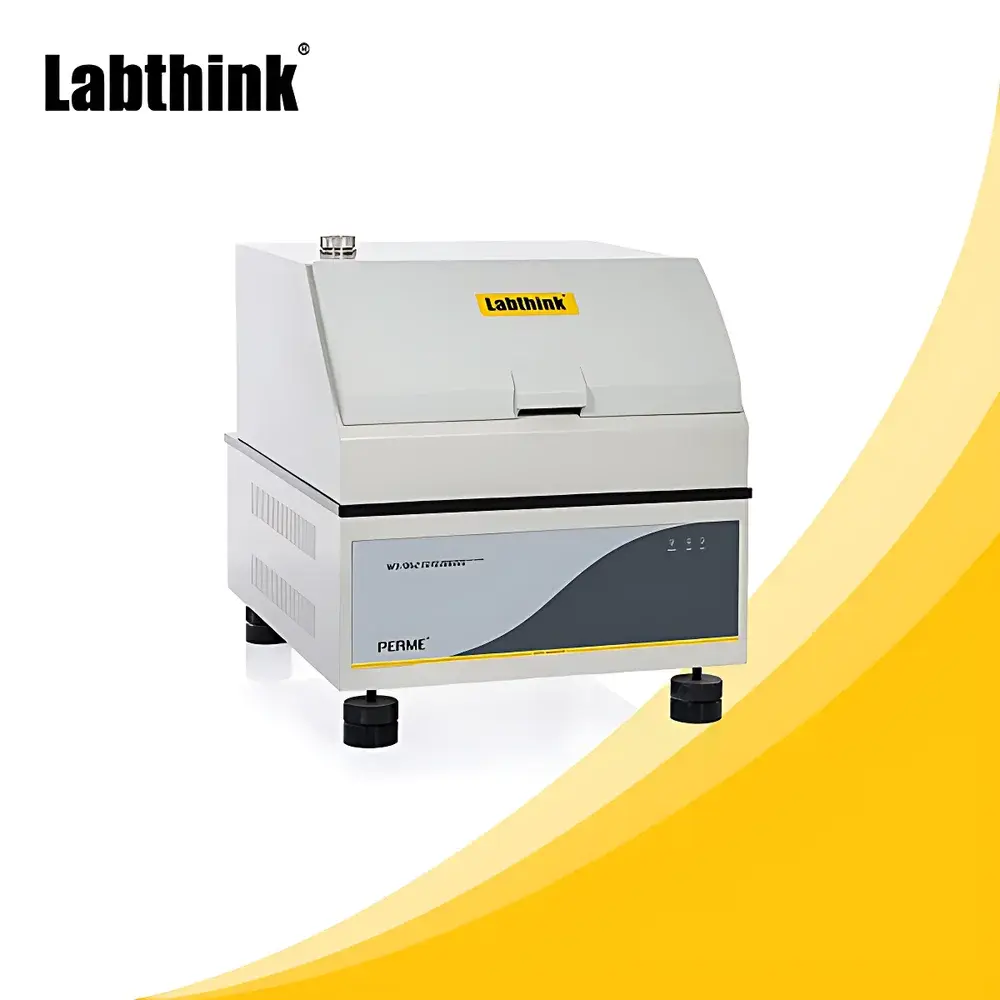
Labthink PERME W3/062 Gravimetric Water Vapor Transmission Rate (WVTR) Tester for Multilayer Coextruded IV Bags
| Brand | Labthink |
|---|---|
| Model | PERME W3/062 |
| Principle | Gravimetric Cup Method (ASTM E96, ISO 2528, GB 1037) |
| Test Range | 0.1–10,000 g/m²·24h (loss mode) |
| Sample Capacity | 1–6 independent specimens per run |
| Temperature Control | 15–55 °C (±0.1 °C) |
| Humidity Control | 10–98 %RH (±1 %RH) |
| Test Area | 33 cm² |
| Specimen Thickness | ≤3 mm |
| Weight Resolution | 0.001 g |
| Power Supply | 220 VAC 50 Hz / 120 VAC 60 Hz |
| Net Weight | 80 kg |
| Dimensions | 660 × 580 × 580 mm (L×W×H) |
Overview
The Labthink PERME W3/062 Gravimetric Water Vapor Transmission Rate (WVTR) Tester is a precision-engineered instrument designed specifically for the quantitative determination of water vapor permeation through polymeric films and laminates used in pharmaceutical packaging—particularly multilayer coextruded films for intravenous (IV) solution bags. It operates on the gravimetric cup method, a primary reference technique standardized under ASTM E96, ISO 2528, GB 1037, and YBB00092003. In this method, a conditioned film specimen seals the mouth of a test cup containing either desiccant (for weight-loss mode) or distilled water (for weight-gain mode), establishing a defined vapor pressure gradient across the sample. The system continuously monitors mass change of the cup assembly over time using a high-resolution analytical balance (0.001 g resolution), enabling calculation of WVTR in g/m²·24h with traceable accuracy. Its architecture supports both regulatory-compliant routine QC testing and R&D-level material screening under tightly controlled temperature (±0.1 °C) and relative humidity (±1 %RH) conditions.
Key Features
- Regulatory-Ready Gravimetric Architecture: Complies with pharmacopoeial and packaging standards including USP <671>, YBB00092003, and ISO 15378 Annex 1 requirements for barrier property verification of sterile packaging components.
- Parallel Six-Station Testing: Equipped with a precision-machined circular sample carousel accommodating six independent permeation cups—each with sealed, isolated environmental control—enabling simultaneous evaluation of heterogeneous film lots or formulation variants without cross-contamination.
- Scalable Multi-Unit Configuration: Supports up to nine satellite units connected to a single master controller, delivering 60-channel parallel testing capacity—ideal for high-throughput stability studies or accelerated aging validation protocols.
- Dynamic Environmental Control: Dual-mode humidity generation (10–98 %RH) and thermally stabilized chamber (15–55 °C) ensure reproducible gradient establishment per ASTM D1653 and TAPPI T464. Optional airflow regulation (0.5–2.5 m/s) mitigates boundary layer effects for low-permeability films.
- Traceable Metrology: Integrated calibration protocol includes certified reference weights and NIST-traceable humidity generators. System resolution of 0.001 g meets GLP audit requirements for raw data integrity and instrument qualification (IQ/OQ/PQ).
Sample Compatibility & Compliance
The W3/062 accommodates rigid and flexible polymeric films up to 3 mm thick—including ethylene vinyl alcohol (EVOH), polyethylene (PE), polypropylene (PP), polyester (PET), and aluminum oxide-coated substrates—commonly employed in Class II and III medical device packaging. Its 33 cm² test area (Φ74 mm specimen) aligns with ISO 2528 and ASTM E96 geometry specifications. All hardware materials contacting test environments are inert stainless steel or anodized aluminum, eliminating outgassing risks during prolonged exposure. The instrument satisfies design controls per ISO 13485:2016 and supports full 21 CFR Part 11 compliance when deployed with Lystem™ Laboratory Data Management System (LDMS), including electronic signatures, audit trails, and role-based access control.
Software & Data Management
Controlled via Labthink’s proprietary PERME OS v3.x software, the W3/062 provides real-time mass trending, automatic endpoint detection, and nonlinear regression fitting for non-steady-state diffusion analysis. Raw weight vs. time datasets are exported in CSV and XML formats compatible with JMP, Minitab, and statistical process control (SPC) platforms. When integrated with Lystem™ LDMS, all test parameters, calibration logs, user actions, and result reports are archived in a centralized SQL database with immutable timestamps—fulfilling ALCOA+ principles (Attributable, Legible, Contemporaneous, Original, Accurate, Complete, Consistent, Enduring, Available). Electronic records support FDA inspection readiness and internal GMP audits.
Applications
- Validation of moisture barrier performance for IV bag films under ICH Q1A(R2) accelerated stability conditions (40 °C/75 %RH).
- Comparative WVTR profiling of alternative sealant layers in tri-layer coextrusions (e.g., PP/EVOH/PP vs. PE/EVOH/PE).
- Quality conformance testing per YBB00092003 for registered pharmaceutical packaging dossiers.
- Diffusion coefficient (D) and solubility coefficient (S) derivation via Fickian modeling of time-lag data.
- Supporting ISO 11607-1 Annex C risk assessments for sterile barrier system integrity.
FAQ
What regulatory standards does the W3/062 directly support?
It natively implements test protocols aligned with ASTM E96 (desiccant and water methods), ISO 2528, GB/T 16928, JIS Z0208, DIN 53122-1, and China’s YBB00092003 for pharmaceutical packaging.
Can the system operate unattended for extended duration?
Yes—equipped with continuous power backup compatibility and automated error recovery, it supports 72+ hour uninterrupted runs with scheduled auto-calibration and humidity drift compensation.
Is method equivalence validation documentation available?
Labthink provides a comprehensive Method Transfer Package (MTP), including inter-laboratory precision studies, ruggedness testing (DoE), and correlation matrices against infrared sensor-based systems per ASTM F1249.
How is data integrity ensured during networked operation?
Lystem™ LDMS enforces 21 CFR Part 11-compliant audit trails, with cryptographic hashing of all raw datasets and dual-authorization workflows for report finalization.
What maintenance intervals are recommended for GMP environments?
Preventive maintenance is scheduled every 6 months, including balance recalibration, humidity sensor verification, and chamber seal integrity checks—all documented in machine-readable service logs.




