
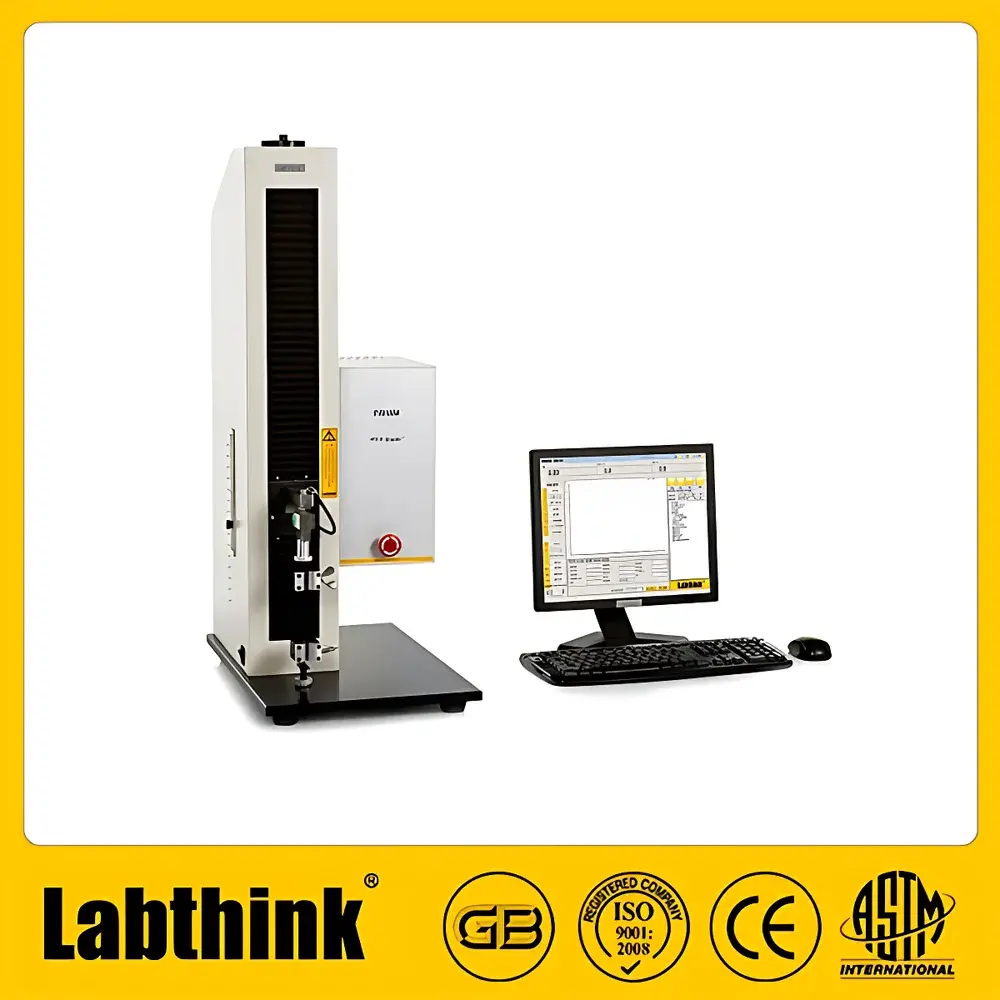
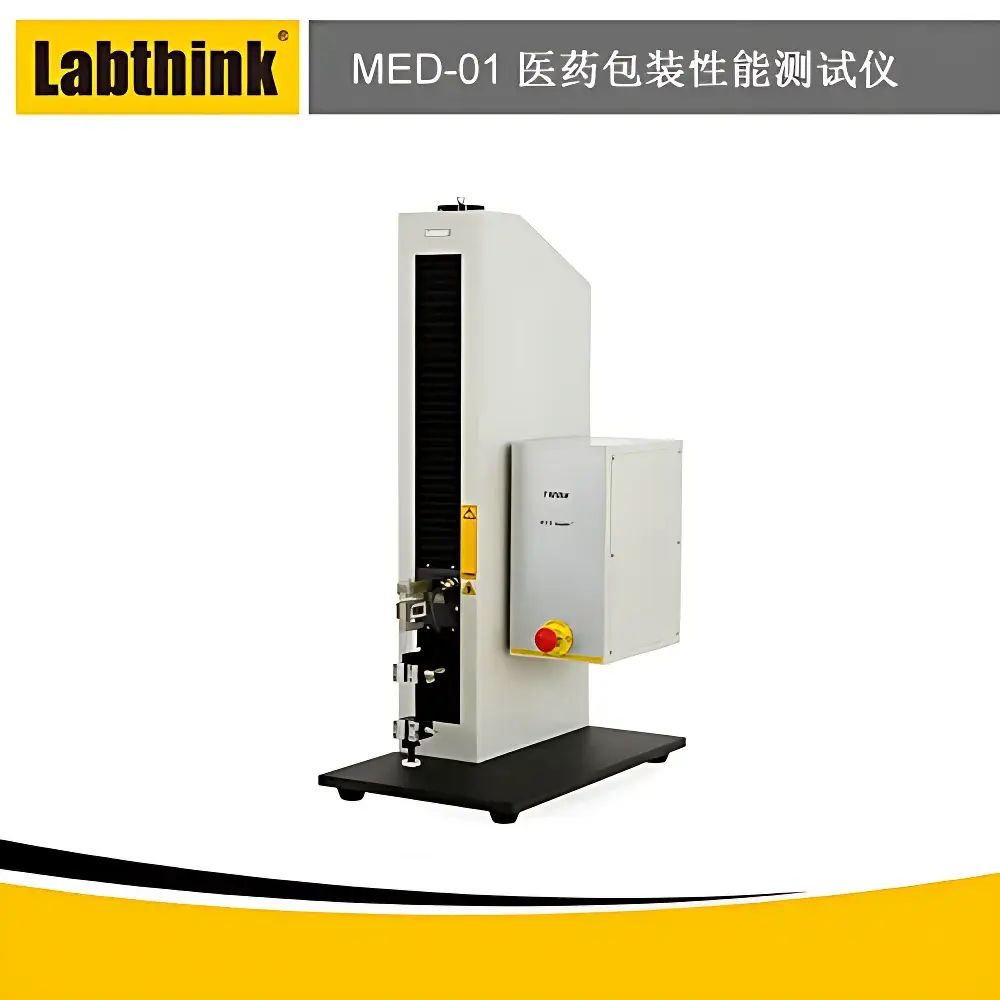
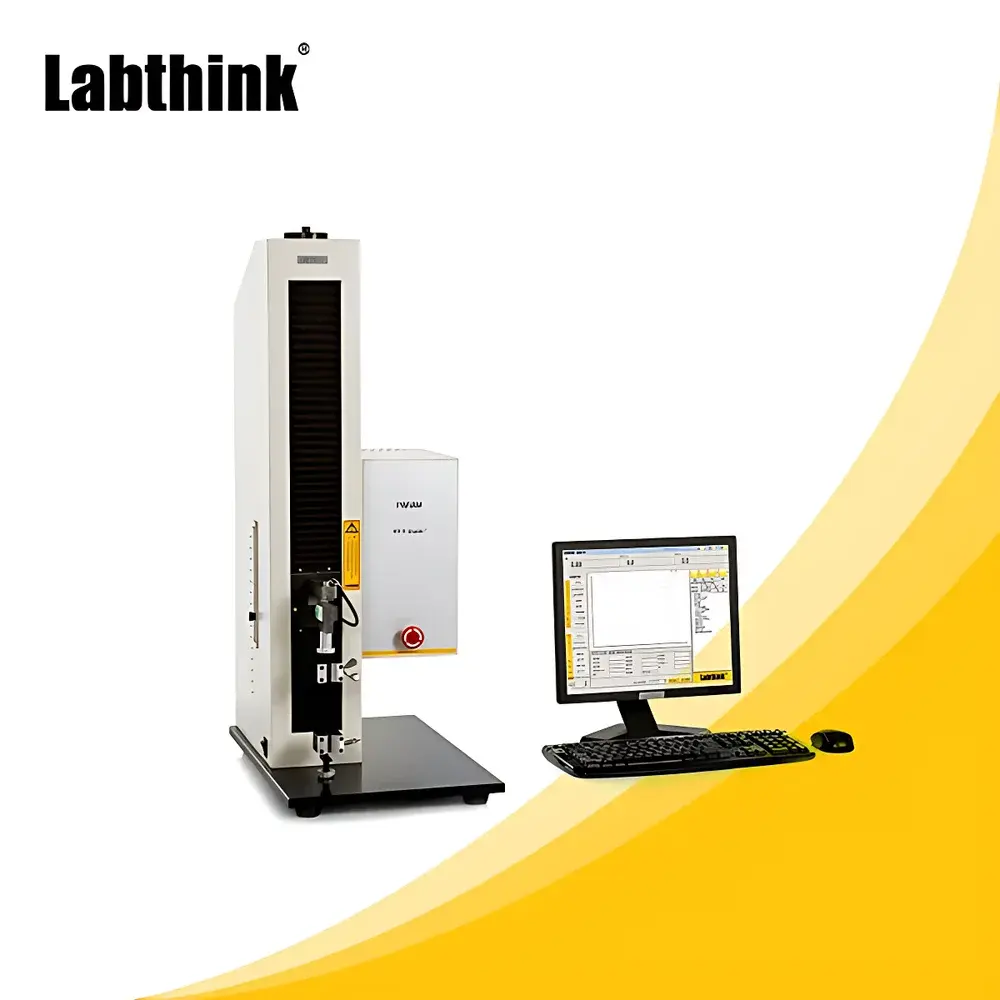
Labthink PRAM博每 MED-01 Sterile Syringe Barrel Integrity Tester (Positive Pressure Method)
| Brand | Labthink |
|---|---|
| Origin | Shandong, China |
| Manufacturer Type | Direct Manufacturer |
| Region of Origin | Domestic (China) |
| Model | PRAM博每 MED-01 |
| Price | Upon Request |
| Load Capacity | 250 N (Standard) |
| Optional | 50 N, 100 N, 500 N |
| Force Accuracy | Better than Class 0.5 |
| Test Speed (Approach) | 10, 50, 100, 150, 200 mm/min (Standard) |
| Test Speed (Return) | 10, 50, 100, 150, 200 mm/min (Standard) |
| Sample Count per Test | 1 |
| Fixture Width | 30 mm (Standard) |
| Clamping Method | Manual |
| Stroke | 600 mm |
| Dimensions (L×W×H) | 851 × 500 × 940 mm |
| Power Supply | AC 220 V, 50 Hz |
| Max Power Consumption | 60 W |
Overview
The Labthink PRAM博每 MED-01 Sterile Syringe Barrel Integrity Tester (Positive Pressure Method) is a dedicated mechanical testing system engineered for the quantitative assessment of barrel–plunger and needle hub–barrel seal integrity in single-use sterile syringes. It operates on the principle of controlled positive pressure application—consistent with the physical validation method specified in YBB00112004 (Chinese Pharmaceutical Packaging Standard) and aligned with functional requirements outlined in ISO 7886-1:2017 *Syringes for medical use — Part 1: Syringes for single use, without needle*. During test execution, the syringe is filled to 50% volume with deaerated water, the needle is capped to prevent venting, and a defined axial force (30 N) is applied to the plunger for 5 seconds. Integrity is confirmed by visual inspection for absence of liquid leakage at the plunger seal or needle hub interface. This deterministic, pass/fail mechanical challenge provides objective evidence of primary container closure integrity under simulated clinical handling conditions.
Key Features
- Compliance-driven test protocol execution: Fully supports the standardized 30 N / 5 s positive pressure hold sequence per YBB00112004 and ISO 7886-1.
- Modular load cell configuration: Standard 250 N capacity with optional 50 N, 100 N, and 500 N transducers—enabling precise force resolution across low-force pediatric syringes and high-force industrial formats.
- Adjustable, repeatable test speed control: Five standard approach and return speeds (10–200 mm/min) ensure consistent plunger displacement kinetics and minimize operator-induced variability.
- Manual clamping architecture with dual-fixture compatibility: Accommodates standard 30 mm and optional 50 mm jaw widths to secure syringes ranging from 1 mL to 60 mL nominal volume.
- Robust mechanical design: 600 mm vertical stroke and rigid frame construction ensure long-term dimensional stability and repeatability over thousands of test cycles.
- Low-power, laboratory-grade operation: 60 W max power draw enables integration into shared QC lab environments without dedicated circuitry.
Sample Compatibility & Compliance
The MED-01 is validated for use with all common configurations of glass and polymer-based single-use sterile syringes, including Luer-lock, Luer-slip, and integrated needle variants. It meets essential regulatory expectations for equipment used in pharmaceutical packaging qualification: mechanical calibration traceability to national standards (e.g., CNAS-accredited reference laboratories), documented force accuracy (< ±0.5% of full scale), and stable environmental performance across typical lab conditions (15–30 °C, ≤70% RH). While not a standalone GMP-certified instrument, its operational parameters and output records are compatible with GLP/GMP documentation workflows when paired with controlled test procedures and audit-ready logbooks.
Software & Data Management
The MED-01 operates as a stand-alone electromechanical tester with analog force feedback and digital speed control—requiring no proprietary software or PC interface. All test parameters (applied force, dwell time, speed profile) are set via front-panel controls. Results are recorded manually or integrated into facility-wide LIMS or ELN systems via operator-entered pass/fail outcomes and timestamped test logs. For facilities requiring electronic records compliant with FDA 21 CFR Part 11, external data capture solutions (e.g., calibrated digital force meters with RS-232/USB output and validated acquisition software) may be deployed in parallel—subject to site-specific validation protocols.
Applications
- Quality control release testing of sterile syringe batches prior to sterilization and packaging.
- Design verification of new syringe platforms during development (e.g., evaluating plunger lubricant efficacy, barrel material creep resistance, or hub adhesive bond strength).
- Supplier qualification audits for contract manufacturing organizations (CMOs) and component vendors.
- Root cause analysis of field complaints related to leakage, dose inaccuracy, or air ingress during clinical use.
- Stability study support: periodic retesting of aged syringes to assess seal degradation under accelerated or real-time storage conditions.
FAQ
Does the MED-01 comply with ISO 7886-1:2017?
Yes—the test methodology (30 N axial force, 5 s dwell, visual leak detection) directly implements Clause 6.5.2 of ISO 7886-1:2017 for barrel–plunger seal evaluation.
Can it test syringes with integrated safety mechanisms?
Yes, provided the safety feature does not obstruct plunger travel or interfere with force transmission; fixture adaptation may be required for non-standard geometries.
Is calibration certification included with shipment?
A factory calibration report is supplied; users must establish internal calibration intervals per their quality system—typically every 6–12 months or after 500 test cycles.
What maintenance is required?
Routine cleaning of guide rods and load cell housing; annual verification of speed accuracy and force linearity using traceable reference weights and timing instruments.
Is the device suitable for regulatory submission dossiers?
Yes—when operated under a validated SOP with documented calibration, preventive maintenance, and operator training records, test data from the MED-01 is acceptable for inclusion in DMF, ANDA, and MDR submissions.






