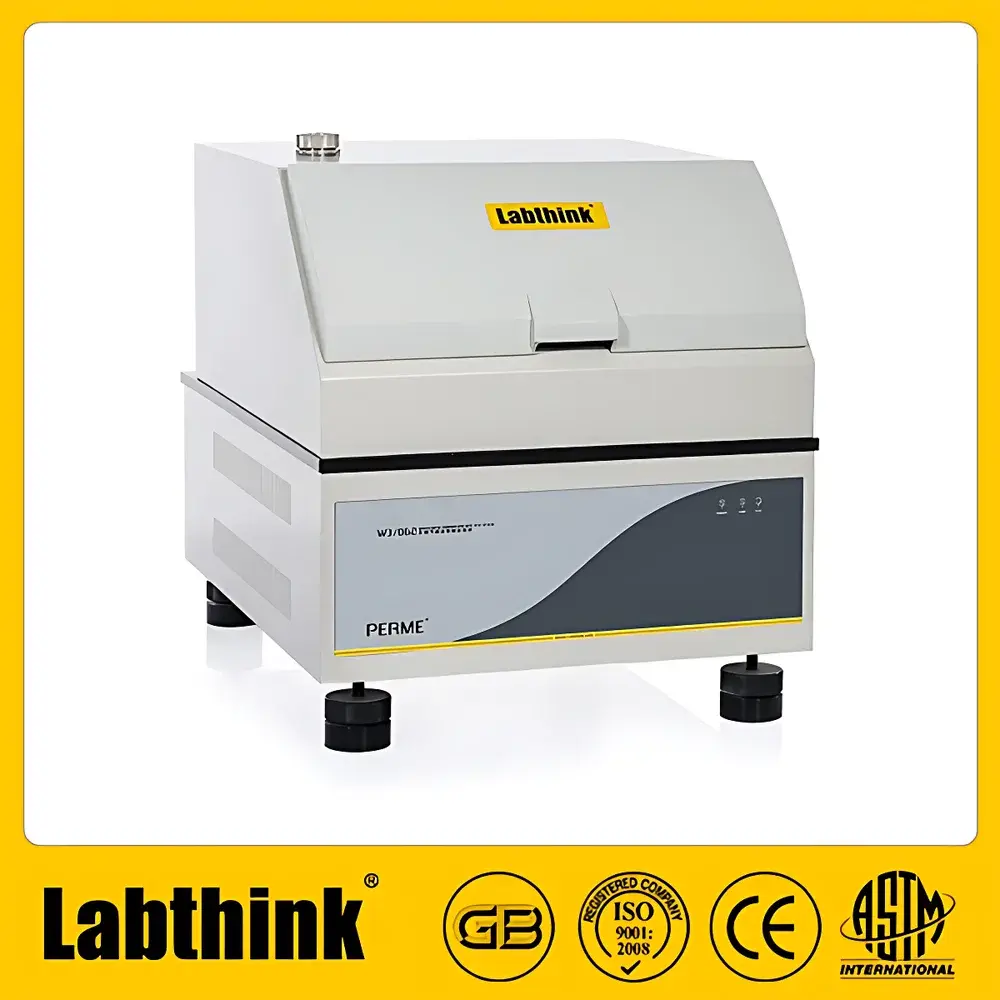
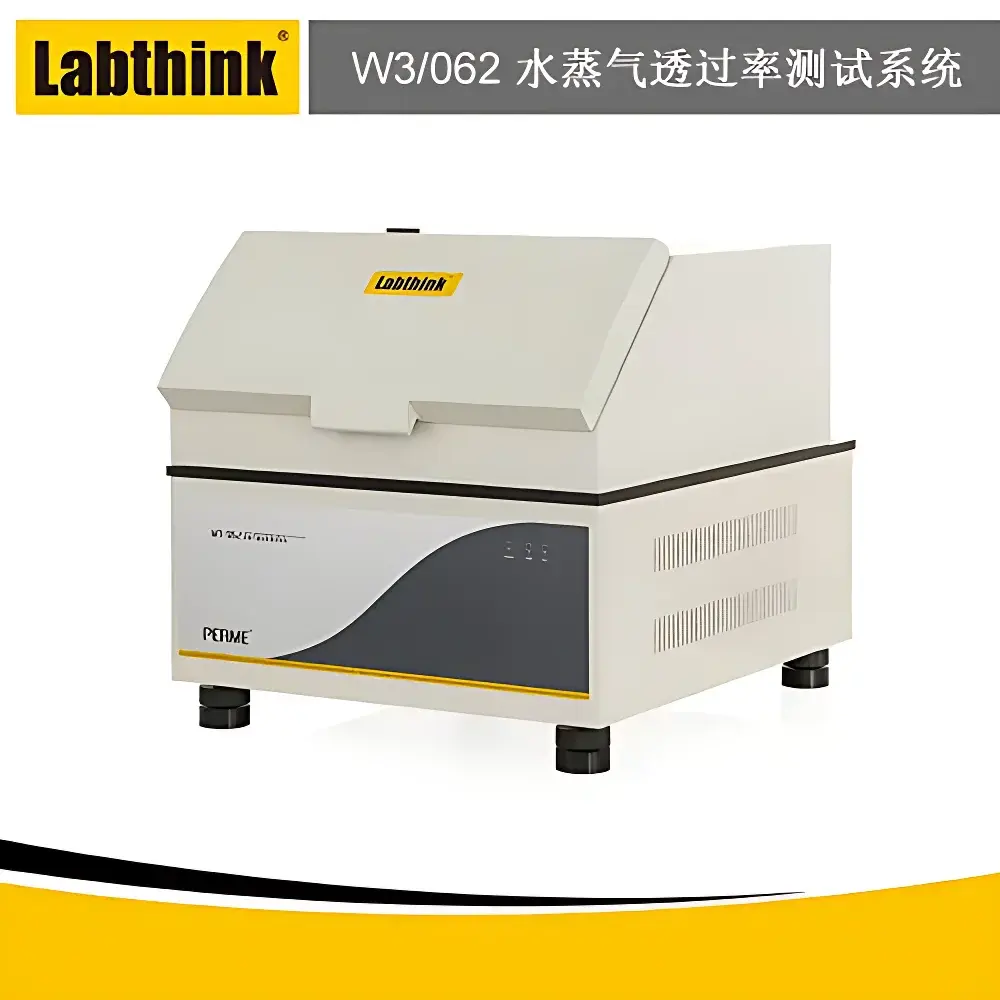
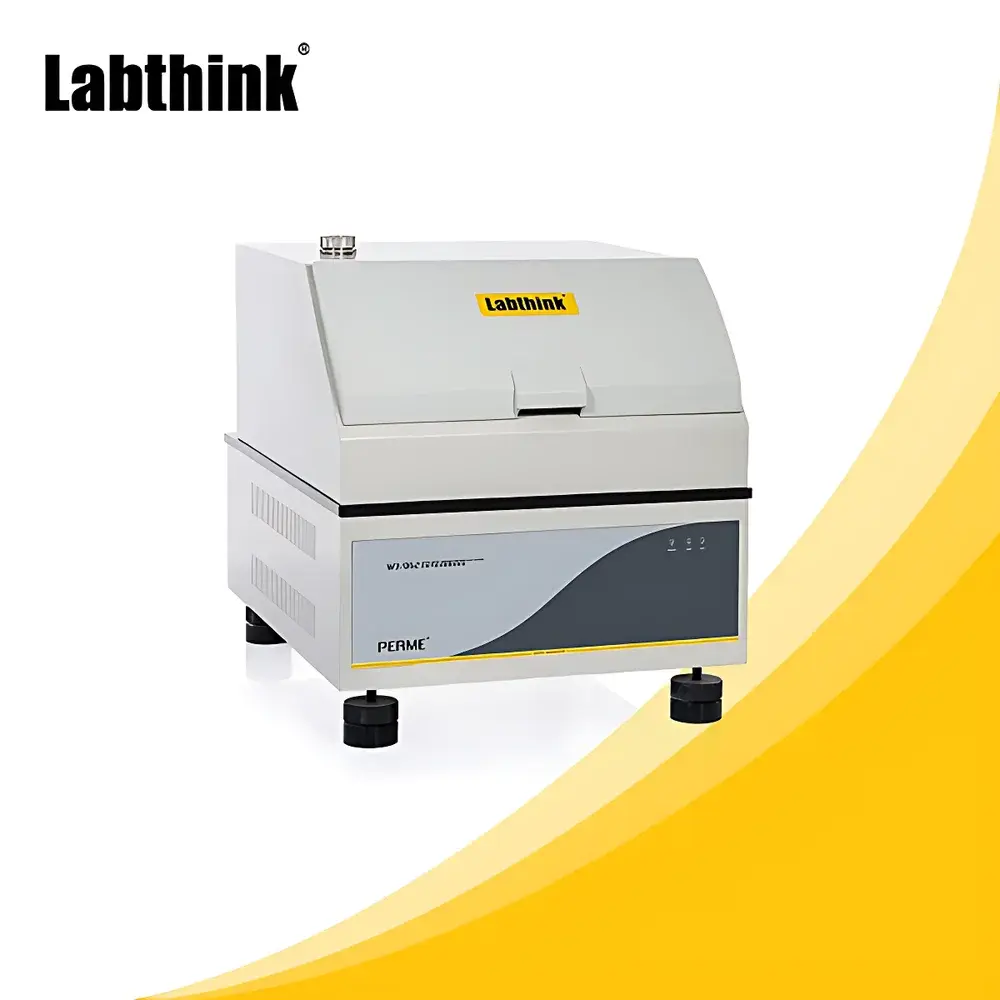
Labthink W3/062 Gravimetric Cup Method Water Vapor Transmission Rate (WVTR) Tester for Building Waterproofing Materials
| Brand | Labthink |
|---|---|
| Model | W3/062 |
| Measurement Principle | Gravimetric Cup Method (Weight Change) |
| Test Range | 0.1–10,000 g/m²·24h (Loss Mode), 0.1–2,500 g/m²·24h (Gain Mode) |
| Sample Capacity | 1–6 independent specimens per run |
| Temperature Control | 15–55°C ±0.1°C |
| Humidity Control | 10–98% RH ±1% RH |
| Test Area | 33 cm² |
| Specimen Thickness | ≤3 mm |
| Chamber Volume | 45 L |
| Power Supply | 220 VAC 50 Hz / 120 VAC 60 Hz |
| Net Weight | 80 kg |
| Compliance | GB/T 17146, GB 1037, GB/T 16928, ASTM E96, ASTM D1653, ISO 2528, DIN 53122-1, JIS Z0208, TAPPI T464, YBB00092003 |
Overview
The Labthink W3/062 is a high-precision gravimetric cup method water vapor transmission rate (WVTR) tester engineered for rigorous regulatory and quality control environments in building materials, packaging, medical device, and pharmaceutical industries. It quantifies the permeation of water vapor through flat sheet materials—including waterproof membranes, polymer films, laminates, and coated substrates—by measuring mass change over time under controlled temperature and relative humidity gradients. The instrument operates on the fundamental principle of Fickian diffusion across a barrier, where a defined vapor pressure differential is established across the specimen, driving water vapor transport from the humid to the dry side (loss mode) or vice versa (gain mode). This method aligns with internationally recognized standards including GB/T 17146 for building waterproofing materials, ASTM E96 for flexible barrier materials, and ISO 2528 for general film characterization—ensuring data traceability and inter-laboratory comparability.
Key Features
- High-resolution gravimetric measurement: Equipped with a calibrated microbalance (resolution: 0.001 g) optimized for long-term stability and minimal drift, enabling detection of WVTR values as low as 0.1 g/m²·24h with repeatability ≤±0.01 g/m²·24h.
- Parallel multi-specimen testing: Six independently sealed test cups mounted on a precision rotary carousel allow concurrent evaluation of up to six distinct samples under identical environmental conditions—reducing inter-test variability and accelerating throughput.
- Scalable architecture: A single master unit can be networked with up to nine satellite units via Ethernet, supporting up to 60 simultaneous tests—ideal for high-volume QC labs or method validation studies requiring statistical robustness.
- Dynamic climate control: Dual-zone environmental chamber maintains precise temperature (±0.1°C) and humidity (±1% RH) across the full operational range (15–55°C; 10–98% RH), with programmable ramp profiles and real-time monitoring of chamber equilibrium status.
- Configurable test modes: Supports both desiccant-based weight-loss and water-saturated weight-gain configurations, accommodating hydrophilic, hydrophobic, and asymmetric barrier structures without hardware modification.
Sample Compatibility & Compliance
The W3/062 accepts rigid and flexible planar specimens up to 3 mm thick and 74 mm in diameter, with standardized test area of 33 cm². It is validated for use with bituminous membranes, polyethylene and PVC geomembranes, spray-applied elastomeric coatings, fiber-reinforced cementitious composites, and multilayer packaging laminates. All system-level compliance—including thermal uniformity, humidity linearity, and balance calibration—is documented per ISO/IEC 17025 requirements. Test reports generated by the instrument support audit readiness for GLP, GMP, and FDA 21 CFR Part 11 environments when deployed with Lystem™ Laboratory Data Management System (LDMS), which enforces electronic signatures, audit trails, and role-based access control.
Software & Data Management
Control and analysis are performed using Labthink’s proprietary WinWVTR software—a Windows-based application compliant with IEC 62304 Class B medical device software standards. The interface provides real-time graphical plotting of cumulative mass change versus time, automatic slope calculation for steady-state WVTR derivation, outlier detection, and statistical summary (mean, SD, CV%) across replicates. Raw data files (.wvtr) are stored in encrypted binary format with embedded metadata (operator ID, timestamp, environmental logs, calibration certificates). When integrated into a local area network, the system interoperates with Lystem™ LDMS for centralized storage, cross-instrument trending, automated report generation (PDF/Excel), and electronic archiving aligned with 21 CFR Part 11 Subpart C requirements for electronic records and signatures.
Applications
- Quantitative assessment of vapor retardancy in roofing underlayments and below-slab vapor barriers per ASTM E1745 and EN 13984.
- Comparative evaluation of moisture management performance in breathable façade membranes used in rainscreen wall assemblies.
- QC release testing of extruded PE films and metallized PET laminates for food and pharmaceutical packaging per ISO 15106-1.
- Stability screening of hydrophilic wound dressings and transdermal patch backing layers under accelerated aging conditions.
- Validation of coating integrity in corrosion-resistant steel claddings and concrete sealants exposed to cyclic humidity environments.
FAQ
What standards does the W3/062 fully support for building waterproofing material testing?
It is fully configured and validated for GB/T 17146–2021 “Test Methods for Water Vapor Permeability of Building Waterproofing Materials”, as well as harmonized references including ASTM E96 (desiccant and water methods), ISO 2528, and JIS Z0208.
Can the instrument measure WVTR for specimens thicker than 3 mm?
Yes—custom cup depth extensions and modified sealing fixtures are available upon request to accommodate specimens up to 10 mm thick, subject to mechanical stability verification.
Is humidity calibration traceable to national standards?
All humidity sensors undergo quarterly recalibration using NIST-traceable saturated salt solutions (LiCl, MgCl₂, NaCl, KCl) across the full 10–98% RH range, with certificate of calibration included.
How is data integrity ensured during extended unattended tests?
The system logs all environmental parameters and mass readings at user-defined intervals (minimum 1 minute), with automatic backup to internal SSD and optional cloud sync; power failure recovery resumes from last valid data point without loss.
Does the W3/062 require external compressed air for operation?
Yes—it uses clean, oil-free compressed air (0.6 MPa, 6 mm PU tubing) to drive humidity generation and chamber purging; an optional integrated oil-free scroll compressor is available as an accessory.