
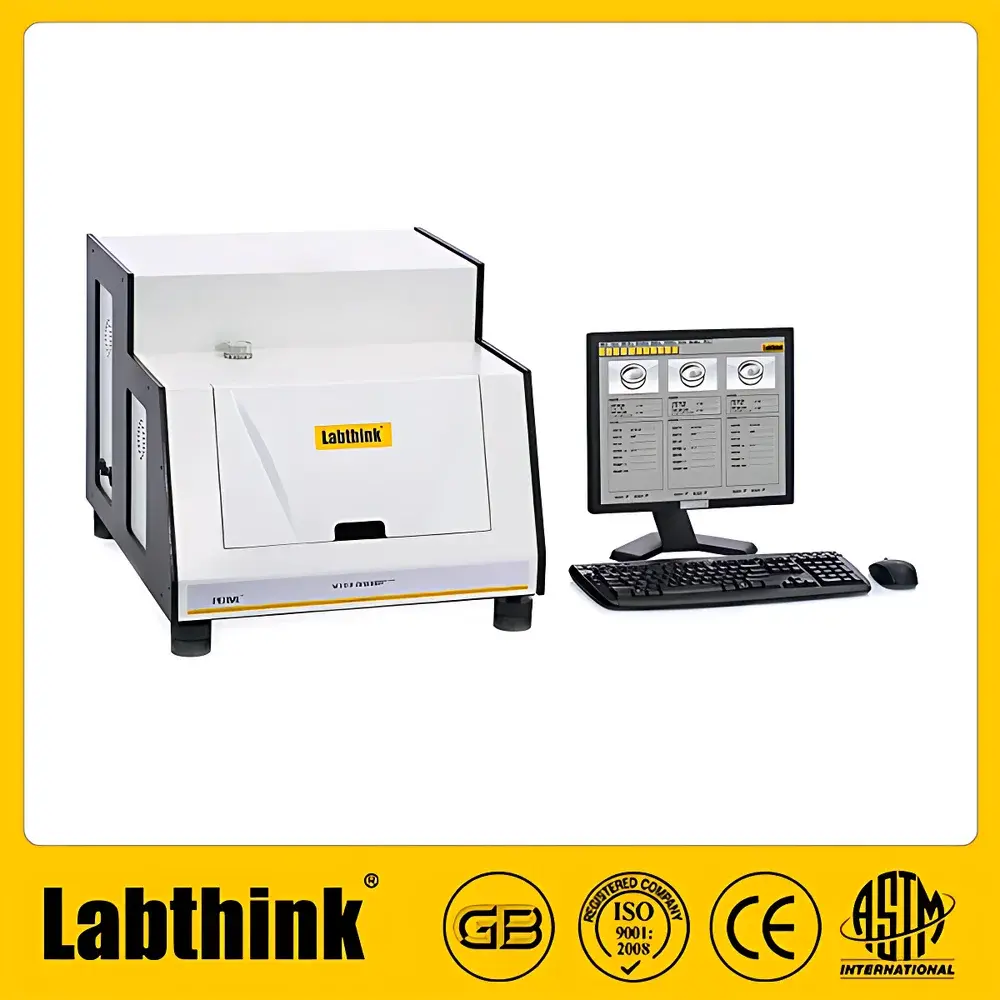
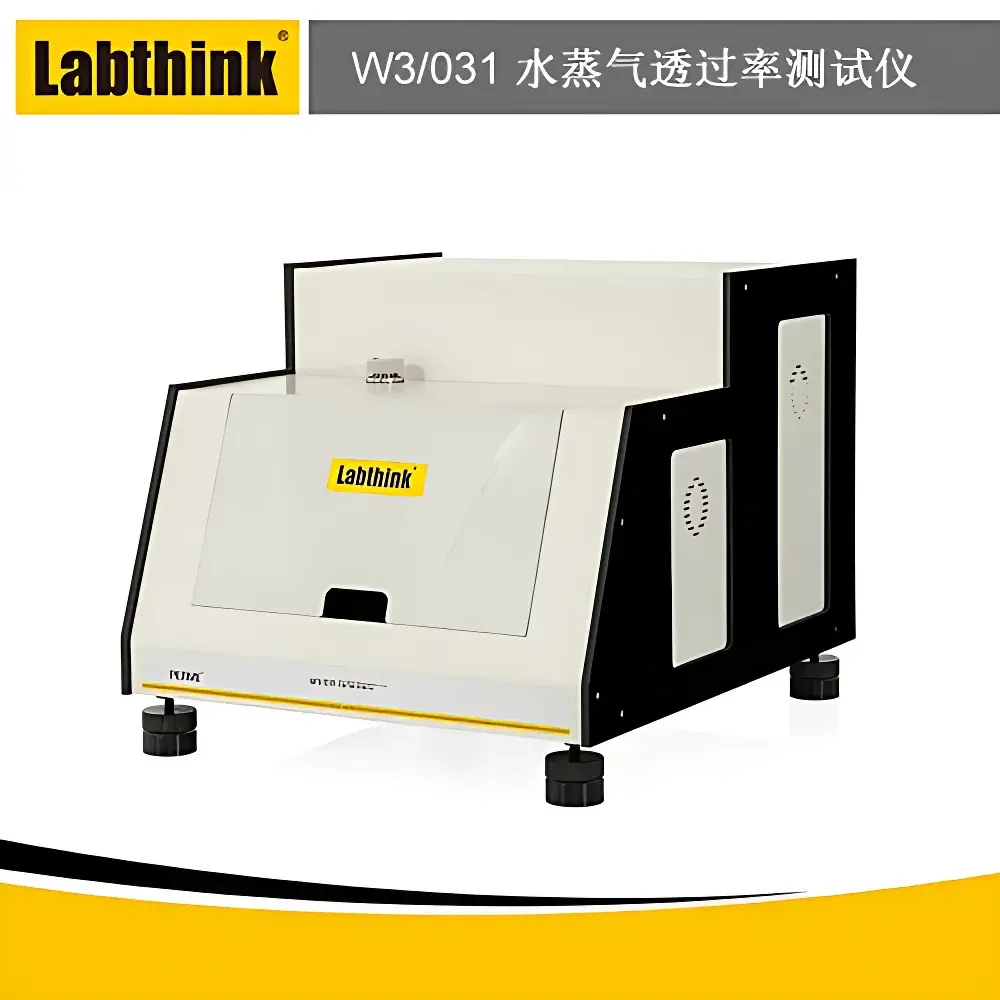
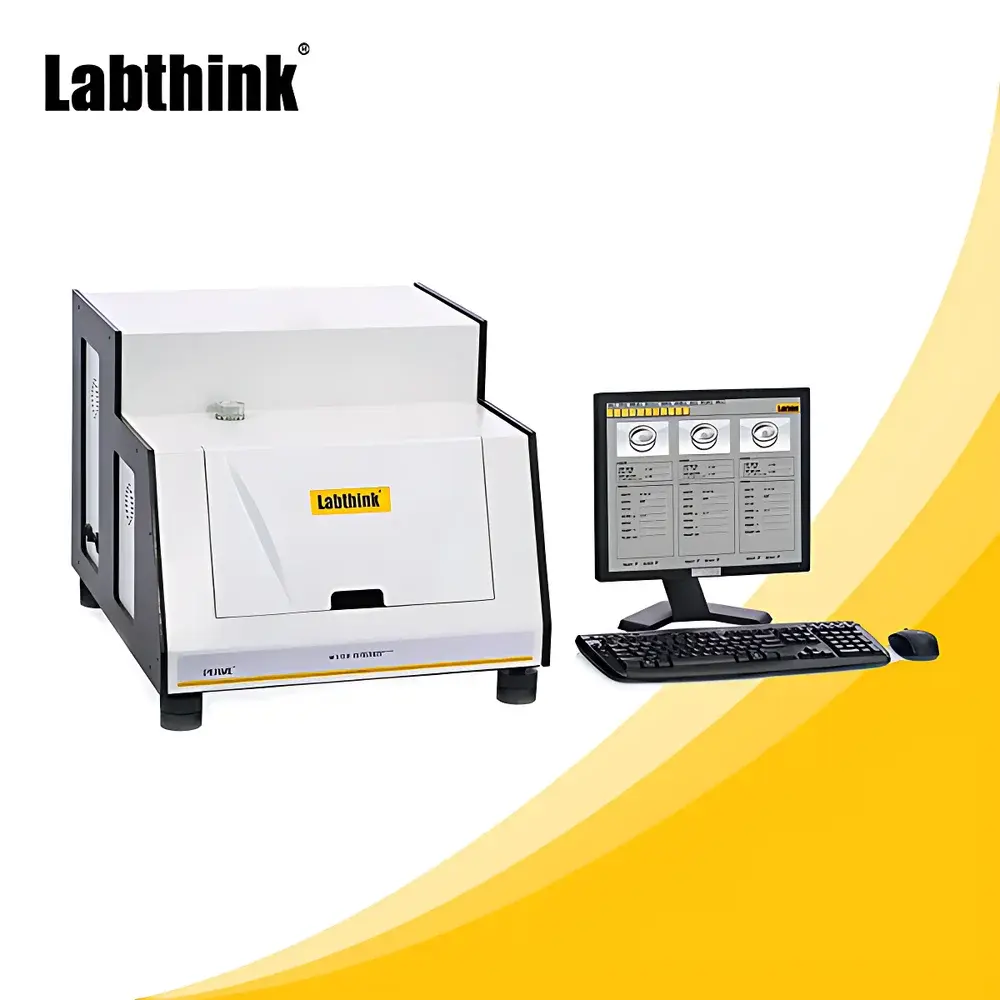
Labthink W3/031 Gravimetric Water Vapor Transmission Rate (WVTR) Tester
| Brand | Labthink |
|---|---|
| Model | W3/031 |
| Origin | Shandong, China |
| Manufacturer | Labthink Co., Ltd. |
| Type | Gravimetric Cup Method WVTR Tester |
| Compliance | ASTM E96, ASTM D1653, ISO 2528, GB/T 1037, GB/T 16928, TAPPI T464, DIN 53122-1, JIS Z0208, YBB00092003 |
| Test Range | 0.1–10,000 g/m²·24h |
| Sample Capacity | 1–3 independent cups |
| Resolution | 0.0001 g |
| Weight Accuracy | ±0.01 g/m²·24h |
| Temperature Control | 15–55 °C (±0.1 °C) |
| Humidity Control | 10–98 %RH (±1 %RH) |
| Test Area | 33 cm² |
| Sample Thickness | ≤3 mm |
| Sample Diameter | Φ74 mm |
| Airflow Velocity | 0.5–2.5 m/s |
| Chamber Volume | 27 L |
| Power Supply | 220 VAC 50 Hz / 120 VAC 60 Hz |
| Net Weight | 83 kg |
| Dimensions | 580 × 680 × 470 mm (L×W×H) |
Overview
The Labthink W3/031 is a gravimetric water vapor transmission rate (WVTR) tester engineered for precision measurement of moisture barrier performance in flexible packaging materials—including wet wipe pouches, laminated films, coated papers, and pharmaceutical blister foils. It operates on the standardized cup method (ASTM E96, ISO 2528), wherein a conditioned test specimen seals a desiccant-filled permeation cup; the cup is placed in a controlled environmental chamber with defined temperature and relative humidity. As water vapor diffuses through the sample into the dry cup interior, mass gain is measured continuously via high-resolution analytical balance. The instrument calculates WVTR (g/m²·24h), permeability coefficient, and diffusion parameters based on Fickian transport models under steady-state conditions. Designed for compliance-driven laboratories, the W3/031 supports full traceability and audit-ready operation in regulated environments including pharmaceutical packaging QC (per USP , YBB00092003) and food contact material validation.
Key Features
- Triple-cup configuration enabling concurrent, fully independent WVTR tests—maximizing throughput without cross-contamination or calibration drift.
- Patented mechanical design isolating weighing modules from thermal expansion, vibration, and airflow turbulence—ensuring long-term stability of ±0.0001 g resolution across 27-L climate-controlled chamber.
- Embedded Linux-based computing platform replacing legacy microcontroller architecture—delivering deterministic real-time control, multi-threaded data acquisition, and firmware-upgradable functionality.
- Automated humidity generation and regulation using dual-stage desiccant/dry-air mixing, achieving ±1 %RH accuracy at 90 %RH setpoint—the industry benchmark for ASTM E96 desiccant method validation.
- Integrated air-sweep system with adjustable velocity (0.5–2.5 m/s) to minimize boundary layer resistance and ensure laminar, reproducible mass transfer conditions per ISO 2528 Annex A.
- Modular hardware architecture supporting optional upgrades: compressed air station integration, PCL3-compatible thermal printer, and certified reference film kits traceable to NIST SRM equivalents.
Sample Compatibility & Compliance
The W3/031 accommodates flat, non-porous, and semi-crystalline polymeric films up to 3 mm thickness, including PE, PP, PET, aluminum foil laminates, metallized CPP, and barrier-coated paperboard. Circular specimens (Φ74 mm) are prepared using included precision die-cutting tooling. All operational parameters—including temperature ramp profiles, RH step sequences, and gravimetric sampling intervals—are programmable to align with method-specific requirements of ASTM E96 (Procedure A–D), ISO 2528 (gravimetric mode), and Chinese pharmacopoeial standard YBB00092003. Instrument qualification includes IQ/OQ documentation templates compliant with GLP and GMP Annex 15, with built-in electronic signatures and 21 CFR Part 11–ready audit trails when deployed with Lystem™ software.
Software & Data Management
Controlled via Labthink’s proprietary Lystem™ v3.0 software, the W3/031 provides intuitive workflow navigation, real-time mass vs. time curve visualization, and automated pass/fail evaluation against user-defined specification limits. Raw gravimetric data is stored with metadata (operator ID, calibration timestamp, environmental logs) in encrypted SQLite databases. When networked within a local area environment, Lystem™ enables centralized access to historical test records, statistical process control (SPC) dashboards, and cross-instrument comparative analysis—supporting ISO/IEC 17025 clause 7.7 data integrity requirements. Export formats include PDF test reports (with digital signature), CSV for external statistical modeling, and XML for LIMS integration.
Applications
- Quality assurance of wet wipe packaging integrity—verifying shelf-life stability under accelerated aging protocols (e.g., 40 °C/90 %RH).
- Development screening of high-barrier coatings (SiOx, AlOx) on PET substrates for medical device pouches.
- Regulatory submission support for FDA 510(k) or CE-marked packaging dossiers requiring ASTM E96-compliant WVTR datasets.
- In-process verification of extrusion coating uniformity during roll-to-roll manufacturing of laminated sachets.
- Comparative assessment of biodegradable films (PLA, PHA) versus conventional PE in moisture-sensitive applications.
FAQ
What standards does the W3/031 fully support out-of-the-box?
ASTM E96 (Procedures A–D), ASTM D1653, ISO 2528, GB/T 1037, GB/T 16928, TAPPI T464, DIN 53122-1, JIS Z0208, and YBB00092003.
Can the instrument perform both desiccant and water-method tests per ASTM E96?
Yes—the W3/031 supports both Procedure A (desiccant) and Procedure B (water) configurations via interchangeable cup assemblies and humidity profile programming.
Is calibration traceable to national metrology institutes?
Standard calibration uses NIST-traceable stainless steel weights (class M1); optional certified reference films with assigned WVTR values (uncertainty <3.5 % k=2) are available for performance verification.
How is data integrity ensured for regulated environments?
Lystem™ software implements role-based access control, electronic signatures, immutable audit logs, and 21 CFR Part 11–compliant electronic record management when configured with server authentication.
What maintenance is required for long-term accuracy?
Quarterly verification of balance linearity, annual recalibration of RH sensors using saturated salt solutions, and routine replacement of desiccant and air filters per manufacturer’s SOPs.





