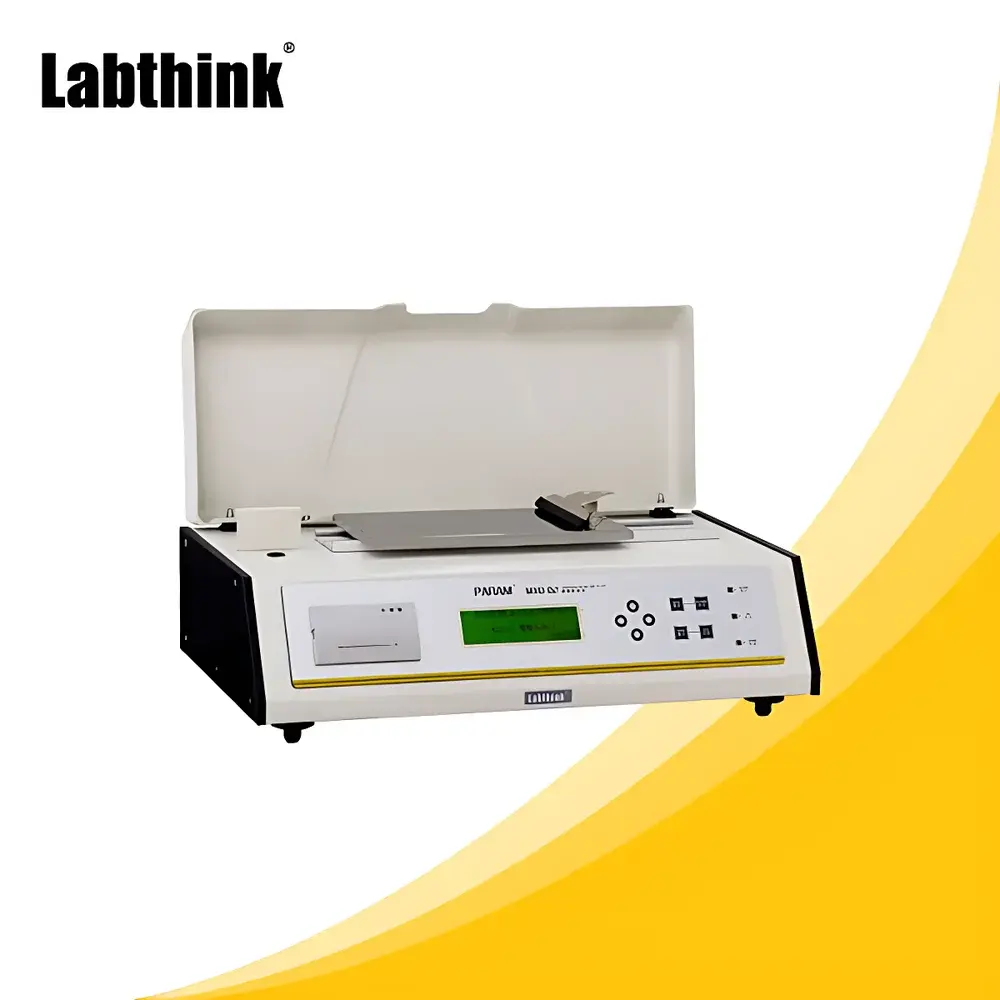
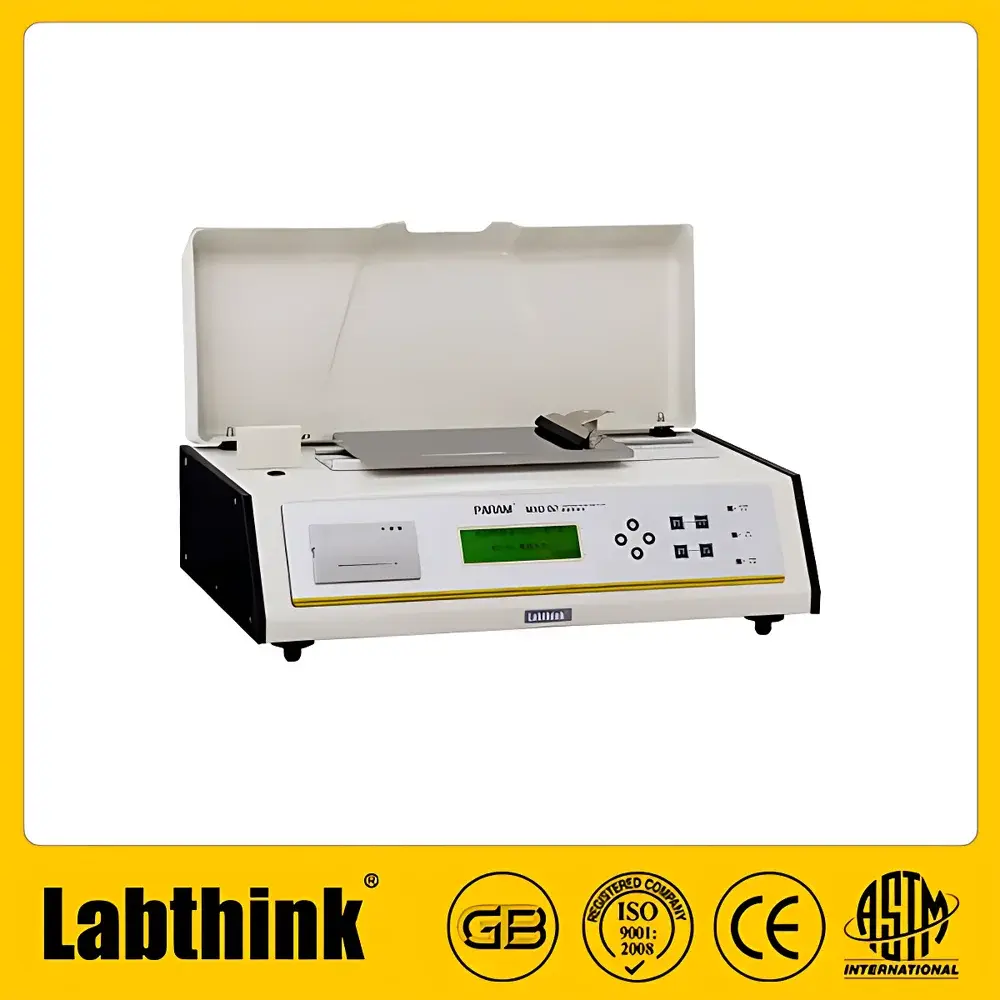
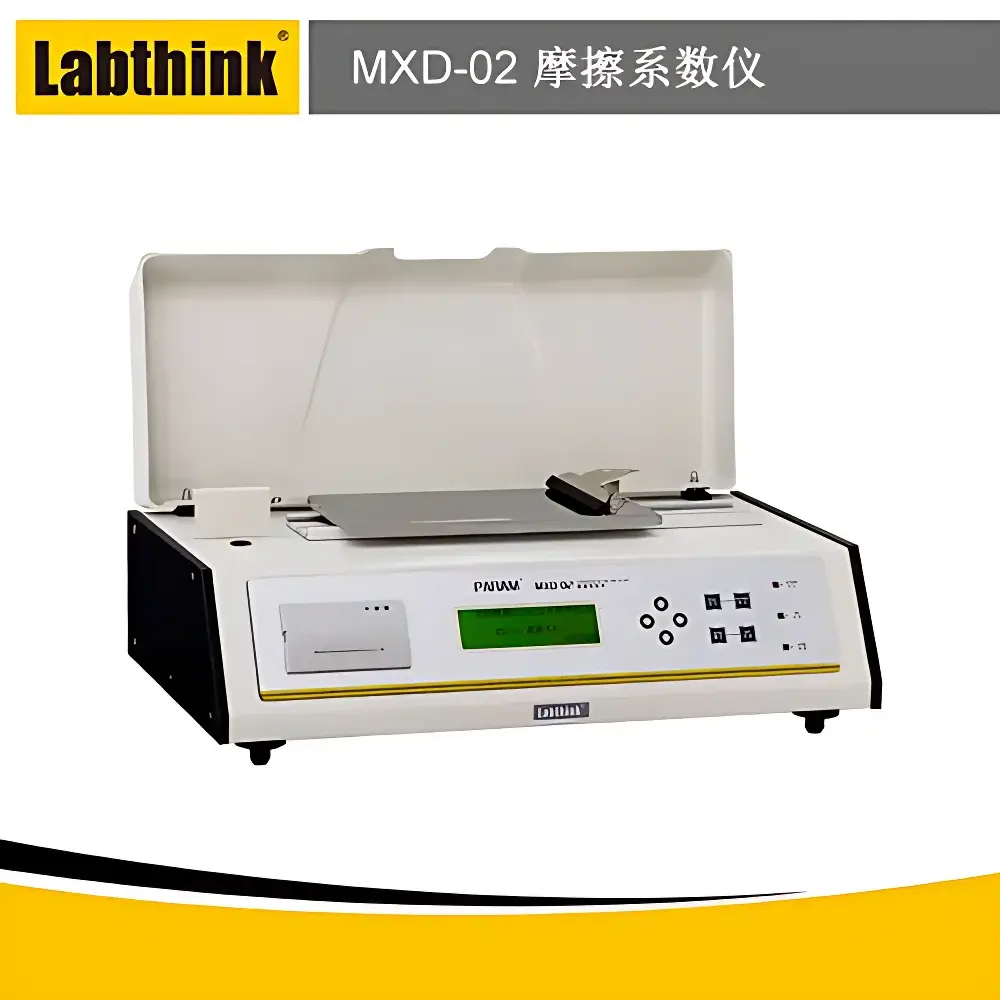
Labthink MXD-02 Coefficient of Friction Tester
| Brand | Labthink |
|---|---|
| Origin | Shandong, China |
| Manufacturer Type | Direct Manufacturer |
| Country of Origin | China |
| Model | MXD-02 |
| Price Range | USD 1,400 – 8,500 |
| Load Range | 0–5 N |
| Accuracy Class | 0.5 |
| Travel Distance | 70 mm / 150 mm |
| Standard Sled Mass | 200 g (custom sleds available) |
| Test Speeds | 100 mm/min, 150 mm/min (adjustable) |
| Environmental Conditions | 23 ± 2 °C, 20–70 %RH |
| Power Supply | 220 VAC 50 Hz / 120 VAC 60 Hz |
| Dimensions (L×W×H) | 630 × 360 × 230 mm |
| Net Weight | 33 kg |
| Compliance Standards | ISO 8295, GB/T 10006, ASTM D1894, TAPPI T816 |
Overview
The Labthink MXD-02 Coefficient of Friction Tester is a microprocessor-controlled instrumentation system engineered for precise and repeatable measurement of static (μs) and kinetic (μk) coefficients of friction between two contacting surfaces under controlled normal load and relative motion. Based on the fundamental principle of horizontal pull testing—where a standardized sled is drawn across a fixed specimen at defined velocity—the instrument quantifies the peak and plateau forces required to initiate and sustain sliding, respectively. This methodology aligns with internationally recognized tribological test protocols used in packaging, medical device, automotive, and consumer goods R&D and QC laboratories. The MXD-02 is not a generic surface analyzer but a purpose-built mechanical tester designed specifically for planar, flexible, and semi-rigid materials where interfacial slip behavior directly impacts functional performance—such as film unwinding consistency, pouch seal integrity, conveyor transport reliability, catheter insertion force, or tactile perception in personal care products.
Key Features
- Simultaneous dual-mode measurement: single test cycle yields both static and kinetic COF values per ASTM D1894 and ISO 8295 requirements
- Programmable test speed: standard presets at 100 mm/min and 150 mm/min; fully adjustable within operational range to accommodate material-specific response characteristics
- Modular sled configuration: includes certified 200 g stainless-steel sled; optional calibrated masses (e.g., 500 g) available for elevated normal force applications
- Electromagnetically neutralized test platform: all critical contact surfaces—including sled base and test bed—are subjected to demagnetization and residual magnetism verification (<0.2 mT), minimizing parasitic force interference
- High-fidelity force transduction: 0–5 N load cell with 0.5-class accuracy (±0.5% FS), temperature-compensated and factory-calibrated traceable to national metrology standards
- Intuitive human-machine interface: backlit LCD display with PVC membrane keypad enables standalone operation without PC dependency
- Robust mechanical architecture: precision-ground linear guide rails, brushless DC drive motor, and vibration-damped base ensure long-term repeatability and minimal maintenance
Sample Compatibility & Compliance
The MXD-02 accommodates flat, sheet-like specimens up to 150 mm wide and 300 mm long, supporting heterogeneous material pairings including polymer films (BOPP, PET, PE, PVDC), laminates, foils, paperboard, nonwovens, woven sacks, rubber sheets, coated metals, and biomedical tubing (e.g., silicone catheters, PVC feeding tubes). It meets essential regulatory and industry-standard test methods: ISO 8295 (plastics—determination of coefficient of friction), GB/T 10006 (Chinese national standard for plastic films and sheets), ASTM D1894 (standard test method for coefficient of friction of plastic film and sheeting), and TAPPI T816 (coefficient of friction of paper and paperboard). Its design supports GLP-compliant workflows through audit-trail-capable software (optional Lystem™), and hardware-level compliance with IEC 61000-4 electromagnetic immunity requirements ensures stable operation in shared laboratory environments.
Software & Data Management
Optional Lystem™ Laboratory Data Sharing System provides comprehensive test lifecycle management: automated pass/fail evaluation against user-defined specification limits; statistical analysis (mean, SD, CV%, min/max) across individual or grouped trials; overlay of time-force curves for comparative assessment; and export-ready reporting in PDF, CSV, and XML formats. All raw data files include embedded metadata—operator ID, timestamp, environmental conditions (if linked to optional温湿度 sensor), calibration status, and instrument firmware version—to satisfy FDA 21 CFR Part 11 electronic record requirements when deployed in regulated quality systems. The RS232 serial interface enables bidirectional communication with external PCs or LIMS platforms, while the integrated thermal printer delivers immediate hard-copy output of summary results.
Applications
- Packaging development: optimizing anti-block additives in PE films, evaluating slip agent efficacy in BOPP pouches, verifying coefficient consistency across roll-to-roll production batches
- Medical device validation: measuring insertion force of urological catheters per ISO 8536-5, assessing lubricity of guidewires and endoscopic components
- Automotive interior testing: characterizing friction between dashboard trim and clothing fabrics, seat cover materials and skin simulants
- Consumer product formulation: quantifying tactile glide performance of cosmetic creams, ophthalmic solutions, and topical pharmaceutical gels
- Industrial materials QA: verifying surface treatment uniformity on conveyor belts, brake linings, and rubber-coated rollers
- Academic research: fundamental tribology studies involving granular–planar interfaces (e.g., grain–metal, hair–hair, tube–flat substrate)
FAQ
What standards does the MXD-02 comply with?
ISO 8295, GB/T 10006, ASTM D1894, and TAPPI T816.
Can the instrument measure both static and kinetic COF in one test?
Yes—each test automatically captures the maximum breakaway force (static COF) and the average sustaining force (kinetic COF) per standard methodology.
Is calibration traceable to national standards?
Yes—load cell calibration is performed using NIST-traceable deadweight standards; certificate included with shipment.
Does the system support multi-user access control and electronic signatures?
When configured with Lystem™ software and appropriate IT infrastructure, it supports role-based permissions, electronic signatures, and full 21 CFR Part 11 audit trails.
What environmental conditions are required for valid testing?
Standard conditioning: 23 ± 2 °C and 20–70 %RH; specimens must be equilibrated per ISO 291 prior to testing.