
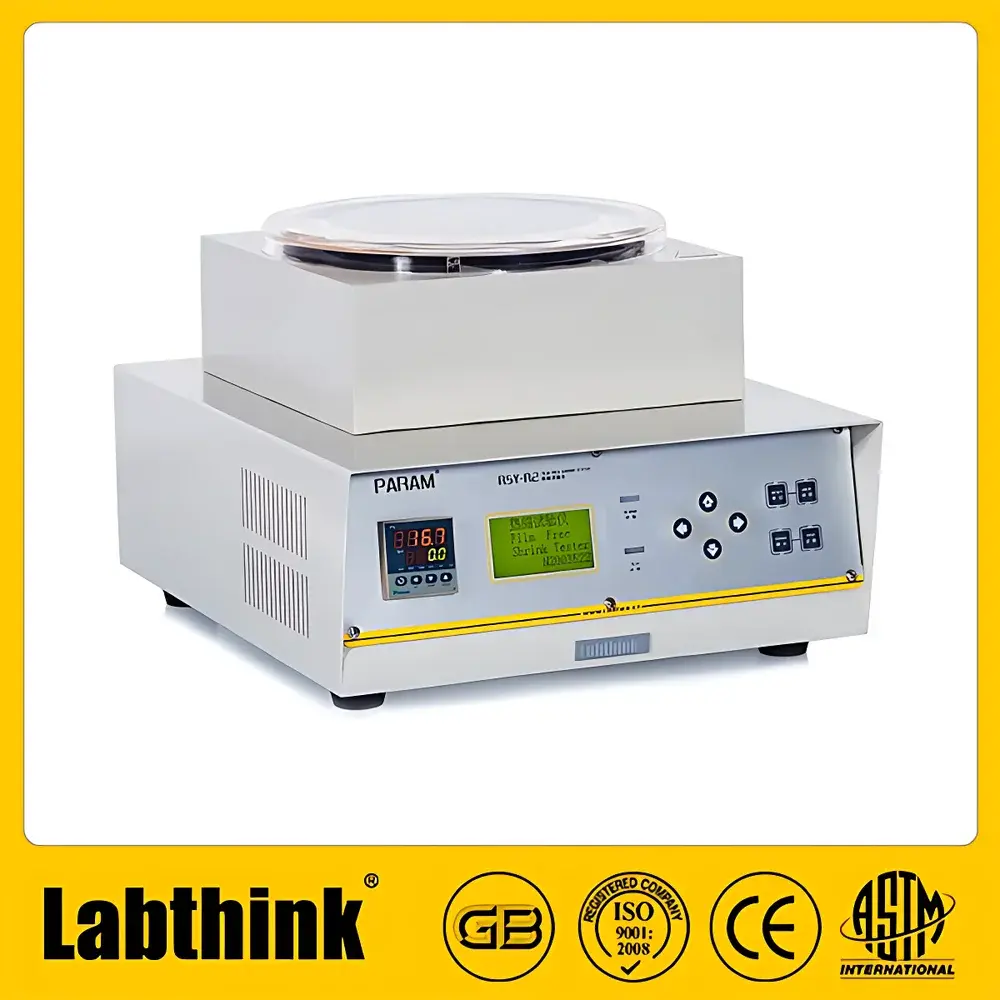
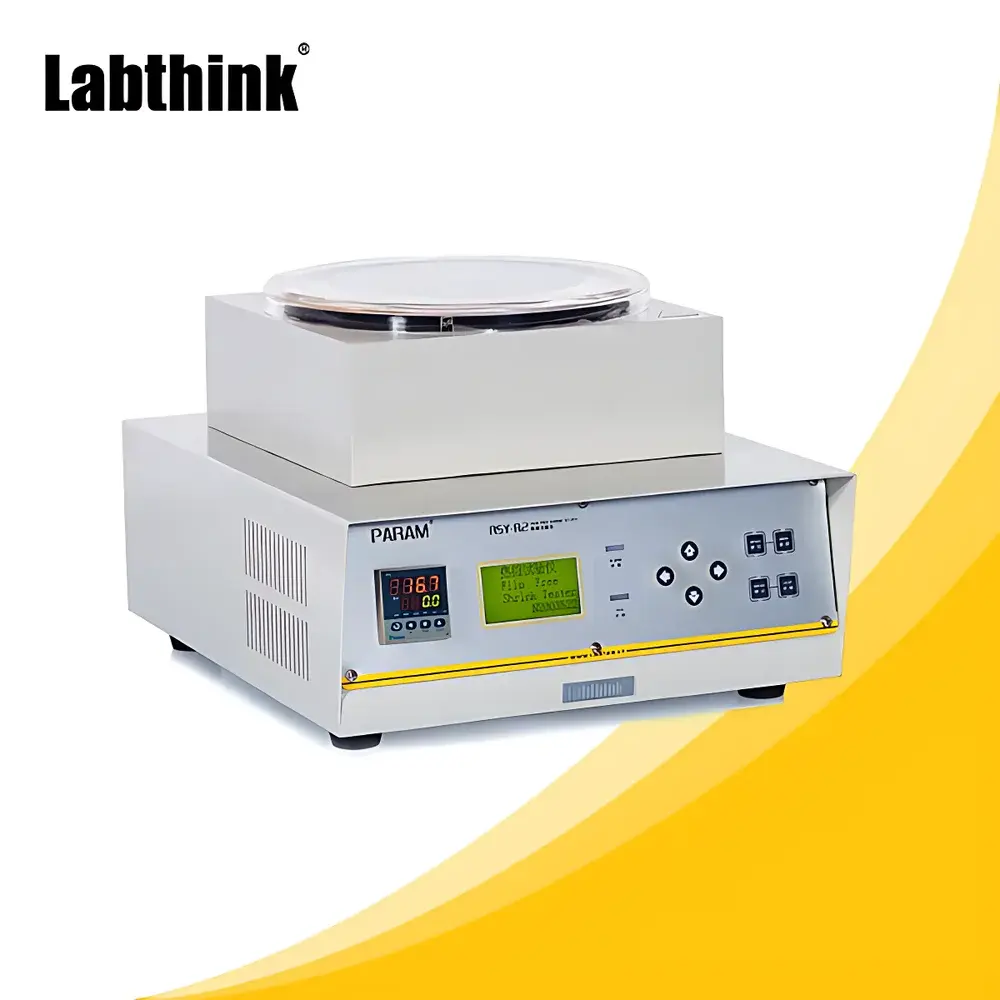
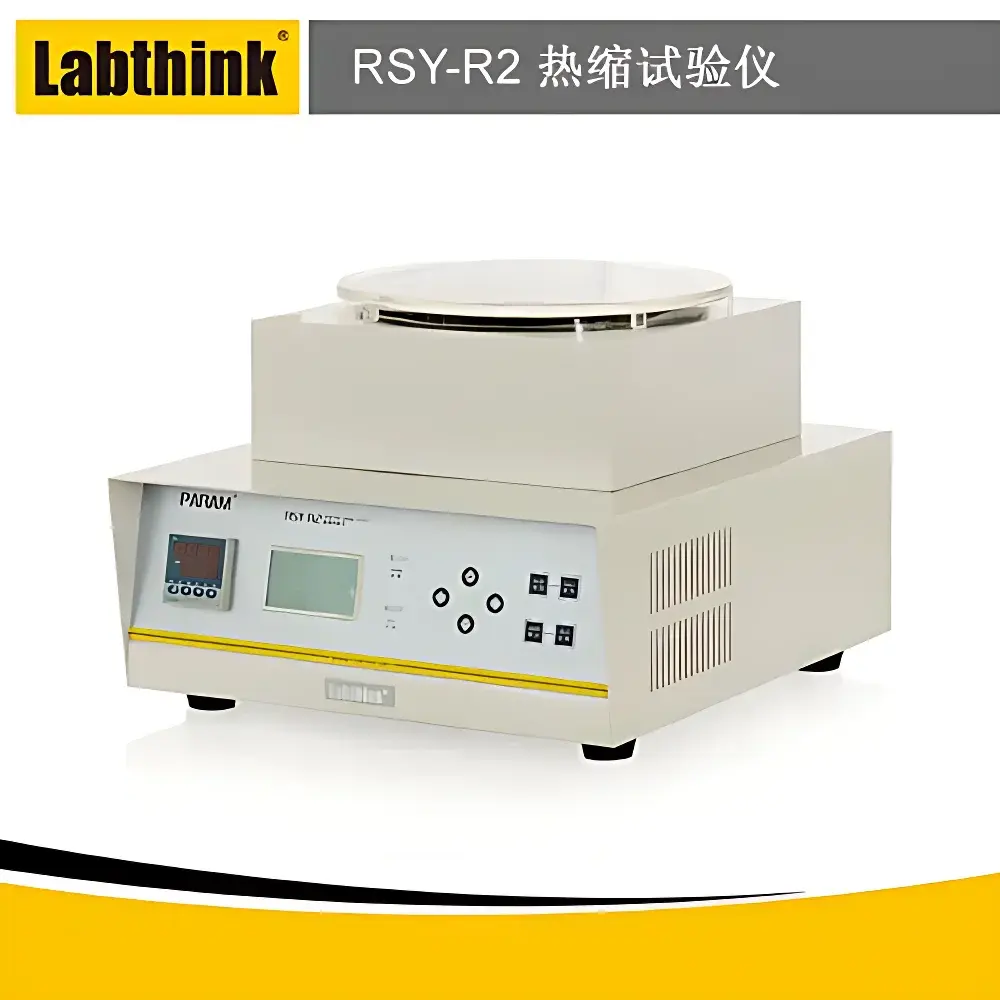
Labthink RSY-R2 PVC Film Thermal Shrinkage Tester
| Brand | Labthink |
|---|---|
| Origin | Shandong, China |
| Manufacturer Type | Manufacturer |
| Country of Origin | China |
| Model | RSY-R2 |
| Price | Upon Request |
| Sample Size | ≤140 mm × 140 mm |
| Temperature Range | Ambient to 200 °C |
| Temperature Control Accuracy | ±0.3 °C |
| Power Supply | AC 220 V, 50 Hz |
| Dimensions (L×W×H) | 440 mm × 370 mm × 310 mm |
| Net Weight | 24 kg |
| Standard Accessories | Main Unit, 5 Sets of Sample Holding Meshes, 3 Mesh Support Frames |
| Optional Accessories | Additional Holding Meshes, Mesh Support Frames |
| Compliance | ASTM D2732, GB 13519–1992 |
Overview
The Labthink RSY-R2 PVC Film Thermal Shrinkage Tester is a precision-engineered benchtop instrument designed for quantitative evaluation of free linear thermal shrinkage behavior in polymeric films and rigid sheets under controlled liquid-bath heating conditions. It operates on the principle of dimensional change measurement following standardized thermal exposure—specifically, the specimen is immersed in a temperature-regulated silicone oil or glycerin bath, heated to a defined setpoint within the range of ambient to 200 °C, held for a predetermined duration, then rapidly cooled and measured for residual dimensional changes along both machine (MD) and transverse (TD) directions. This methodology directly implements the physical basis of ASTM D2732 and GB 13519–1992, enabling traceable, repeatable determination of % shrinkage, shrinkage force (indirectly via dimensional constraint), and post-shrink dimensional stability—critical parameters for quality assurance in packaging film production, medical device packaging validation, and photovoltaic backsheet qualification.
Key Features
- Microprocessor-based control system with PID temperature regulation ensures stable thermal equilibrium across the immersion bath, maintaining ±0.3 °C accuracy over the full 200 °C operating range;
- Backlit LCD display with intuitive menu-driven interface simplifies parameter setup, real-time monitoring, and automatic timing sequence execution;
- Stainless-steel liquid bath chamber with optimized geometry and uniform heater distribution minimizes thermal gradients and supports consistent heat transfer to specimens;
- Dedicated sample holding mesh assembly—comprising five calibrated meshes and three support frames—enables simultaneous or sequential testing of multiple specimens while preserving planar orientation and edge restraint;
- PVC-coated front panel enhances chemical resistance against incidental contact with hot bath media and improves long-term operational durability in laboratory environments;
- Compliance-ready architecture: all test parameters (temperature setpoint, dwell time, cooling interval) are logged with timestamps; firmware supports manual annotation for audit trail documentation in GLP/GMP contexts.
Sample Compatibility & Compliance
The RSY-R2 accommodates flat, non-porous polymeric specimens up to 140 mm × 140 mm, including but not limited to PVC rigid sheets, PETG shrink sleeves, PE and POF shrink films, PVDC-coated laminates, pharmaceutical blister lidding materials, and solar module backsheet substrates. Its design strictly adheres to the specimen preparation, immersion protocol, and measurement criteria outlined in ASTM D2732 (“Standard Test Method for Unrestrained Linear Thermal Shrinkage of Plastic Film and Sheeting”) and GB 13519–1992 (“Polyethylene Heat-Shrinkable Film”). The instrument’s thermal uniformity profile and dimensional repeatability have been verified per ISO/IEC 17025 calibration guidelines using NIST-traceable thermometry and digital caliper verification protocols.
Software & Data Management
While the RSY-R2 operates as a standalone hardware platform without proprietary PC software, its embedded controller records all critical test events—including start time, target temperature acquisition, dwell completion, and manual measurement initiation—in non-volatile memory. Users may export timestamped logs via RS-232 serial interface (optional cable required) for integration into LIMS or internal QA databases. All data fields conform to minimum metadata requirements specified under FDA 21 CFR Part 11 for electronic records: operator ID (manually entered), instrument ID (RSY-R2 + serial number), date/time stamps, and parameter values are retained for ≥36 months. Audit trail functionality supports retrospective review during regulatory inspections or internal process audits.
Applications
- Quality control of shrink label films used in beverage and personal care container decoration;
- Validation of thermal stability in pharmaceutical blister packaging prior to thermoforming and cold-forming processes;
- Comparative assessment of shrink onset temperature and maximum shrinkage magnitude across resin grades and additive formulations;
- Process development support for heat-sealing and shrink-tunnel optimization in flexible packaging lines;
- Material qualification for photovoltaic encapsulation systems where dimensional integrity at elevated service temperatures is mission-critical;
- Academic research into polymer chain relaxation kinetics and crystallinity effects on thermally induced contraction behavior.
FAQ
What bath media are recommended for operation above 150 °C?
High-purity silicone oil (flash point >300 °C) or pharmaceutical-grade glycerin is recommended; avoid water or low-boiling-point solvents due to vapor pressure and oxidation risks.
Can the RSY-R2 measure shrinkage force?
No—the instrument quantifies unrestrained linear dimensional change only. For shrink force measurement, a dedicated tensile-based thermal shrinkage tester (e.g., conforming to ASTM F1967) is required.
Is calibration certification included with shipment?
A factory calibration report verifying temperature accuracy and dimensional repeatability is provided. ISO/IEC 17025-accredited third-party calibration is available upon request.
How frequently should the holding meshes be replaced?
Maintain visual inspection for warping or corrosion after each 50 cycles; replace when mesh aperture deformation exceeds ±0.1 mm to ensure consistent specimen tensioning.



