
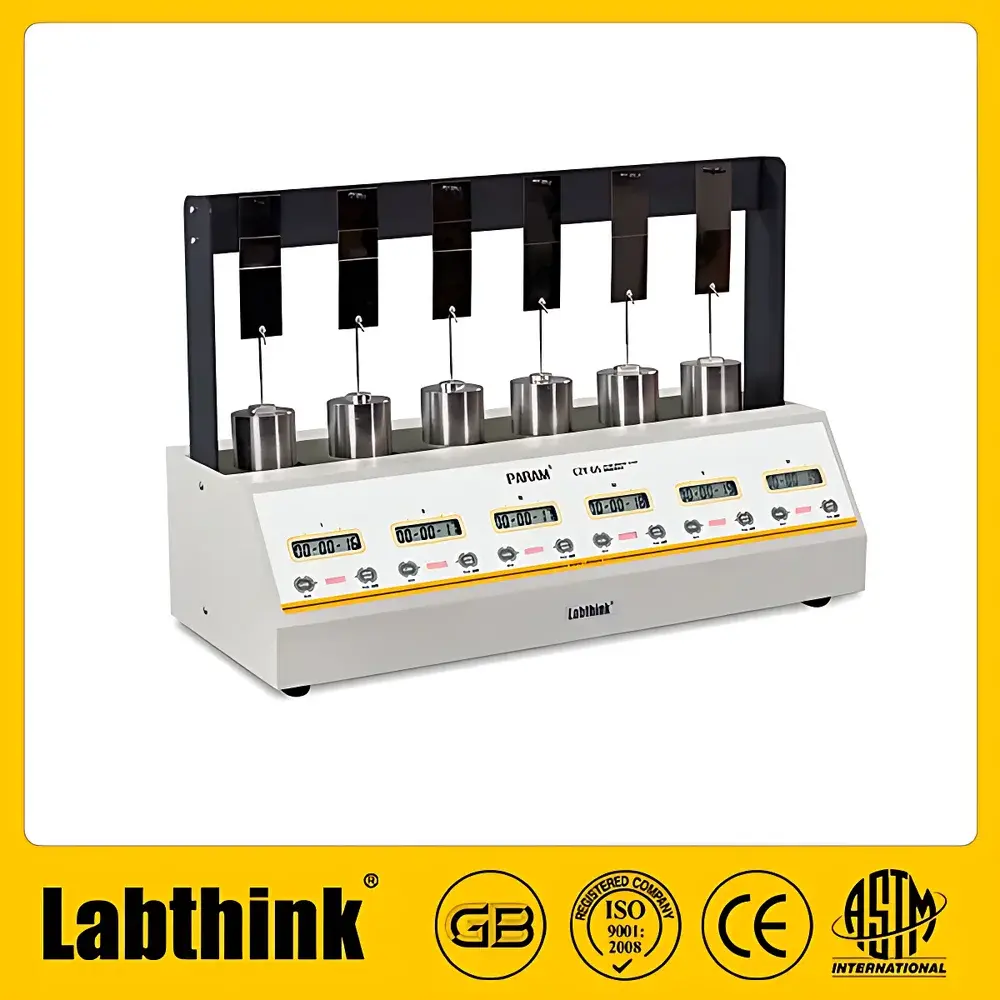
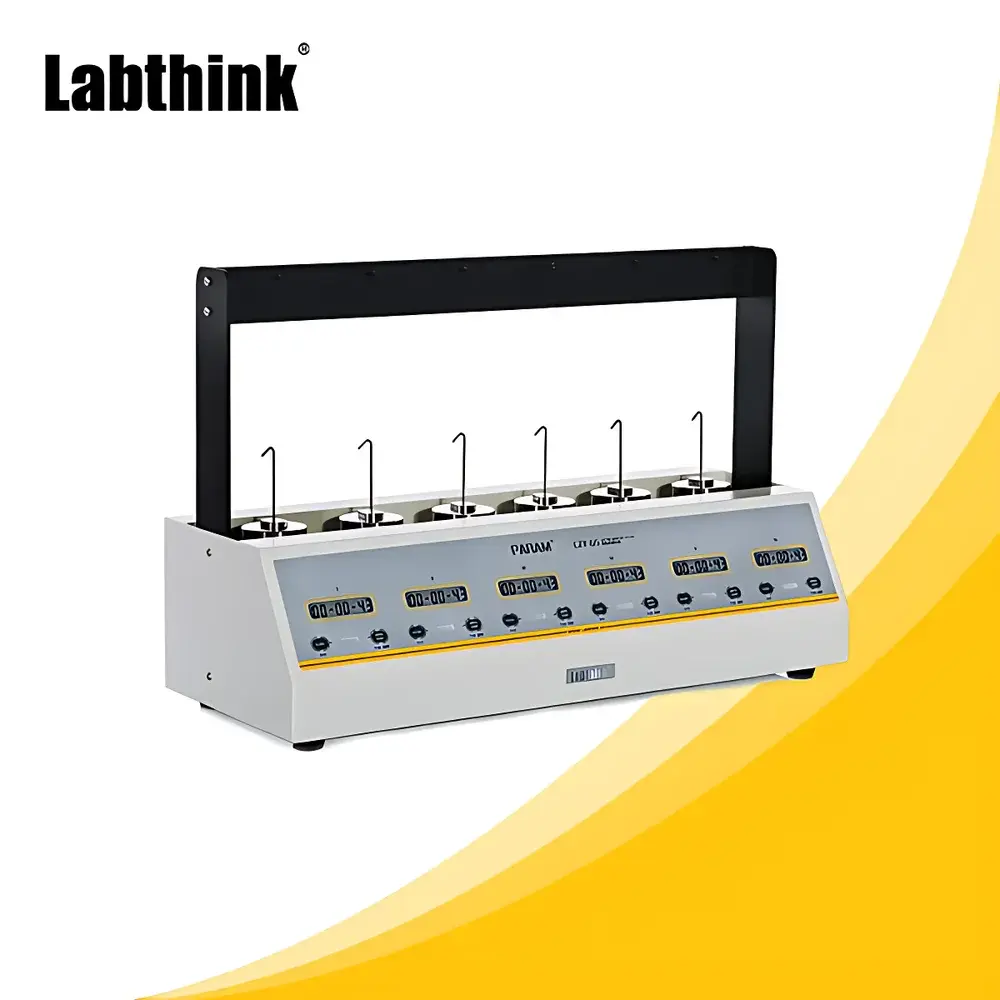
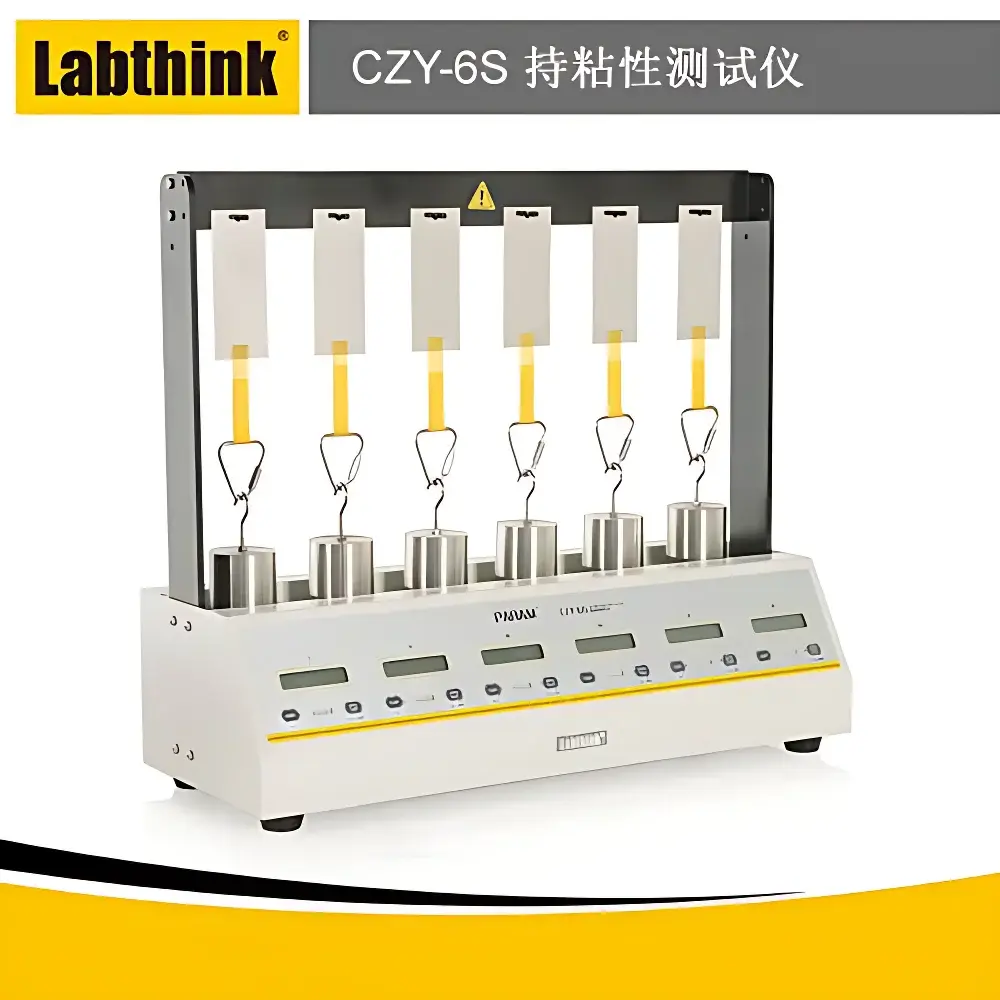
Labthink CZY-6S GB/T 4851 Adhesion Holding Power Tester
| Brand | Labthink |
|---|---|
| Origin | Shandong, China |
| Manufacturer Type | Direct Manufacturer |
| Country of Origin | China |
| Model | CZY-6S |
| Instrument Category | Holding Power Tester |
| Voltage | 220 VAC 50 Hz / 120 VAC 60 Hz |
| Dimensions (L×W×H) | 600 × 240 × 400 mm |
| Net Weight | 20 kg |
| Test Stations | 6 |
| Standard Roller Mass | 2000 g ± 50 g |
| Standard Weight Load | 1000 g ± 10 g (including loading plate) |
| Test Plate Dimensions | 60 mm (L) × 40 mm (W) × 1.5 mm (D) |
| Timing Range | 0–99 h (standard) |
| Compliance Standards | GB/T 4851, ASTM D3654, JIS Z0237 |
Overview
The Labthink CZY-6S GB/T 4851 Adhesion Holding Power Tester is a precision-engineered instrument designed to quantify the resistance of pressure-sensitive adhesive materials to shear stress under constant load and controlled environmental conditions. Based on the principle of vertical static shear testing, it measures either the displacement of the adhesive specimen from the substrate after a defined duration—or the total time until complete detachment—when subjected to a standardized gravitational load. This method directly reflects real-world performance of adhesive products under sustained mechanical stress, making it indispensable for quality assurance in manufacturing, regulatory compliance, and R&D validation. The tester strictly implements the core mechanical configuration specified in GB/T 4851–1998, ensuring metrological traceability and inter-laboratory comparability across Chinese industrial laboratories.
Key Features
- Six independent test stations enable parallel evaluation of multiple specimens, significantly improving throughput without compromising repeatability.
- Microprocessor-controlled operation with PVC membrane keypad and backlit LCD display ensures intuitive navigation, real-time status feedback, and unambiguous parameter confirmation.
- Standardized hardware components—including a 2000 g ± 50 g rubber-coated roller for uniform sample application and a calibrated 1000 g ± 10 g weight assembly (inclusive of loading plate)—guarantee strict adherence to GB/T 4851 mechanical specifications.
- Programmable timing system supports both standard (0–99 h) and extended-duration (0–9999 h) testing modes, accommodating accelerated aging protocols or long-term stability studies.
- Robust aluminum alloy frame and precision-machined stainless steel test plates ensure dimensional stability, thermal inertia, and corrosion resistance over extended service life.
- Auto-lock function freezes elapsed time upon specimen detachment, eliminating operator-dependent reaction delays and enhancing measurement objectivity.
Sample Compatibility & Compliance
The CZY-6S is validated for use with a broad spectrum of pressure-sensitive adhesive substrates, including but not limited to: acrylic- and rubber-based tapes, medical transdermal patches, self-adhesive labels, protective films for electronics and automotive finishes, and laminated packaging materials. Its mechanical design conforms explicitly to the specimen geometry, loading configuration, and environmental requirements outlined in GB/T 4851–1998. In addition, the instrument satisfies the fundamental test setup criteria of ASTM D3654 (for shear adhesion of pressure-sensitive tapes) and JIS Z0237 (for peel and shear tests of PSAs), enabling cross-standard reporting where applicable. While not inherently compliant with FDA 21 CFR Part 11 or EU Annex 11, its deterministic mechanical operation and non-volatile timer output support audit-ready documentation when integrated into GLP/GMP workflows with appropriate procedural controls.
Software & Data Management
The CZY-6S operates as a standalone hardware platform with embedded firmware—no external PC or proprietary software is required for basic operation. All timing data are displayed in real time and retained in volatile memory until power-off; users manually record results in laboratory notebooks or LIMS-compatible spreadsheets. For laboratories requiring digital traceability, optional RS-232 or USB-to-serial interfaces (available upon request) allow integration with third-party data acquisition systems. When deployed in regulated environments, the instrument’s deterministic behavior—absent of user-modifiable algorithms or internal data editing—facilitates straightforward validation per IQ/OQ protocols. Calibration certificates for weights and rollers can be supplied with NIST-traceable documentation upon request.
Applications
- Quality control of production batches of masking tape, duct tape, and double-sided foam tapes against internal specifications and GB/T 4851 pass/fail thresholds.
- Formulation development of medical adhesives, where holding power correlates with skin residence time and patient compliance in transdermal drug delivery systems.
- Comparative assessment of aging effects—e.g., post-thermal cycling or UV exposure—on adhesive integrity using identical test conditions across time points.
- Supplier qualification testing for label stock used in pharmaceutical secondary packaging, verifying adherence to USP <1207> guidance on container closure integrity for adhesive-based seals.
- Supporting stability studies per ICH Q5C, where adhesive performance degradation over shelf life is monitored under accelerated and real-time storage conditions.
FAQ
What standards does the CZY-6S directly implement?
It is mechanically configured and validated to meet all physical requirements of GB/T 4851–1998, including test plate dimensions, weight mass tolerance, roller specifications, and vertical alignment tolerances.
Can the instrument be used for dynamic or cyclic loading tests?
No—the CZY-6S performs only static, constant-load shear testing. It does not support oscillatory, ramped, or fatigue loading profiles.
Is calibration service available from Labthink?
Yes; certified calibration of weights and rollers—including uncertainty statements traceable to national metrology institutes—is offered as an optional add-on with purchase or during annual maintenance.
What environmental conditions are recommended during testing?
Per GB/T 4851, tests should be conducted at 23 ± 2 °C and 50 ± 5 % RH, with specimens conditioned for ≥2 h prior to application. The instrument itself requires no climate control but must be placed on a vibration-isolated, level surface.
How is specimen failure defined during a test?
Failure is defined as either full separation of the adhesive from the test plate, or displacement exceeding 25 mm (as specified in GB/T 4851), whichever occurs first. The instrument records the time at which either condition is met.



