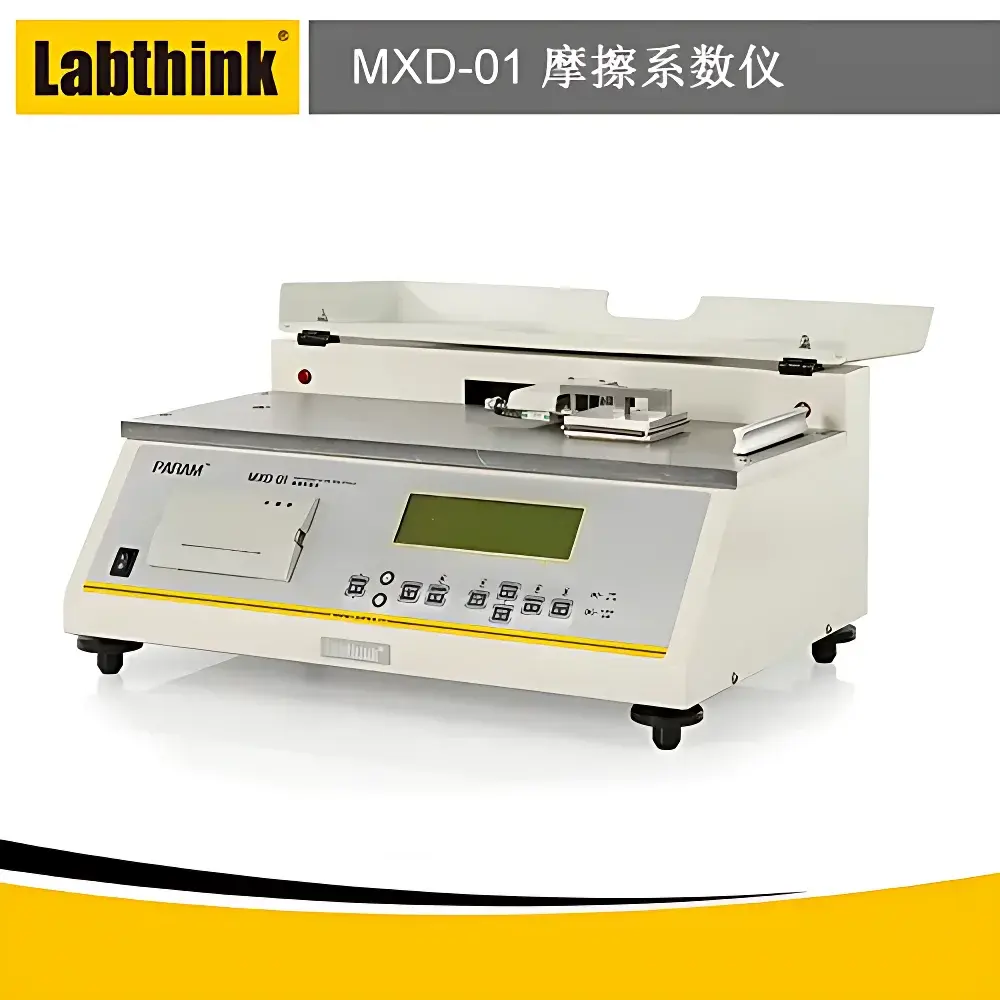
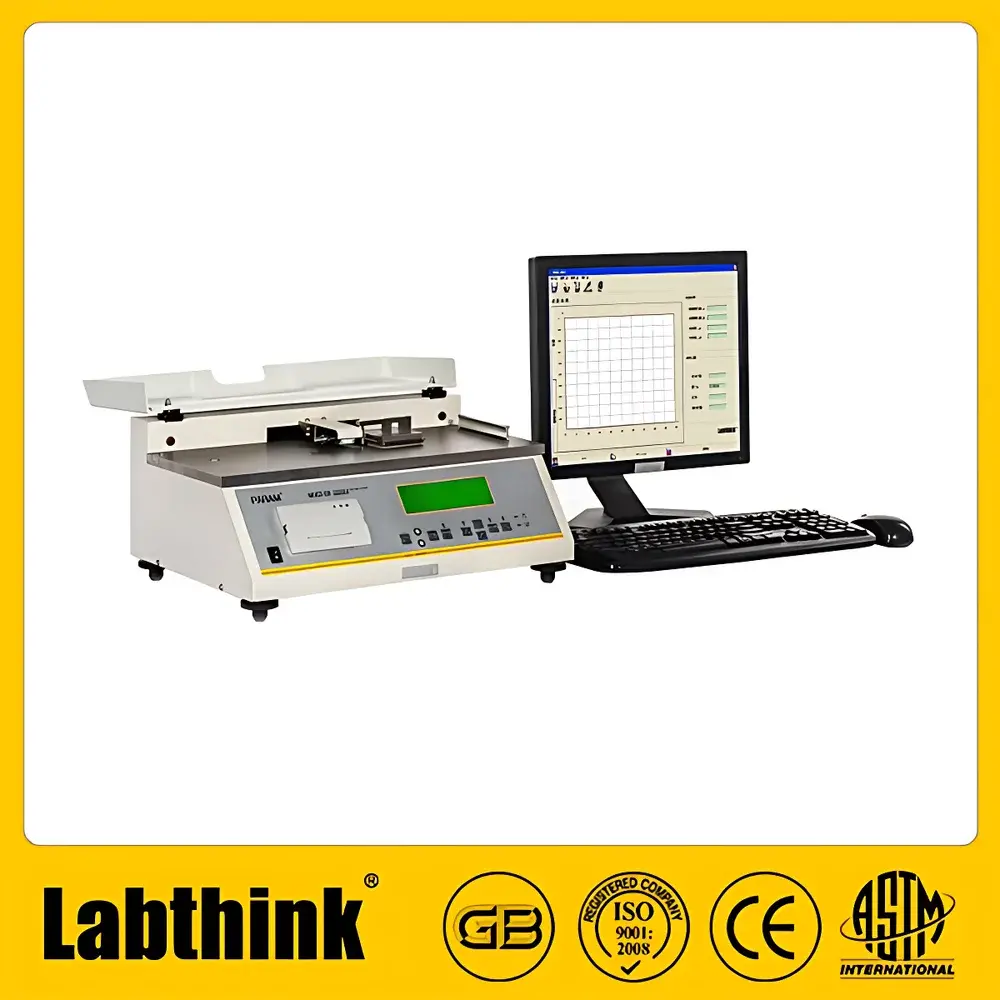
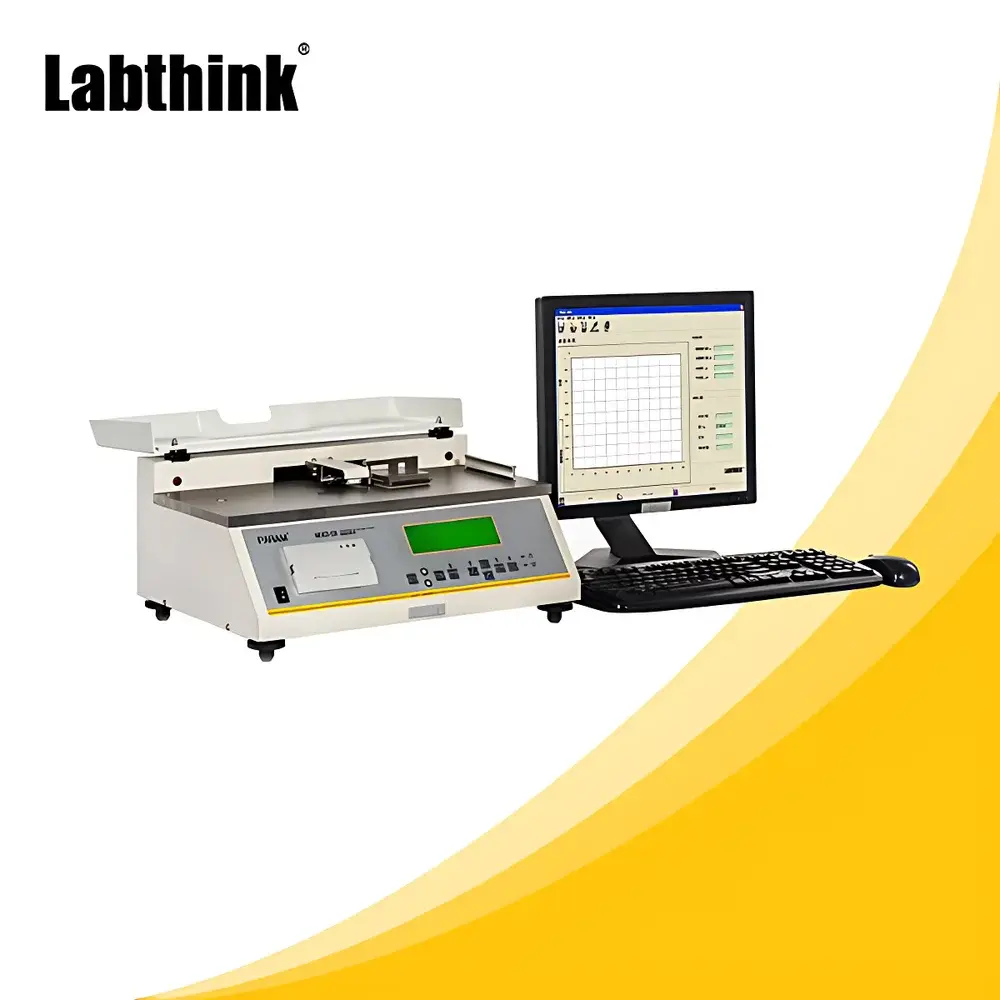
Labthink MXD-01 Static and Dynamic Coefficient of Friction Tester
| Brand | Labthink |
|---|---|
| Origin | Shandong, China |
| Manufacturer Type | Manufacturer |
| Country of Origin | China |
| Model | MXD-01 Static and Dynamic Coefficient of Friction Tester |
| Price Range | USD 1,400 – 7,000 |
| Load Range | 0–5 N |
| Accuracy Class | Class 1 |
| Travel Distance | 10 mm + 60 mm |
| Slider Masses | 200 g, 500 g (1000 g optional) |
| Test Speed | 100 mm/min |
| Environmental Operating Conditions | 10–40 °C, 20–70 %RH |
| Power Supply | 220 VAC 50 Hz / 120 VAC 60 Hz |
| Dimensions (L×W×H) | 470 × 310 × 200 mm |
| Net Weight | 31 kg |
| Compliance | GB 10006, ISO 8295 |
Overview
The Labthink MXD-01 Static and Dynamic Coefficient of Friction Tester is an electromechanical instrument engineered for precision measurement of static (μs) and kinetic (μk) coefficients of friction under controlled sliding conditions. It operates on the fundamental principle of horizontal pull testing: a standardized slider is placed atop a stationary specimen, and a motor-driven carriage applies incremental tensile force until motion initiates (for μs) and sustains at constant velocity (for μk). Force transduction is achieved via a calibrated load cell, with displacement synchronized to real-time force acquisition. Designed specifically for quality control laboratories in packaging, paper, polymer, and automotive component manufacturing, the MXD-01 delivers traceable, repeatable friction data essential for evaluating surface slip resistance, handling performance, and functional compatibility—such as film unwinding behavior on high-speed packaging lines or brake pad–rotor interface stability.
Key Features
- Simultaneous dual-mode measurement: automatic detection and recording of both static and dynamic COF in a single test cycle, with programmable dwell time (static hold period) and auto-zeroing prior to motion initiation
- Demagnetized test platform and stainless-steel sliders validated for residual magnetism (<0.2 mT), minimizing electromagnetic interference with load cell signal integrity
- Microprocessor-based control system featuring an intuitive PVC membrane keypad and backlit LCD display; no external PC required for basic operation
- Modular slider configuration: standard 200 g and 500 g masses included; 1000 g and custom-mass sliders available for specialized applications (e.g., heavy-gauge composites or coated metals)
- Imported high-stability components including S-type load cell (Class 1 accuracy per JJG 391), stepper motor with closed-loop position feedback, and low-drift signal conditioning circuitry
- Integrated thermal management ensures stable electronics performance across ambient temperatures from 10 °C to 40 °C
Sample Compatibility & Compliance
The MXD-01 accommodates flat, flexible, and semi-rigid sheet materials up to 150 mm wide and 300 mm long. Validated substrates include plastic films (BOPP, PET, PE), paperboard, corrugated fiberboard, woven/nonwoven textiles, rubber compounds, metallic foils, coated cables, conveyor belt surfaces, and elastomeric footwear soles. All measurements conform to internationally recognized standards: GB 10006 (China’s national standard for plastic film friction), ISO 8295 (Plastics — Film and sheeting — Determination of coefficient of friction), and ASTM D1894 (Standard Test Method for Coefficient of Friction of Plastic Film and Sheeting). The instrument supports GLP-compliant workflows through audit-trail-capable software options and meets mechanical safety requirements per IEC 61010-1.
Software & Data Management
Optional Lystem™ Laboratory Data Sharing System enables centralized database storage, role-based user access control, and electronic signature support aligned with FDA 21 CFR Part 11 requirements. The software performs automated stick-slip event recognition using first-derivative threshold analysis of force–time curves. It calculates quantitative dispersion metrics—including 95% confidence intervals, coefficient of variation (CV%), and statistical significance (p-value) for inter-group comparisons—and generates ISO/IEC 17025–compatible calibration reports. Raw data export is supported in CSV, XML, and PDF formats. RS232 serial interface ensures interoperability with legacy lab information management systems (LIMS) and SCADA platforms.
Applications
- Optimizing anti-blocking agent concentration in polyolefin film extrusion processes
- Validating surface treatment efficacy (e.g., corona, plasma, or chemical priming) on aluminum foil laminates
- Assessing tactile perception and application consistency of cosmetic creams and lotions on simulated skin substrates
- Verifying compliance of medical device packaging with ISO 11607–2 requirements for peel-open reliability
- Evaluating wear-part interface friction in automotive interior trim assemblies (e.g., dashboard panel sliding resistance)
- Supporting R&D of sustainable paper-based packaging alternatives by correlating fiber orientation, sizing, and calendering parameters with COF profiles
FAQ
What standards does the MXD-01 comply with for regulatory submissions?
The instrument fully implements GB 10006 and ISO 8295 test protocols, with documented uncertainty budgets traceable to NIM (National Institute of Metrology, China). Optional software modules provide Part 11–compliant electronic records for FDA-regulated environments.
Can the MXD-01 measure friction on curved or textured surfaces?
It is designed exclusively for planar specimens. Curved, perforated, or highly embossed samples require flattening or alternative metrology (e.g., tribometers with spherical indenters).
Is calibration certification included with shipment?
A factory calibration report with measurement uncertainty statement is provided. On-site accredited calibration services are available upon request.
How is repeatability verified during routine operation?
Built-in verification routines execute daily checks using certified reference sliders and standard polyester film strips; deviation alerts trigger automatic log entries.
Does the system support multi-language UI or reporting?
The embedded display interface is English-only, but Lystem™ software supports English, Spanish, German, French, and Simplified Chinese report generation.
Related Products