
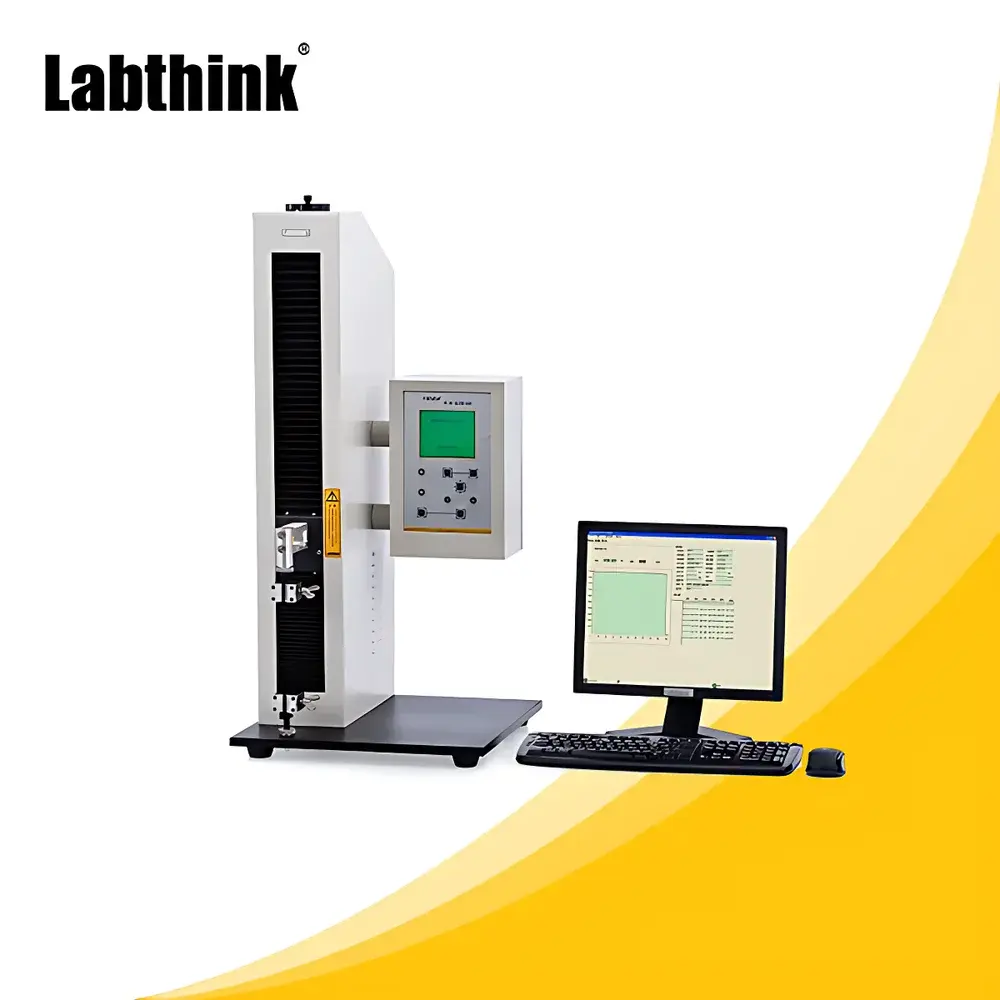
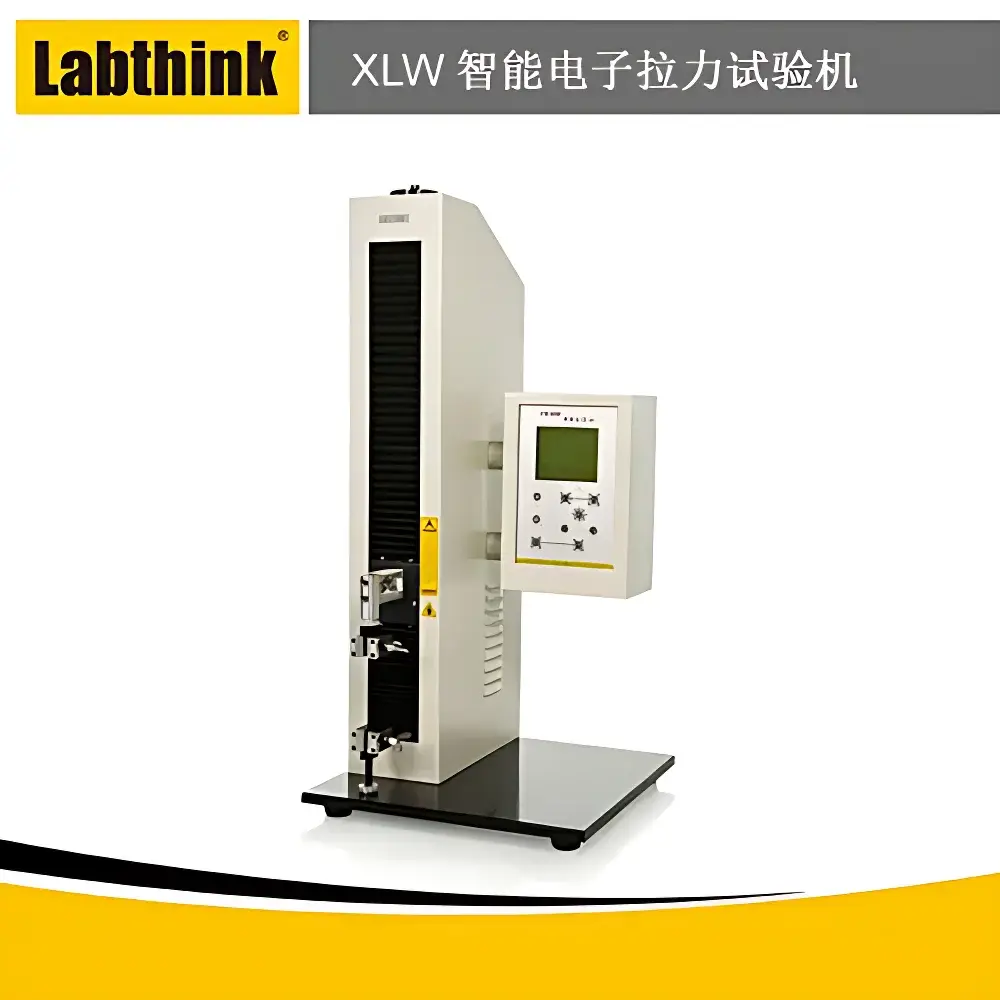
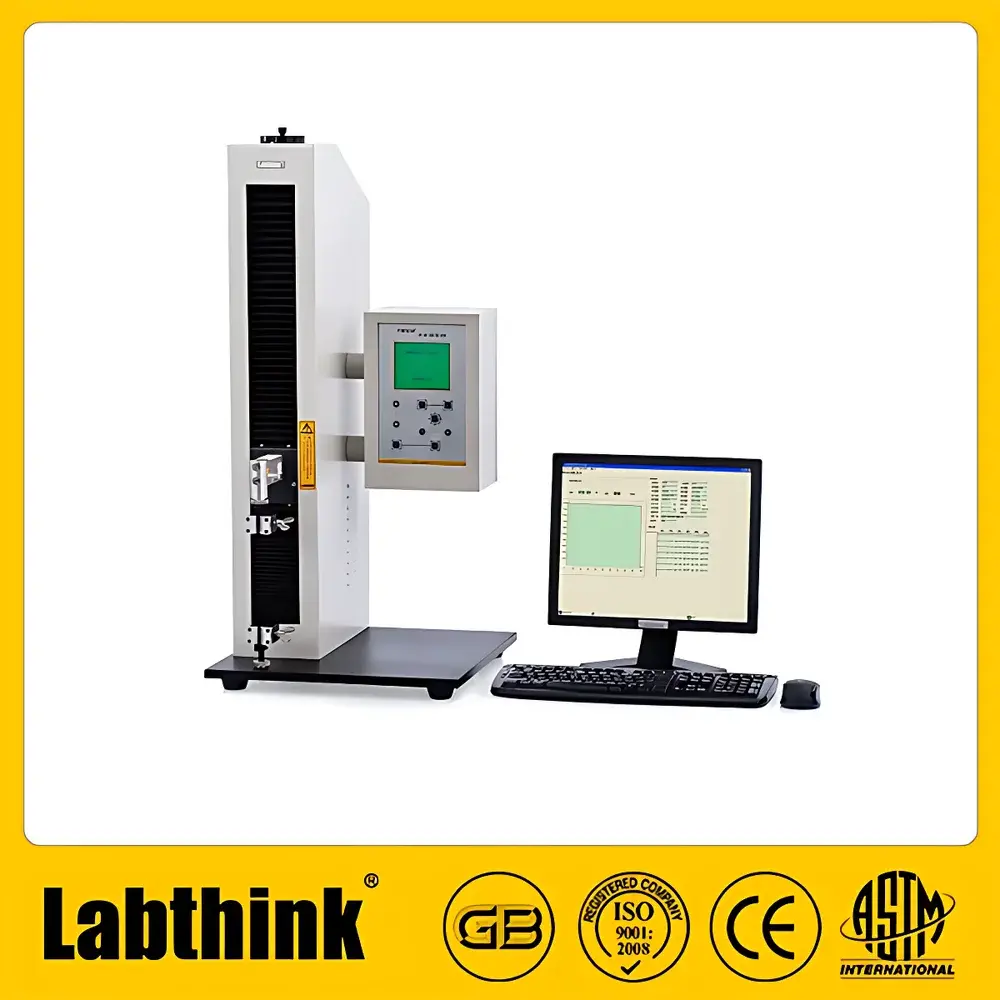
Labthink XLW Pharmaceutical Aluminum-Plastic Closure Opening Force Tester
| Brand | Labthink |
|---|---|
| Origin | Shandong, China |
| Manufacturer Type | Direct Manufacturer |
| Product Origin | Domestic (China) |
| Model | XLW Bottle Cap Opening Force Tester |
| Pricing | Available Upon Request |
| Key Specifications | 100 N / 200 N / 500 N Load Capacity (selectable) |
| Accuracy Class | Class 1 |
| Test Speeds | 50–500 mm/min (7 preset speeds) |
| Standard Clamp Width | 30 mm |
| Optional Clamp Width | 50 mm |
| Maximum Travel | 600 mm |
| Dimensions (L×W×H) | 450 × 450 × 980 mm |
| Power Supply | AC 220 V, 50 Hz |
| Net Weight | 65 kg |
| Compliance | GB 13022, GB 8808, GB 1040, GB 4850, GB 7753, GB 7754, GB 453, GB/T 17200, GB/T 16578, GB/T 7122, GB/T 2790–2792, GB/T 17590, ASTM E4, ASTM D828, ASTM D882, ASTM D1938, ASTM D3330, ASTM F88, ASTM F904, ISO 37, JIS P8113, QB/T 2358, QB/T 1130 |
Overview
The Labthink XLW Pharmaceutical Aluminum-Plastic Closure Opening Force Tester is a precision electromechanical force measurement system engineered for regulated pharmaceutical packaging quality control. It operates on the principle of controlled uniaxial tensile and peel force application under programmable displacement rates, conforming to standardized mechanical testing protocols for closures, seals, and flexible packaging materials. Designed specifically for compliance-driven environments—including QC laboratories in pharmaceutical manufacturing, contract packaging organizations (CPOs), and regulatory validation units—the XLW delivers traceable, repeatable force data essential for verifying package integrity, patient usability, and regulatory conformance. Its architecture integrates load cell-based force transduction with high-resolution linear motion control, enabling accurate quantification of critical functional parameters such as aluminum-plastic cap opening torque equivalence (via axial pull), infusion bag pull-ring activation force, spike penetration resistance, suspension strength, cannula retention, and injection port seal integrity—all within a single platform.
Key Features
- Microprocessor-controlled operation with intuitive menu-driven interface and large backlit LCD display for real-time force, displacement, and curve visualization
- Three selectable load capacity ranges (100 N, 200 N, 500 N), each calibrated to ISO/IEC 17025-traceable standards and certified to Class 1 accuracy per ISO 7500-1
- Seven independent test modes: tensile, peel, tear, heat seal strength, opening force, puncture, and hanging force—each with dedicated algorithmic compensation for dynamic loading effects
- Seven programmable crosshead speeds (50–500 mm/min), adjustable in 1 mm/min increments, supporting both static and quasi-dynamic assessments per USP & Ph. Eur. guidelines
- Robust dual-column frame with 600 mm travel range and motorized auto-return; equipped with mechanical overload protection, end-of-travel limit switches, and emergency stop circuitry
- Comprehensive data management suite including group statistical analysis (mean, SD, CV%), curve overlay comparison, fixed-strain stress calculation, power-loss memory retention, and automatic zero-point drift correction
- Standard RS232 serial interface, parallel printer port (for thermal micro-printer), and optional Ethernet module for LAN-based centralized data aggregation and remote firmware updates
Sample Compatibility & Compliance
The XLW accommodates a broad spectrum of pharmaceutical primary and secondary packaging formats. Standard 30 mm jaw width supports routine testing of vial caps, ampoule seals, and syringe plungers; optional 50 mm jaws extend capability to larger infusion bags, multi-dose containers, and pouch-style delivery systems. All fixtures—including universal tensile grips, floating roller peel clamps, puncture probes, and custom-designed cap-retention fixtures—are machined from corrosion-resistant stainless steel and comply with ISO 15378:2017 requirements for equipment used in GMP environments. The instrument meets or exceeds mechanical testing provisions outlined in multiple pharmacopoeial and industrial standards: GB/T 17200 (general tensile testing), GB/T 2792 (peel strength), ASTM F88 (seal strength), ASTM F904 (burst pressure correlation), ISO 37 (rubber tensile properties), and USP on package integrity evaluation. Full audit trail functionality—including user login, parameter change logs, test result timestamps, and electronic signature support—is available when paired with Labthink’s validated software suite compliant with FDA 21 CFR Part 11 Annex 11 requirements.
Software & Data Management
Labthink’s proprietary PC-based control and analysis software provides full instrument orchestration, method definition, and report generation. Users define test protocols via drag-and-drop workflow templates aligned with SOPs for specific closure types (e.g., “Alu-PVC Flip-Off Cap – Opening Force – Ph. Eur. 3.2.1”). Raw force-displacement datasets are stored in encrypted binary format with SHA-256 checksum verification. Export options include CSV, PDF (with embedded calibration certificate ID), and XML for LIMS integration. The software supports GLP/GMP-compliant features: role-based access control (admin/operator/auditor profiles), electronic signatures with biometric or token-based authentication, and immutable audit logs retained for ≥36 months. Network deployment enables synchronized calibration status tracking across multi-site facilities and automated backup to secure cloud repositories meeting ISO/IEC 27001 criteria.
Applications
- Quantification of aluminum-plastic combination cap removal force to ensure child-resistant yet senior-accessible functionality per ISO 8317 and ASTM D3475
- Infusion bag pull-ring activation force validation to prevent premature opening during transport or handling
- Puncture resistance testing of rubber septa and injection ports using standardized stainless-steel needles (e.g., 21G, 23G)
- Retention force measurement of IV spike connectors after insertion into port membranes
- Heat seal strength assessment of laminated pouches used for lyophilized drug products
- Tensile properties (UTS, elongation at break, Young’s modulus) of multilayer films per ASTM D882 and ISO 527-3
- Seal integrity screening of cold-form blisters and push-through packaging via controlled delamination force profiling
FAQ
What regulatory standards does the XLW directly support?
The XLW is pre-configured to execute test methods referenced in GB, ASTM, ISO, JIS, and QB standards listed in its technical documentation; it also supports method development for ICH Q5C stability-related packaging assessments.
Can the XLW be integrated into an existing LIMS or MES environment?
Yes—via its RS232 or Ethernet interface, the XLW supports HL7, ASTM E1384, and custom API-based data exchange protocols for bidirectional communication with laboratory information management systems.
Is calibration certification included with purchase?
Each unit ships with a factory-issued ISO/IEC 17025-accredited calibration certificate valid for 12 months; on-site recalibration services and IQ/OQ/PQ documentation packages are available upon request.
Does the system support multi-language UI and reporting?
The software interface and generated reports are available in English, Simplified Chinese, German, and Spanish; language selection is configurable per user profile.
What maintenance intervals are recommended for GMP operation?
Daily visual inspection, weekly load cell zero-check, and quarterly mechanical alignment verification are advised; annual full metrological recalibration is required to maintain Class 1 accuracy compliance.



