
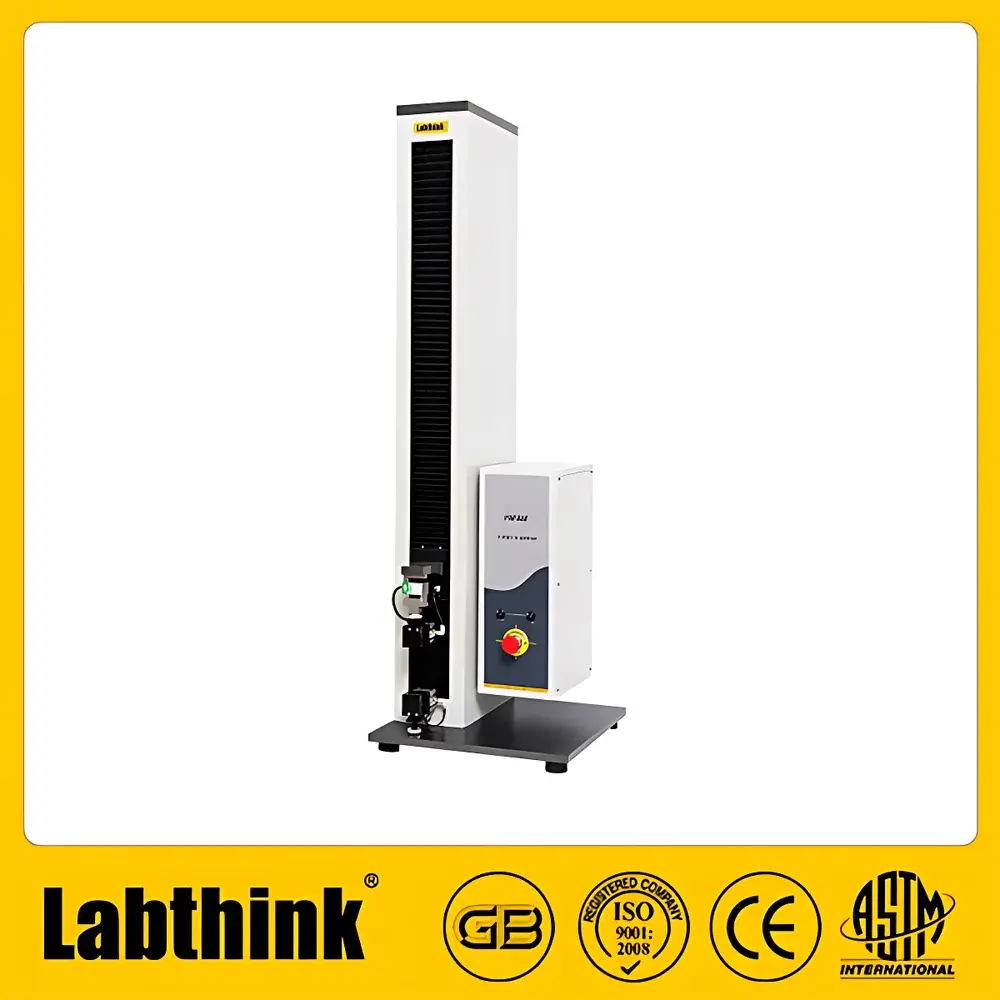
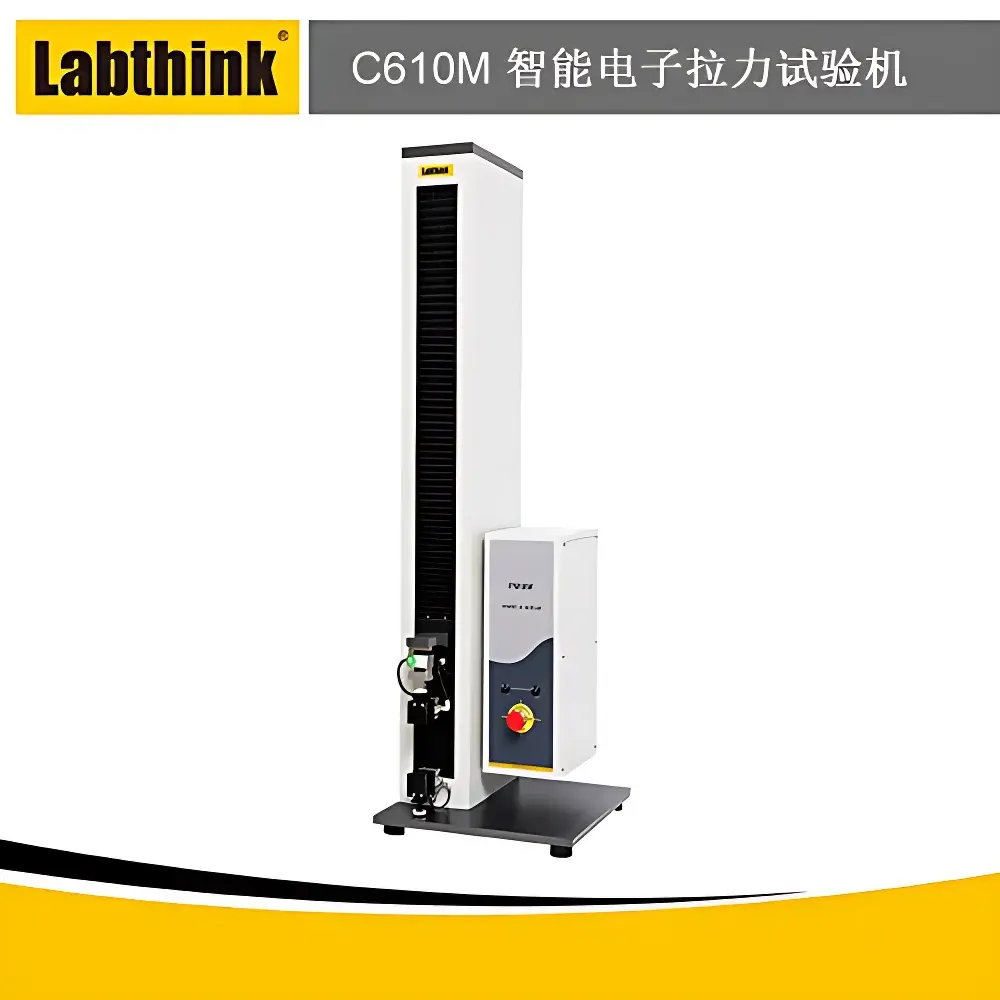
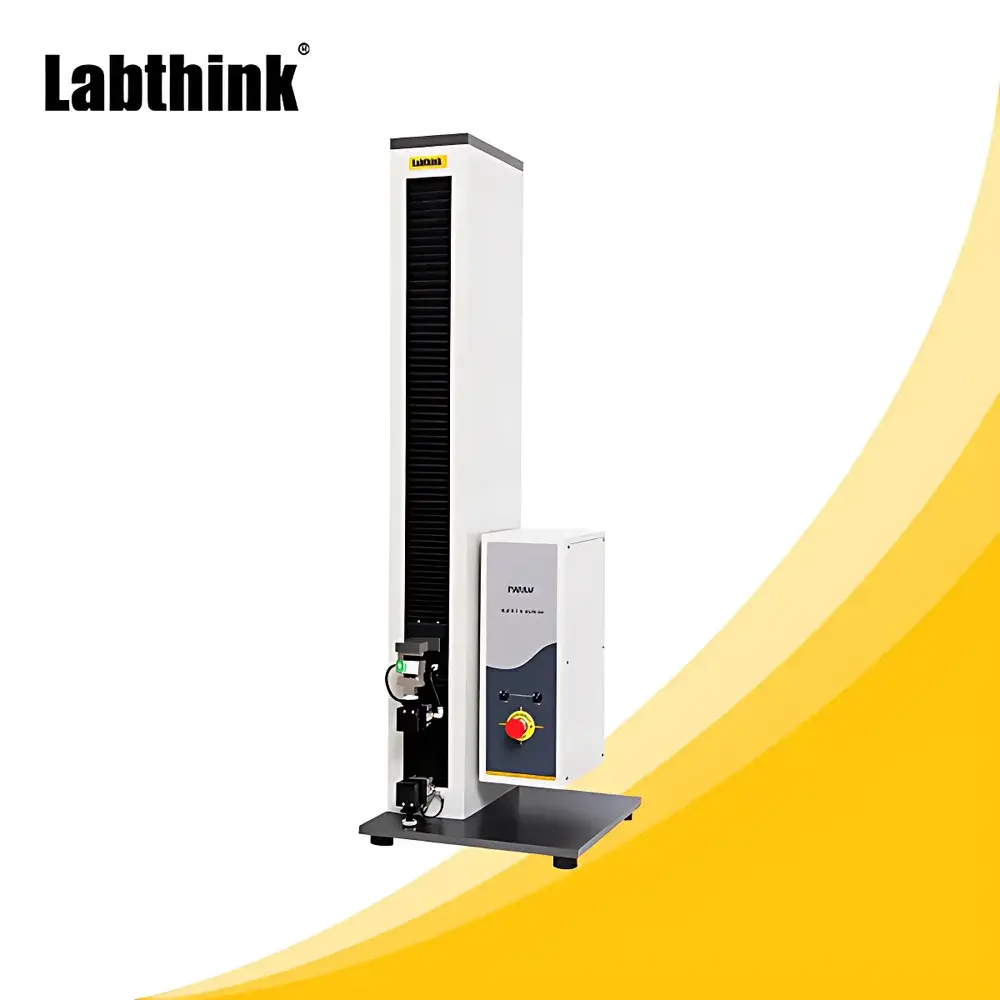
Labthink C610M Medical Adhesion Tester for Hydrocolloid Patches, Gel Plasters, and IV Site Dressings
| Brand | Labthink |
|---|---|
| Origin | Shandong, China |
| Manufacturer Type | OEM/ODM Manufacturer |
| Product Category | Domestic |
| Model | C610M |
| Instrument Classification | Electromechanical Peel & Tensile Tester |
| Force Sensor Options | 5 N (custom), 50 N, 100 N, 250 N, 500 N (standard), 1000 N |
| Test Speed Range | 0–500 mm/min (adjustable in integer increments) |
| Force Accuracy | ±0.5% of reading (2–100% FS), ±0.01% FS (0–2% FS) |
| Displacement Accuracy | Better than 0.5% |
| Resolution | 0.001 N |
| Sample Width | 30 mm (standard), 50 mm (optional) |
| Stroke | 950 mm (1200 mm optional) |
| Pneumatic Clamping | Air supply required (0.5–0.7 MPa) |
| Dimensions | 450 × 450 × 1410 mm (L×W×H) |
| Weight | ~95 kg |
| Power Supply | 220 VAC ±10%, 50 Hz or 120 VAC ±10%, 60 Hz |
Overview
The Labthink C610M Medical Adhesion Tester is an electromechanical universal testing system engineered for precision measurement of peel adhesion, tensile strength, puncture resistance, seal integrity, and mechanical deformation across a broad spectrum of soft, flexible, and layered medical and pharmaceutical materials. Designed specifically to meet the stringent performance validation requirements of transdermal patches (e.g., hydrocolloid-based babbu plasters), gel dressings, IV site adhesive dressings, protective films, and sterile packaging components, the C610M operates on a dual-mode force-displacement principle compliant with standardized quasi-static mechanical testing protocols. Its architecture integrates high-fidelity load cell technology, servo-controlled linear actuation, and pneumatically actuated sample gripping—enabling reproducible application of controlled tensile, compressive, and shear loads under defined displacement rates and environmental conditions. The instrument satisfies foundational mechanical test paradigms outlined in ISO 37, ASTM D3330 (180° peel), ASTM F88 (seal strength), ASTM D882 (tensile properties of thin plastic sheeting), and GB/T 2792 (peel resistance of pressure-sensitive tapes), while supporting method development aligned with USP and ISO 15378 for primary packaging qualification.
Key Features
- Ten preconfigured, independent test modules—including 180° peel, 90° peel, tensile elongation, tear resistance, heat seal strength, puncture hold force, compression, cap opening force, and syringe plunger resistance—enable rapid method switching without software reconfiguration.
- Dual-directional force capability supports both tension and compression testing, facilitating evaluation of rubber stopper puncture force (per ISO 8537), ampoule breakage force (per Ph. Eur. 2.9.1), and combination cap removal torque simulation via axial loading.
- High-accuracy force measurement system with ±0.5% full-scale accuracy (2–100% range) and 0.001 N resolution ensures traceable data generation suitable for regulatory submissions and internal quality audits.
- Precision servo-driven motion control with ball-screw transmission delivers displacement accuracy better than 0.5% and programmable speed stability within ±0.5% of setpoint across 0–500 mm/min.
- Pneumatic clamping system eliminates specimen slippage during high-speed or low-force peel tests, maintaining consistent grip pressure (0.5–0.7 MPa) and minimizing edge stress concentration artifacts.
- Integrated embedded computing platform eliminates dependency on external PCs; all test execution, real-time plotting, statistical analysis, and report generation occur onboard.
- Compliance-ready architecture includes optional DataShield™ data management suite and GMP-compliant audit trail functionality (21 CFR Part 11 Annex 11 compatible), supporting electronic record integrity, user access control, and change history logging.
Sample Compatibility & Compliance
The C610M accommodates over 100 fixture configurations—including floating roller peel fixtures, angled peel jigs (20°, 23°, 45°, 90°, 135°), cap-opening adapters, puncture probes, and custom mandrels—enabling standardized and application-specific evaluation of diverse substrates. Validated use cases span hydrocolloid wound dressings, silicone gel sheets, IV catheter securement tapes, blister lidding foils, pouch seal seams, peelable pouches, aluminum foil laminates, nonwovens, medical-grade elastomers, and simulated skin membranes. All mechanical test methods align with pharmacopoeial and industrial standards including USP , ISO 15378:2017, ISO 8537:2015, Ph. Eur. 2.9.1, GB/T 2792–2014, GB/T 1040.2–2006, and ASTM D1898. Optional IQ/OQ documentation packages support installation and operational qualification per GMP Annex 15.
Software & Data Management
The embedded operating system features intuitive touchscreen navigation, multi-language UI (English, Chinese, Spanish), and built-in statistical tools for mean, SD, CV%, max/min, and trend analysis across up to 20 grouped specimens. Data export supports CSV, PDF, and XML formats with customizable templates. USB 2.0 and Ethernet interfaces enable seamless integration into LIMS or MES environments. Optional DataShield™ provides centralized database synchronization, role-based permissions, encrypted backups, and automated metadata tagging (operator ID, timestamp, method version, environmental log). Audit trails capture all user actions—including parameter edits, result overrides, and report approvals—with immutable timestamps and digital signatures.
Applications
Primary applications include peel adhesion quantification of transdermal patch backing layers, gel plaster release liners, and IV site dressings under controlled humidity and temperature; tensile modulus and elongation-at-break assessment of elastic bandages and surgical drapes; puncture resistance of rubber stoppers and septa; seal strength verification of Tyvek®-laminated trays; and opening force validation of child-resistant closures. Secondary applications extend to peel testing of pressure-sensitive adhesives on simulated skin substrates, tear propagation analysis of breathable films, compression resilience of foam dressings, and detachment force evaluation of catheter connectors and sensor mounting pads. Custom fixture design services support novel device geometries and emerging regulatory test requirements.
FAQ
Does the C610M comply with FDA 21 CFR Part 11 requirements?
Yes—when equipped with the optional GMP Computer System package and DataShield™, the system supports electronic signatures, audit trails, and data integrity controls aligned with Part 11 and EU Annex 11.
Can the instrument perform both static and dynamic peel tests?
It performs quasi-static peel testing per ASTM D3330 and ISO 8510-2; dynamic peel (impact-based) is outside its design scope.
Is calibration traceable to national standards?
All force sensors are calibrated using NIST-traceable deadweight standards; certificate of calibration is provided with each unit.
What environmental conditions are recommended during testing?
Testing should be conducted in a conditioned environment per ISO 291 (23°C ±2°C, 50% RH ±5%) unless otherwise specified by material standard or internal SOP.
Are firmware updates available remotely?
Yes—updates are delivered via USB stick or network download; version history and change logs are maintained in the system’s maintenance module.



