
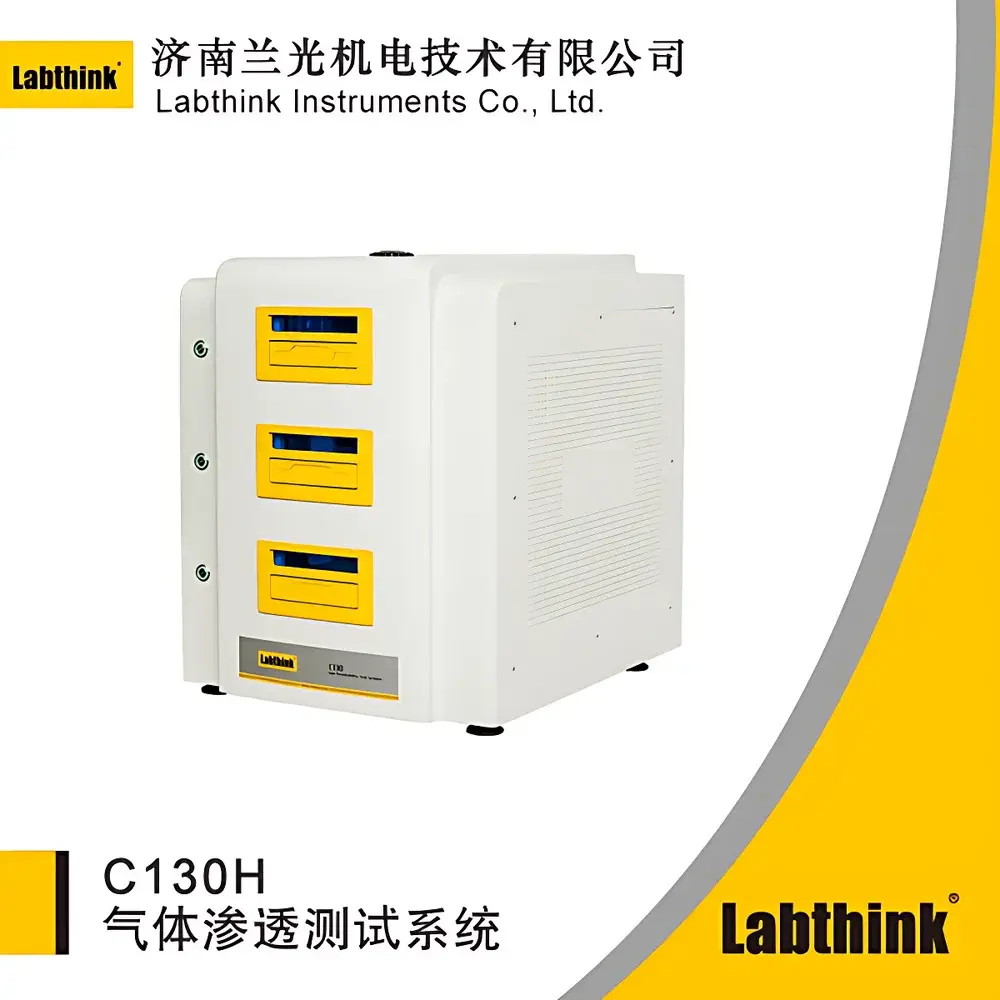
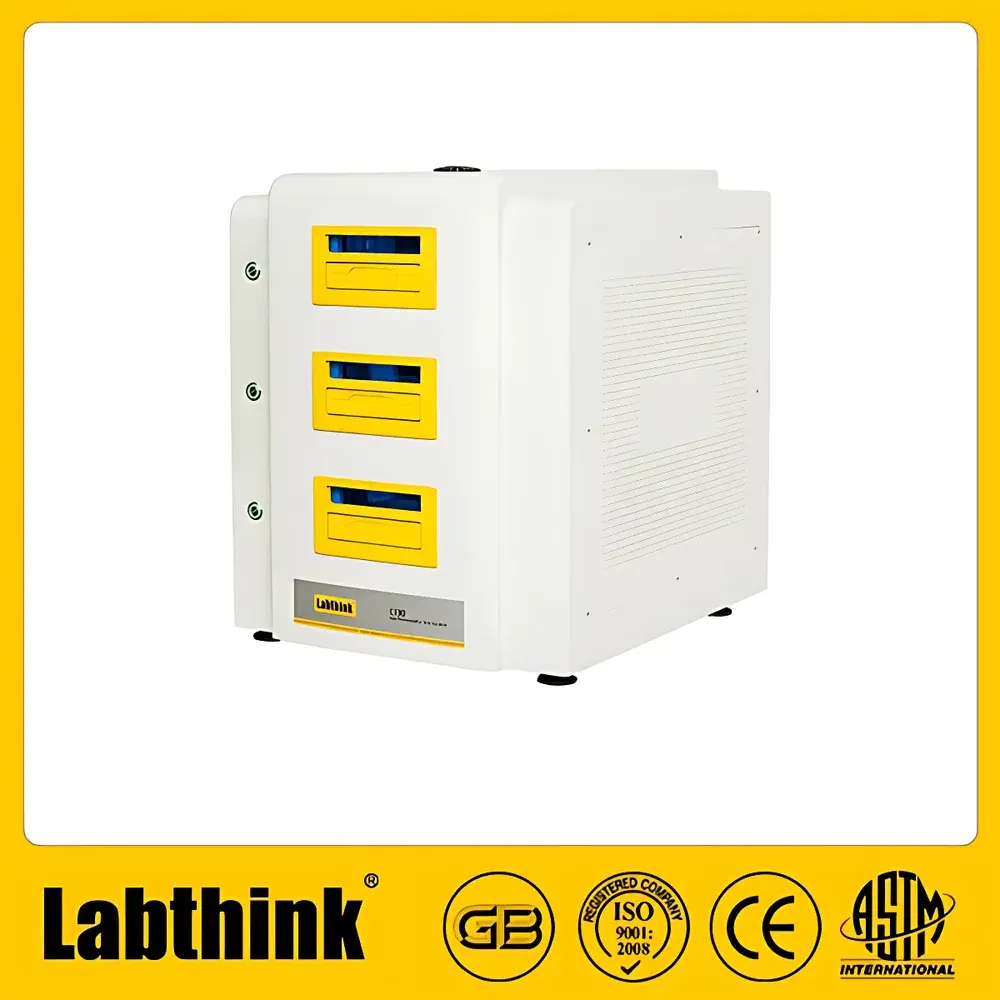
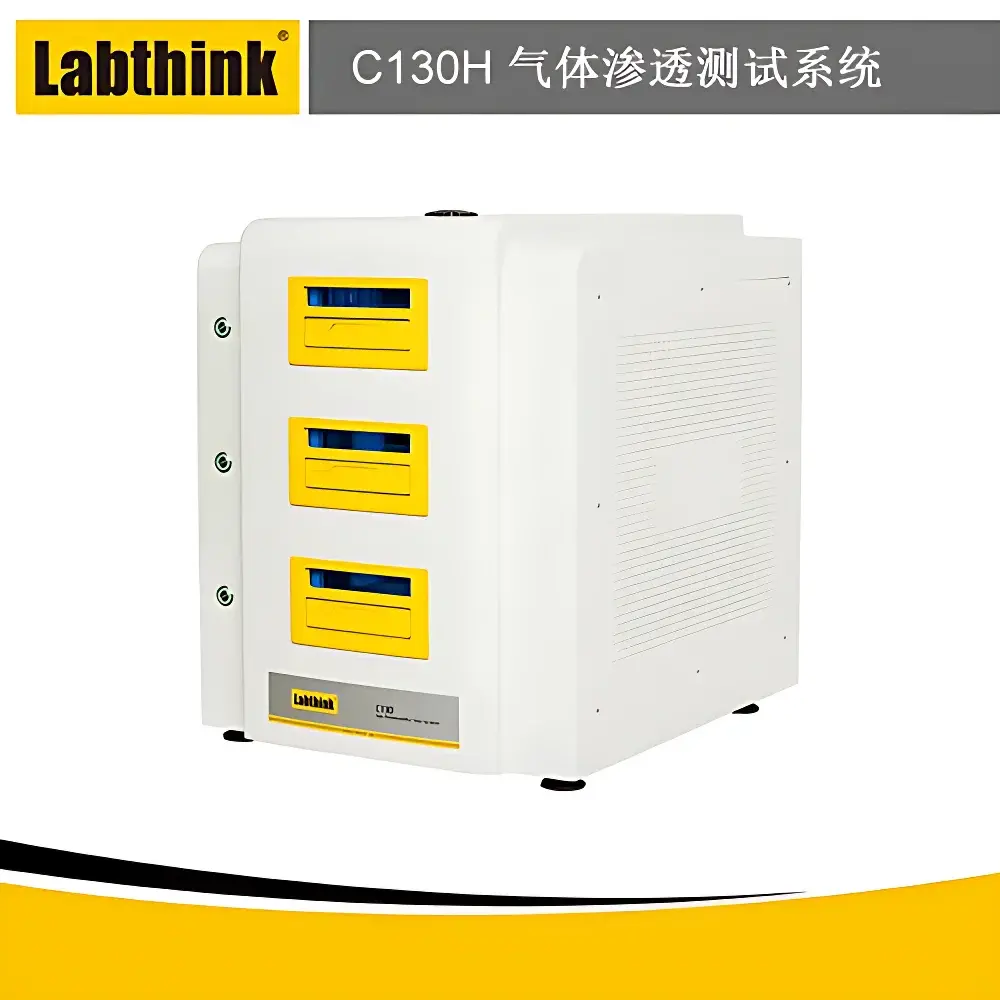
Labthink C130H Gas Permeability Tester (GB/T 1038 Compliant, Differential Pressure Method)
| Brand | Labthink |
|---|---|
| Origin | Shandong, China |
| Manufacturer Type | Direct Manufacturer |
| Country of Origin | China |
| Model | C130H-Labthink |
| Price Range | USD 14,000 – 70,000 |
| Test Principle | Differential Pressure Method (ISO 15105-1, ISO 2556, GB/T 1038-2000, ASTM D1434, JIS K7126-1, YBB 00082003) |
| Measurement Range | 0.01–50,000 cm³/m²·24h·0.1MPa |
| Resolution | 0.001 cm³/m²·24h·0.1MPa |
| Test Temperature | 10–50 °C (±0.05 °C stability, ±0.3 °C accuracy via calibration port) |
| Vacuum Capability | <10 Pa chamber vacuum, sensor resolution 0.01 Pa, accuracy ±0.2% of reading (1–100% of sensor span) |
| Test Pressure Range | 10–210 kPa (adjustable, pressure drift <0.2 kPa during test) |
| Specimen Size | Ø97 mm |
| Effective Test Area | 38.48 cm² |
| Specimen Capacity | 3 independent test chambers |
| Gas Compatibility | O₂, N₂, CO₂, He, air, and custom hazardous or humidified gases (optional modules) |
| Power Supply | 220 VAC ±10%, 50 Hz or 120 VAC ±10%, 60 Hz |
| Dimensions | 710 × 350 × 630 mm (L×W×H) |
| Net Weight | ~100 kg |
Overview
The Labthink C130H Gas Permeability Tester is an engineered differential pressure (manometric) system designed for precise, repeatable quantification of gas transmission rates through polymeric films, laminates, foils, and rigid sheet materials. Operating in strict accordance with ISO 15105-1, ISO 2556, GB/T 1038-2000, ASTM D1434, and JIS K7126-1, the instrument measures oxygen, nitrogen, carbon dioxide, helium, and other process gases across a broad permeability range—from ultra-high-barrier packaging (e.g., PVDC-coated PET or AlOx-coated films) to low-barrier thermoplastics. The core principle relies on establishing a stable, user-defined pressure gradient (10–210 kPa) across a conditioned specimen sealed between high- and low-pressure chambers. As gas permeates under this gradient, the rising pressure in the evacuated low-pressure chamber is monitored via a high-stability vacuum transducer (0.01 Pa resolution). Real-time data acquisition enables calculation of gas transmission rate (GTR), permeability coefficient (P), diffusion coefficient (D), and solubility coefficient (S) using Fickian and solution-diffusion models—fully traceable to first principles.
Key Features
- Triple independent test chambers: Simultaneous, non-interfering measurements with individual vacuum control, pressure regulation, and data logging—enabling statistical validation and throughput optimization.
- Automated drawer-style test cavity: Motorized ejection and pneumatic clamping ensure consistent compressive force (±2% repeatability), eliminating operator-induced seal variability and reducing setup time by >40%.
- High-fidelity environmental control: 360° forced-air thermal circulation maintains temperature stability within ±0.05 °C over full 10–50 °C operating range; calibrated via dual-port verification ports per chamber.
- Ultra-low vacuum architecture: Integrated UK-sourced vacuum pump achieves ≤0.2 Pa ultimate pressure; automated pump sequencing eliminates manual intervention and reduces energy consumption by 35% versus legacy systems.
- Dual-mode operation: Standard “One-Touch” mode (predefined temperature/pressure) for routine QC; Advanced Research Mode for granular control of ramp rates, dwell times, multi-step pressure profiles, and real-time coefficient derivation.
- Import-grade sensing & actuation: German-engineered vacuum transducers (0.01 Pa resolution, ±0.2% full-scale accuracy), Japanese pneumatic valves (MTBF >500,000 cycles), and US-sourced vacuum grease ensure long-term metrological integrity.
Sample Compatibility & Compliance
The C130H accommodates flat, non-porous specimens up to Ø97 mm (38.48 cm² effective area), including monolayer plastics (PET, PP, PE), metallized films (Al foil, SiOx/AlOx coatings), paperboard composites, rubber sheets, and aerospace-grade laminates. It supports testing under controlled humidity (optional integrated humidification module per ISO 15105-2), inert atmospheres, and certified hazardous gas protocols (e.g., H2, CH4, Cl2) when equipped with explosion-proof actuators and gas-tight manifolds. Regulatory alignment includes full traceability to ISO/IEC 17025 calibration hierarchies, built-in audit trail per FDA 21 CFR Part 11 (when GMP-compliant software option is enabled), and compatibility with GLP/GMP documentation workflows. All firmware and calibration records are digitally signed and exportable in PDF/A-2 format.
Software & Data Management
Embedded Windows-based platform (Intel Celeron, 4 GB RAM, 64 GB SSD) eliminates external PC dependencies—mitigating virus exposure, OS incompatibility, and driver conflicts. The Labthink Permeation Suite provides real-time visualization of pressure-vs.-time, GTR-vs.-time, and temperature-vs.-time curves with adjustable smoothing and derivative overlays. Automated curve fitting applies ASTM E1153 and ISO 2556 Annex B algorithms to derive D, S, and P coefficients with confidence intervals. DataShield™ optional module enables encrypted, role-based access control, centralized SQL database logging, and HL7/CSV/API integration with LIMS or MES platforms. Raw data files (.ltd) include embedded metadata: operator ID, calibration certificate IDs, environmental logs, and digital signatures compliant with EU Annex 11.
Applications
Primary use cases span pharmaceutical blister packaging (O2 ingress into moisture-sensitive tablets), food packaging shelf-life modeling (CO2 loss in modified-atmosphere trays), lithium-ion battery separator validation (He leak rate at 100 kPa), aerospace inflatable structures (helium retention in composite bladders), and medical device pouch integrity (sterilant gas (e.g., EtO) transmission). Secondary applications include biodegradable film degradation kinetics (O2 uptake vs. compost time), automotive gasket permeability (fuel vapor transmission), and barrier coating R&D (quantifying defect density via Arrhenius activation energy plots from multi-temperature tests).
FAQ
What standards does the C130H directly support?
ISO 15105-1, ISO 2556, GB/T 1038-2000, ASTM D1434, JIS K7126-1, and YBB 00082003—all implemented via hardware configuration and software calculation engines.
Can the system measure helium permeation for aerospace applications?
Yes—helium is fully supported as a standard test gas; the 0.01 cm³/m²·24h·0.1MPa lower detection limit and <0.2 kPa pressure drift enable reliable measurement of ultra-low-permeability composites used in zero-pressure helium bladders.
Is humidity-controlled testing possible?
Yes—optional integrated humidity generator enables precise RH control (10–90% RH, ±2% RH accuracy) in the high-pressure chamber per ISO 15105-2, with automatic dew-point compensation and condensate management.
How is system calibration verified?
Each chamber includes dedicated temperature and pressure calibration ports; certified reference membranes (NIST-traceable O2 and He standards) are supplied for periodic performance verification per ISO 17025 requirements.
Does the instrument meet pharmaceutical data integrity requirements?
With the optional GMP software package, it delivers ALCOA+ compliant audit trails, electronic signatures, 21 CFR Part 11 user access controls, and immutable data archiving—validated for use in FDA-inspected facilities.




