
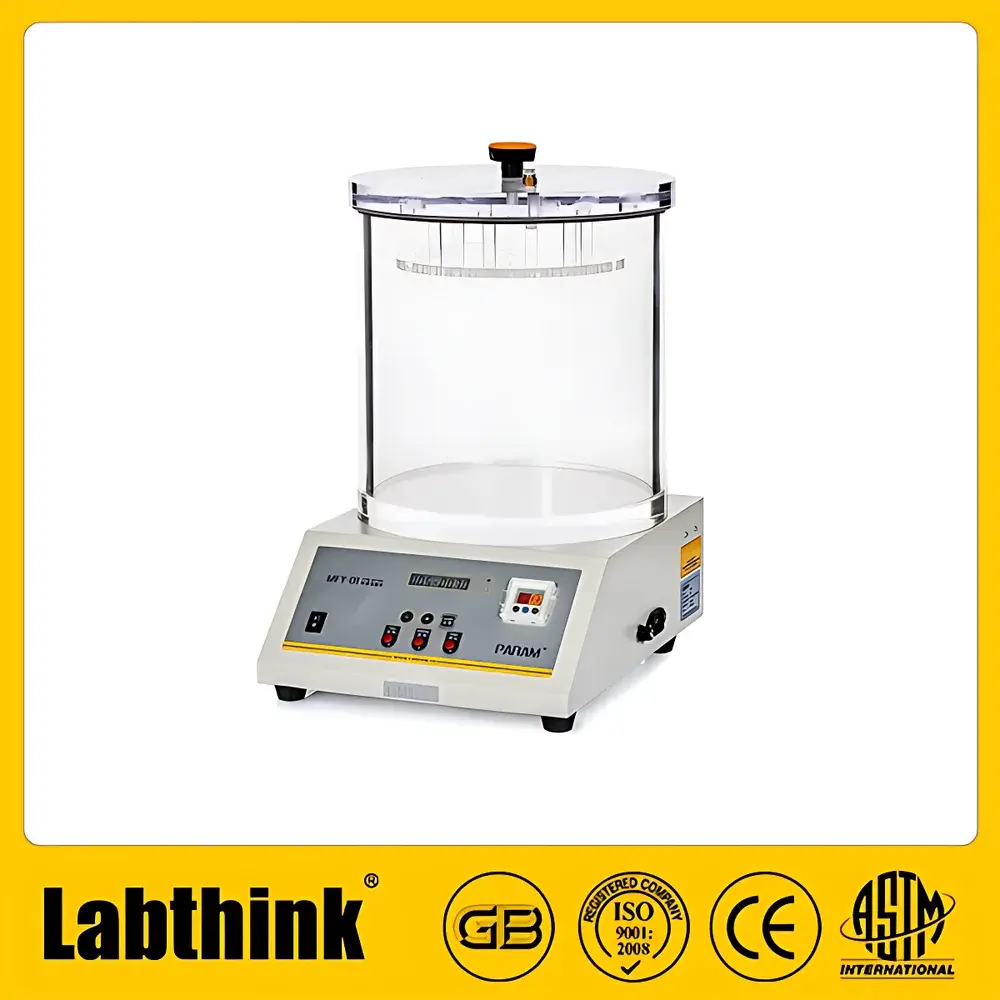
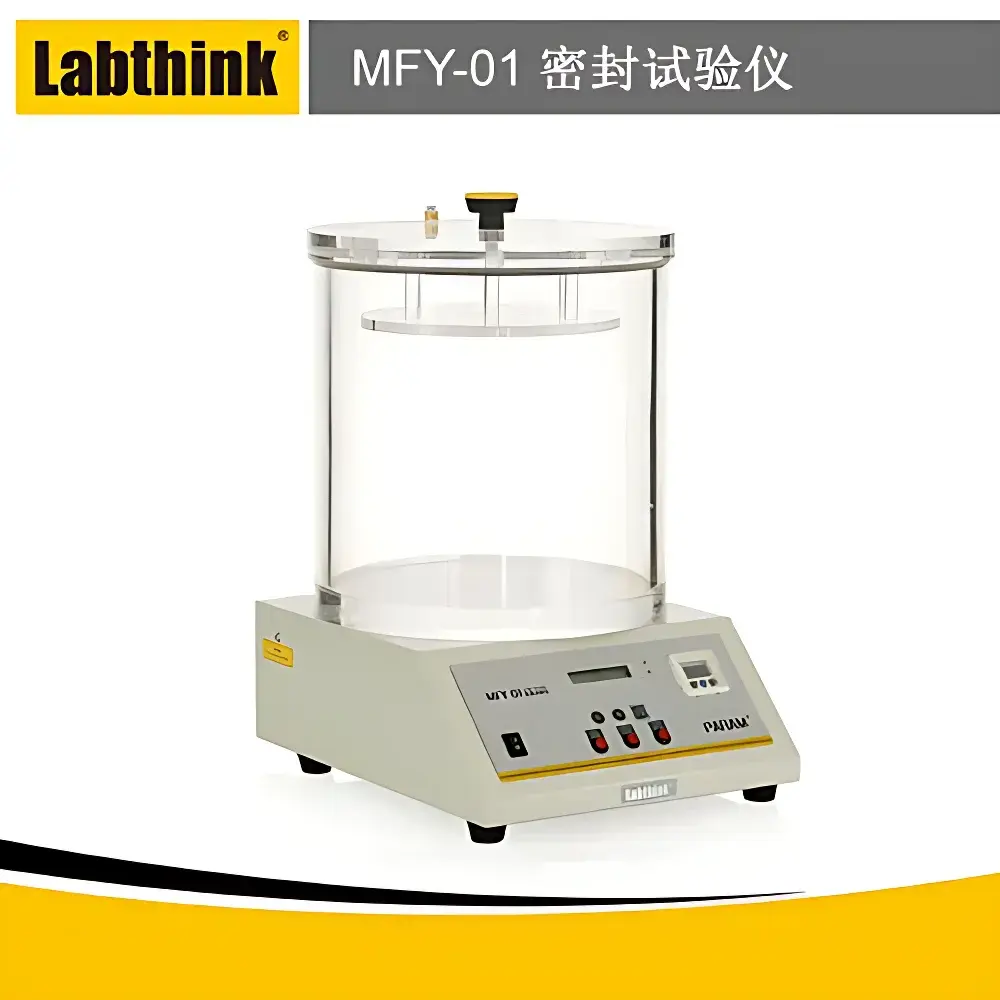
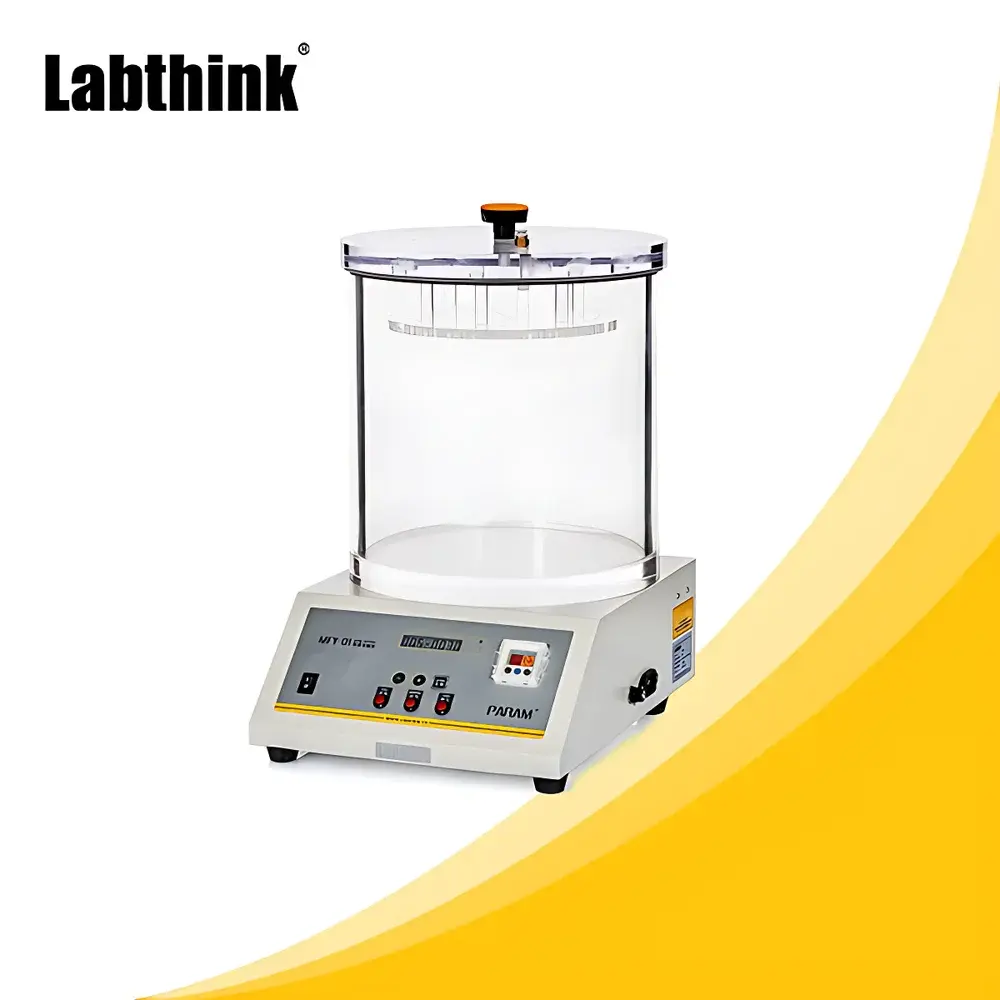
Labthink MFY-01 Leak Tester for Flexible Packaging Integrity Verification
| Brand | Labthink |
|---|---|
| Model | MFY-01 |
| Origin | Jinan, Shandong, China |
| Manufacturer Type | Direct Manufacturer |
| Country of Origin | China |
| Price Range | USD 1,400 – 4,200 (FOB) |
| Vacuum Range | 0 to –90 kPa |
| Accuracy Class | Grade 1 |
| Standard Vacuum Chamber Dimensions | Φ270 mm × 210 mm (H) |
| Optional Chambers | Φ360 mm × 585 mm (H), Φ460 mm × 330 mm (H) |
| Air Supply Requirement | 0.7 MPa (user-provided) |
| Air Inlet | Φ6 mm polyurethane tubing |
| Overall Dimensions | 300 mm (L) × 380 mm (W) × 450 mm (H) |
| Power | 220 VAC 50 Hz / 120 VAC 60 Hz |
| Net Weight | 12 kg |
| Compliance Standards | GB/T 15171–1994, ASTM D3078–22 |
Overview
The Labthink MFY-01 Leak Tester is a microprocessor-controlled vacuum decay-based integrity verification system engineered for non-destructive, qualitative assessment of seal integrity in flexible and semi-rigid packaging. It operates on the principle of controlled vacuum application within a sealed water-submerged chamber, inducing differential pressure across the package wall. Two complementary evaluation modes are supported: (1) Gas Evolution Observation, where leakage manifests as visible bubbles escaping from compromised seals or micro-perforations during vacuum hold; and (2) Package Distension & Recovery Analysis, wherein structural deformation under vacuum and subsequent elastic recovery upon venting indicate barrier continuity and seal resilience. This dual-mode methodology aligns with standardized physical challenge testing protocols used in regulated manufacturing environments—particularly where deterministic pass/fail criteria are required prior to release.
Key Features
- Digital vacuum setpoint control with programmable hold time (0–999 s), enabling repeatable test conditions compliant with method validation requirements
- High-stability pneumatic components sourced from globally recognized suppliers, ensuring long-term operational consistency and minimal drift over extended duty cycles
- Automatic pressure compensation circuitry maintains target vacuum level throughout the test duration, mitigating ambient temperature or minor chamber leakage effects
- Integrated microcontroller with backlit LCD display and tactile PVC membrane keypad—designed for glove-compatible operation in cleanroom or production-floor settings
- Onboard firmware supports automated post-test functions including controlled air bleed (reverse purge) and timed cycle termination, reducing operator dependency and inter-test downtime
- Modular vacuum chamber architecture with three factory-certified dimension options (standard + two optional configurations), plus custom chamber design support for atypical package geometries
Sample Compatibility & Compliance
The MFY-01 accommodates a broad spectrum of primary and secondary packaging formats—including pouches with spouted closures (e.g., jelly drink pouches), laminated sachets, blister cards, PE/ALU tubes, PET jars, and thermoformed trays. Its methodology satisfies the physical inspection requirements outlined in GB/T 15171–1994 “Method for Determination of Seal Integrity of Flexible Package” and ASTM D3078–22 “Standard Test Method for Determination of Leaks in Flexible Packaging by Bubble Emission”. While not a quantitative leak rate measurement instrument (i.e., it does not report mL/min or cc/sec), its binary pass/fail output is widely accepted for routine QC screening in food, pharmaceutical, and medical device packaging lines operating under ISO 13485, HACCP, or FDA 21 CFR Part 11–aligned quality systems. The unit’s mechanical construction and control logic support audit-ready documentation when paired with external data loggers or validated LIMS interfaces.
Software & Data Management
The MFY-01 operates via embedded firmware without external PC dependency—ensuring robustness in industrial environments with limited IT infrastructure. All test parameters (vacuum setpoint, dwell time, chamber ID) are stored in non-volatile memory and recalled per user profile. While native data export is not supported, the device includes an RS-232 serial interface (optional USB-to-serial adapter available) for integration into centralized QA databases or MES platforms. When deployed in GLP/GMP-regulated facilities, users commonly implement supplementary procedural controls—including written test methods, equipment calibration logs (per ISO/IEC 17025), and manual entry of results into electronic batch records—with full traceability to operator ID, date/time stamp, and chamber configuration. Firmware updates are provided by Labthink upon request and require authorized service technician intervention.
Applications
- Pre-release verification of heat-seal strength and channel integrity in retortable and pasteurized fruit gelatin pouches with integrated drinking nozzles
- Post-distribution simulation testing: evaluating seal survivability after ISTA 2A/3A-compliant drop, compression, and vibration stress exposure
- Comparative validation of new sealing parameter sets (temperature, dwell time, pressure) during packaging line qualification
- Root cause analysis of field complaints related to moisture ingress, oxidation, or microbial contamination in shelf-stable products
- Supplier qualification audits for contract packagers producing child-resistant or tamper-evident closures
- Internal training tool for packaging technicians to visually correlate defect morphology (e.g., seal width inconsistency, contamination-induced weak spots) with bubble patterns
FAQ
Does the MFY-01 provide quantitative leak rate measurements?
No. It is a qualitative, visual detection system based on ASTM D3078 and GB/T 15171. It identifies presence/absence of leaks but does not quantify volumetric flow.
Is compressed air supply included with the instrument?
No. A clean, oil-free compressed air source delivering 0.7 MPa (100 psi) is required and must be provided by the user.
Can the MFY-01 test rigid containers such as glass vials or aluminum cans?
It is optimized for flexible and semi-rigid materials. Rigid containers may not exhibit observable distension or bubble emission under standard test conditions; alternative methods (e.g., pressure decay or helium mass spectrometry) are recommended.
What maintenance is required for long-term reliability?
Routine cleaning of the vacuum chamber and O-ring surfaces with isopropyl alcohol; annual verification of vacuum sensor calibration and pneumatic valve response time by an accredited service provider.
Is the device compatible with 21 CFR Part 11 requirements?
The standalone unit lacks electronic signature capability or audit trail generation. Compliance requires integration with validated third-party software or paper-based procedural controls meeting ALCOA+ principles.





