
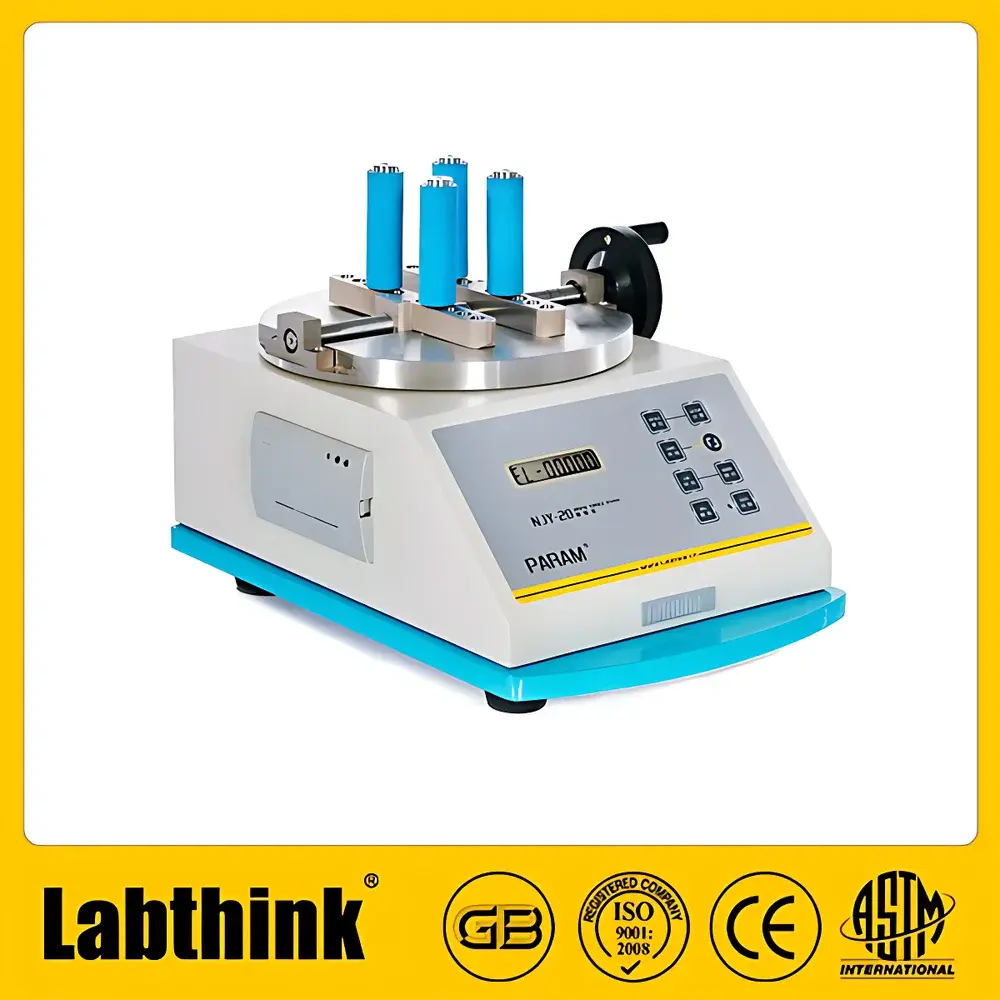
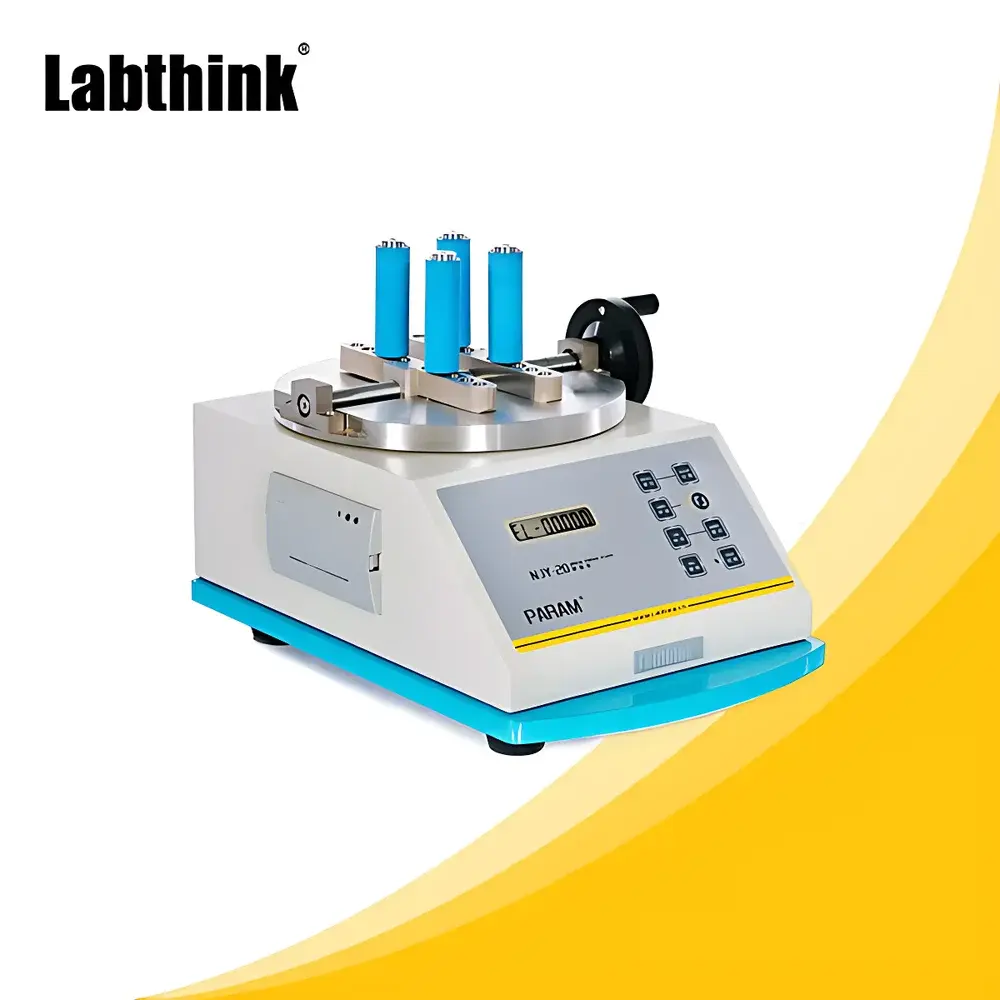
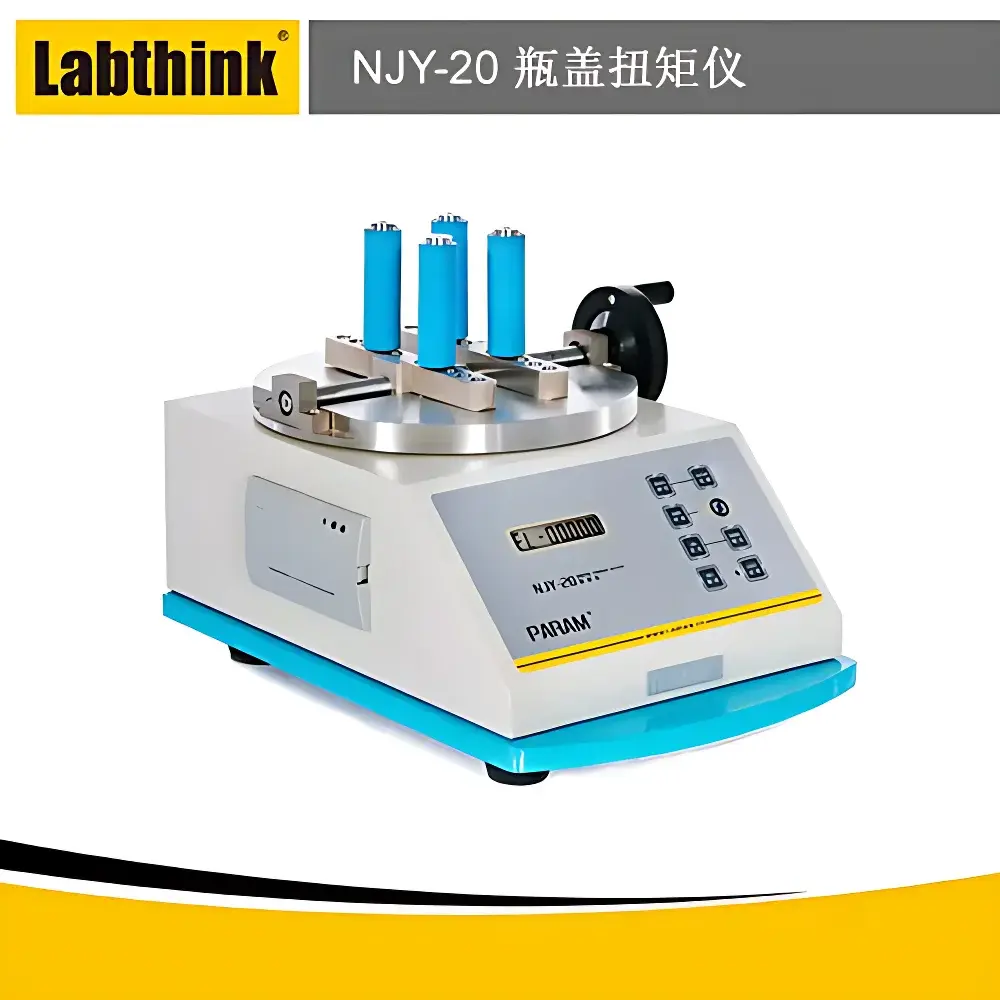
Labthink NJY-20 Advanced Bottle Cap Torque Tester
| Brand | Labthink |
|---|---|
| Model | NJY-20 |
| Type | Digital Torsion Testing Machine for Closure Torque Measurement |
| Torque Range | 20 N·m (standard), optional 40 N·m / 50 N·m |
| Accuracy Class | Class 1 |
| Resolution | 0.001 N·m |
| Clamp Diameter Range | Φ5 mm – Φ170 mm |
| Sample Count per Test Sequence | 1–9 (unlimited via Lystem™ software) |
| Dimensions (L×W×H) | 350 mm × 240 mm × 140 mm |
| Weight | 19 kg |
| Power Supply | 220 VAC 50 Hz / 120 VAC 60 Hz |
| Compliance Standards | GB/T 17876, ASTM D2063, ASTM D3198, ASTM D3474, BB/T 0025, BB/T 0034 |
Overview
The Labthink NJY-20 Advanced Bottle Cap Torque Tester is a precision-engineered digital torsion testing instrument designed to quantify the rotational force required to tighten (closure torque) or loosen (removal torque) threaded closures on rigid and semi-rigid packaging systems. It operates on the principle of controlled angular displacement with real-time torque transduction, utilizing a high-stability strain-gauge-based load cell calibrated to ISO 376 traceable standards. The device meets the mechanical and metrological requirements for routine quality control in pharmaceutical, food & beverage, cosmetic, and household product manufacturing environments—where consistent cap torque directly impacts seal integrity, shelf-life stability, child-resistant functionality, and user experience during opening. Its compact benchtop architecture supports both offline laboratory verification and inline process validation workflows, delivering repeatable measurements under GLP-compliant conditions.
Key Features
- Microprocessor-controlled operation with LCD display and tactile PVC membrane keypad for intuitive parameter input and real-time result visualization
- Dual-mode testing capability: independent measurement of clockwise (tightening) and counterclockwise (removal) torque, each with automatic peak-hold function to capture maximum transient values
- Class 1 accuracy per ISO 7500-1, with 0.001 N·m system resolution across the standard 20 N·m range; extended-range variants (40 N·m, 50 N·m) available for industrial-grade closures
- Adjustable mechanical clamping mechanism accommodating cylindrical closures from 5 mm to 170 mm in outer diameter—compatible with PET bottles, HDPE jars, aluminum screw caps, laminated tubes, and insulated thermos lids
- Integrated safety logic including overload protection, auto-zero reset at start-up, and diagnostic error codes for operational transparency and maintenance readiness
- Onboard thermal mini-printer and RS232 serial interface for immediate hardcopy output and legacy system integration; fully compatible with Labthink’s Lystem™ Laboratory Data Management System for centralized audit-trail generation
Sample Compatibility & Compliance
The NJY-20 accommodates a broad spectrum of closure geometries and materials, including but not limited to polypropylene (PP), polyethylene (PE), aluminum, and multi-layer laminates used in pharmaceutical blister-to-bottle transitions, single-dose liquid packaging, and personal care squeeze tubes. It complies with internationally recognized test methodologies: GB/T 17876 (Chinese national standard for plastic bottle caps), ASTM D2063 (standard test method for torque removal of closures), ASTM D3198 (for peelable seals), ASTM D3474 (for torque-tension relationships), and BB/T 0025 and BB/T 0034 (China packaging industry standards for cap performance). All measurements adhere to ISO/IEC 17025 documentation protocols when operated within accredited laboratories, supporting FDA 21 CFR Part 11–aligned electronic record retention when paired with validated Lystem™ software.
Software & Data Management
The optional Lystem™ Laboratory Data Management System transforms the NJY-20 into a networked node within a regulated QC ecosystem. It enables automated test sequence programming, multi-user role-based access control, time-stamped audit logs, statistical process control (SPC) charting (X̄–R, Cp/Cpk), and export to CSV, PDF, or XML formats compliant with enterprise LIMS architectures. Raw torque vs. angle curves can be visualized and annotated; batch-level summaries include mean, SD, min/max, and pass/fail status against user-defined specification limits. All data transactions are timestamped, immutable, and support full 21 CFR Part 11 compliance—including electronic signatures, operator authentication, and change history tracking.
Applications
- Primary packaging validation: torque profiling of threaded closures on sterile vials, oral solid dosage containers, and parenteral delivery systems per USP and handling guidelines
- Transport simulation correlation: establishing torque thresholds that prevent accidental loosening during vibration, drop, or compression stress testing
- Child-resistant and senior-friendly design verification: quantifying differential torque ratios between initial break-loose and full removal phases
- Closure material aging studies: monitoring torque decay over accelerated shelf-life conditions (e.g., UV exposure, humidity cycling)
- Supplier qualification: comparative analysis of torque consistency across multiple cap batches or OEM sources using ANOVA-enabled reporting
- Process FMEA support: identifying torque outliers linked to capping machine parameters such as spindle speed, dwell time, or chuck pressure
FAQ
What torque ranges does the NJY-20 support out of the box?
The base configuration delivers 20 N·m full-scale capacity; optional upgrade kits extend this to 40 N·m or 50 N·m without hardware replacement.
Can the NJY-20 test non-circular or irregularly shaped closures?
It is optimized for rotationally symmetric threaded closures; asymmetric or snap-fit designs require custom fixturing and are outside its standardized scope.
Is calibration certification included with shipment?
Yes—a NIST-traceable calibration certificate valid for 12 months is supplied; annual recalibration is recommended per ISO/IEC 17025 practice.
Does the instrument meet FDA 21 CFR Part 11 requirements?
Standalone operation does not fulfill Part 11; full compliance requires deployment with validated Lystem™ software, secure network infrastructure, and documented SOPs.
How many test results can be stored internally without external software?
The onboard memory retains up to 9 sequential test records; unlimited storage and advanced analytics require Lystem™ integration.



