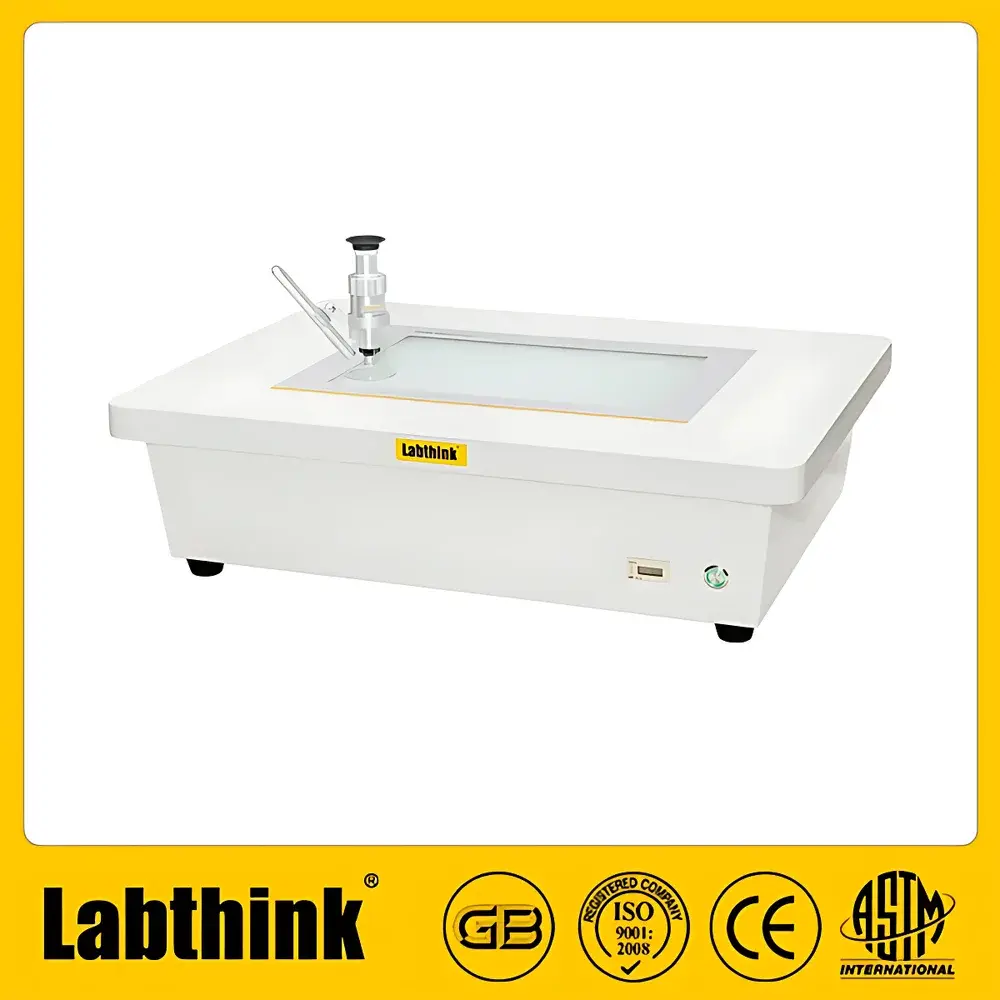
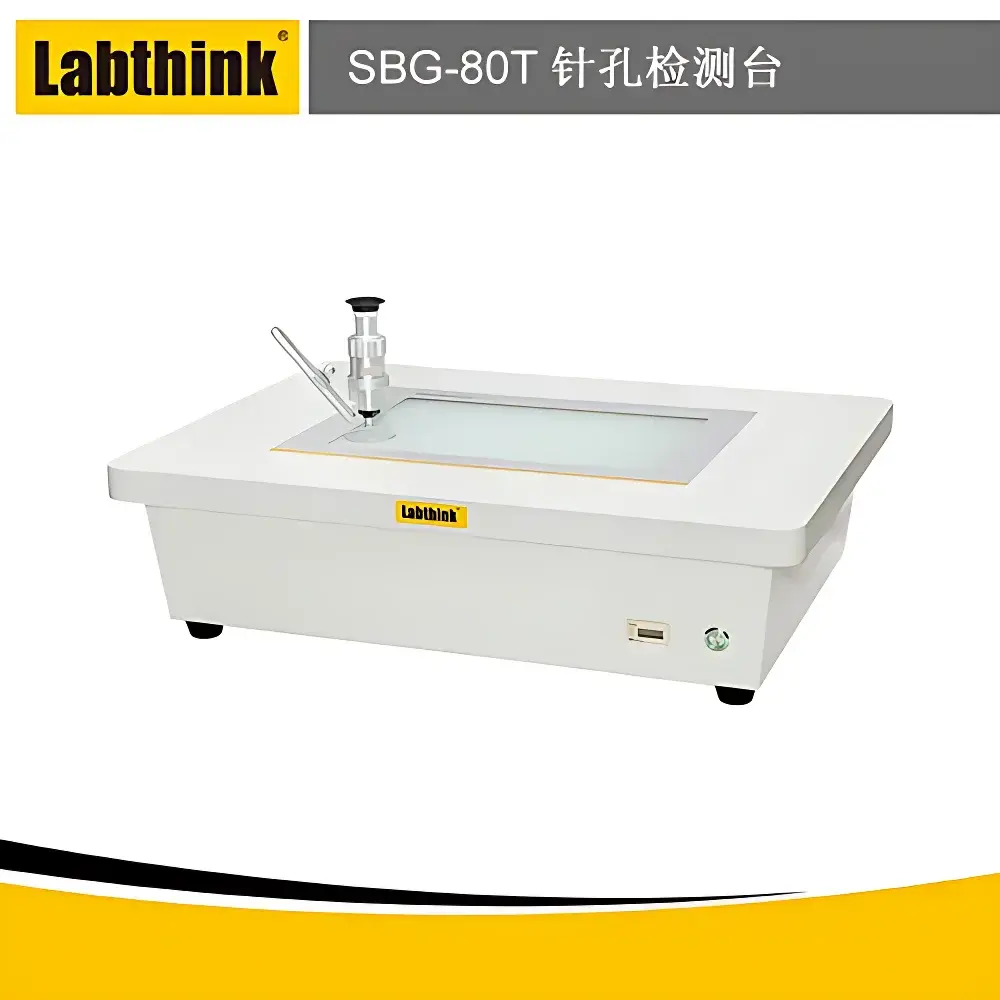
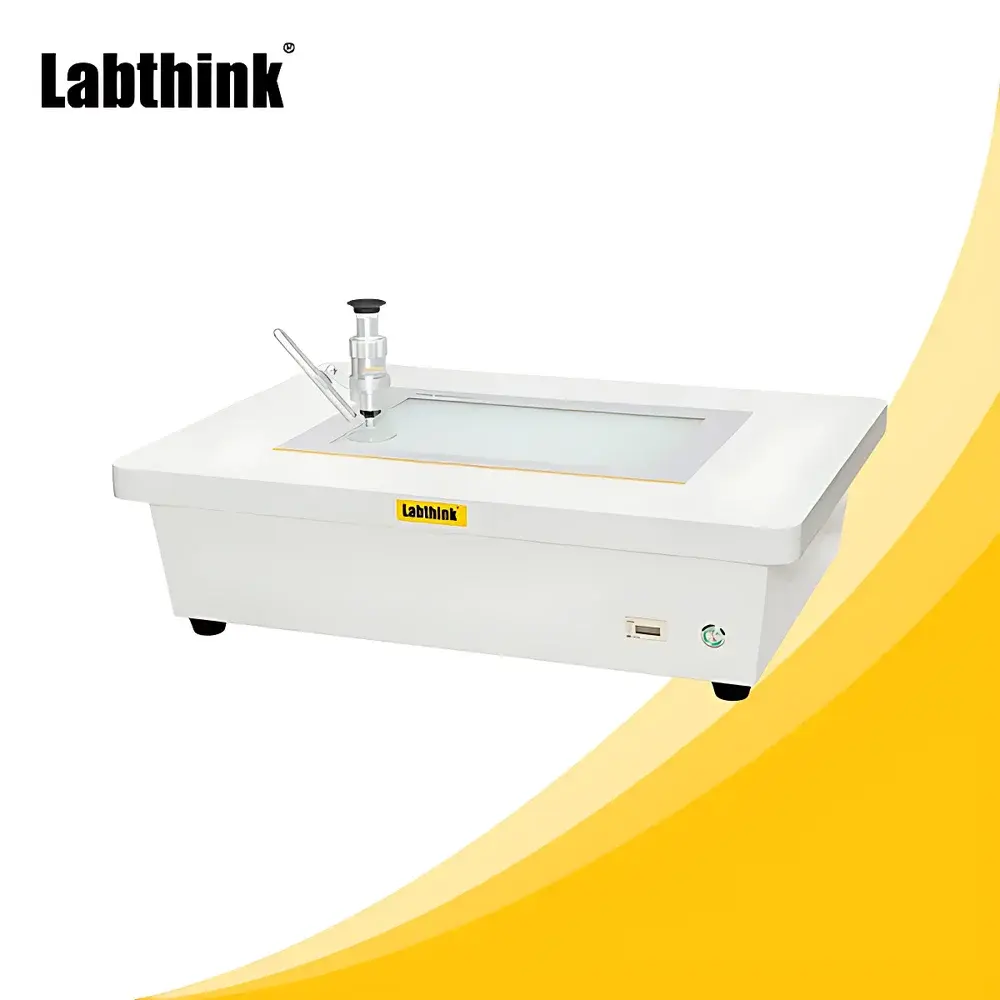
Labthink SBG-80T Aluminum Foil Pinhole Inspection Station
| Brand | Labthink |
|---|---|
| Model | SBG-80T |
| Light Source | CIE D65-compliant 6500 K fluorescent tube (D6500 high-CRI super fluorescent lamp) |
| Viewing Area | 400 × 250 mm |
| Illuminance on Glass Surface | ~1000 lux |
| Ambient Light Requirement | 20–50 lux |
| Magnification | 100× |
| Minimum Scale Division | 0.01 mm |
| Power Supply | 220 VAC, 50 Hz / 120 VAC, 60 Hz |
| Dimensions (L×W×H) | 800 × 600 × 230 mm |
| Net Weight | 10 kg |
| Compliance | GB/T 3198, GB/T 22638.2, YBB 00152002–2015, CIE S 002:2022 (CIE D65 illuminant), CY3–91 |
Overview
The Labthink SBG-80T Aluminum Foil Pinhole Inspection Station is a dedicated optical inspection system engineered for quantitative assessment of pinholes and surface discontinuities in pharmaceutical and industrial aluminum foil laminates. It operates on the principle of transmitted-light visualization: under standardized D65 illumination conditions, microscopic defects—such as pinholes, micro-cracks, and localized thinning—become optically resolvable due to differential light transmission through the foil substrate. The system integrates a CIE D65-compliant 6500 K fluorescent light source (D6500 series) with calibrated spectral power distribution and high color rendering index (CRI > 90), ensuring photometric fidelity required for regulatory-grade visual evaluation. Its rigid optical architecture—featuring tempered glass diffuser plates, uniform irradiance distribution across the 400 × 250 mm viewing field, and ambient light isolation—enables repeatable, operator-independent detection of sub-100 µm defects in accordance with pharmacopoeial and packaging material specifications.
Key Features
- CIE D65 illumination compliant with ISO/CIE S 002:2022 and Chinese standard CY3–91, delivering stable 6500 K chromaticity and spectral consistency over extended operational life
- Integrated illuminance monitoring: calibrated 1000 lux output at the glass surface, maintained within ±5% uniformity across the full viewing area
- Dual-voltage compatibility (220 VAC/50 Hz or 120 VAC/60 Hz) for global laboratory deployment without external transformers
- Optical magnification system (100×) with 0.01 mm minimum scale resolution, enabling precise dimensional annotation of defect morphology
- Automatic lamp-hour counter embedded in control circuitry, supporting preventive maintenance scheduling and GLP traceability
- Compact benchtop footprint (800 × 600 × 230 mm) with 10 kg net weight, optimized for QC labs with limited floor space and strict vibration isolation requirements
Sample Compatibility & Compliance
The SBG-80T accommodates flat, non-stretchable aluminum foil specimens up to 400 mm wide and 250 mm long, including laminated pharmaceutical foils (e.g., PVC/PVDC/Alu–Alu blisters), cold-forming foils, and industrial-grade pure aluminum rolls (≥30 µm thickness). It is validated for use in environments meeting ISO 14644–1 Class 8 (ISO 8) cleanroom lighting protocols and complies with multiple regulatory frameworks: GB/T 3198 (aluminum and aluminum alloy foil), GB/T 22638.2 (test methods for aluminum foil used in pharmaceutical packaging), and YBB 00152002–2015 (Chinese Pharmacopoeia Supplement for Packaging Materials). Its optical design satisfies the photometric requirements of ASTM D7101 (Standard Guide for Visual Evaluation of Transparent and Translucent Films) and supports audit readiness for FDA 21 CFR Part 11–aligned quality systems when paired with Labthink’s optional digital documentation module.
Software & Data Management
While the SBG-80T is primarily a manual visual inspection platform, it interfaces seamlessly with Labthink’s optional VisionLink™ Digital Annotation Suite (sold separately), which provides time-stamped image capture, defect mapping, measurement logging, and CSV/PDF report generation. All captured data include metadata such as operator ID, sample ID, inspection date/time, lamp operating hours, and ambient light level (measured via integrated sensor). Audit trails comply with ALCOA+ principles (Attributable, Legible, Contemporaneous, Original, Accurate, Complete, Consistent, Enduring, Available) and support 21 CFR Part 11 electronic signature workflows when deployed with validated user access controls and electronic record archiving.
Applications
- Pharmaceutical packaging QC: verification of pinhole density in child-resistant and moisture-barrier blister foils prior to release
- Supplier qualification testing: incoming inspection of aluminum foil rolls against YBB 00152002–2015 acceptance criteria (≤5 pinholes per 400 cm²)
- Process validation support: correlation of foil defect profiles with cold-forming press parameters or laminating line speed
- Stability study monitoring: longitudinal tracking of pinhole formation during accelerated aging (40 °C/75% RH) per ICH Q1A(R2)
- Root cause analysis: morphological classification (circular vs. elongated, edge-localized vs. bulk-distributed) to distinguish mechanical damage from metallurgical flaws
FAQ
What standards does the SBG-80T directly reference for pinhole quantification?
It implements test procedures aligned with GB/T 3198, GB/T 22638.2, and YBB 00152002–2015, all of which define maximum allowable pinhole counts per unit area and specify D65 illumination geometry.
Can the SBG-80T be used for non-aluminum flexible packaging materials?
It is calibrated and validated exclusively for aluminum-based foils; polymeric films (e.g., PET, OPP) exhibit different light-scattering behavior and require alternate methodologies such as laser scanning or automated vision systems.
Is the 100× magnification fixed or adjustable?
The optical magnification is fixed at 100× via integrated eyepiece and objective lens assembly; no zoom or variable magnification capability is provided.
Does the instrument include calibration certification?
Each unit ships with a factory-issued Certificate of Conformance referencing NIST-traceable illuminance and color temperature verification; ISO/IEC 17025 calibration services are available upon request.
How is ambient light controlled during operation?
The system requires ambient illumination between 20–50 lux, verified using a handheld lux meter; users must conduct inspections in dimmed rooms or use optional light-shielding enclosures to prevent stray light interference.