
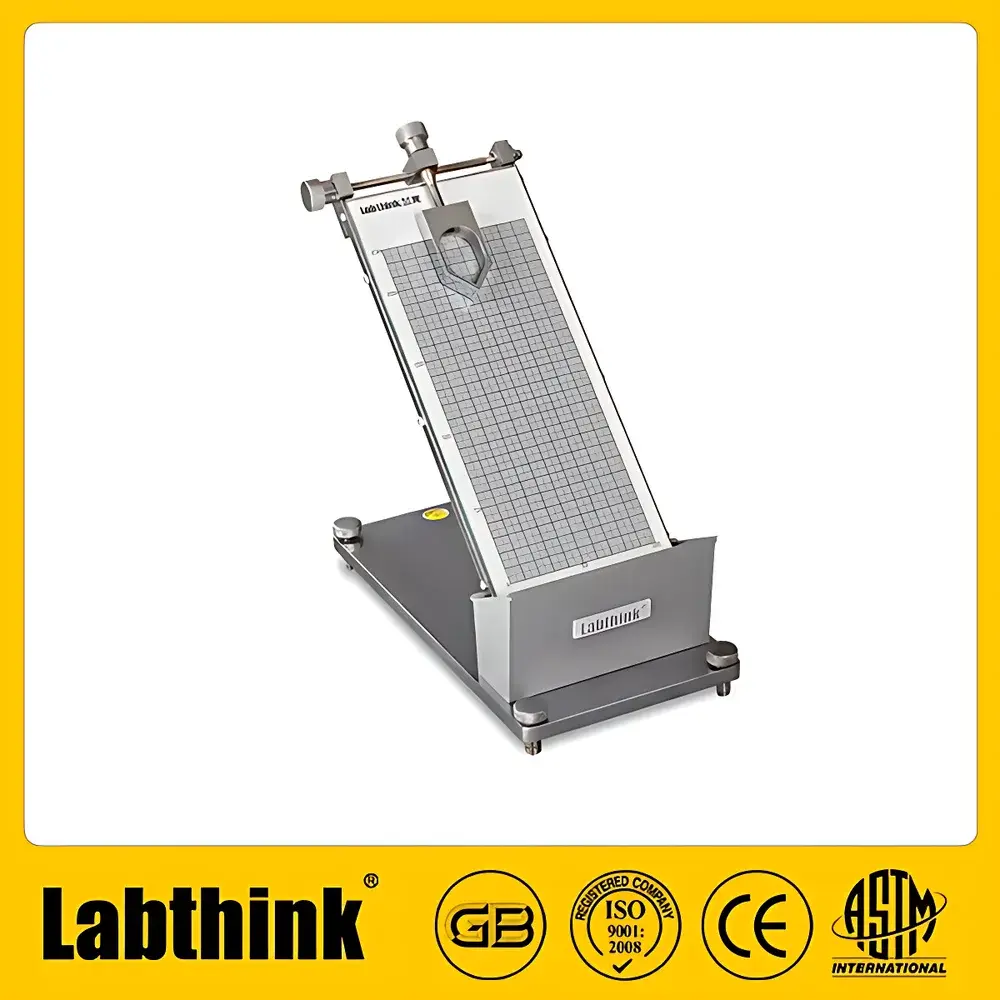
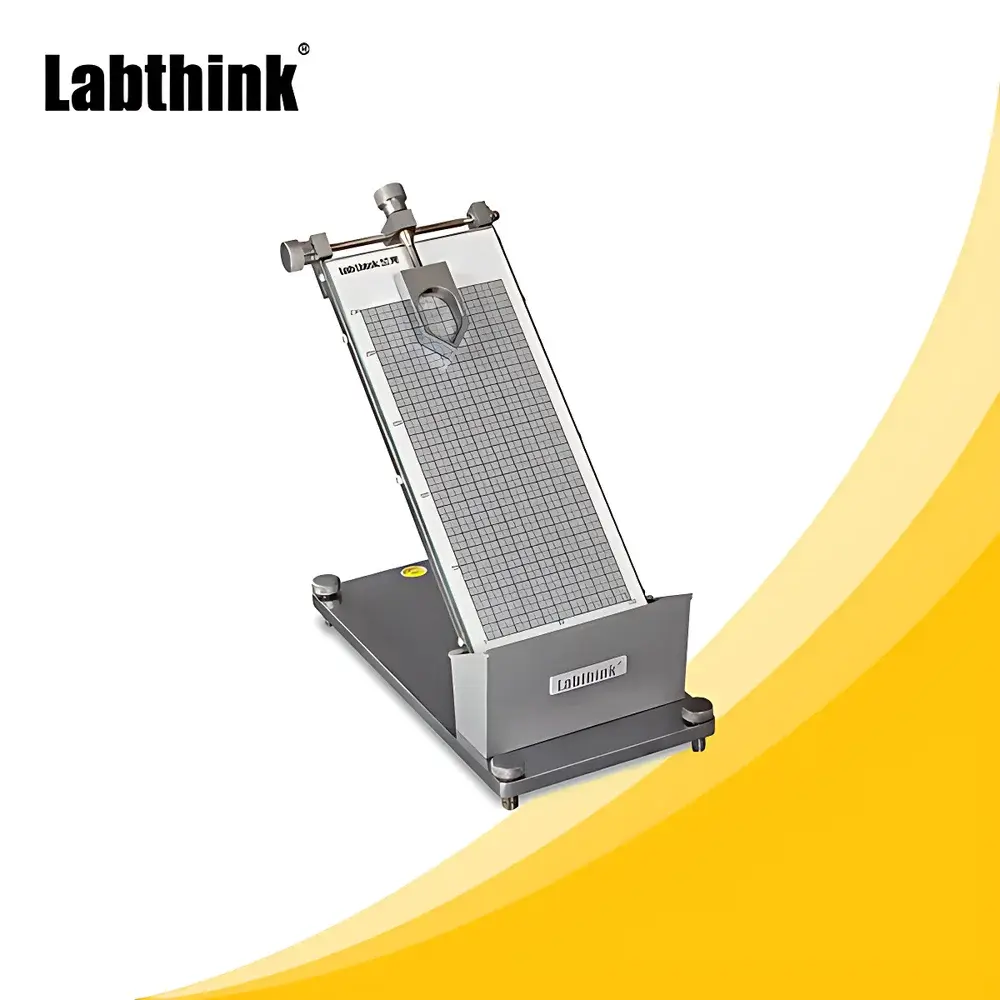
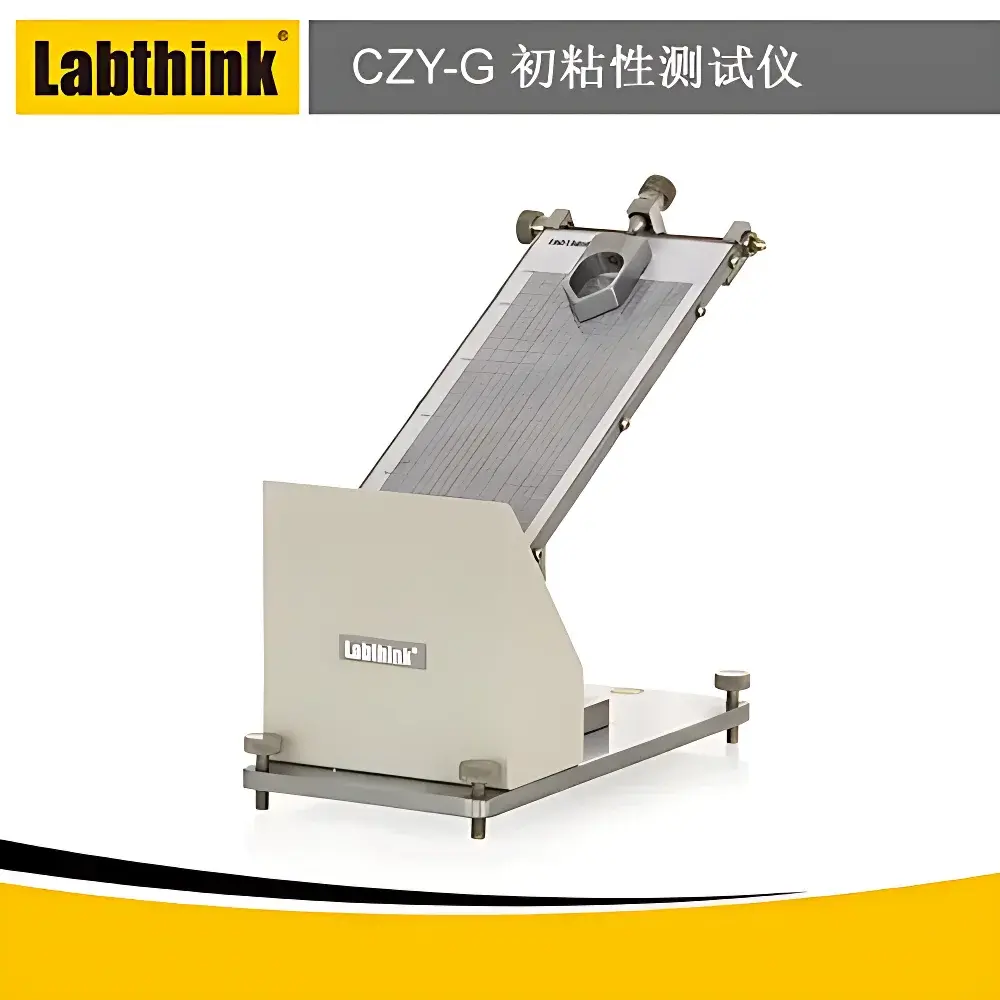
Labthink CZY-G Initial Adhesion Tester (Inclined Plane Ball Rolling Method)
| Brand | Labthink |
|---|---|
| Model | CZY-G |
| Testing Principle | Inclined Plane Ball Rolling Method |
| Adjustable Incline Angle | 0–60° |
| Test Surface Width | 80 mm |
| Platform Width | 120 mm |
| Standard Steel Balls | 1/32″ to 1″ (0.794 mm to 25.4 mm) |
| Dimensions (L×W×H) | 320 × 140 × 180 mm |
| Net Weight | 6 kg |
| Compliance | GB/T 4852, JIS Z0237 |
Overview
The Labthink CZY-G Initial Adhesion Tester is an engineered precision instrument designed for quantitative evaluation of the initial tack—i.e., the instantaneous adhesive attraction—of pressure-sensitive materials under controlled mechanical contact conditions. It operates on the well-established inclined plane ball rolling method, a standardized physical test principle widely accepted in global adhesive R&D, quality control, and regulatory validation workflows. In this method, a standardized steel ball is released from rest at the top of an adjustable incline, rolls down a defined distance, and makes momentary contact with the adhesive surface of a specimen mounted horizontally at the base. The largest ball diameter that fails to roll off the test area—i.e., remains adhered—is recorded as the “initial adhesion value”, expressed in fractional inch or millimeter equivalents. This empirical yet highly reproducible approach correlates strongly with real-world handling performance, such as label application behavior, tape unwind resistance, and medical patch skin contact integrity.
Key Features
- Adjustable incline angle (0° to 60° in precise mechanical increments), enabling systematic sensitivity tuning across low- to high-tack formulations.
- Optimized test zone geometry: 80 mm effective width ensures consistent ball trajectory alignment while minimizing edge effects; platform width (120 mm) provides ample lateral stability during operation.
- Full compatibility with internationally recognized steel ball sets per ASTM E11 and ISO 3290, covering diameters from 1/32″ (0.794 mm) up to 1″ (25.4 mm), allowing granular resolution in tack grading.
- Robust aluminum alloy frame with anti-slip rubber feet ensures vibration-damped positioning on standard laboratory benches—critical for repeatable ball release dynamics.
- Compact footprint (320 × 140 × 180 mm) and lightweight design (6 kg net weight) facilitate easy relocation between QC labs, production floors, and metrology workstations without recalibration.
Sample Compatibility & Compliance
The CZY-G accommodates a broad range of pressure-sensitive substrates, including acrylic-, rubber-, and silicone-based tapes; medical transdermal patches; self-adhesive labels; protective films for electronics and displays; and laminated packaging films. Specimen mounting requires no clamping fixtures—samples are simply affixed flat onto the designated test zone using low-residue double-sided tape or vacuum hold-down (optional accessory). The instrument fully complies with GB/T 4852–2002 “Test Methods for Initial Tack of Pressure-Sensitive Adhesive Tapes (Inclined Plane Ball Rolling Method)” and JIS Z0237:2019 “Testing Methods for Pressure-Sensitive Adhesive Tapes and Sheets”. While not a direct ISO or ASTM standard instrument, its mechanical configuration and operational protocol align with the principles underlying ISO 29651 (adhesive tack measurement) and ASTM D3121 (ball tack test), supporting cross-referenced data reporting in multinational supply chain documentation.
Software & Data Management
The CZY-G is a manually operated mechanical tester with no embedded electronics or digital interface. All measurements are recorded visually and documented manually, ensuring full traceability without software validation overhead. This analog architecture inherently satisfies GLP and GMP environments where audit trails must be human-readable, paper-based, and free from firmware dependencies. Users maintain compliance with FDA 21 CFR Part 11 requirements by implementing standardized lab notebooks, witnessed test logs, and instrument calibration records—procedures routinely verified during third-party audits. Optional accessories include calibrated steel ball certification kits traceable to NIM (National Institute of Metrology, China) and reusable specimen holders for rapid batch testing.
Applications
- Formulation screening of new PSA (pressure-sensitive adhesive) chemistries during R&D phase.
- In-process verification of coating uniformity and solvent residual effects in tape manufacturing lines.
- Supplier qualification testing for incoming raw materials such as facestocks, liners, and adhesive-coated webs.
- Stability assessment of medical adhesives under accelerated aging (e.g., 40°C/75% RH per ISO 11607), tracking tack degradation over time.
- Comparative benchmarking against competitive products in technical sales support and customer-facing validation reports.
FAQ
What standards does the CZY-G comply with?
GB/T 4852–2002 and JIS Z0237:2019 are the primary referenced standards. Its geometry and procedure also support alignment with ISO 29651 and ASTM D3121 for comparative reporting.
Is calibration required, and how often?
Annual verification of incline angle accuracy using a certified digital inclinometer (±0.2° tolerance) and steel ball diameter traceability (via certified gauge blocks) is recommended per ISO/IEC 17025 guidelines.
Can the CZY-G test curved or textured surfaces?
No—the test method requires a flat, rigid, and smooth substrate. Curved or embossed specimens must be mounted on a planar backing plate prior to testing.
Does Labthink provide certified reference materials?
Yes—certified steel ball sets with NIM-traceable diameter certificates and pre-cut adhesive specimen blanks are available as optional accessories.
Is operator training necessary?
Yes—consistent results require adherence to standardized sample conditioning (23°C ±2°C, 50% RH ±5% for ≥2 h), ball cleaning protocol (isopropanol wipe, lint-free cloth), and release technique (zero initial velocity, center-aligned drop point). Training modules are included with purchase.



