
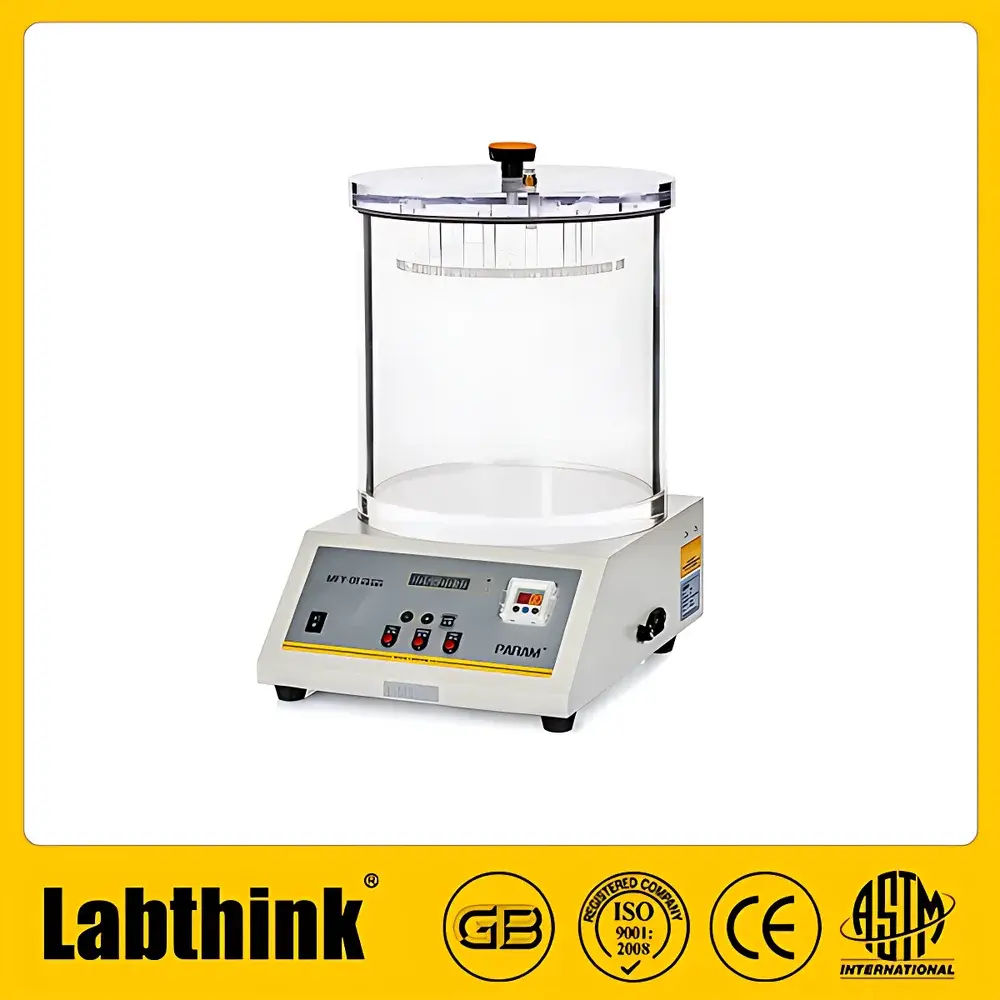
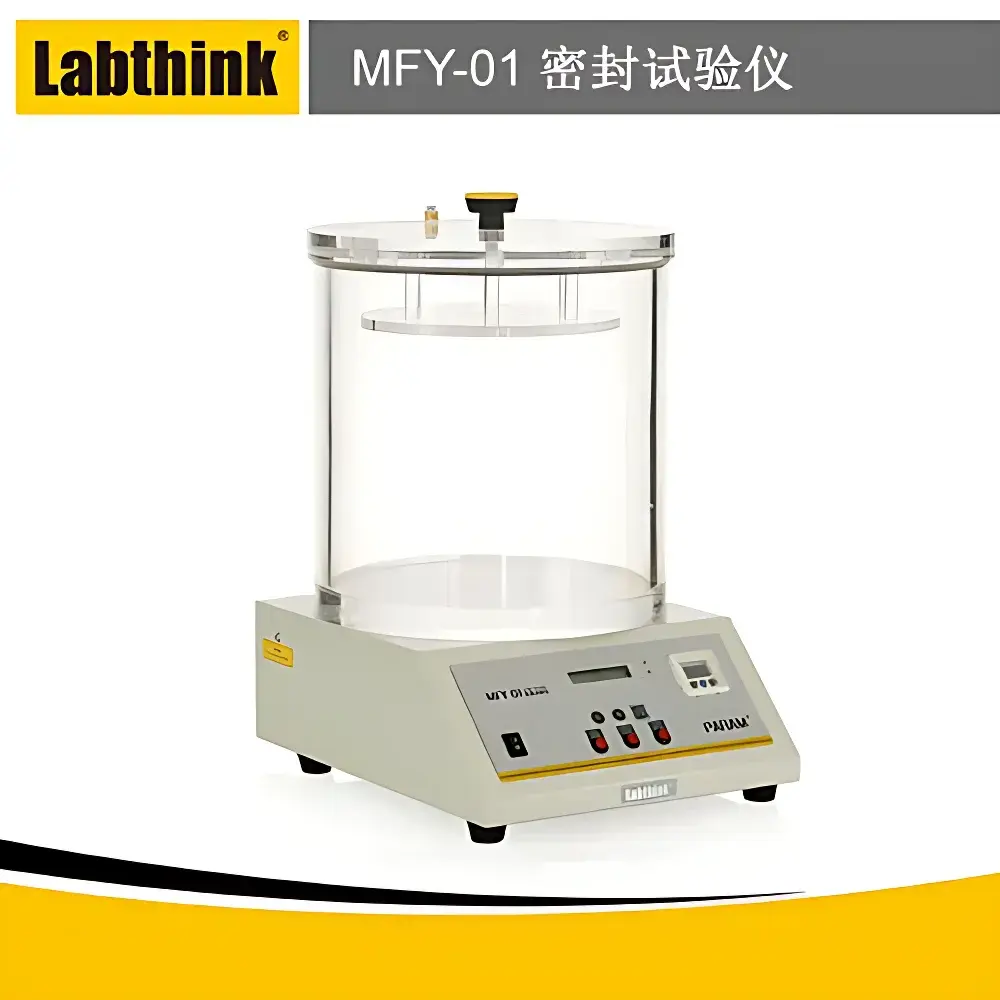
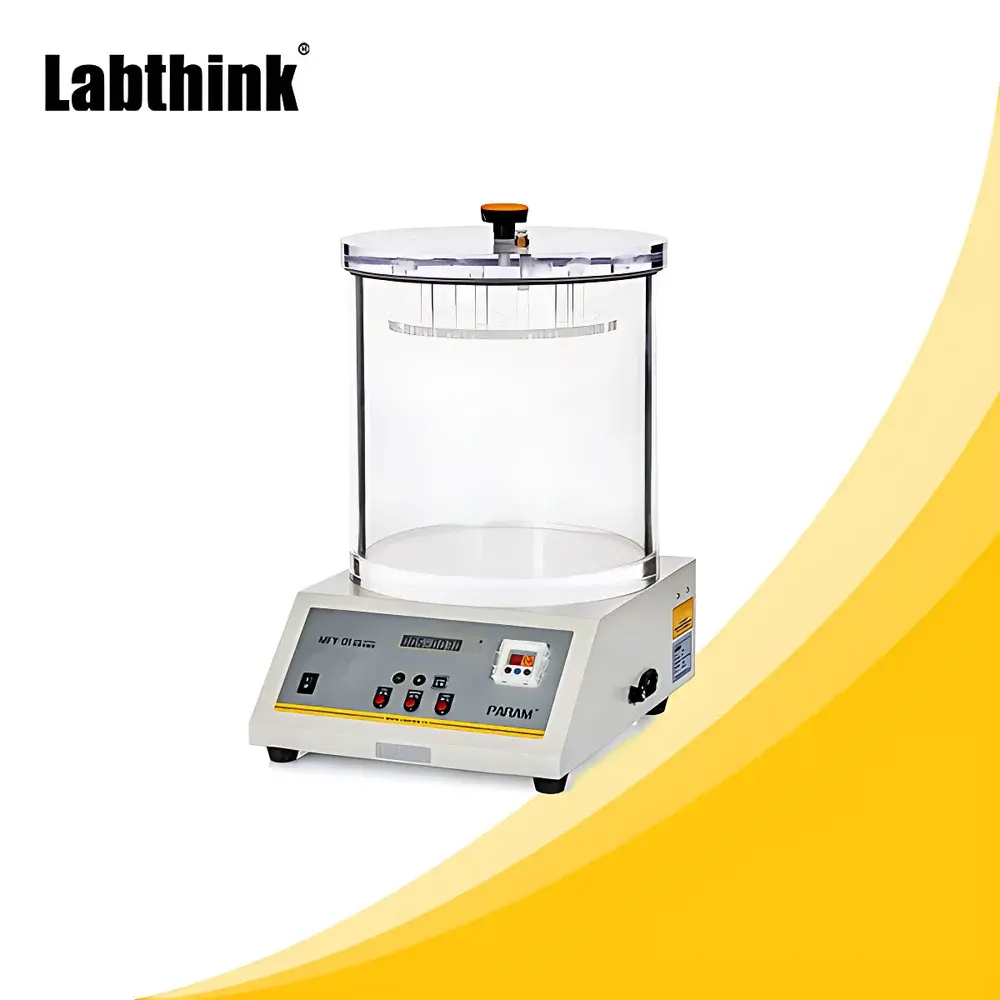
Labthink MFY-01 Vacuum Decay Seal Integrity Tester
| Brand | Labthink |
|---|---|
| Model | MFY-01 |
| Origin | Shandong, China |
| Manufacturer Type | Direct Manufacturer |
| Country of Origin | China |
| Price | USD 2,150 (approx.) |
| Vacuum Range | 0 to –90 kPa |
| Accuracy Class | Class 1 |
| Standard Vacuum Chamber Dimensions | Φ270 mm × 210 mm (H) |
| Optional Chambers | Φ360 mm × 585 mm (H), Φ460 mm × 330 mm (H) |
| Air Supply Requirement | 0.7 MPa (user-provided) |
| Air Inlet | Φ6 mm polyurethane tubing |
| Overall Dimensions | 300 mm (L) × 380 mm (W) × 450 mm (H) |
| Power | 220 VAC 50 Hz / 120 VAC 60 Hz |
| Net Weight | 12 kg |
Overview
The Labthink MFY-01 Vacuum Decay Seal Integrity Tester is an engineered solution for non-destructive, deterministic assessment of package seal integrity across regulated and industrial sectors. It operates on the principle of vacuum decay testing—also referenced as the “bubble emission” or “visual immersion” method—per ASTM D3078 and GB/T 15171. The instrument evacuates a sealed test chamber containing a submerged specimen, generating a controlled negative pressure differential across the package wall. Integrity is evaluated by direct visual observation of air leakage (bubbles escaping from seals or defects) or by monitoring physical deformation (e.g., expansion, collapse, or shape recovery upon vacuum release). This method provides qualitative pass/fail results aligned with packaging validation requirements in pharmaceutical, food, medical device, and consumer goods manufacturing—particularly where gross leak detection (<100 µm equivalent hole size) is mandated prior to distribution.
Key Features
- Digital vacuum setpoint control with programmable hold time ensures consistent test conditions and eliminates operator variability.
- Integrated pneumatic components sourced from globally recognized suppliers deliver long-term stability and minimal maintenance under repeated cycling.
- Microprocessor-based control system with backlit LCD and tactile PVC membrane keypad enables intuitive operation, real-time parameter monitoring, and immediate access to test history.
- Automatic pressure compensation maintains constant vacuum level during test duration, compensating for minor chamber leakage or thermal drift—critical for reproducible outcomes.
- Software-driven auto-depressurization and test termination sequences reduce manual intervention and support standardized workflow execution in GLP/GMP environments.
- Modular vacuum chamber design supports three standard configurations (Φ270×210 mm, Φ360×585 mm, Φ460×330 mm), with custom dimensions available to accommodate irregularly shaped or oversized packages—including blister cards, pouches, trays, and rigid containers.
Sample Compatibility & Compliance
The MFY-01 accommodates flexible and semi-rigid packaging formats widely used in pharmaceuticals (aluminum foil laminates, cold-form blisters), food (stand-up pouches, retort bags, vacuum-sealed trays), medical devices (sterile barrier systems per ISO 11607), and consumer products (cosmetic tubes, electronic component clamshells). It supports post-stress evaluation—such as after drop impact, compression, or vibration—to verify seal robustness under simulated distribution conditions. The test methodology complies with ASTM D3078 (“Standard Test Method for Determination of Leaks in Flexible Packaging by Bubble Emission”) and Chinese national standard GB/T 15171 (“Flexible Package Seal Integrity Test Method”). While not a quantitative leak rate instrument, its visual detection threshold meets industry-accepted criteria for gross leak screening in pre-release quality control and process validation protocols.
Software & Data Management
The embedded firmware records vacuum setpoint, actual achieved vacuum level, dwell time, and operator ID (if enabled via optional login module). All test parameters and outcomes are timestamped and stored locally in non-volatile memory. Data export is supported via USB interface in CSV format for integration into laboratory information management systems (LIMS) or electronic batch records. Audit trail functionality—including user actions, parameter changes, and test start/stop events—can be configured to align with FDA 21 CFR Part 11 requirements when paired with appropriate networked infrastructure and procedural controls. No cloud connectivity or remote telemetry is included by default; data sovereignty remains fully under user control.
Applications
- Pharmaceutical primary packaging verification: aluminum/PVC blisters, sachets, and foil-laminated pouches per USP & EP guidelines on container closure integrity.
- Food packaging QA: evaluating heat-seal strength and defect presence in nitrogen-flushed snack bags, infant formula pouches, and ready-to-eat meal trays.
- Medical device sterile barrier validation: detecting channel leaks, seal delamination, or micro-perforations in Tyvek®-laminated pouches and thermoformed trays.
- Automotive and electronics: assessing moisture barrier integrity of ESD-safe packaging for sensors and PCB assemblies.
- Process development support: correlating sealing parameter settings (temperature, dwell time, pressure) with observed leak frequency during line qualification studies.
FAQ
What types of packages can be tested with the MFY-01?
It accepts flexible, semi-rigid, and rigid packages that can be fully submerged—including pouches, bottles with caps, tubes, trays, and blister cards—as long as they withstand the applied vacuum without permanent deformation.
Is the MFY-01 compliant with FDA or EU regulatory expectations?
The test method conforms to ASTM D3078 and GB/T 15171, both cited in FDA guidance documents and EU Annex 1 references for gross leak detection. Its use supports GMP-compliant packaging validation when incorporated into a documented protocol with defined acceptance criteria.
Does the instrument require external compressed air?
Yes. A clean, dry, oil-free air supply at 0.7 MPa is required to actuate the vacuum release valve and maintain stable chamber pressure control. Users must provide this utility.
Can test results be exported for audit purposes?
Yes. Test logs—including vacuum values, timing, and operator input—are exportable in CSV format via USB port for inclusion in quality documentation or regulatory submissions.
Is calibration traceable to national standards?
The vacuum sensor is factory-calibrated against NIST-traceable reference instruments. Annual recalibration is recommended and supported by Labthink’s global service network.





