
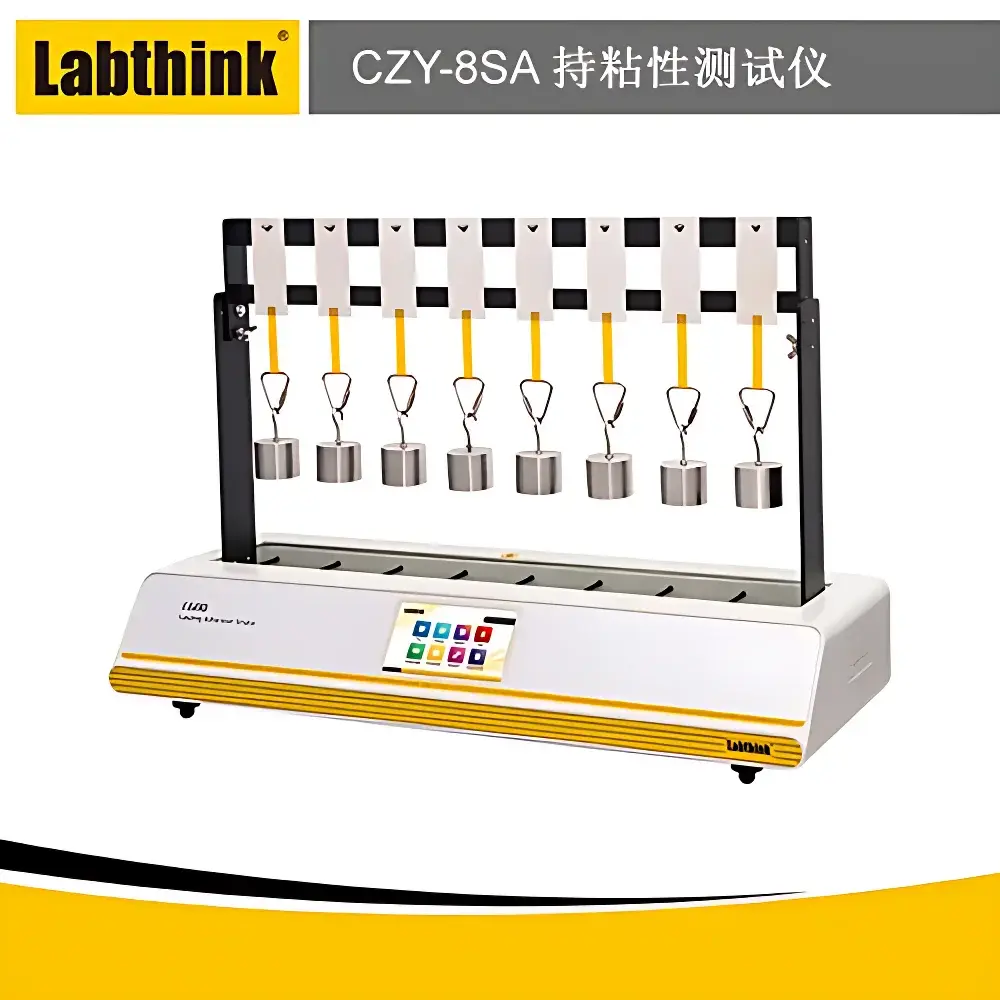
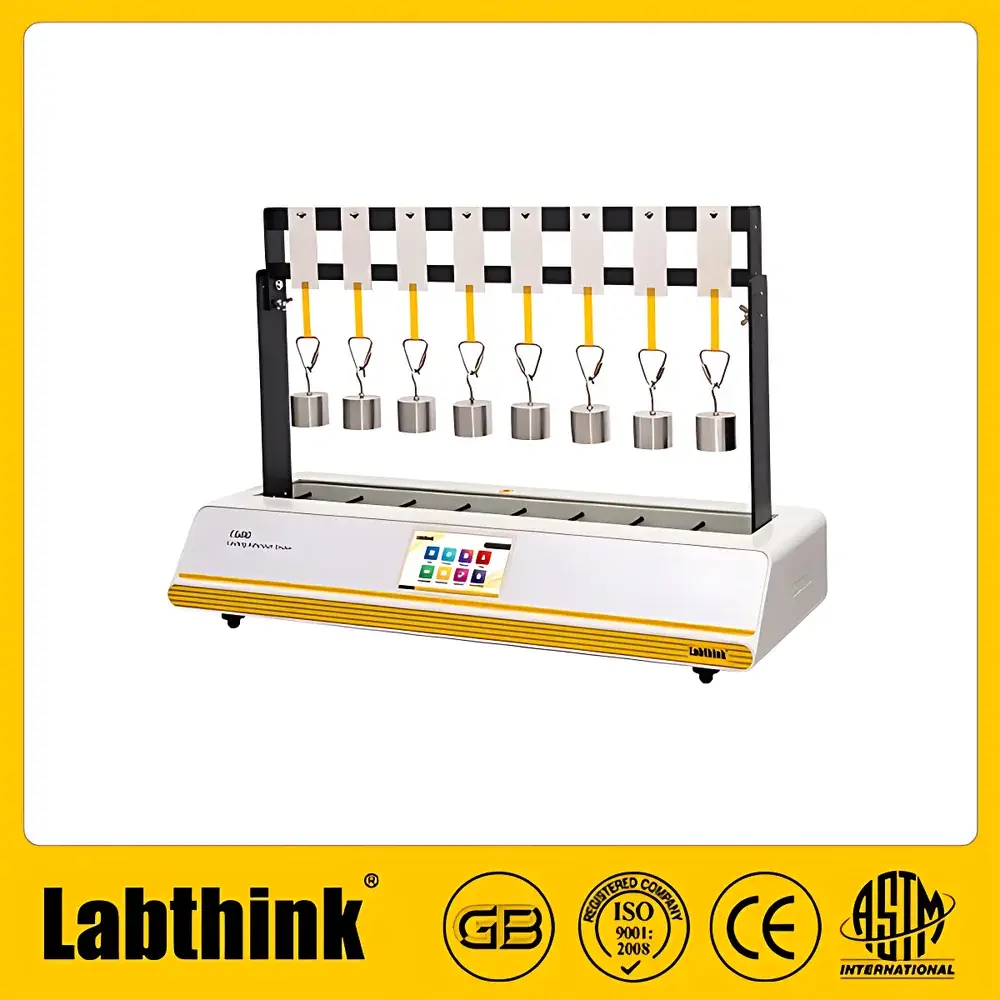
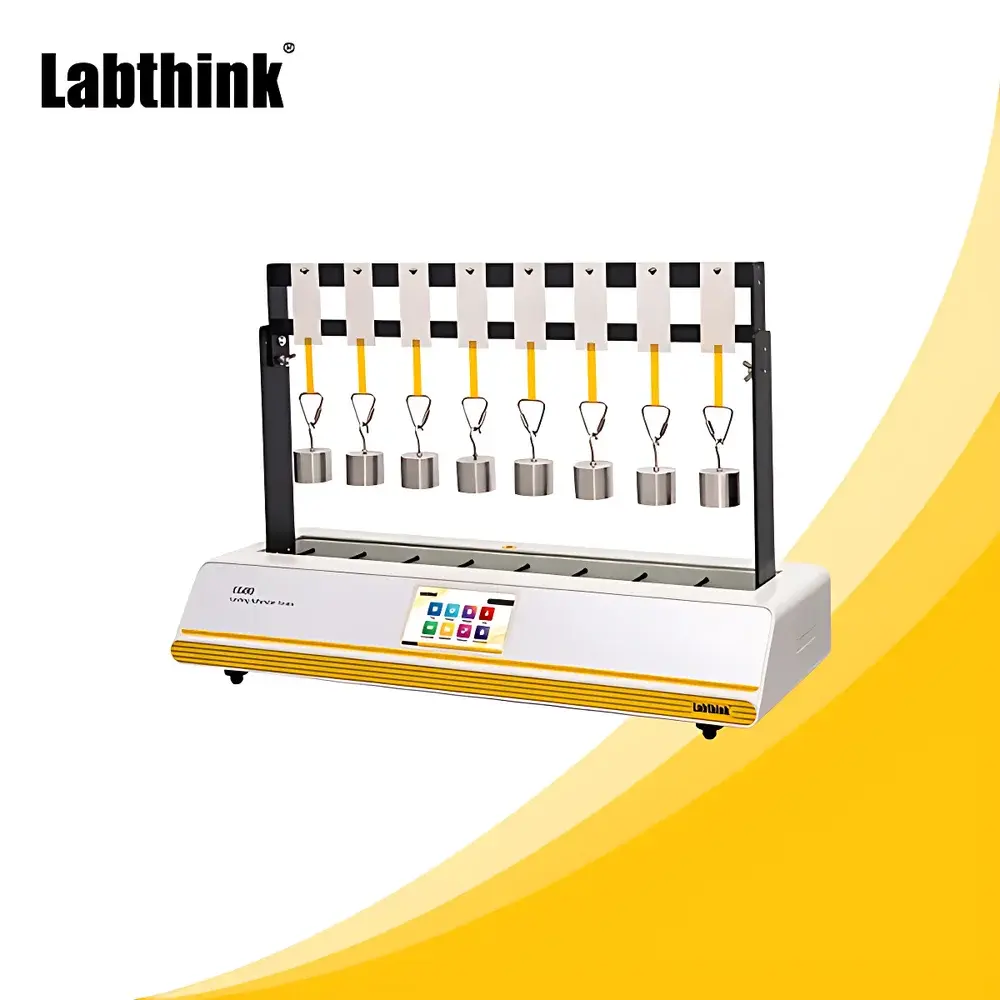
Labthink CZY-8SA Adhesion Hold-Time Tester for Pressure-Sensitive Tapes and Labels
| Brand | Labthink |
|---|---|
| Origin | Shandong, China |
| Manufacturer Type | Direct Manufacturer |
| Country of Origin | China |
| Model | CZY-8SA |
| Instrument Category | Hold-Time Adhesion Tester |
| Power Supply | 220VAC±10% 50Hz / 120VAC±10% 60Hz (selectable) |
| Standard Roller Weight | 2000g ± 50g |
| Test Load | 1000g ± 5g (including triangular hook) |
| Test Plate A Dimensions | 125mm(L) × 50mm(W) × 1.3mm(D) |
| Timing Range | 0–9999 h 59 min 59 s |
| Test Stations | 8 |
| Overall Dimensions | 900mm(L) × 315mm(W) × 544mm(H) |
| Net Weight | 25 kg |
Overview
The Labthink CZY-8SA Adhesion Hold-Time Tester is an engineered solution for quantifying the time-dependent resistance of pressure-sensitive adhesives (PSAs) to shear-induced debonding under constant load. It operates on the principle of vertical static shear testing per GB/T 4851, ASTM D3654, and JIS Z0237—where a standardized test specimen is affixed to a vertically oriented stainless-steel test plate, loaded with a precisely calibrated mass, and monitored for either displacement over time or total detachment duration. This gravimetric shear method delivers reproducible, traceable data essential for quality control, formulation development, and regulatory compliance in adhesive manufacturing, labeling, and protective film production. Designed for laboratory and production QC environments, the CZY-8SA integrates mechanical precision with digital instrumentation to meet ISO/IEC 17025-aligned testing workflows.
Key Features
- Eight independent test stations enable parallel evaluation of multiple specimens—significantly improving throughput and statistical robustness.
- Dual-mode operation: supports both time-to-failure measurement (total detachment time) and displacement-based hold-time analysis (e.g., mm of slippage after fixed duration).
- Industrial-grade capacitive touch interface with intuitive icon-driven navigation; supports firmware updates via Ethernet or USB.
- Bilingual (English/Chinese) UI with multi-level user authentication (administrator, operator, reviewer), password protection, and audit trail logging.
- Integrated environmental monitoring: real-time display and automatic logging of ambient temperature (°C/°F selectable) and relative humidity during test execution.
- High-resolution inductive displacement sensors ensure accurate detection of sub-millimeter slippage across all stations.
- Auto-statistics engine computes and exports max/min/mean/log-reduced values per batch—fully compliant with GLP data integrity requirements.
- Optional temperature-controlled chamber module enables precise thermal conditioning at 23°C ± 0.5°C or 38°C ± 0.5°C using Labthink’s proprietary active cooling technology—eliminating dependence on ambient lab conditions.
Sample Compatibility & Compliance
The CZY-8SA accommodates standard PSA substrates including acrylic, rubber-based, and silicone pressure-sensitive tapes; self-adhesive labels (paper, PET, PP); and temporary protective films used in electronics, automotive, and medical device assembly. Test plates conform to GB/T 4851 specifications (125 × 50 × 1.3 mm stainless steel, Ra ≤ 0.2 µm surface finish). The system complies with mechanical tolerances defined in ASTM D3654 (roller mass ±2.5%, load mass ±0.5%) and supports optional NIST SRM 1810A fiberboard for cross-laboratory validation. Data acquisition meets FDA 21 CFR Part 11 requirements when configured with optional GMP-compliant software and DataShield™ data management suite—enabling electronic signatures, change control, and secure database integration.
Software & Data Management
The embedded operating system records timestamped raw displacement and time data for each station, with automatic backup to internal flash memory (≥1200 test records). USB 2.0 and RS-232 interfaces support direct export to CSV or Excel-compatible formats. Optional Labthink AdhesionSuite™ software provides advanced curve fitting, statistical process control (SPC) charts, batch comparison reports, and PDF certificate generation. When deployed with DataShield™, test data flows into centralized LIMS or MES platforms via OPC UA or RESTful API—ensuring full chain-of-custody traceability from instrument to enterprise system. All data logs include operator ID, instrument serial number, calibration status, and environmental metadata.
Applications
This instrument serves critical roles across R&D and manufacturing: validating adhesive shelf-life stability under accelerated aging protocols; comparing competing formulations for long-term bond retention; qualifying label performance on curved or textured packaging surfaces; verifying protective film removability without residue after extended dwell times; and supporting submissions for ISO 15378 (primary packaging for pharmaceuticals) and ASTM F2253 (medical device labeling). It is routinely deployed by global suppliers to consumer electronics, food & beverage packaging, and regulated healthcare sectors where adhesive reliability directly impacts product safety and brand integrity.
FAQ
What standards does the CZY-8SA comply with?
GB/T 4851, ASTM D3654, and JIS Z0237 are fully supported through hardware design, test fixture geometry, and software calculation logic.
Can the instrument operate unattended for multi-day tests?
Yes—the 9999-hour timer, non-volatile memory, and auto-power-resume functionality enable continuous operation without manual intervention.
Is calibration traceable to national standards?
Standard configurations include factory calibration certificates traceable to CNAS-accredited labs; optional on-site calibration with NIST-traceable weights and micrometers is available.
Does the system support IQ/OQ/PQ documentation packages?
Yes—Labthink provides comprehensive validation templates aligned with ISO 13485 and EU Annex 11 for pharmaceutical and medical device customers.
How is data security enforced in regulated environments?
With optional GMP mode enabled, the system enforces role-based access control, electronic signatures, immutable audit trails, and encrypted local storage—all validated per ALCOA+ principles.



