
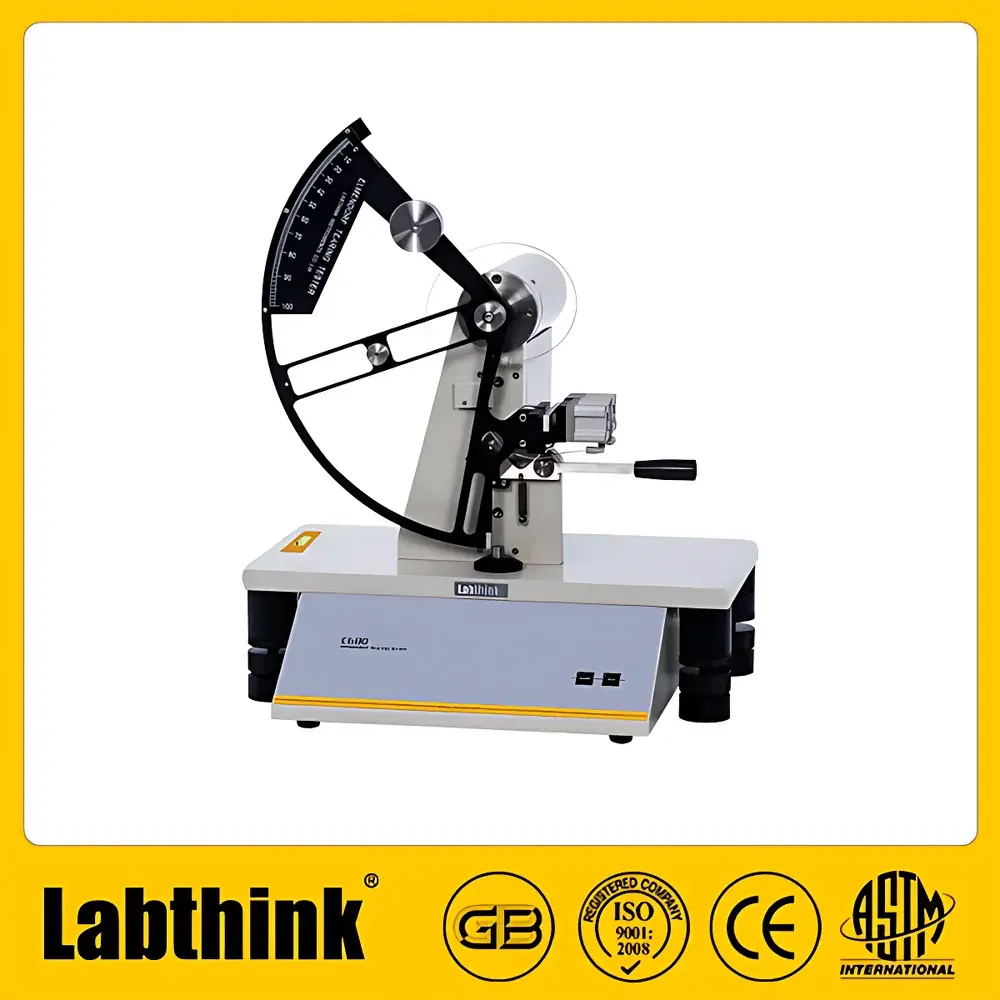
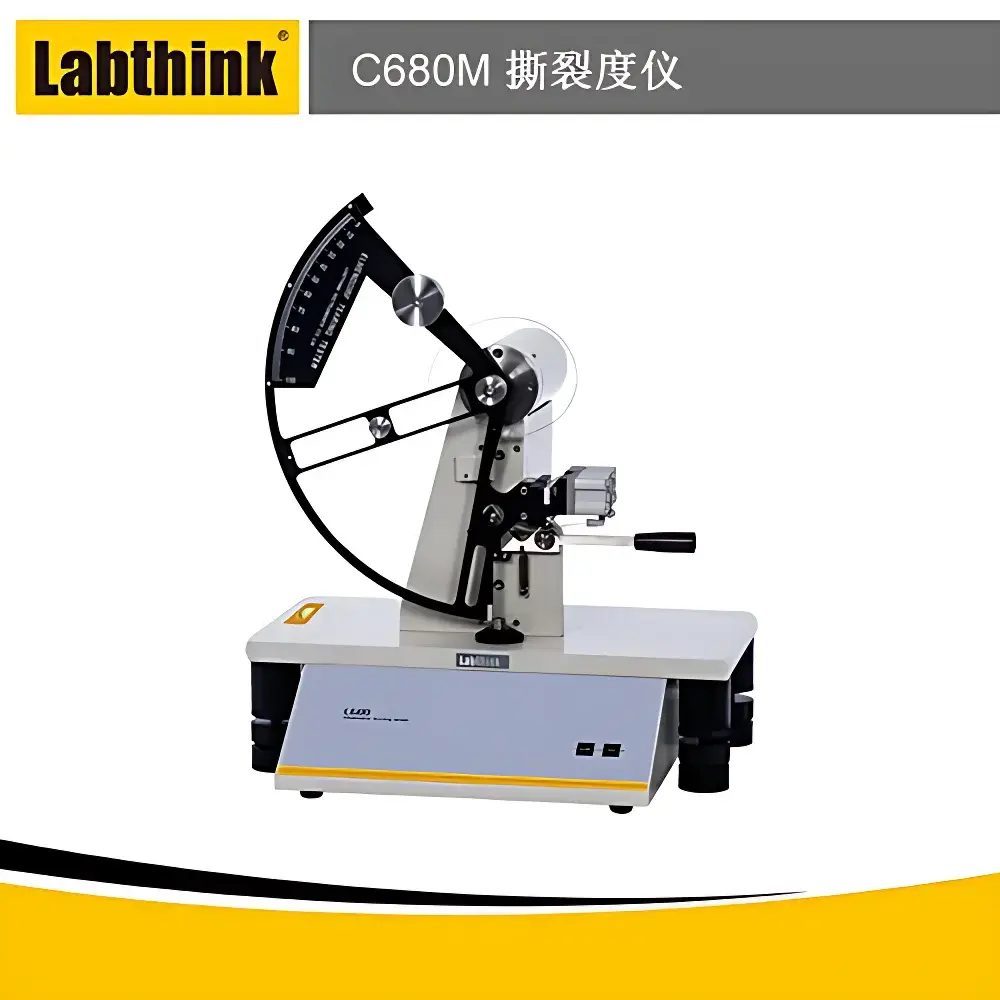
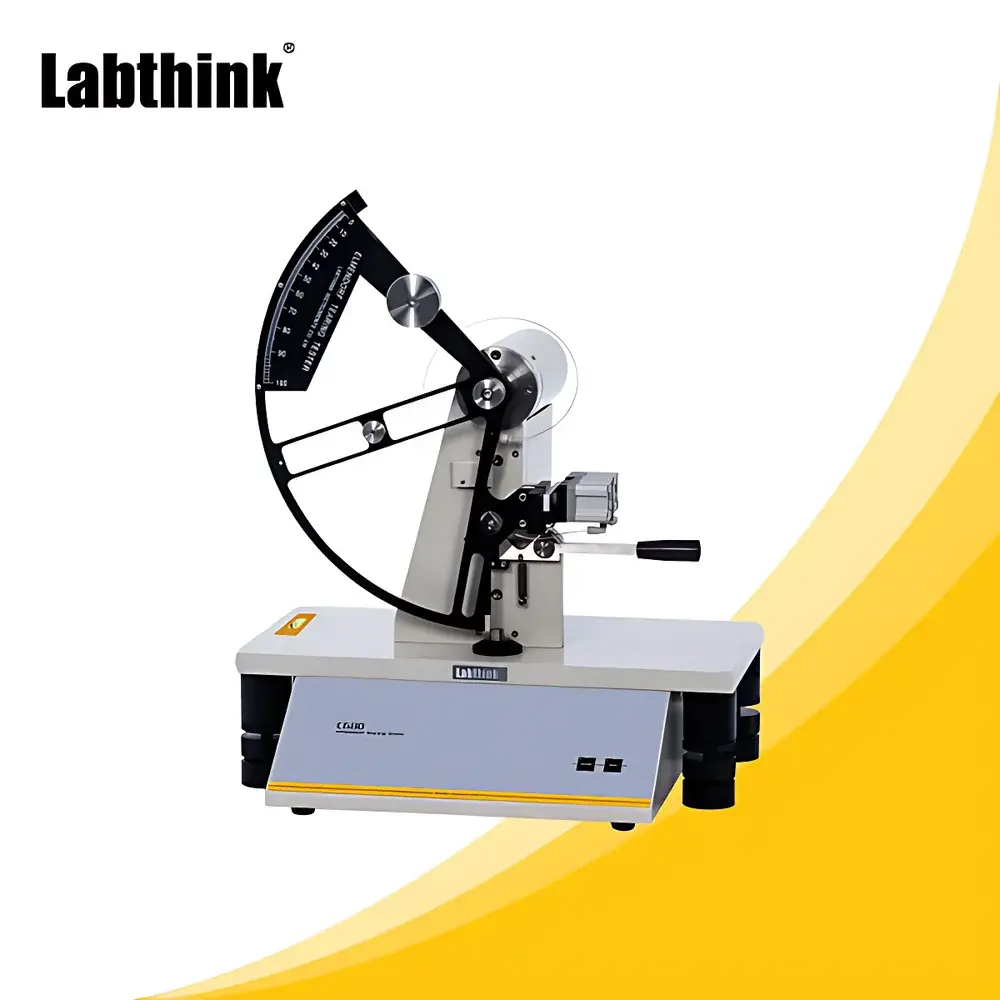
Labthink PARAM-C680M Elastomeric Film & Sheet Tear Resistance Tester
| Brand | Labthink |
|---|---|
| Model | PARAM-C680M |
| Measurement Principle | Pendulum-type tear energy absorption (Elmendorf method) |
| Compliant Standards | ISO 6383-1:1983, ISO 6383-2:1983, ISO 1974, ASTM D1922, ASTM D1424, ASTM D689, TAPPI T414, GB/T 455, GB/T 16578.2–2009 |
| Pendulum Capacities | 200 gf, 400 gf, 800 gf, 1600 gf, 3200 gf, 6400 gf |
| Air Supply Requirement | 0.6 MPa (user-supplied), Φ4 mm polyurethane tubing interface |
| Dimensions (L×W×H) | 480 × 380 × 560 mm |
| Weight | 23.5 kg (with 200 gf base pendulum) |
| Power Input | 220 VAC 50 Hz / 120 VAC 60 Hz |
| Interface | RS232 serial port |
| Software | Dedicated tear testing application with audit-trail-capable data logging and unit conversion (cN, gf, mN, N) |
Overview
The Labthink PARAM-C680M Elastomeric Film & Sheet Tear Resistance Tester is an electromechanical pendulum-type instrument engineered for precise determination of tear resistance in flexible planar materials according to the Elmendorf principle. It quantifies the energy required to propagate a pre-initiated tear under controlled dynamic conditions—specifically, the energy absorbed by a falling pendulum as it ruptures a notched specimen. This method provides high reproducibility for comparative quality control and material specification verification across packaging, paper, textile, and polymer film manufacturing environments. The instrument operates on standardized gravimetric force units derived from calibrated pendulum mass and angular displacement, ensuring traceability to national metrological standards. Its design adheres to fundamental mechanical measurement principles: potential energy conversion into kinetic energy, followed by energy dissipation through controlled material fracture. Unlike tensile-based tear metrics, the Elmendorf method isolates propagation resistance independent of clamping geometry or strain rate effects, making it particularly suitable for thin, anisotropic, or highly extensible substrates.
Key Features
- Fully automated operation with pneumatic specimen clamping—eliminates manual handling variability and ensures consistent jaw pressure and alignment.
- Motor-driven pendulum release mechanism synchronized with high-speed optical position sensing for zero-timing error during swing initiation.
- Integrated horizontal leveling assistance system with dual-axis digital inclinometer feedback, enabling rapid instrument calibration prior to each test sequence.
- Modular pendulum configuration supporting six discrete capacity ranges (200–6400 gf), allowing seamless adaptation to low-strength films (e.g., PVDC-coated lamination) and high-toughness industrial liners (e.g., woven PP geotextiles).
- Dedicated microprocessor-based controller with real-time torque compensation algorithms to correct for bearing friction and air resistance deviations across pendulum mass variants.
- RS232 serial interface compliant with industry-standard communication protocols, facilitating integration into centralized LIMS or MES platforms without proprietary drivers.
Sample Compatibility & Compliance
The PARAM-C680M accommodates specimens up to 75 mm wide × 100 mm long, with thicknesses ranging from 0.012 mm (12 µm PET foil) to 2.0 mm (laminated corrugated board). Validated applications include single-layer and coextruded plastic films (LDPE, BOPP, PET, PA), metallized barrier structures, fiber-based substrates (kraft paper, cardboard, filter paper), nonwovens (spunbond PP, meltblown SMS), elastomeric gloves (natural rubber, nitrile), and stretch hooding films. All test procedures conform to internationally recognized regulatory frameworks: ISO 6383 series for plastics, ISO 1974 for paper, ASTM D1922 for plastic film tear propagation, and TAPPI T414 for paperboard. Data acquisition meets GLP/GMP documentation requirements, with software-enforced user authentication, electronic signatures, and immutable audit trails compliant with FDA 21 CFR Part 11 when deployed with validated IT infrastructure.
Software & Data Management
The included Labthink TearMaster software provides full-cycle test management—from parameter definition and method selection to statistical reporting and export. It supports customizable test templates aligned with specific standard clauses (e.g., “ISO 6383-2 Annex A – Constant Angle Mode”). Raw pendulum deflection data is sampled at ≥1 kHz and processed using second-order polynomial curve fitting to determine peak energy absorption. Results are displayed in multiple units (gf, cN, mN, N) with automatic unit conversion and uncertainty estimation per GUM (Guide to the Expression of Uncertainty in Measurement). Export formats include CSV, PDF reports with embedded metadata (operator ID, timestamp, environmental conditions), and XML for ERP integration. All data files carry SHA-256 checksums to ensure integrity verification during archival or transfer.
Applications
Primary use cases span R&D formulation screening, incoming raw material inspection, and final package qualification. In packaging development, the instrument evaluates seal integrity margins in heat-sealed pouches, assesses delamination resistance in multilayer laminates, and validates tear initiation thresholds for easy-open features. For paper mills, it supports ISO 455-compliant tear index calculations used in grade certification. In medical device manufacturing, it verifies glove tear resistance per ASTM D6319-derived specifications. Additional validated extensions include tear performance mapping of agricultural mulch films under UV-aged conditions, comparative analysis of biodegradable PLA vs. conventional PE films, and QC monitoring of adhesive-coated release liners used in label production.
FAQ
What standards does the PARAM-C680M support out-of-the-box?
The instrument is factory-configured for ISO 6383-1, ISO 6383-2, ISO 1974, ASTM D1922, ASTM D1424, ASTM D689, TAPPI T414, GB/T 455, and GB/T 16578.2–2009. Custom method definitions can be added via software configuration.
Is external air supply mandatory?
Yes—a clean, oil-free compressed air source delivering 0.6 MPa ±0.05 MPa must be provided by the user. The instrument uses a Φ4 mm polyurethane quick-connect fitting compatible with standard industrial pneumatic systems.
Can test data be exported to LIMS without third-party middleware?
Yes. The RS232 interface supports ASCII-based command-response protocol with configurable baud rates (9600–115200 bps), enabling direct ingestion by LIMS systems equipped with serial port drivers.
How is pendulum calibration verified?
Each pendulum includes NIST-traceable calibration certificates. Users perform routine verification using certified reference weights (200–6400 gf) supplied with the system; deviation tolerance is ±0.5% of nominal value.
Does the software support multi-user role-based access control?
Yes. Administrator, technician, and reviewer roles are enforced with password protection, session timeout, and activity logging—including all parameter changes and report generation events.




